Thin-lipped grey mullet
Fish · Last reviewed 2026-08-17
The grey mullet that will chase a baited spinner up a tidal river — which makes it the only one of the three that can be fished for like a predator, and the reason a whole British technique existed with nothing to attach it to.
Safety: fish welfare — can cause injury needing treatment. One more point applies here.
Contamination and toxins in the catch — Can cause injury needing treatment
Thin-lipped mullet feed by grazing the surface layer off mud, stone and structure in estuaries, harbours and lower rivers — which is exactly where a catchment's runoff, sewage discharge and sediment contamination accumulate. A fish taken for the table from an urban harbour has been feeding on that sediment.
What reduces it: Treat mullet from harbours, marinas and urban estuaries as a fish to return rather than eat. Where the catch is intended for the table, the relevant question is the water's classification and discharge history, which is a matter for the environmental regulator rather than for a fishing page.
Worse when:
- Harbours, marinas and estuaries receiving urban or industrial discharge
- After heavy rain, when combined sewer overflows operate
Catching Thin-lipped grey mullet
Everything here on fishing for it. Each entry opens the page behind it.
- Where
- 2 places FishingHQ documents — strongest claim anywhere: regular local target · From the shore
Grey mullet have a reputation as the hardest ordinary fish in Britain to catch on purpose, and it is deserved for two of the three species. The thin-lipped mullet is the exception, and the exception has a technique built around it.
THE UPPER LIP IS THIN. That is the identification and it is also, indirectly, the reason for everything else: a narrow upper lip less than about a quarter the eye's diameter in depth, against the thick rubbery lip of a thick-lipped mullet. There is a dark spot at the base of the pectoral fin as a second check.
IT RUNS FAR UP RIVERS. Thin-lipped mullet are the most estuarine and the most freshwater-tolerant of the three, moving well above the tidal limit in summer and appearing in genuinely fresh water in numbers. Anglers meet them in places nobody expects a sea fish.
AND IT CHASES THINGS. A small spinner or a tiny fly, with a scrap of ragworm on the hook or a worm-baited tail behind the blade, worked past a shoal, will be taken — deliberately, repeatedly, by a fish that is otherwise a filter-feeding grazer. Thick-lipped mullet do this rarely and unwillingly. The thin-lipped mullet is the reason the baited-spinner technique exists in British angling at all, and while FishingHQ held only the other two species there was nowhere for that technique to live.
How it is caught
- Float fishingBread and small baits under a float on fine tackle, which is the conventional mullet approach and works on all three species.
- Saltwater fly fishingThe mullet that will chase a moving fly, which makes it the only one of the three that is a realistic fly proposition rather than a bread-and-patience one.
- SpinningThe baited spinner — a small blade with a worm-tipped hook behind it, retrieved slowly past a shoal — is the British technique this species carries, and it works on the thin-lipped mullet far better than on the other two.
Where Thin-lipped grey mullet is documented
Places where public sources describe this species as fished, with how it is fished and how strongly the evidence supports it. This is not a range map and it is not a recommendation — it is what has been written down about a fishery rather than a record of any individual catch, and being listed is never permission to fish.
West Cork
2 documented places
Estuary
Regular local target
From the shore
Estuary
Regular local target
From the shore
What these strengths mean
- Regular local target
- Fishing sources describe this as a normal local target here, not merely as caught.
Identification
No photograph of Thin-lipped grey mullet has passed identity review yet, so none is shown. A photograph is published only once somebody has checked the animal in it against the diagnostic features described on this page.
- Scientific name
- Chelon ramada
- Family
- Mugilidae
- Water
- Saltwater, Brackish, Freshwater
- Conservation status
- Least Concern
- Regions
- Britain & Ireland, Western Europe, Northern Europe, Mediterranean, North Africa, West Africa
- THE UPPER LIP IS THIN — narrow, and much less than the diameter of the eye in depth. A thick-lipped mullet's upper lip is deep, rubbery and obviously swollen, with small papillae along it. This is the character everything else follows from.
- A DARK SPOT AT THE BASE OF THE PECTORAL FIN, present on most thin-lipped mullet and absent from the thick-lipped.
- NO GOLD CHEEK SPOT. A golden grey mullet has a distinct golden-yellow blotch on the gill cover; a thin-lipped mullet does not.
- SLIMMER AND MORE STREAMLINED than a thick-lipped mullet of the same length, with a smaller head.
- TWO WIDELY SEPARATED DORSAL FINS, the front one with four spines — shared by all grey mullet and the character that identifies the family at a glance.
- FOUND FURTHER UP RIVERS than the other two. A grey mullet several miles above the tidal limit in summer is far more likely to be this species.
Size
- Typical
- 30–45 cm and 0.7–1.5 kg.
- Large
- Over 55 cm and 2.5 kg is a very good thin-lipped mullet.
Exceptional: Around 70 cm is the widely reported maximum for the species; fish of that size are rare and the thick-lipped mullet reaches a heavier weight.
The baited spinner, and why it works on this mullet and not the others
British angling has a technique that consists of retrieving a small spinner, with a worm on the hook behind it, past a shoal of mullet. It looks eccentric. It works, and it works on one species far better than the rest.
WHAT THE TECHNIQUE IS. A size 0 or 1 blade, or a similar small flashing attractor, with a short trace behind it carrying a single hook baited with a small piece of ragworm — sometimes just the worm tail. Cast beyond a shoal in a tidal river and retrieved slowly, so the blade turns and the bait follows.
WHY IT WORKS AT ALL. A grey mullet is a grazer with a gizzard, not a predator, and a moving spinner is nothing it eats. The consensus among people who use the method is that the blade is an attractor and a provoker — fish are drawn to it and then take the worm behind it — rather than a lure being eaten as prey. The bait is doing the catching; the blade is doing the finding.
WHY THIS SPECIES. Thin-lipped mullet respond to a moving bait far more readily than thick-lipped or golden grey mullet do. That difference is consistent enough to be a practical rule: an angler working a baited spinner in a tidal river is fishing for thin-lips, and catches of the other two on the method are the exception.
WHERE. Tidal rivers and upper estuaries on a making or early ebbing tide, over mud and sand, with shoals visible or showing. Access matters more than distance — a great deal of this fishing is done from bank, footbridge and slipway.
AND THE REST OF THE MULLET TACKLE STILL APPLIES. Light line, small hooks, careful approach, and the assumption that the fish has seen you before you have seen it. Mullet fishing rewards patience in a way very few British fisheries do.
A NOTE ON WHY THIS PAGE EXISTS. FishingHQ held the thick-lipped and flathead grey mullet and not this one, which meant the baited-spinner method had no species to attach to. A missing fish had quietly removed a technique.
What experienced anglers do — why, and the sources (3)
Widely and independently recommended by experienced anglers and specialist sources. This is real angling knowledge, not proof: controlled evidence for it is limited, and FishingHQ records it as convention rather than as a demonstrated effect.
- Sea Angler — Bauer Media (Specialist angling publication)Relied on for: Contemporary UK sea angling practice as reported by practitioners: ground, seasonal timing, bait and method convention.States this directlyCitation checked — the work exists and is described correctly
- General angling website restatements of established technique — Various (Credible secondary source)Relied on for: Widely restated descriptions of species behaviour and regional angling practice, recorded as consensus rather than as scholarship.Background and mechanism onlyCitation checked — the work exists and is described correctly
- The Fishes of the British Isles and North-West Europe — Macmillan, 1969 (Reference work)Relied on for: Distribution, habitat, identification characters and biology of the fishes of the British Isles and north-west Europe.States this directlyCitation checked — the work exists and is described correctly
Three British grey mullet, and the lip that decides
The three species are routinely lumped together as 'mullet', and separating them takes ten seconds if you know where to look.
THICK-LIPPED GREY MULLET — the upper lip is deep, rubbery and obviously swollen, roughly half the eye's diameter or more, with rows of small papillae on it. The commonest of the three around most of Britain and the heaviest.
THIN-LIPPED GREY MULLET — the upper lip is narrow and unremarkable, much less than a quarter of the eye's diameter. A dark spot at the base of the pectoral fin. Runs furthest up rivers, and takes a moving bait.
GOLDEN GREY MULLET — a distinct golden-yellow blotch on the gill cover, and a preference for surf and open sandy beaches over harbours. Smaller and less common in Britain than the other two.
THE FLATHEAD GREY MULLET is a fourth, larger, more southerly species that occurs in Britain occasionally and is far commoner across the Mediterranean and globally.
WHY IT MATTERS PRACTICALLY. Because the method follows the species. A shoal in a tidal river that ignores bread and takes a baited spinner is telling you which fish it is, and the identification and the technique confirm one another.
AND WHY IT MATTERS AS A LESSON. Three fish called by one name, differing in the shape of one structure, feeding differently enough to change the tackle. That is the general case in fish identification, not the exception, and it is exactly what a guide holding two of three cannot teach.
What experienced anglers do — why, and the sources (3)
Widely and independently recommended by experienced anglers and specialist sources. This is real angling knowledge, not proof: controlled evidence for it is limited, and FishingHQ records it as convention rather than as a demonstrated effect.
- The Fishes of the British Isles and North-West Europe — Macmillan, 1969 (Reference work)Relied on for: Distribution, habitat, identification characters and biology of the fishes of the British Isles and north-west Europe.States this directlyCitation checked — the work exists and is described correctly
- FAO Species Identification Guides for Fishery Purposes and the FAO Species Catalogues — Food and Agriculture Organization of the United Nations (Scientific institute)Relied on for: Diagnostic identification characters, family placement, depth range and distribution as set out in the FAO species identification sheets for the eastern Atlantic and Mediterranean.States this directlyCitation checked — the work exists and is described correctly
- Sea Angler — Bauer Media (Specialist angling publication)Relied on for: Contemporary UK sea angling practice as reported by practitioners: ground, seasonal timing, bait and method convention.States this directlyCitation checked — the work exists and is described correctly
Lifecycle and reproduction
Thin-lipped mullet mature at around four to seven years, live to twenty or more, and grow slowly. Spawning takes place at sea in autumn and winter, well offshore, with pelagic eggs; juveniles move into estuaries and coastal lagoons and spend their early years in brackish and fresh water. The adult pattern is a seasonal one: fish move into estuaries and rivers as water warms in spring, feed there through summer, and drop back to sea in autumn. The species is catadromous in habit though not obligately so, and the long juvenile residence in estuaries makes it dependent on the health of exactly the water that receives most of a catchment's pollution.
Spawning happens at sea in the colder half of the year and has never been much observed in British waters; the eggs and early larvae are pelagic and offshore. Nothing about the reproductive cycle produces the concentrated inshore spawning run that a shad or a salmon makes, so the seasonal appearance of mullet in a river is a feeding migration and not a spawning one. That distinction matters for anybody reasoning about close seasons from behaviour, and it is why the shoals seen nosing about a harbour in July are not doing what they look like they are doing.
Feeding and senses
Primarily a grazer and filter feeder. Thin-lipped mullet take diatoms, algae, detritus and the micro-invertebrates in it, sucking the surface layer off mud, stone, weed, ropes and pontoons, and filtering fine material through modified gill rakers. They have a muscular gizzard-like stomach to grind it. That is why bread, tiny baits and long fine tackle catch them, and why a fish with a stomach full of mud is not accidentally full of mud. The exception is the thing this species is known for: it will pursue and take a small moving object, which is a genuinely different feeding behaviour and not merely a curiosity of tackle.
Extremely good eyesight in shallow, often clear estuarine water, and a wariness that follows directly from it. Mullet in a harbour will move off a shadow, a heavy footfall on a pontoon or a thick line, and the whole convention of light lines, small hooks and long waits comes from that rather than from any subtlety in what they eat. They also detect vibration well, which is the practical reason for approaching a shoal quietly across mud.
Through the year
Strongly seasonal in Britain. Fish move into estuaries and up rivers from spring, are present and feeding through summer, and drop back seaward in autumn as temperature falls. Cold water shuts the fishing off almost completely. The upriver movement is more pronounced in this species than in either of the others.
Distribution
Eastern Atlantic from the North Sea and southern Scandinavia to Senegal, and throughout the Mediterranean and Black Sea, in coastal water, estuaries, lagoons and the lower and middle reaches of rivers. Common around southern and western Britain and Ireland in summer and scarcer to the north.
This is a biological range — where the species occurs, not a prediction that you will catch one. To browse the fishing geography FishingHQ holds, start at fishing places.
Why anglers care
The mullet a British angler can realistically fish for with a moving bait, and therefore the species that carries an entire technique. Baited spinner — a small blade with a worm-tipped hook behind it, retrieved slowly past a shoal in a tidal river — is a recognised British method and it works on this species far better than on the others. Thin-lipped mullet also take small flies and bread on float and freeline tackle. They fight hard for their size in shallow water, they are abundant in places with easy access, and they are almost universally returned. For a great many anglers a mullet in a tidal river is the closest thing to sight fishing available without leaving the country.
Handling and returning
Mullet are soft-mouthed and thin-scaled and are caught on fine tackle in shallow water, which combines badly. Use a knotless net, wet hands, and unhook in the water where possible. They are prone to losing scales against dry surfaces and to damage from being held on gravel or concrete. Fish from estuaries, harbours and lower rivers accumulate what the water carries, and a mullet from an urban harbour is a fish that has been feeding on the sediment there; that is a food-safety consideration rather than an angling one, and it is one reason the fishery is overwhelmingly catch-and-release in Britain.
Safety
Contamination and toxins in the catch is set out at the top of this page, where it cannot be missed.
Fish welfare — Can cause injury needing treatment
Mullet are soft-mouthed and thin-scaled, caught on fine tackle in shallow water, and are frequently landed onto mud, shingle or concrete. Hooks pull, scales are lost against dry surfaces, and a long fight on very light line in warm summer water exhausts the fish.
What reduces it: A knotless net, wet hands, unhooking in the water where the bank allows, and line strong enough to end the fight. Do not lay a mullet on a dry surface.
Worse when:
- Warm, low-oxygen summer water in an upper estuary
- Steep concrete or shingle landing spots
Further safety reading
- Wading safely — Estuarine mullet fishing puts anglers on soft intertidal ground on a tide, which is a hazard model of its own.
Check the rules before you fish
Fishing laws, bylaws, access rules, seasons, bait restrictions and permitted methods vary by location and can change. Check the current rules from the relevant authority and the water you intend to fish before fishing.
Check with:
- Current national or regional law for where you are fishing
- Current local bylaws
- The relevant fisheries authority
- The landowner, club or fishery whose water it is
- Any restrictions specific to the species or the method you intend to use
Where to go next
Where it lives
- Brackish waterA species whose adult life is largely spent in the salinity gradient rather than at either end of it.
- EstuaryThe most estuarine of the three British grey mullet, moving well up tidal rivers and into genuinely fresh water in summer.
- Harbours, piers and breakwatersHarbours, marinas and pontoons hold mullet grazing the surface film off structure, which is where most people first see them.
Understanding this fish
- Algae and biofilm as foodGrey mullet graze the surface film of diatoms, algae and detritus off mud, stone, weed and structure, which is what the modelled prey category exists to hold.
- Organic detritus as foodDetritus and the micro-invertebrates within it are processed through a muscular gizzard-like stomach — a diet described in the literature as a category rather than by species.
Told apart from
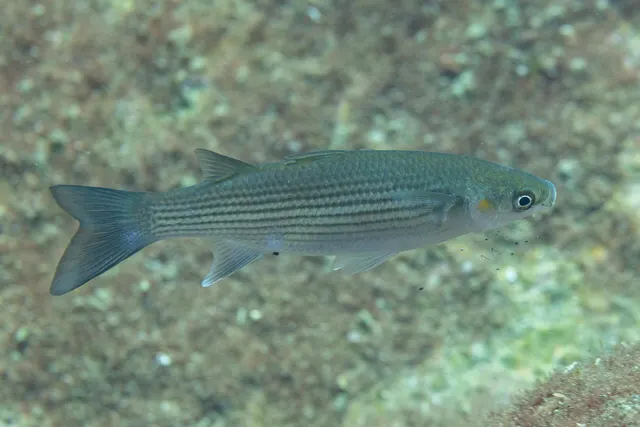 Thick-lipped grey mulletThe lip decides it, and the method follows: a thick-lipped mullet's upper lip is deep, rubbery and papillate and it will generally not chase a moving bait; a thin-lipped mullet's is narrow, and it will.
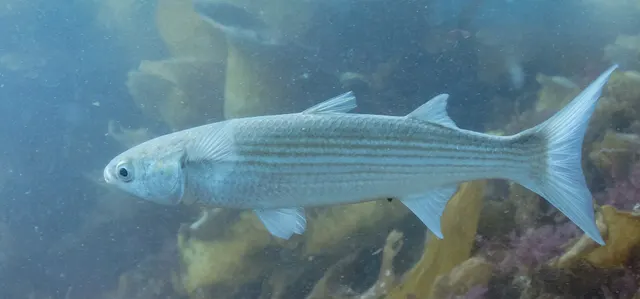 Flathead grey mulletA third grey mullet, larger and more southerly, occurring in Britain occasionally and commonly elsewhere. The genus is the same problem in every sea it occurs in.
Sources and evidence
- The Fishes of the British Isles and North-West Europe — Macmillan, 1969 (Reference work)Relied on for: Distribution, habitat, identification characters and biology of the fishes of the British Isles and north-west Europe.States this directlyCitation checked — the work exists and is described correctly
- FAO Species Identification Guides for Fishery Purposes and the FAO Species Catalogues — Food and Agriculture Organization of the United Nations (Scientific institute)Relied on for: Diagnostic identification characters, family placement, depth range and distribution as set out in the FAO species identification sheets for the eastern Atlantic and Mediterranean.States this directlyCitation checked — the work exists and is described correctly
- The IUCN Red List of Threatened Species — International Union for Conservation of Nature (Conservation authority)Relied on for: The global Red List category and the assessment behind it, assessed 11 January 2014. A statement about the species across its range and not about any managed stock.States this directlyCitation checked — the work exists and is described correctly
- Sea Angler — Bauer Media (Specialist angling publication)Relied on for: Contemporary UK sea angling practice as reported by practitioners: ground, seasonal timing, bait and method convention.States this directlyCitation checked — the work exists and is described correctly
- Cefas science, advice and data on marine and freshwater environments — Centre for Environment, Fisheries and Aquaculture Science (Government fisheries body)Relied on for: UK marine fisheries science: survey data, distribution and the biological basis of management advice.States this directlyCitation checked — the work exists and is described correctly
Why the 11 connections on this page are here, and the sources
How it is caught
What experienced anglers do — 3 connections
Widely and independently recommended by experienced anglers and specialist sources. This is real angling knowledge, not proof: controlled evidence for it is limited, and FishingHQ records it as convention rather than as a demonstrated effect.
Float fishing
A statement about how a species is fished, which is angling convention rather than biology and is labelled as such.
- Sea Angler — Bauer Media (Specialist angling publication)Relied on for: Contemporary UK sea angling and shore gathering practice as reported by practitioners: ground, seasonal timing, tackle, bait and method convention.States this directlyCitation checked — the work exists and is described correctly
- General angling website restatements of established technique — Various (Credible secondary source)Relied on for: Widely restated descriptions of technique, fish behaviour and regional practice, recorded as consensus rather than as scholarship.Background and mechanism onlyCitation checked — the work exists and is described correctly
Saltwater fly fishing
A statement about how a species is fished, which is angling convention rather than biology and is labelled as such.
- Still Water Fly-Fishing — Andre Deutsch, 1952 (Specialist angling publication)Relied on for: Fly-fishing practice from a practitioner tradition: line control, depth management, retrieve and the reading of water.States this directlyCitation checked — the work exists and is described correctly
- Sea Angler — Bauer Media (Specialist angling publication)Relied on for: Contemporary UK sea angling practice as reported by practitioners: ground, tackle, presentation and seasonal timing.States this directlyCitation checked — the work exists and is described correctly
Spinning
A statement about how a species is fished, which is angling convention rather than biology and is labelled as such.
- Sea Angler — Bauer Media (Specialist angling publication)Relied on for: Contemporary UK sea angling and shore gathering practice as reported by practitioners: ground, seasonal timing, tackle, bait and method convention.States this directlyCitation checked — the work exists and is described correctly
- General angling website restatements of established technique — Various (Credible secondary source)Relied on for: Widely restated descriptions of technique, fish behaviour and regional practice, recorded as consensus rather than as scholarship.Background and mechanism onlyCitation checked — the work exists and is described correctly
Where it lives
Backed by research — 3 connections
Supported by peer-reviewed research or fisheries science. The sources are listed and can be checked.
Brackish water
A distributional claim about where a species is found, resting on the standard regional reference works rather than on angling report.
- The Fishes of the British Isles and North-West Europe — Macmillan, 1969 (Reference work)Relied on for: Distribution, habitat association, identification and biology of the fishes and inshore fauna of the British Isles and north-west Europe.States this directlyCitation checked — the work exists and is described correctly
- FAO Species Identification Guides for Fishery Purposes and the FAO Species Catalogues — Food and Agriculture Organization of the United Nations (Scientific institute)Relied on for: Diagnostic characters, family placement, habitat and depth range as set out in the FAO species identification sheets for the eastern Atlantic and Mediterranean.States this directlyCitation checked — the work exists and is described correctly
Estuary
A distributional claim about where a species is found, resting on the standard regional reference works rather than on angling report.
- The Fishes of the British Isles and North-West Europe — Macmillan, 1969 (Reference work)Relied on for: Distribution, habitat association, identification and biology of the fishes and inshore fauna of the British Isles and north-west Europe.States this directlyCitation checked — the work exists and is described correctly
- FAO Species Identification Guides for Fishery Purposes and the FAO Species Catalogues — Food and Agriculture Organization of the United Nations (Scientific institute)Relied on for: Diagnostic characters, family placement, habitat and depth range as set out in the FAO species identification sheets for the eastern Atlantic and Mediterranean.States this directlyCitation checked — the work exists and is described correctly
Harbours, piers and breakwaters
A distributional claim about where a species is found, resting on the standard regional reference works rather than on angling report.
- The Fishes of the British Isles and North-West Europe — Macmillan, 1969 (Reference work)Relied on for: Distribution, habitat association, identification and biology of the fishes and inshore fauna of the British Isles and north-west Europe.States this directlyCitation checked — the work exists and is described correctly
- FAO Species Identification Guides for Fishery Purposes and the FAO Species Catalogues — Food and Agriculture Organization of the United Nations (Scientific institute)Relied on for: Diagnostic characters, family placement, habitat and depth range as set out in the FAO species identification sheets for the eastern Atlantic and Mediterranean.States this directlyCitation checked — the work exists and is described correctly
Understanding this fish
Backed by research — 2 connections
Supported by peer-reviewed research or fisheries science. The sources are listed and can be checked.
Algae and biofilm as food
A diet claim recorded at group level, pointed at a modelled prey CATEGORY, because the reference works describe the diet as a group rather than by species. Naming a particular species FishingHQ happens to hold would invent a precision the evidence never had.
- The Fishes of the British Isles and North-West Europe — Macmillan, 1969 (Reference work)Relied on for: Distribution, habitat association, identification and biology of the fishes and inshore fauna of the British Isles and north-west Europe.States this directlyCitation checked — the work exists and is described correctly
- FAO Species Identification Guides for Fishery Purposes and the FAO Species Catalogues — Food and Agriculture Organization of the United Nations (Scientific institute)Relied on for: Diagnostic characters, family placement, habitat and depth range as set out in the FAO species identification sheets for the eastern Atlantic and Mediterranean.States this directlyCitation checked — the work exists and is described correctly
Organic detritus as food
A diet claim recorded at group level, pointed at a modelled prey CATEGORY, because the reference works describe the diet as a group rather than by species. Naming a particular species FishingHQ happens to hold would invent a precision the evidence never had.
- The Fishes of the British Isles and North-West Europe — Macmillan, 1969 (Reference work)Relied on for: Distribution, habitat association, identification and biology of the fishes and inshore fauna of the British Isles and north-west Europe.States this directlyCitation checked — the work exists and is described correctly
- FAO Species Identification Guides for Fishery Purposes and the FAO Species Catalogues — Food and Agriculture Organization of the United Nations (Scientific institute)Relied on for: Diagnostic characters, family placement, habitat and depth range as set out in the FAO species identification sheets for the eastern Atlantic and Mediterranean.States this directlyCitation checked — the work exists and is described correctly
Told apart from
What experienced anglers do — 2 connections
Widely and independently recommended by experienced anglers and specialist sources. This is real angling knowledge, not proof: controlled evidence for it is limited, and FishingHQ records it as convention rather than as a demonstrated effect.
Thick-lipped grey mullet
A comparison a reader with the animal or the decision in front of them actually needs, joining two records that resolve one another.
- The Fishes of the British Isles and North-West Europe — Macmillan, 1969 (Reference work)Relied on for: Distribution, habitat association, identification and biology of the fishes and inshore fauna of the British Isles and north-west Europe.States this directlyCitation checked — the work exists and is described correctly
- FAO Species Identification Guides for Fishery Purposes and the FAO Species Catalogues — Food and Agriculture Organization of the United Nations (Scientific institute)Relied on for: Diagnostic characters, family placement, habitat and depth range as set out in the FAO species identification sheets for the eastern Atlantic and Mediterranean.States this directlyCitation checked — the work exists and is described correctly
Flathead grey mullet
A comparison a reader with the animal or the decision in front of them actually needs, joining two records that resolve one another.
- The Fishes of the British Isles and North-West Europe — Macmillan, 1969 (Reference work)Relied on for: Distribution, habitat association, identification and biology of the fishes and inshore fauna of the British Isles and north-west Europe.States this directlyCitation checked — the work exists and is described correctly
- FAO Species Identification Guides for Fishery Purposes and the FAO Species Catalogues — Food and Agriculture Organization of the United Nations (Scientific institute)Relied on for: Diagnostic characters, family placement, habitat and depth range as set out in the FAO species identification sheets for the eastern Atlantic and Mediterranean.States this directlyCitation checked — the work exists and is described correctly
Backed by research — 1 connection
Supported by peer-reviewed research or fisheries science. The sources are listed and can be checked.
Thick-lipped grey mullet
Taxonomic and practical relatedness recorded because confusable species matter more to a reader than a shared family does, with the evidence naming the species the edge is about.
- The Fishes of the British Isles and North-West Europe — Macmillan, 1969 (Reference work)Relied on for: Identification characters, family placement and biology of Chelon labrosus and of the species it is confused with, as set out for the fauna of the British Isles and north-west Europe.States this directlyCitation checked — the work exists and is described correctly
- FAO Species Identification Guides for Fishery Purposes and the FAO Species Catalogues — Food and Agriculture Organization of the United Nations (Scientific institute)Relied on for: Diagnostic characters and family placement of Chelon labrosus as set out in the FAO species identification sheets for the region concerned.States this directlyCitation checked — the work exists and is described correctly
Safety reading
Official guidance — 1 connection
Stated by a fisheries authority, scientific institute or recognised angling body. Authoritative, but summarising rather than demonstrating.
Wading safely
A link to a safety topic substantial enough to be read in full.
- RNLI water safety guidance: cold water shock and Float to Live — Royal National Lifeboat Institution (Water-safety or diver-training authority)Relied on for: Water safety guidance for coastal and inland users.States this directlyPassage read and verified
How FishingHQ labels evidence is explained in the evidence policy.