Thick-lipped grey mullet vs Thin-lipped grey mullet
How to tell them apart, and what follows from getting it right.
Why they get confused
Two grey mullet of the same shape and colour in the same harbours and estuaries, often in mixed company and seldom seen closer than a rod length. They are confused on the bank constantly, and large thin-lipped fish have probably been recorded as thick-lipped. A third fish, the golden grey mullet, is smaller, more slender and usually carries a gold spot on the gill cover.
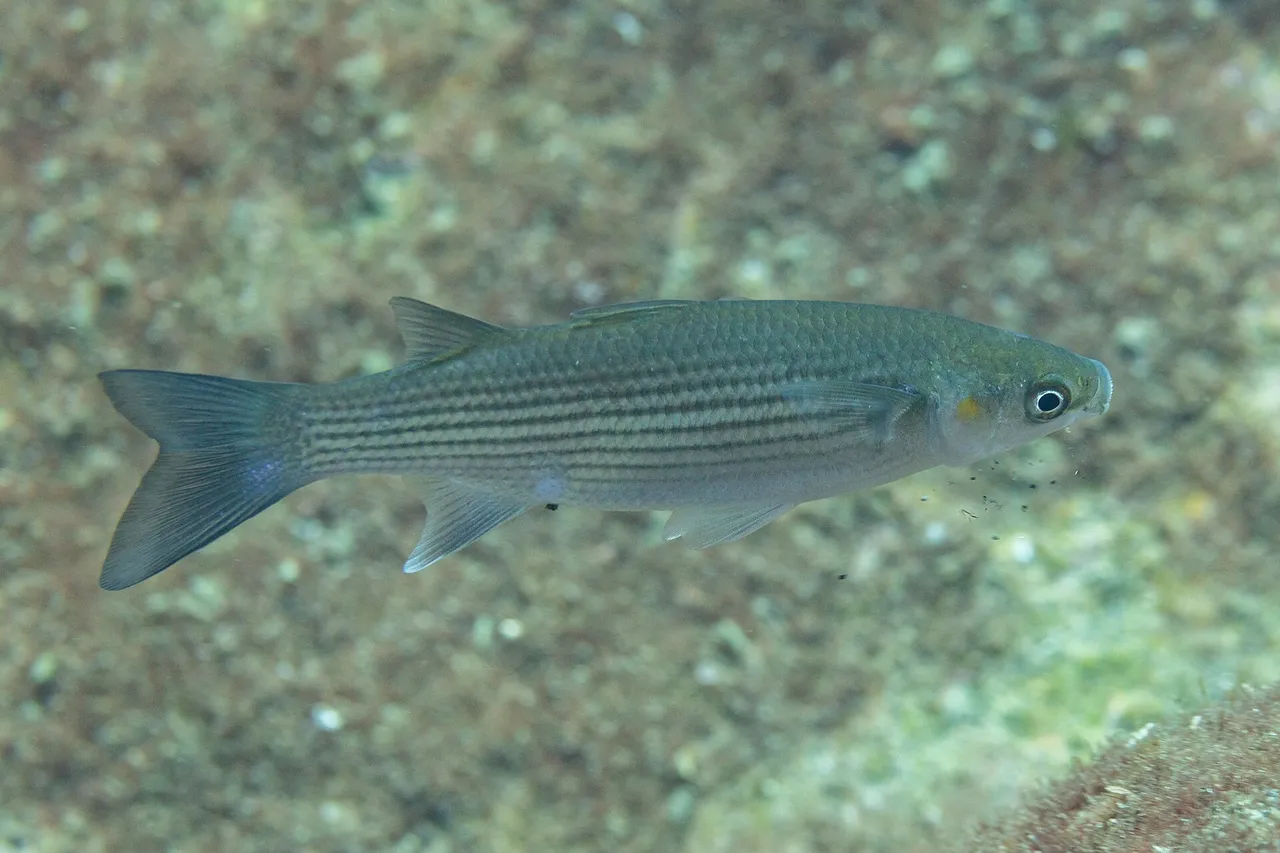
,_Catania,_Sicilia,_Italia,_2025-04-04,_DD_63.jpg)
Thin-lipped grey mullet
Chelon ramada — Mugilidae
No photograph of Thin-lipped grey mullet has passed identity review yet, so none is shown. A photograph is published only once somebody has checked the animal in it against the diagnostic features described on this page.
The differences
Each difference is marked with how far it can be trusted on its own. A single diagnostic character settles the identification; suggestive ones only narrow it.
| Character | Thick-lipped grey mullet | Thin-lipped grey mullet | Reliability |
|---|---|---|---|
| The upper lipIdentification | Deep and fleshy, with rows of small wart-like bumps along its lower part. | A thin, narrow strip, much less deep than the eye is wide. | Diagnostic on its own |
| The gap under the throatIdentification | Narrow: the gill covers nearly meet beneath the head. | Wide: a clear gap between the gill covers beneath the head. | Diagnostic on its own |
| The base of the pectoral finIdentification | No dark patch at the base of the pectoral fin. | Usually a dark patch at the upper root of the pectoral fin, which does not reach the eye when folded forward. | Supporting — use with others |
| A gold spot on the gill coverIdentification | May be present. The specialist club warns the spot can occur on all three grey mullet. | May be present. It is usual on the golden grey mullet and does not separate these two. | Suggestive only — varies |
| What it will takeFeeding | A grazer that can be brought on to bread with groundbait, and is rarely taken on any lure. | Takes a small ragworm trailed behind a spinner blade, and is seldom caught on bread or the baits used for the other. | Supporting — use with others |
| Where in the estuarySeason | Harbours, creeks, saltmarsh and bays, as well as the open coast. | The main channels with more current, and further up into fresh water than the other. | Suggestive only — varies |
Why it matters
It decides the method. Bread and a float is how thick-lipped mullet are fished for; a baited spinner is the thin-lipped mullet's, and each is close to useless for the other fish. Identify the first one caught and it tells you which water you are standing over. Both grow slowly and are returned by most who fish for them.
The full species pages
This page compares two species. Each of them has a full page covering biology, behaviour, handling and the evidence behind all of it.
More about thick-lipped grey mullet
Where it lives, how it is caught, and what else it is confused with.
Similar and related fish
- European sea bassThe standing confusion from a harbour wall or at the edge of underwater visibility — the mouth settles it.
- Flathead grey mulletBoth are Mugilidae feeding on detritus and surface film rather than on prey, which is why both are so difficult on conventional baits and why bread and algae work.
How it is caught
- Float fishingFine tackle and small baits presented at a set depth in harbours and creeks, which is the classic approach to a fish that inspects everything.
- LedgeringA light leger in flowing harbour and estuary water, used where a float cannot be controlled or where fish are feeding on the bottom.
- Saltwater fly fishingAn established specialist approach, imitating the algae, maggots and small crustaceans mullet graze on rather than presenting a baitfish pattern.
Gear for this fish
- BreadBread is the conventional starting bait for mullet in harbours precisely because it can be fished as loose feed and hook bait at once, which suits a fish that inspects at length before taking.
- Fish strip and cut baitThe other mullet bait, and the one that works where a harbour has a fish factory or a commercial fleet: small pieces of fish or offal. The statutory guide names it at Fenit, at Castletownbere and at Ballycotton, and a Dublin page describes a mackerel's liver whipped into muslin.
Where it lives
- EstuaryGrey mullet are the estuarine fish above all others — tolerant of the full salinity range, feeding on the fine organic material estuaries produce in quantity, and present in harbours and creeks where nothing else is.
Why the 8 connections on this page are here, and the sources
Similar and related fish
Backed by research — 2 connections
Supported by peer-reviewed research or fisheries science. The sources are listed and can be checked.
European sea bass
Unrelated fish — a moronid predator and a mugilid grazer — that share harbours and estuary mouths and are separated by the mouth, the upper lip and the first dorsal fin.
- FishBase: a global information system on fishes — Froese, R. and D. Pauly, eds. — FishBase Consortium (Scientific institute)Relied on for: The family placement and diagnostic morphology of Dicentrarchus labrax and Chelon labrosus, including dorsal spine counts and mouth form.States this directlyPassage read and verified
Unrelated fish — a moronid predator and a mugilid grazer — that share harbours and estuary mouths and are separated by the mouth, the upper lip and the first dorsal fin.
- FishBase: a global information system on fishes — Froese, R. and D. Pauly, eds. — FishBase Consortium (Scientific institute)Relied on for: The family placement and diagnostic morphology of Dicentrarchus labrax and Chelon labrosus, including dorsal spine counts and mouth form.States this directlyPassage read and verified
Flathead grey mullet
A comparison resting on shared family and feeding ecology, naming both binomials.
- FishBase: a global information system on fishes — Froese, R. and D. Pauly, eds. — FishBase Consortium (Scientific institute)Relied on for: That Mugil cephalus and Chelon labrosus are both Mugilidae feeding on detritus and organic material in coastal and estuarine water.States this directlyPassage read and verified
How it is caught
What experienced anglers do — 3 connections
Widely and independently recommended by experienced anglers and specialist sources. This is real angling knowledge, not proof: controlled evidence for it is limited, and FishingHQ records it as convention rather than as a demonstrated effect.
Float fishing
An established way this species is taken recreationally in north-west European waters.
- Sea Angler — Bauer Media (Specialist angling publication)Relied on for: Shore and boat practice in north-west European sea angling for the species and method described, presented across multiple independent contributors.States this directlyCitation checked — the work exists and is described correctly
- General angling website restatements of established technique — Various (Credible secondary source)Relied on for: Widely restated practice connecting this species to this method, recorded as practitioner consensus rather than as tested fact.Background and mechanism onlyCitation checked — the work exists and is described correctly
Ledgering
An established way this species is taken recreationally in north-west European waters.
- Sea Angler — Bauer Media (Specialist angling publication)Relied on for: Shore and boat practice in north-west European sea angling for the species and method described, presented across multiple independent contributors.States this directlyCitation checked — the work exists and is described correctly
- General angling website restatements of established technique — Various (Credible secondary source)Relied on for: Widely restated practice connecting this species to this method, recorded as practitioner consensus rather than as tested fact.Background and mechanism onlyCitation checked — the work exists and is described correctly
Saltwater fly fishing
An established way this species is taken recreationally in north-west European waters.
- Sea Angler — Bauer Media (Specialist angling publication)Relied on for: Shore and boat practice in north-west European sea angling for the species and method described, presented across multiple independent contributors.States this directlyCitation checked — the work exists and is described correctly
- General angling website restatements of established technique — Various (Credible secondary source)Relied on for: Widely restated practice connecting this species to this method, recorded as practitioner consensus rather than as tested fact.Background and mechanism onlyCitation checked — the work exists and is described correctly
Gear for this fish
What experienced anglers do — 2 connections
Widely and independently recommended by experienced anglers and specialist sources. This is real angling knowledge, not proof: controlled evidence for it is limited, and FishingHQ records it as convention rather than as a demonstrated effect.
Bread
Established angling convention about what a bait is used for. Convention is what this is, and labelling it as convention is what stops it being read as a tested result.
- Sea Angler — Bauer Media (Specialist angling publication)Relied on for: Contemporary UK sea angling practice as reported and restated by practitioners, including shore technique, bait use and species behaviour.States this directlyCitation checked — the work exists and is described correctly
- General angling website restatements of established technique — Various (Credible secondary source)Relied on for: Widely restated angling practice and belief, recorded as practitioner consensus rather than as tested fact.Background and mechanism onlyCitation checked — the work exists and is described correctly
Fish strip and cut bait
Named at five working harbours across two publishers, and in each case attached to a harbour where fish waste is present — which is a mechanism rather than a preference.
- Inland Fisheries Ireland: South West Sea Angling Guide — the Kerry and Beara angling marks — Inland Fisheries Ireland, 2020 (Government fisheries body)Relied on for: The statutory body naming small pieces of fish offal for mullet at three separate working harbours.Passage read and verified
- Sea Angling in Ireland: the shore marks of Wicklow, Dublin, Louth and Meath — Sea Angling Ireland (Credible secondary source)Relied on for: A county directory describing a mackerel's liver wrapped in muslin on pennel-rigged hooks for harbour mullet.Passage read and verified
Where it lives
Backed by research — 1 connection
Supported by peer-reviewed research or fisheries science. The sources are listed and can be checked.
Estuary
A habitat and salinity-tolerance claim held to a scientific standard, because the tolerance is the biological fact that explains everything about where the fish is found.
- The Fishes of the British Isles and North-West Europe — Macmillan, 1969 (Reference work)Relied on for: Estuarine and brackish habitat use and the feeding habits of Chelon labrosus on fine organic material.States this directlyCitation checked — the work exists and is described correctly
- FishBase: a global information system on fishes — Froese, R. and D. Pauly, eds. — FishBase Consortium (Scientific institute)Relied on for: Recorded habitat and salinity tolerance for Chelon labrosus.States this directlyPassage read and verified
Reviewed 2026-10-11. FishingHQ does not state what any rule is or where any rule applies. Where this page says the two species are managed differently, that is a reason to check the authority for the water you are on — not a statement of what it requires.