Thick-lipped grey mullet
Fish · Last reviewed 2026-08-10
A shoaling coastal fish that eats algae and detritus rather than prey — which makes it the hardest common sea fish to catch and the most interesting to think about.
Safety: standing precautions apply on this water.
,_Catania,_Sicilia,_Italia,_2025-04-04,_DD_63.jpg)
Catching Thick-lipped grey mullet
Everything here on fishing for it. Each entry opens the page behind it.
- Ground
- When
- Mar and May–Oct — months recorded at the places that document it, not a season for the whole range.
- Where
- 87 places FishingHQ documents — strongest claim anywhere: regular local target · From the shore, From a kayak
Almost every fish on FishingHQ is a predator or an omnivore that behaves like one. Mullet are not. They feed on benthic diatoms, epiphytic algae, small invertebrates and detritus, grazing surfaces and sifting sediment, and FishBase places them at a trophic level of 2.6 — closer to a grazing animal than to a hunter.
That single fact makes them the most technically demanding common sea species to catch. There is no prey item to imitate. A mullet is not looking for something to chase; it is grazing, and persuading one to take a hook means offering something within the range of what it is already eating, presented so finely that the fish does not detect the tackle. Mullet anglers use freshwater float tackle, tiny hooks and baits like bread and harbour weed for exactly this reason.
They are also fast, powerful, extremely wary, and long-lived — up to 25 years — which is a combination that produces a lot of lost fish and a small, devoted following.
How it is caught
- Float fishingFine tackle and small baits presented at a set depth in harbours and creeks, which is the classic approach to a fish that inspects everything.
- LedgeringA light leger in flowing harbour and estuary water, used where a float cannot be controlled or where fish are feeding on the bottom.
- Saltwater fly fishingAn established specialist approach, imitating the algae, maggots and small crustaceans mullet graze on rather than presenting a baitfish pattern.
Gear for this fish
- BreadBread is the conventional starting bait for mullet in harbours precisely because it can be fished as loose feed and hook bait at once, which suits a fish that inspects at length before taking.
- Fish strip and cut baitThe other mullet bait, and the one that works where a harbour has a fish factory or a commercial fleet: small pieces of fish or offal. The statutory guide names it at Fenit, at Castletownbere and at Ballycotton, and a Dublin page describes a mackerel's liver whipped into muslin.
Where Thick-lipped grey mullet is documented
Places where public sources describe this species as fished, with how it is fished and how strongly the evidence supports it. This is not a range map and it is not a recommendation — it is what has been written down about a fishery rather than a record of any individual catch, and being listed is never permission to fish.
The Cornish and Devon coasts
18 documented places
Estuary
Recorded here
From the shore
Exmouth and the Exe estuary
Estuary
Recorded here
From the shore
Teignmouth
Estuary mark
Recorded here
From the shore
Harbour wall
Repeatedly reported
From the shore
The Dart estuary
Estuary
Recorded here
From the shore
Breakwater
Recorded here
From the shore
The Tamar estuary
Estuary
Recorded here
From the shore
Estuary mark
Repeatedly reported
From a kayak
Beach section
Recorded here
From the shore
West Cork
6 documented places
Harbour wall
Regular local target
From the shore
Sound or strait
Recorded here
From the shore
Pier
Regular local target
From the shore
Estuary
Regular local target
From the shore
Estuary mark
Regular local target
From the shore
Estuary
Regular local target
From the shore
Dublin Bay and the Wicklow coast
4 documented places
The Great South Wall, Dublin Bay
Breakwater
Regular local target
From the shore
Pier
Regular local target
From the shore
Surf beach
Regular local target
From the shore
Around Jun, Jul, Aug, Sept
Pier
Regular local target
From the shore
The Kerry coast
4 documented places
Pier
Regular local target
From the shore
Estuary
Regular local target
From the shore
Beach
Regular local target
From the shore
Harbour wall
Regular local target
From the shore
East Lothian and the Firth of Forth coast
3 documented places
Rock mark
Seasonal
From the shore
Around Jun, Jul, Aug, Sept
Breakwater
Recorded here
From the shore
Rock mark
Regular local target
From the shore
Connemara and Galway Bay
3 documented places
Bay
Regular local target
From the shore
Promenade
Regular local target
From the shore
Harbour wall
Regular local target
From the shore
Around May, Jun, Jul, Aug, Sept, Oct
The Clare coast and the Shannon estuary
3 documented places
Pier
Regular local target
From the shore
Surf beach
Regular local target
From the shore
Rock platform
Regular local target
From the shore
Clew Bay and Achill
2 documented places
Bay
Regular local target
From the shore
Harbour wall
Regular local target
From the shore
Also documented on 27 more coasts
Fewer places each, or less strongly supported. Each one names its own marks.
Cork Harbour and the east Cork coast (2) · The Waterford coast (2) · The Wexford coast (2) · Brittany and the French Atlantic coast (2) · The Donegal coast and its sea loughs (2) · The Channel shingle coasts (1) · France (1) · Weymouth Bay (1) · The Sligo and Leitrim coast (1) · The Louth and Meath coast (1) · The Norfolk and Suffolk sandbank coast (8) · The Welsh coast and Anglesey (3) · The Wash and the Lincolnshire coast (2) · The Causeway and Antrim coast (2) · Belfast Lough and the north Down shore (2) · Strangford Lough and the Ards coast (1) · The East Antrim coast (1) · The Firth of Clyde (1) · The Gower and Carmarthen Bay (1) · Pembrokeshire and the south-west Wales coast (1) · Outer Hebrides (1) · The Azores (1) · The Bay of Biscay (1) · Chesil Beach (1) · Cardigan Bay and the sarnau (1) · Lough Foyle and its rivers (1) · The Isles of Scilly (1)
What these strengths mean
- Recorded here
- At least one credible public account of this species being caught here. That is all it means.
- Seasonal
- Well supported, and concentrated in part of the year rather than spread through it.
- Regular local target
- Fishing sources describe this as a normal local target here, not merely as caught.
- Repeatedly reported
- Several independent public accounts. Enough to say it happens more than once; not enough to call it a fishery.
- Occasional
- Caught here, and described as unusual rather than normal. Do not plan a session around it.
When to fish for thick-lipped grey mullet
Where the places here state a season for thick-lipped grey mullet, it clusters in Jun–Sep. This is a count of how many documented places name each month — evidence about when people fish for it, not a prediction of what any particular day will produce.
| Jan | Feb | Mar | Apr | May | Jun | Jul | Aug | Sep | Oct | Nov | Dec |
|---|---|---|---|---|---|---|---|---|---|---|---|
| January: no place here names this month — no place names it. | February: no place here names this month — no place names it. | March: 1 place names this month — few places. | April: no place here names this month — no place names it. | May: 4 places name this month — few places. | June: 31 places name this month — most places. | July: 31 places name this month — most places. | August: 31 places name this month — most places. | September: 31 places name this month — most places. | October: 5 places name this month — few places. | November: no place here names this month — no place names it. | December: no place here names this month — no place names it. |
32 of the 87 places that record catches of thick-lipped grey mullet state which months. The other 55 name no season, so they are counted in neither direction: the shape above is what the dated records say, not the whole picture. The dated records span 22 separate areas.
Identification
- Scientific name
- Chelon labrosus
- Family
- Mugilidae
- Water
- Saltwater, Brackish, Freshwater
- Conservation status
- Near Threatened
- Regions
- Britain & Ireland, Western Europe, Mediterranean, North Africa, Northern Europe
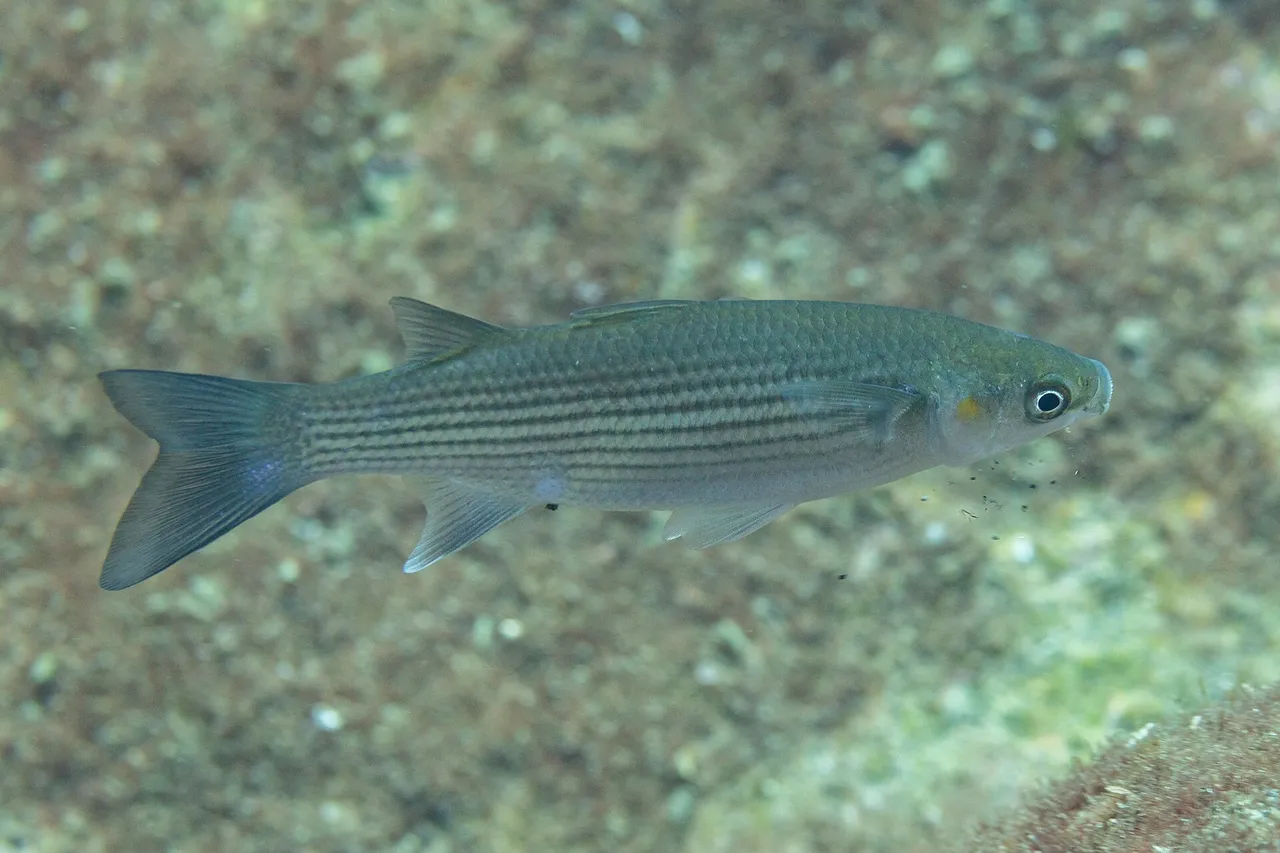
- A distinctly THICK upper lip — the feature that names the species and separates it from thin-lipped grey mullet, whose upper lip is narrow.
- Blunt head with a small mouth and no obvious teeth.
- Two widely separated dorsal fins, the first with four spines.
- Grey-blue back with silver flanks marked by faint longitudinal grey stripes.
- Large scales extending forward onto the head.
Size
- Typical
- 30–45 cm and 0.7–1.8 kg.
- Large
- Over 55 cm and 3 kg.
Exceptional: FishBase records a maximum of 75 cm SL and 4.5 kg. Fish at that end are exceptional and old.
Harbours, estuaries and the shallow warm water nobody else uses
Mullet occupy a niche almost no other fish an inshore angler meets can use, and that is why they are found in places that look unpromising and are not.
THE SALINITY TOLERANCE IS EXTREME. Thick-lipped grey mullet move between full seawater, brackish estuary and genuine fresh water, and they do it routinely rather than as an occasional excursion. That puts them far up estuaries, in harbours, marinas, creeks, drainage outfalls and river systems well above the tidal limit in places.
AND THE FEEDING IS THE OTHER HALF. Mullet graze on detritus, algae, and the film of organic material on surfaces, with a specialised gut and a muscular gizzard-like stomach for processing it. They also take small invertebrates and, notoriously, whatever organic matter accumulates around human activity. A fish that can digest detritus can live where a predator cannot, which is why a harbour with a fish quay holds mullet and holds little else of size.
THE DEPTH IS SHALLOW — typically two to fifteen metres, and often very much less. Mullet are frequently in water that barely covers them, visible, over mud and weed.
WHICH MAKES THEM A SIGHT FISHERY AND A DIFFICULT ONE. They are shallow, visible, in clear or slightly coloured water, and extremely wary. The difficulty is not that they are hard to find; it is that they can see everything, including the angler.
AND THE NURSERY DEPENDENCE MATTERS. Juveniles use estuaries, harbours and brackish creeks as nursery ground, which ties the stock directly to water quality in exactly the places most affected by discharge and development. This species is assessed as Near Threatened, which is unusual among the common inshore fish and is worth knowing before deciding whether to keep one.
Backed by research — why, and the sources (3)
Supported by peer-reviewed research or fisheries science. The sources are listed and can be checked.
- FishBase: a global information system on fishes — Froese, R. and D. Pauly, eds. — FishBase Consortium (Scientific institute)Relied on for: Depth range, habitat association, distribution, spawning mode and recorded maximum size for the species.States this directlyPassage read and verified
- The Fishes of the British Isles and North-West Europe — Macmillan, 1969 (Reference work)Relied on for: Habitat, life history and seasonal occurrence of the species in north-west European waters.States this directlyCitation checked — the work exists and is described correctly
- ICES Advice on fishing opportunities, catch and effort — International Council for the Exploration of the Sea (Scientific institute)Relied on for: That management advice for these species is issued per stock rather than per species, and that stock status differs between areas.Background and mechanism onlyCitation checked — the work exists and is described correctly
The mullet year, and the tide-hour that matters more than the month
Mullet seasonality is a temperature story like most inshore species, but the daily and tidal pattern is far more decisive for this fish than for anything else on the same coast.
THE SEASON. Mullet arrive inshore as water warms in late spring and remain through summer and early autumn, moving offshore and southward as it cools. In the northern part of the range they are effectively a warm-season fish; further south the season is far longer. The trigger is temperature rather than date.
BUT THE TIDE IS WHAT ORGANISES THE FISHING. Mullet follow the flood into shallow ground, creeks, and over mud and weed that were dry an hour before, feeding as they go, and drop back on the ebb. A harbour or creek fishes for a specific part of the tide and is empty for the rest of it. Within that, the last of the flood and the first of the ebb are frequently when fish are most concentrated and most catchable.
DISTURBANCE MATTERS MORE THAN TIME OF DAY. Mullet in a working harbour become accustomed to noise and movement and can be caught in daylight beside considerable activity; the same fish in a quiet creek will not tolerate a shadow. Time of day is a weaker predictor for this species than for most.
CONDITION IMPROVES THROUGH THE SEASON, so late-summer and autumn fish are the heaviest.
WHAT NOT TO CONVERT INTO A CALENDAR. The arrival tracks water temperature across a range running from Iceland to Cape Verde. "They come in May" describes one coast.
AND THE STANDING CAUTION. This species is assessed as Near Threatened, grows slowly and is long-lived. The fishery for it is very largely catch-and-release, and that is a deliberate response to the assessment rather than a convention.
Backed by research — why, and the sources (3)
Supported by peer-reviewed research or fisheries science. The sources are listed and can be checked.
- FishBase: a global information system on fishes — Froese, R. and D. Pauly, eds. — FishBase Consortium (Scientific institute)Relied on for: Depth range, habitat association, distribution, spawning mode and recorded maximum size for the species.States this directlyPassage read and verified
- The Fishes of the British Isles and North-West Europe — Macmillan, 1969 (Reference work)Relied on for: Habitat, life history and seasonal occurrence of the species in north-west European waters.States this directlyCitation checked — the work exists and is described correctly
- ICES Advice on fishing opportunities, catch and effort — International Council for the Exploration of the Sea (Scientific institute)Relied on for: That management advice for these species is issued per stock rather than per species, and that stock status differs between areas.Background and mechanism onlyCitation checked — the work exists and is described correctly
How mullet reproduce, and why the estuary is where the stock is decided
Mullet reproduction separates the adults and the juveniles into different environments, and the environment the juveniles need is the one under the most pressure.
THE STRATEGY. Spawning takes place at sea, offshore, with pelagic eggs released into open water. There is no nest and no parental care. The eggs and larvae drift, and the juveniles move into estuaries, harbours and brackish creeks.
AND THOSE NURSERIES ARE THE CONSTRAINT. Small mullet are most abundant in exactly the brackish, sheltered, organically rich water that adult mullet also exploit, and the dependence is obligatory rather than opportunistic for the early life stage. Water quality, discharge, dredging and the physical modification of estuaries and harbours therefore act directly on recruitment.
WHICH IS WHY THE CONSERVATION STATUS IS WHAT IT IS. A species dependent on estuarine nursery habitat across a range where that habitat is heavily modified is exposed in a way its apparent abundance in a harbour does not suggest. The Near Threatened assessment is a statement about that.
MATURITY IS LATE AND GROWTH IS SLOW. Mullet take several years to mature and large fish are old. Combined with the nursery dependence, that gives a population that recovers slowly from depletion.
AND THE PRACTICAL CONSEQUENCE IS THE FISHERY'S OWN NORM. Mullet angling in Britain and Ireland is overwhelmingly catch-and-release, and the specialist groups that fish for them advocate it explicitly. That is not squeamishness about a fish with a poor culinary reputation; it is a response to a slow-growing, late-maturing, habitat-limited species assessed as Near Threatened.
WHAT THIS SECTION DOES NOT DO. Identify spawning aggregations.
Backed by research — why, and the sources (3)
Supported by peer-reviewed research or fisheries science. The sources are listed and can be checked.
- FishBase: a global information system on fishes — Froese, R. and D. Pauly, eds. — FishBase Consortium (Scientific institute)Relied on for: Depth range, habitat association, distribution, spawning mode and recorded maximum size for the species.States this directlyPassage read and verified
- The Fishes of the British Isles and North-West Europe — Macmillan, 1969 (Reference work)Relied on for: Habitat, life history and seasonal occurrence of the species in north-west European waters.States this directlyCitation checked — the work exists and is described correctly
- ICES Advice on fishing opportunities, catch and effort — International Council for the Exploration of the Sea (Scientific institute)Relied on for: That management advice for these species is issued per stock rather than per species, and that stock status differs between areas.Background and mechanism onlyCitation checked — the work exists and is described correctly
How big mullet get, and why a five-pounder is a serious fish
Mullet size is worth stating carefully because the species is widely dismissed and the large fish are, in age terms, among the most impressive an inshore angler will encounter.
THE ORDINARY FISH is thirty to forty-five centimetres and roughly seven hundred grams to one and three-quarter kilograms. That is what most harbours and creeks produce and it is already a fish that has taken years to get there.
A GOOD FISH is over fifty-five centimetres and around three kilograms. Specialists regard a fish of that size as a genuine achievement, and the difficulty is not landing it but deceiving it.
THE RECORDED MAXIMUM is 75 centimetres and 4.5 kilograms in FishBase. Fish at that end are exceptional and old.
WHAT MAKES THE NUMBERS MEANINGFUL IS THE AGE BEHIND THEM. Mullet grow slowly and live a long time, so the weight is a poor guide to what the fish represents. A three-kilogram mullet may be older than a much heavier bass, and it belongs to a species assessed as Near Threatened.
WHICH IS THE ARGUMENT FOR RETURNING THEM. The specialist mullet fishery in Britain and Ireland is very largely catch-and-release, and the reason is the combination above: slow growth, late maturity, dependence on degraded nursery habitat, and a conservation assessment worse than any comparable inshore species.
AND A NOTE ON IDENTIFICATION AFFECTING SIZE CLAIMS. Several grey mullet species occur in the same water and are confused routinely, and weight records attributed to one may belong to another. A size figure for this species is only as good as the identification behind it.
Backed by research — why, and the sources (3)
Supported by peer-reviewed research or fisheries science. The sources are listed and can be checked.
- FishBase: a global information system on fishes — Froese, R. and D. Pauly, eds. — FishBase Consortium (Scientific institute)Relied on for: Depth range, habitat association, distribution, spawning mode and recorded maximum size for the species.States this directlyPassage read and verified
- The Fishes of the British Isles and North-West Europe — Macmillan, 1969 (Reference work)Relied on for: Habitat, life history and seasonal occurrence of the species in north-west European waters.States this directlyCitation checked — the work exists and is described correctly
- ICES Advice on fishing opportunities, catch and effort — International Council for the Exploration of the Sea (Scientific institute)Relied on for: That management advice for these species is issued per stock rather than per species, and that stock status differs between areas.Background and mechanism onlyCitation checked — the work exists and is described correctly
Freshwater tactics in salt water, and the most technically demanding fish on a British shore
Mullet fishing is the clearest case in British angling of a sea species that must be approached with freshwater technique, and understanding why makes the whole discipline coherent.
THE FISH IS A GRAZER WITH A SMALL MOUTH AND EXCELLENT EYESIGHT. Mullet feed on algae, detritus, small organisms and biofilm, sifting and sucking rather than seizing. They have a small mouth, soft lips and a fine-meshed filtering apparatus, and they are extremely wary in the clear shallow water of harbours and estuaries where they are usually seen. Nothing about that combination suits conventional sea tackle.
SO THE TACKLE AND METHOD COME FROM COARSE FISHING. Light float rods, fine line, small hooks, small baits and a float or freeline presentation are what work — essentially roach tactics applied to salt water. Heavy tackle is detected and refused, and the difference between fine and heavy tackle here is the difference between catching and watching.
GROUNDBAITING IS CENTRAL AND IT TAKES TIME. Mullet are conditioned rather than persuaded: introducing small quantities of bait regularly over a period gets a shoal feeding confidently, and then a hook bait among it is taken. A single cast into a shoal of unfed mullet achieves nothing. Bread, mashed bread and fish-based groundbaits are the standard, and patience is the actual technique.
BAIT IS SMALL AND OFTEN BREAD OR HARBOUR FOOD. Bread flake and mashed bread are the classic; where mullet are feeding on harbour outfalls or on weed and algae, matching what they are actually taking is what converts a fed shoal into a caught fish.
THE TAKE IS SUBTLE AND THE FIGHT IS NOT. Mullet bites are delicate and easily missed, and a hooked mullet then runs hard and long for a fish of its size — powerful, fast and difficult on fine tackle, particularly around harbour structure. The soft mouth means the hook hold is fragile throughout.
AND THE SPECIES IS SLOW-GROWING AND LONG-LIVED, which is a strong argument for release. Mullet are frequently returned by the anglers who target them for that reason. What may be retained is a matter for the competent authority, and in some areas mullet are subject to specific measures.
What experienced anglers do — why, and the sources (2)
Widely and independently recommended by experienced anglers and specialist sources. This is real angling knowledge, not proof: controlled evidence for it is limited, and FishingHQ records it as convention rather than as a demonstrated effect.
- Sea Angler — Bauer Media (Specialist angling publication)Relied on for: Established shore and boat angling practice, including tackle selection and the reasoning behind it.States this directlyCitation checked — the work exists and is described correctly
- General angling website restatements of established technique — Various (Credible secondary source)Relied on for: The widely restated sea angling practice for this species, recorded as a consensus position rather than as an original observation.States this directlyCitation checked — the work exists and is described correctly
Lifecycle and reproduction
Mullet are slow-growing and long-lived, with FishBase recording a maximum reported age of 25 years. They mature comparatively late and shoal by size throughout life. Their catadromous habit — moving between salt, brackish and fresh water — means individual fish may use a wide range of habitats over a season.
Spawning takes place at sea, offshore, with pelagic eggs. Juveniles move into estuaries, harbours and brackish creeks, which are the nursery habitat and where small mullet are most abundant. The dependence on estuarine and harbour habitat makes water quality in those places directly relevant to the stock.
Feeding and senses
Adults feed on benthic diatoms, epiphytic algae, small invertebrates and detritus, grazing surfaces and processing sediment; juveniles feed on zooplankton. The gut is long and the fish has a muscular gizzard-like stomach region for grinding, which is what a diet of algae and sediment requires. This is a grazing animal, and the whole difficulty of catching one follows from it.
Vision dominates and mullet are exceptionally wary in the clear shallow water they favour — a shoal in a harbour will move away from a shadow. They also respond strongly to introduced food, which is the crack in the armour: a mullet shoal that has been fed steadily on bread over an hour behaves very differently from one that has not.
Through the year
Mullet arrive inshore as water warms in late spring and remain through summer and early autumn, moving offshore and southward as it cools. They tolerate a wide salinity range and penetrate far up estuaries and into fresh water. Within a day, tide state and disturbance matter more than time of day.
Distribution
Eastern Atlantic from Iceland and southern Norway south to Cape Verde, throughout the Mediterranean and Black Sea basins, west to the Azores. Marine, brackish and fresh water at depths of 2 to 15 m. The global IUCN category is NEAR THREATENED, assessed in June 2022 — the only Wave 2 species not at Least Concern, and worth knowing before deciding whether to retain one.
This is a biological range — where the species occurs, not a prediction that you will catch one. To browse the fishing geography FishingHQ holds, start at fishing places.
Why anglers care
A specialist pursuit with a devoted following, fished with freshwater tackle scaled down further than most sea angling would recognise. Mullet are the clearest demonstration in sea angling that matching the feeding behaviour matters more than matching the size of the fish.
Handling and returning
Mullet have soft mouths and small hooks tear out easily, which argues for a soft rod and a light drag rather than a firm strike. They are otherwise easy to handle, with no spines or teeth. Given the Near Threatened assessment and the slow growth, returning them is the default that most mullet anglers already apply.
Going further
- What does thick-lipped grey mullet eat? — feeding biology, kept separate from what anglers infer from it.
- Thick-lipped grey mullet vs Flathead grey mullet — how to tell them apart.
Safety
Precautions that always apply here
- Wet your hands before touching a fish. Dry hands strip the protective mucus layer that keeps infection out.
- Check the tide before you go and know your exit route. Being cut off is the commonest way a shore session becomes a rescue.
- Support the fish's weight along its body, keep it out of the water for as short a time as possible, and hold it over something soft.
Check the rules before you fish
Fishing laws, bylaws, access rules, seasons, bait restrictions and permitted methods vary by location and can change. Check the current rules from the relevant authority and the water you intend to fish before fishing.
Check with:
- Current national or regional law for where you are fishing
- Current local bylaws
- The relevant fisheries authority
- The landowner, club or fishery whose water it is
- Any restrictions specific to the species or the method you intend to use
Where to go next
Similar and related fish
Where it lives
Where you will find it
- AngleseyThe harbours, the strait and the sheltered creeks hold a mullet fishery among the better ones in Wales, and it is the fishery most visitors walk past.
- Connemara and Galway BayA genuine local speciality: mullet shoal around the piers, the working port and the promenade of this coast, and are taken on the float from May into early October.
- Cork Harbour and the east Cork coastShoal in the harbour through summer, associated with a working commercial fleet and the offal it produces, and taken on small float-fished fish strips with fish over three kilos recorded.
- CyprusThe harbour species that most rewards effort, and the one that makes the island's fine-tackle-and-groundbait approach make sense. Mullet in clear, tideless, heavily-watched harbour water are as technical a proposition as anything in European shore fishing.
- Dublin Bay and the Wicklow coastShoal in the tidal river through the city and around the working harbours, taken on float-fished bread and on offal from the commercial fleet — genuinely urban fishing rather than coast that happens to be near a city.
- Morecambe Bay and the north-west England coastIn the creeks and around the freshwater outfalls through the summer, in the numbers estuaries of this kind always hold and with the difficulty they always present.
- Pembrokeshire and the south-west Wales coastIn Milford Haven, the estuaries and the harbours through the warmer months, which is a quite different water from the exposed coast a few miles seaward.
- The Atlantic coast of IrelandAssociated with the sheltered bays, sea inlets, harbours and estuary mouths of this coast rather than with its exposed rock, and present through the warmer months.
10 more
- The Black Sea Fishing regions
- The East Antrim coast Fishing regions
- The Isles of Scilly Fishing regions
- The Kerry coast Fishing regions
- The Severn Estuary Fishing regions
- The Sligo and Leitrim coast Fishing regions
- The Solent and the Hampshire coast Fishing regions
- The Thames Estuary Fishing regions
- The Waterford coast Fishing regions
- West Cork Fishing regions
Understanding this fish
- Algae and biofilm as foodThis is a grazing animal working algae off surfaces, and the long gut and grinding stomach region are what a diet of algae and sediment requires.
- How fish detect preyMullet are famously difficult because they feed by sifting fine material rather than by attacking prey — so almost everything about conventional bait presentation is aimed at the wrong behaviour.
- Organic detritus as foodDetritus is taken with the algae as the fish processes sediment, which is why the two categories appear together on both grey mullet records.
- Sight fishing and blind searchingThe British sight-fishing target, and evidence that the technique is not a tropical import. Mullet are visible in harbours, estuaries and shallow bays through the summer, they can be watched feeding for an hour before a cast is made, and they punish a fly lined over them exactly as a flats fish does.
- Where fly fishing goes beyond troutThe fish that breaks the category hardest. A sea fish, extremely visible, extremely difficult, feeding on algae and tiny items in harbours and estuaries, and taken on flies that imitate neither insect nor baitfish. Nothing about it fits the discipline's self-description and it is one of the finest fly targets in Britain.
Told apart from
Sources and evidence
- FishBase: a global information system on fishes — Froese, R. and D. Pauly, eds. — FishBase Consortium (Scientific institute)Relied on for: Family (Mugilidae), maxima of 75 cm SL and 4.5 kg, maximum reported age 25 years, the catadromous habit at 2–15 m, the adult diet of benthic diatoms, epiphytic algae, small invertebrates and detritus, trophic level 2.6, and NEAR THREATENED assessed 7 June 2022. Read during source review.States this directlyPassage read and verified
Why the 31 connections on this page are here, and the sources
Similar and related fish
Backed by research — 1 connection
Supported by peer-reviewed research or fisheries science. The sources are listed and can be checked.
Flathead grey mullet
A comparison resting on shared family and feeding ecology, naming both binomials.
- FishBase: a global information system on fishes — Froese, R. and D. Pauly, eds. — FishBase Consortium (Scientific institute)Relied on for: That Mugil cephalus and Chelon labrosus are both Mugilidae feeding on detritus and organic material in coastal and estuarine water.States this directlyPassage read and verified
How it is caught
What experienced anglers do — 3 connections
Widely and independently recommended by experienced anglers and specialist sources. This is real angling knowledge, not proof: controlled evidence for it is limited, and FishingHQ records it as convention rather than as a demonstrated effect.
Float fishing
An established way this species is taken recreationally in north-west European waters.
- Sea Angler — Bauer Media (Specialist angling publication)Relied on for: Shore and boat practice in north-west European sea angling for the species and method described, presented across multiple independent contributors.States this directlyCitation checked — the work exists and is described correctly
- General angling website restatements of established technique — Various (Credible secondary source)Relied on for: Widely restated practice connecting this species to this method, recorded as practitioner consensus rather than as tested fact.Background and mechanism onlyCitation checked — the work exists and is described correctly
Ledgering
An established way this species is taken recreationally in north-west European waters.
- Sea Angler — Bauer Media (Specialist angling publication)Relied on for: Shore and boat practice in north-west European sea angling for the species and method described, presented across multiple independent contributors.States this directlyCitation checked — the work exists and is described correctly
- General angling website restatements of established technique — Various (Credible secondary source)Relied on for: Widely restated practice connecting this species to this method, recorded as practitioner consensus rather than as tested fact.Background and mechanism onlyCitation checked — the work exists and is described correctly
Saltwater fly fishing
An established way this species is taken recreationally in north-west European waters.
- Sea Angler — Bauer Media (Specialist angling publication)Relied on for: Shore and boat practice in north-west European sea angling for the species and method described, presented across multiple independent contributors.States this directlyCitation checked — the work exists and is described correctly
- General angling website restatements of established technique — Various (Credible secondary source)Relied on for: Widely restated practice connecting this species to this method, recorded as practitioner consensus rather than as tested fact.Background and mechanism onlyCitation checked — the work exists and is described correctly
Gear for this fish
What experienced anglers do — 2 connections
Widely and independently recommended by experienced anglers and specialist sources. This is real angling knowledge, not proof: controlled evidence for it is limited, and FishingHQ records it as convention rather than as a demonstrated effect.
Bread
Established angling convention about what a bait is used for. Convention is what this is, and labelling it as convention is what stops it being read as a tested result.
- Sea Angler — Bauer Media (Specialist angling publication)Relied on for: Contemporary UK sea angling practice as reported and restated by practitioners, including shore technique, bait use and species behaviour.States this directlyCitation checked — the work exists and is described correctly
- General angling website restatements of established technique — Various (Credible secondary source)Relied on for: Widely restated angling practice and belief, recorded as practitioner consensus rather than as tested fact.Background and mechanism onlyCitation checked — the work exists and is described correctly
Fish strip and cut bait
Named at five working harbours across two publishers, and in each case attached to a harbour where fish waste is present — which is a mechanism rather than a preference.
- Inland Fisheries Ireland: South West Sea Angling Guide — the Kerry and Beara angling marks — Inland Fisheries Ireland, 2020 (Government fisheries body)Relied on for: The statutory body naming small pieces of fish offal for mullet at three separate working harbours.Passage read and verified
- Sea Angling in Ireland: the shore marks of Wicklow, Dublin, Louth and Meath — Sea Angling Ireland (Credible secondary source)Relied on for: A county directory describing a mackerel's liver wrapped in muslin on pennel-rigged hooks for harbour mullet.Passage read and verified
Where it lives
Backed by research — 1 connection
Supported by peer-reviewed research or fisheries science. The sources are listed and can be checked.
Estuary
A habitat and salinity-tolerance claim held to a scientific standard, because the tolerance is the biological fact that explains everything about where the fish is found.
- The Fishes of the British Isles and North-West Europe — Macmillan, 1969 (Reference work)Relied on for: Estuarine and brackish habitat use and the feeding habits of Chelon labrosus on fine organic material.States this directlyCitation checked — the work exists and is described correctly
- FishBase: a global information system on fishes — Froese, R. and D. Pauly, eds. — FishBase Consortium (Scientific institute)Relied on for: Recorded habitat and salinity tolerance for Chelon labrosus.States this directlyPassage read and verified
Where you will find it
Backed by research — 18 connections
Supported by peer-reviewed research or fisheries science. The sources are listed and can be checked.
Anglesey
A distributional claim about where a species occurs, which is a claim about the world and rests on the reference literature rather than on angling report.
- The Fishes of the British Isles and North-West Europe — Macmillan, 1969 (Reference work)Relied on for: Distribution, habitat association and biology of the fishes of the British Isles and north-west Europe.States this directlyCitation checked — the work exists and is described correctly
- Cefas science, advice and data on marine and freshwater environments — Centre for Environment, Fisheries and Aquaculture Science (Government fisheries body)Relied on for: UK marine fisheries science: distribution, survey data and the biological basis of management advice.States this directlyCitation checked — the work exists and is described correctly
Connemara and Galway Bay
A claim that a coast contains the ground and conditions the species is associated with. It is a distributional statement about the world, it rests on the regional reference literature, and it deliberately asserts nothing about access, permission or catch.
- The Fishes of the British Isles and North-West Europe — Macmillan, 1969 (Reference work)Relied on for: Distribution and habitat association of the marine and estuarine fishes of the British Isles and north-west Europe, including which coasts and ground types a species occupies.States this directlyCitation checked — the work exists and is described correctly
- FishBase: a global information system on fishes — Froese, R. and D. Pauly, eds. — FishBase Consortium (Scientific institute)Relied on for: Recorded distribution, depth range and habitat association for the species named.States this directlyPassage read and verified
Cork Harbour and the east Cork coast
A claim that a coast contains the ground and conditions the species is associated with. It is a distributional statement about the world, it rests on the regional reference literature, and it deliberately asserts nothing about access, permission or catch.
- The Fishes of the British Isles and North-West Europe — Macmillan, 1969 (Reference work)Relied on for: Distribution and habitat association of the marine and estuarine fishes of the British Isles and north-west Europe, including which coasts and ground types a species occupies.States this directlyCitation checked — the work exists and is described correctly
- FishBase: a global information system on fishes — Froese, R. and D. Pauly, eds. — FishBase Consortium (Scientific institute)Relied on for: Recorded distribution, depth range and habitat association for the species named.States this directlyPassage read and verified
Cyprus
A distribution edge resting on published regional identification and distribution references, written where the species is genuinely characteristic of the destination's fishing rather than merely recorded from its waters.
- FAO Species Identification Guides for Fishery Purposes and the FAO Species Catalogues — Food and Agriculture Organization of the United Nations (Scientific institute)Relied on for: Distribution, habitat association and biology of the fishes of the eastern central Atlantic and the Mediterranean, from the regional identification guides prepared for fishery purposes.States this directlyCitation checked — the work exists and is described correctly
- FishBase: a global information system on fishes — Froese, R. and D. Pauly, eds. — FishBase Consortium (Scientific institute)Relied on for: Recorded environment, depth range, distribution and biology of the species named.States this directlyPassage read and verified
Dublin Bay and the Wicklow coast
A claim that a coast contains the ground and conditions the species is associated with. It is a distributional statement about the world, it rests on the regional reference literature, and it deliberately asserts nothing about access, permission or catch.
- The Fishes of the British Isles and North-West Europe — Macmillan, 1969 (Reference work)Relied on for: Distribution and habitat association of the marine and estuarine fishes of the British Isles and north-west Europe, including which coasts and ground types a species occupies.States this directlyCitation checked — the work exists and is described correctly
- FishBase: a global information system on fishes — Froese, R. and D. Pauly, eds. — FishBase Consortium (Scientific institute)Relied on for: Recorded distribution, depth range and habitat association for the species named.States this directlyPassage read and verified
Morecambe Bay and the north-west England coast
A claim that a place contains the ground, water and seasonal conditions the species is associated with. It is a distributional statement about the world, it rests on the regional reference literature, and it deliberately asserts nothing about access, permission or catch.
- The Fishes of the British Isles and North-West Europe — Macmillan, 1969 (Reference work)Relied on for: Distribution and habitat association of the marine, estuarine and freshwater fishes of the British Isles, including which coasts and ground types a species occupies.States this directlyCitation checked — the work exists and is described correctly
- FishBase: a global information system on fishes — Froese, R. and D. Pauly, eds. — FishBase Consortium (Scientific institute)Relied on for: Recorded distribution, depth range and habitat association for the species named.States this directlyPassage read and verified
Pembrokeshire and the south-west Wales coast
A claim that a place contains the ground, water and seasonal conditions the species is associated with. It is a distributional statement about the world, it rests on the regional reference literature, and it deliberately asserts nothing about access, permission or catch.
- The Fishes of the British Isles and North-West Europe — Macmillan, 1969 (Reference work)Relied on for: Distribution and habitat association of the marine, estuarine and freshwater fishes of the British Isles, including which coasts and ground types a species occupies.States this directlyCitation checked — the work exists and is described correctly
- FishBase: a global information system on fishes — Froese, R. and D. Pauly, eds. — FishBase Consortium (Scientific institute)Relied on for: Recorded distribution, depth range and habitat association for the species named.States this directlyPassage read and verified
The Atlantic coast of Ireland
A claim that a place contains the ground and conditions the species is associated with. It is a distributional statement about the world, it rests on the regional reference literature, and it deliberately asserts nothing about access, permission or catch.
- The Fishes of the British Isles and North-West Europe — Macmillan, 1969 (Reference work)Relied on for: Distribution and habitat association of the marine and estuarine fishes of the British Isles, including which coasts and ground types a species occupies.States this directlyCitation checked — the work exists and is described correctly
- FishBase: a global information system on fishes — Froese, R. and D. Pauly, eds. — FishBase Consortium (Scientific institute)Relied on for: Recorded distribution, depth range and habitat association for the species named.States this directlyPassage read and verified
The Black Sea
A distribution edge resting on published identification and distribution references rather than on angling report, written where the species is genuinely characteristic of the system rather than merely recorded in it once.
- FishBase: a global information system on fishes — Froese, R. and D. Pauly, eds. — FishBase Consortium (Scientific institute)Relied on for: Recorded environment, salinity tolerance, depth range, distribution and biology of the species named.States this directlyPassage read and verified
- FAO Species Identification Guides for Fishery Purposes and the FAO Species Catalogues — Food and Agriculture Organization of the United Nations (Scientific institute)Relied on for: Distribution, habitat association and identification of the fishes of the Mediterranean and Black Sea region.States this directlyCitation checked — the work exists and is described correctly
The East Antrim coast
A claim that a coast or region contains the ground and conditions this species is associated with. It is a distributional statement about the world, it rests on the reference literature and on the institute that surveyed it, and it deliberately asserts nothing about access, permission or catch.
- The Fishes of the British Isles and North-West Europe — Macmillan, 1969 (Reference work)Relied on for: Distribution and habitat association of the marine fishes of the British Isles and north-west Europe, including which coasts and ground types a species occupies.States this directlyCitation checked — the work exists and is described correctly
- FishBase: a global information system on fishes — Froese, R. and D. Pauly, eds. — FishBase Consortium (Scientific institute)Relied on for: Recorded distribution, depth range and habitat association for the species named.States this directlyPassage read and verified
The Isles of Scilly
A claim that a place contains the ground, water and seasonal conditions the species is associated with. It is a distributional statement about the world, it rests on the regional reference literature, and it deliberately asserts nothing about access, permission or catch.
- The Fishes of the British Isles and North-West Europe — Macmillan, 1969 (Reference work)Relied on for: Distribution and habitat association of the marine, estuarine and freshwater fishes of the British Isles, including which coasts, estuaries and ground types a species occupies.States this directlyCitation checked — the work exists and is described correctly
- FishBase: a global information system on fishes — Froese, R. and D. Pauly, eds. — FishBase Consortium (Scientific institute)Relied on for: Recorded distribution, depth range and habitat association for the species named.States this directlyPassage read and verified
The Kerry coast
A claim that a coast contains the ground and conditions the species is associated with. It is a distributional statement about the world, it rests on the regional reference literature, and it deliberately asserts nothing about access, permission or catch.
- The Fishes of the British Isles and North-West Europe — Macmillan, 1969 (Reference work)Relied on for: Distribution and habitat association of the marine and estuarine fishes of the British Isles and north-west Europe, including which coasts and ground types a species occupies.States this directlyCitation checked — the work exists and is described correctly
- FishBase: a global information system on fishes — Froese, R. and D. Pauly, eds. — FishBase Consortium (Scientific institute)Relied on for: Recorded distribution, depth range and habitat association for the species named.States this directlyPassage read and verified
The Severn Estuary
A distribution association between an animal and a kind of water, rather than a claim about any named mark.
- The Fishes of the British Isles and North-West Europe — Macmillan, 1969 (Reference work)Relied on for: Distribution, habitat association, depth and ground preference of fishes in British and north-west European waters.States this directlyCitation checked — the work exists and is described correctly
- FishBase: a global information system on fishes — Froese, R. and D. Pauly, eds. — FishBase Consortium (Scientific institute)Relied on for: Distribution, habitat association and depth range recorded for the species.Background and mechanism onlyPassage read and verified
The Sligo and Leitrim coast
A claim that a coast contains the ground and conditions the species is associated with. It is a distributional statement about the world, it rests on the regional reference literature, and it deliberately asserts nothing about access, permission or catch.
- The Fishes of the British Isles and North-West Europe — Macmillan, 1969 (Reference work)Relied on for: Distribution and habitat association of the marine and estuarine fishes of the British Isles and north-west Europe, including which coasts and ground types a species occupies.States this directlyCitation checked — the work exists and is described correctly
- FishBase: a global information system on fishes — Froese, R. and D. Pauly, eds. — FishBase Consortium (Scientific institute)Relied on for: Recorded distribution, depth range and habitat association for the species named.States this directlyPassage read and verified
The Solent and the Hampshire coast
A claim that a place contains the ground, water and seasonal conditions the species is associated with. It is a distributional statement about the world, it rests on the regional reference literature, and it deliberately asserts nothing about access, permission or catch.
- The Fishes of the British Isles and North-West Europe — Macmillan, 1969 (Reference work)Relied on for: Distribution and habitat association of the marine, estuarine and freshwater fishes of the British Isles, including which coasts, estuaries and ground types a species occupies.States this directlyCitation checked — the work exists and is described correctly
- FishBase: a global information system on fishes — Froese, R. and D. Pauly, eds. — FishBase Consortium (Scientific institute)Relied on for: Recorded distribution, depth range and habitat association for the species named.States this directlyPassage read and verified
The Thames Estuary
A claim that a place contains the ground, water and seasonal conditions the species is associated with. It is a distributional statement about the world, it rests on the regional reference literature, and it deliberately asserts nothing about access, permission or catch.
- The Fishes of the British Isles and North-West Europe — Macmillan, 1969 (Reference work)Relied on for: Distribution and habitat association of the marine, estuarine and freshwater fishes of the British Isles, including which coasts, estuaries and ground types a species occupies.States this directlyCitation checked — the work exists and is described correctly
- FishBase: a global information system on fishes — Froese, R. and D. Pauly, eds. — FishBase Consortium (Scientific institute)Relied on for: Recorded distribution, depth range and habitat association for the species named.States this directlyPassage read and verified
The Waterford coast
A claim that a coast contains the ground and conditions the species is associated with. It is a distributional statement about the world, it rests on the regional reference literature, and it deliberately asserts nothing about access, permission or catch.
- The Fishes of the British Isles and North-West Europe — Macmillan, 1969 (Reference work)Relied on for: Distribution and habitat association of the marine and estuarine fishes of the British Isles and north-west Europe, including which coasts and ground types a species occupies.States this directlyCitation checked — the work exists and is described correctly
- FishBase: a global information system on fishes — Froese, R. and D. Pauly, eds. — FishBase Consortium (Scientific institute)Relied on for: Recorded distribution, depth range and habitat association for the species named.States this directlyPassage read and verified
West Cork
A claim that a coast contains the ground and conditions the species is associated with. It is a distributional statement about the world, it rests on the regional reference literature, and it deliberately asserts nothing about access, permission or catch.
- The Fishes of the British Isles and North-West Europe — Macmillan, 1969 (Reference work)Relied on for: Distribution and habitat association of the marine and estuarine fishes of the British Isles and north-west Europe, including which coasts and ground types a species occupies.States this directlyCitation checked — the work exists and is described correctly
- FishBase: a global information system on fishes — Froese, R. and D. Pauly, eds. — FishBase Consortium (Scientific institute)Relied on for: Recorded distribution, depth range and habitat association for the species named.States this directlyPassage read and verified
Understanding this fish
Backed by research — 3 connections
Supported by peer-reviewed research or fisheries science. The sources are listed and can be checked.
Algae and biofilm as food
Recorded diet evidence identifies benthic diatoms and epiphytic algae as food for this species, at group level rather than as a named organism. The edge uses `consumes` rather than `preys_on` because nothing here is hunted, and it points at the category record so the granularity is visible.
- FishBase: a global information system on fishes — Froese, R. and D. Pauly, eds. — FishBase Consortium (Scientific institute)Relied on for: Food items recorded for this species, given as benthic diatoms and epiphytic algae.States this directlyPassage read and verified
- FAO Species Identification Guides for Fishery Purposes and the FAO Species Catalogues — Food and Agriculture Organization of the United Nations (Scientific institute)Relied on for: Species account describing this species' feeding, recorded as benthic diatoms and epiphytic algae.Background and mechanism onlyCitation checked — the work exists and is described correctly
How fish detect prey
A feeding-mechanism claim that explains the species' reputation, and one worth stating as biology rather than as the folklore it usually appears as.
- The Fishes of the British Isles and North-West Europe — Macmillan, 1969 (Reference work)Relied on for: The feeding apparatus and habits of grey mullet.States this directlyCitation checked — the work exists and is described correctly
- FishBase: a global information system on fishes — Froese, R. and D. Pauly, eds. — FishBase Consortium (Scientific institute)Relied on for: Feeding habits recorded for Chelon labrosus.States this directlyPassage read and verified
Organic detritus as food
Recorded diet evidence identifies detritus and processed sediment as food for this species, at group level rather than as a named organism. The edge uses `consumes` rather than `preys_on` because nothing here is hunted, and it points at the category record so the granularity is visible.
- FishBase: a global information system on fishes — Froese, R. and D. Pauly, eds. — FishBase Consortium (Scientific institute)Relied on for: Food items recorded for this species, given as detritus and processed sediment.States this directlyPassage read and verified
- FAO Species Identification Guides for Fishery Purposes and the FAO Species Catalogues — Food and Agriculture Organization of the United Nations (Scientific institute)Relied on for: Species account describing this species' feeding, recorded as detritus and processed sediment.Background and mechanism onlyCitation checked — the work exists and is described correctly
What experienced anglers do — 2 connections
Widely and independently recommended by experienced anglers and specialist sources. This is real angling knowledge, not proof: controlled evidence for it is limited, and FishingHQ records it as convention rather than as a demonstrated effect.
Sight fishing and blind searching
A fish or a water joined to the fly-fishing mechanism it is a worked example of, written only where the subject's own behaviour or physical character is what this page explains. The direction is the one FishingHQ writes this kind of connection in, and the one it already uses 176 times, and it is also the semantically correct one: the mechanism explains the fish, not the reverse.
- Sea Angler — Bauer Media (Specialist angling publication)Relied on for: British sea angling practice including shore fishing for bass, pollack and mullet, the ground each is found over and the presentation each takes.FishingHQ's interpretation of what it saysCitation checked — the work exists and is described correctly
- FAO Species Identification Guides for Fishery Purposes and the FAO Species Catalogues — Food and Agriculture Organization of the United Nations (Scientific institute)Relied on for: Distribution, habitat and feeding biology of coastal and tropical marine species, from regional identification guides prepared for fishery purposes.States this directlyCitation checked — the work exists and is described correctly
- Freshwater Fishes of the British Isles — HarperCollins (New Naturalist 75), 1992 (Reference work)Relied on for: Life history, feeding biology, habitat requirement and seasonal behaviour of the freshwater fishes of the British Isles.States this directlyCitation checked — the work exists and is described correctly
- FishBase: a global information system on fishes — Froese, R. and D. Pauly, eds. — FishBase Consortium (Scientific institute)Relied on for: Recorded environment, depth range, feeding biology and distribution of the species named.States this directlyPassage read and verified
Where fly fishing goes beyond trout
A fish or a water joined to the fly-fishing mechanism it is a worked example of, written only where the subject's own behaviour or physical character is what this page explains. The direction is the one FishingHQ writes this kind of connection in, and the one it already uses 176 times, and it is also the semantically correct one: the mechanism explains the fish, not the reverse.
- Sea Angler — Bauer Media (Specialist angling publication)Relied on for: British sea angling practice including shore fishing for bass, pollack and mullet, the ground each is found over and the presentation each takes.FishingHQ's interpretation of what it saysCitation checked — the work exists and is described correctly
- FAO Species Identification Guides for Fishery Purposes and the FAO Species Catalogues — Food and Agriculture Organization of the United Nations (Scientific institute)Relied on for: Distribution, habitat and feeding biology of coastal and tropical marine species, from regional identification guides prepared for fishery purposes.States this directlyCitation checked — the work exists and is described correctly
- Freshwater Fishes of the British Isles — HarperCollins (New Naturalist 75), 1992 (Reference work)Relied on for: Life history, feeding biology, habitat requirement and seasonal behaviour of the freshwater fishes of the British Isles.States this directlyCitation checked — the work exists and is described correctly
- FishBase: a global information system on fishes — Froese, R. and D. Pauly, eds. — FishBase Consortium (Scientific institute)Relied on for: Recorded environment, depth range, feeding biology and distribution of the species named.States this directlyPassage read and verified
Told apart from
What experienced anglers do — 1 connection
Widely and independently recommended by experienced anglers and specialist sources. This is real angling knowledge, not proof: controlled evidence for it is limited, and FishingHQ records it as convention rather than as a demonstrated effect.
Thin-lipped grey mullet
A comparison a reader with the animal or the decision in front of them actually needs, joining two records that resolve one another.
- The Fishes of the British Isles and North-West Europe — Macmillan, 1969 (Reference work)Relied on for: Distribution, habitat association, identification and biology of the fishes and inshore fauna of the British Isles and north-west Europe.States this directlyCitation checked — the work exists and is described correctly
- FAO Species Identification Guides for Fishery Purposes and the FAO Species Catalogues — Food and Agriculture Organization of the United Nations (Scientific institute)Relied on for: Diagnostic characters, family placement, habitat and depth range as set out in the FAO species identification sheets for the eastern Atlantic and Mediterranean.States this directlyCitation checked — the work exists and is described correctly
Backed by research — 1 connection
Supported by peer-reviewed research or fisheries science. The sources are listed and can be checked.
Thin-lipped grey mullet
Taxonomic and practical relatedness recorded because confusable species matter more to a reader than a shared family does, with the evidence naming the species the edge is about.
- The Fishes of the British Isles and North-West Europe — Macmillan, 1969 (Reference work)Relied on for: Identification characters, family placement and biology of Chelon labrosus and of the species it is confused with, as set out for the fauna of the British Isles and north-west Europe.States this directlyCitation checked — the work exists and is described correctly
- FAO Species Identification Guides for Fishery Purposes and the FAO Species Catalogues — Food and Agriculture Organization of the United Nations (Scientific institute)Relied on for: Diagnostic characters and family placement of Chelon labrosus as set out in the FAO species identification sheets for the region concerned.States this directlyCitation checked — the work exists and is described correctly
How FishingHQ labels evidence is explained in the evidence policy.