Organic detritus as food
Explainer · Last reviewed 2026-08-12
Decomposing organic matter in and on sediment, together with the bacteria breaking it down — the base of a great many food webs and the direct diet of a few fish.
Background, not a fishing profile
This page is here so FishingHQ can describe a biological relationship accurately — usually because a fish covered elsewhere on the site feeds on this. It covers what it is, where it lives and the evidence behind that relationship, and deliberately nothing about methods, bait or tackle. Its presence here is not a statement that anybody fishes for it.
Detritus is what is left of everything else: fragmented plant material, dead animals, faeces and the bacterial and fungal community decomposing all of it, mixed into the top layer of sediment.
Calling it the fish's food is slightly imprecise in a way worth stating. A detritivore ingesting sediment is deriving much of its nutrition from the microbial community living in the detritus rather than from the dead material itself, which is why the gut of such a fish is long and why the process is slow. The distinction matters because it explains why detritus supports fish at all, when the material by itself is poor food.
The flathead grey mullet is the clearest case on FishingHQ, ingesting sand and mud with the organic film and grinding it in a muscular stomach region. It is also, at scale, one of the more important things happening in an estuary: detritivores move energy from the decomposition pathway back into the food web, which is a large part of why estuaries are as productive as they are.
The scope is decomposing organic matter in and on sediment and the associated microbial community. Living algae and biofilm are covered separately, though in practice a feeding mullet takes both and no diet study separates them cleanly.
Where to go next
Fish this applies to
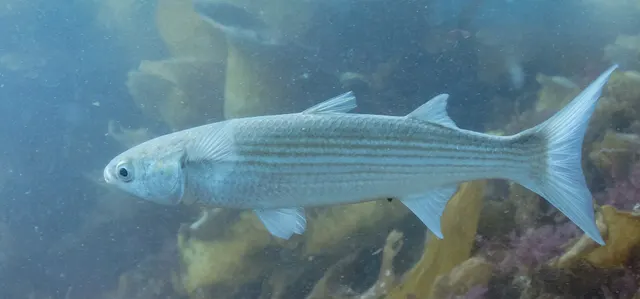 Flathead grey mulletThe mullet ingests sand and mud along with the organic film on it and grinds the mixture in a muscular gizzard-like stomach region, which is the anatomical signature of a detritivore rather than of a predator.
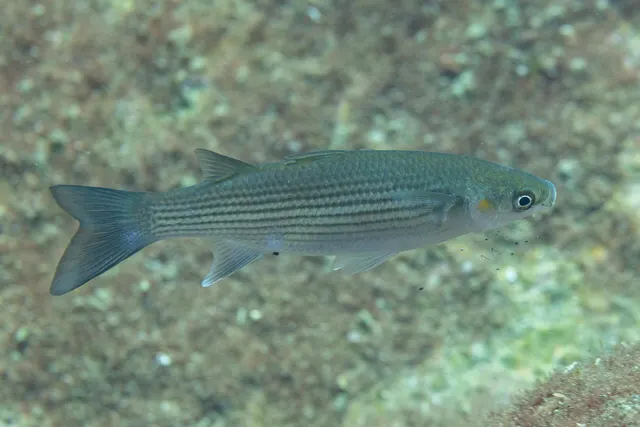 Thick-lipped grey mulletDetritus is taken with the algae as the fish processes sediment, which is why the two categories appear together on both grey mullet records.
- Thin-lipped grey mulletDetritus and the micro-invertebrates within it are processed through a muscular gizzard-like stomach — a diet described in the literature as a category rather than by species.
More explainers
Not related to this page — just the rest of the section. There is little else joined to this subject yet, and a short page should still lead somewhere.
Sources and evidence
- FishBase: a global information system on fishes — Froese, R. and D. Pauly, eds. — FishBase Consortium (Scientific institute)Relied on for: Recorded food items for the species this category is cited for, at the granularity the database records them.States this directlyPassage read and verified
- NOAA National Ocean Service education on estuaries and the National Estuarine Research Reserve System — National Oceanic and Atmospheric Administration, United States (Government fisheries body)Relied on for: The role of detritus and decomposition in estuarine productivity and food webs.States this directlyCitation checked — the work exists and is described correctly
Why the 3 connections on this page are here, and the sources
Fish this applies to
Backed by research — 3 connections
Supported by peer-reviewed research or fisheries science. The sources are listed and can be checked.
Flathead grey mullet
Recorded diet evidence identifies organic detritus and sediment organic matter as food for this species, at group level rather than as a named organism. The edge uses `consumes` rather than `preys_on` because nothing here is hunted, and it points at the category record so the granularity is visible.
- FishBase: a global information system on fishes — Froese, R. and D. Pauly, eds. — FishBase Consortium (Scientific institute)Relied on for: Food items recorded for this species, given as organic detritus and sediment organic matter.States this directlyPassage read and verified
- FAO Species Identification Guides for Fishery Purposes and the FAO Species Catalogues — Food and Agriculture Organization of the United Nations (Scientific institute)Relied on for: Species account describing this species' feeding, recorded as organic detritus and sediment organic matter.Background and mechanism onlyCitation checked — the work exists and is described correctly
Thick-lipped grey mullet
Recorded diet evidence identifies detritus and processed sediment as food for this species, at group level rather than as a named organism. The edge uses `consumes` rather than `preys_on` because nothing here is hunted, and it points at the category record so the granularity is visible.
- FishBase: a global information system on fishes — Froese, R. and D. Pauly, eds. — FishBase Consortium (Scientific institute)Relied on for: Food items recorded for this species, given as detritus and processed sediment.States this directlyPassage read and verified
- FAO Species Identification Guides for Fishery Purposes and the FAO Species Catalogues — Food and Agriculture Organization of the United Nations (Scientific institute)Relied on for: Species account describing this species' feeding, recorded as detritus and processed sediment.Background and mechanism onlyCitation checked — the work exists and is described correctly
Thin-lipped grey mullet
A diet claim recorded at group level, pointed at a modelled prey CATEGORY, because the reference works describe the diet as a group rather than by species. Naming a particular species FishingHQ happens to hold would invent a precision the evidence never had.
- The Fishes of the British Isles and North-West Europe — Macmillan, 1969 (Reference work)Relied on for: Distribution, habitat association, identification and biology of the fishes and inshore fauna of the British Isles and north-west Europe.States this directlyCitation checked — the work exists and is described correctly
- FAO Species Identification Guides for Fishery Purposes and the FAO Species Catalogues — Food and Agriculture Organization of the United Nations (Scientific institute)Relied on for: Diagnostic characters, family placement, habitat and depth range as set out in the FAO species identification sheets for the eastern Atlantic and Mediterranean.States this directlyCitation checked — the work exists and is described correctly
How FishingHQ labels evidence is explained in the evidence policy.