What does thick-lipped grey mullet eat?
What is established about how thick-lipped grey mullet feeds, kept separate from what anglers infer from it.
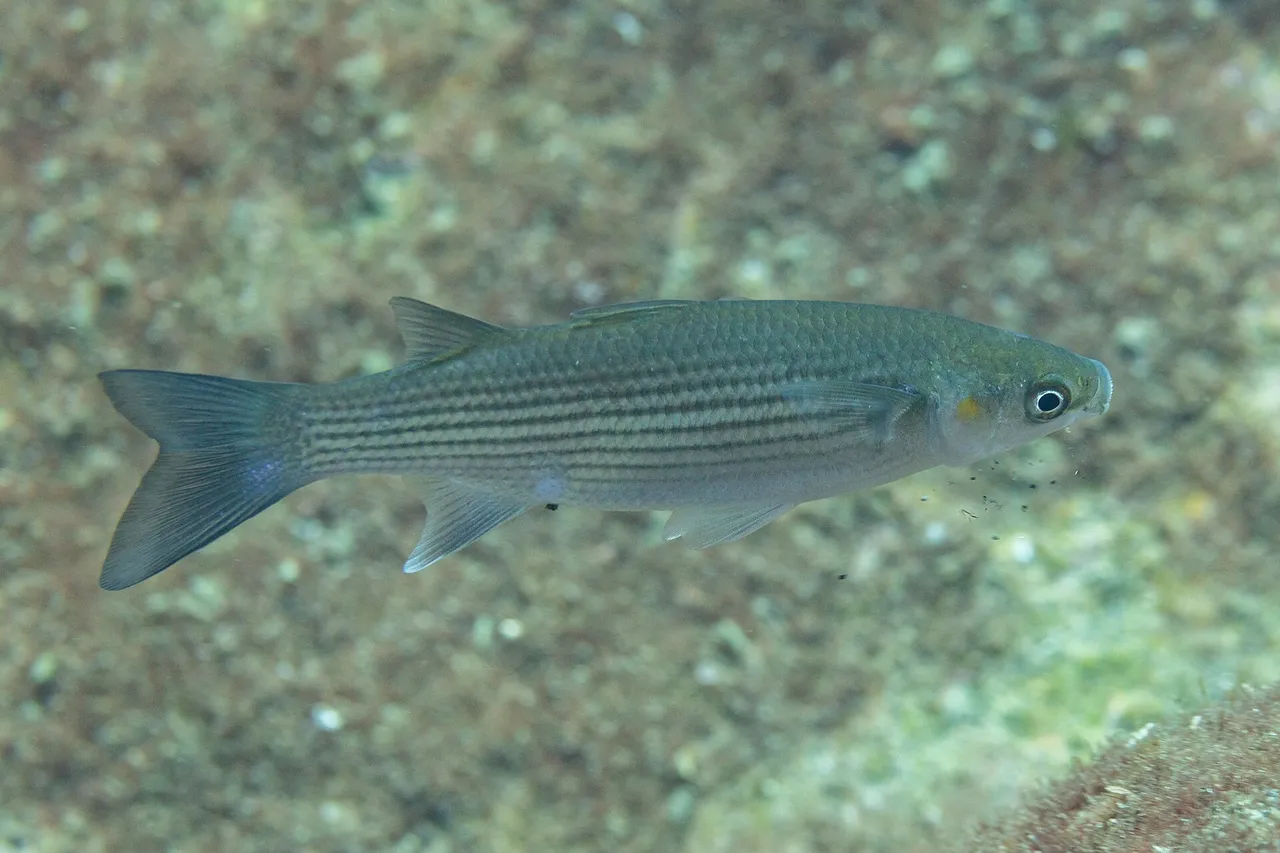
How this was identified, and who took it
Identified by: Full lateral view over sand. Longitudinal stripes following the scale rows, two well-separated dorsal fins and the thick upper lip at the snout are all visible.Diego Delso — CC BY-SA 4.0, via Wikimedia Commons — source, licenceWhat is known about how it feeds
This is a grazing animal, and the whole of its reputation among anglers follows from that one word.
Adults work surfaces: benthic diatoms, epiphytic algae growing on weed, rock and harbour walls, and the small invertebrates and detritus mixed into that film. The lips that give the species its name are thickened and are part of the apparatus for scraping it. Behind them, the gut is long and the stomach carries a muscular grinding region, which is what a diet of algae and sediment requires.
The two verified relationships are algae and biofilm first, detritus second — the reverse emphasis from the flathead grey mullet, which processes more sediment and grazes less surface. That is a real distinction between two species anglers frequently treat as interchangeable.
Both are `consumes` edges. The fish hunts nothing.
Juveniles feed on zooplankton before the adult apparatus is functional, which means a young mullet and an adult are doing entirely different things in the same water.
The practical consequence is the same as for its relative and worth stating twice because it is so consistently misunderstood: a fish grazing a film is not searching for an object, and its indifference to a well-presented offering is not caution. It is a description of what it eats.
The food
Prey with a verified dietary link to this fish. Each entry carries its own evidence, and each is written at the precision the source actually used: a named species where the source named one, a group or food category where it said “polychaetes”, “crustaceans” or “detritus” and meant it. That is why this list is shorter than the animal’s real diet rather than longer.
- Algae and biofilm as food — a group rather than a species: the evidence names the group
This is a grazing animal working algae off surfaces, and the long gut and grinding stomach region are what a diet of algae and sediment requires.
- Organic detritus as food — a group rather than a species: the evidence names the group
Detritus is taken with the algae as the fish processes sediment, which is why the two categories appear together on both grey mullet records.
Food with no page of its own here yet
These are real components of the diet, listed as plain text because FishingHQ has no page for them yet. Inventing pages to make the list look fuller would be the fabrication this whole approach exists to prevent.
- zooplankton, in juveniles
- small crustaceans taken with algae
- harbour-wall weed and its associated fauna
What anglers do with this
Everything below is interpretation, not finding. It is what experienced anglers conclude from the biology above, and the reasoning is usually sound and almost never tested. It is separated from the biology deliberately.
The grazing habit is why bread-based approaches dominate the fishery and why conventional baits fail, and the reasoning from diet to method is explicit rather than inherited.
The surface-grazing behaviour also explains the specific situations anglers seek out: mullet working weed-covered harbour walls, or feeding in the surface layer where an introduced material has been broken up and is drifting. Both put the fish into a mode where it is taking loose particles, which is the closest its feeding gets to what an angler can offer.
The species is capable of considerable speed and stamina for its size, so the difficulty of the fishery is at both ends: persuading a fish to take, and then holding it on the fine terminal tackle that persuading it usually requires.
All of this is practitioner convention. The biology above is what makes the convention make sense.
What this does not establish
Both relationships are food categories rather than organisms. Neither establishes proportion, and the split between grazed algae and processed detritus varies with location and season. The juvenile zooplankton diet is a separate phase. Diet studies of grey mullets frequently do not separate the species reliably, which limits how confidently the contrast drawn above can be stated.
Where this connects
These are the baits, lures, methods and explainers FishingHQ already joins to this fish — which is why the list is sometimes short. They are not chosen for this page, and a link here means an evidenced relationship exists, not that it follows from the diet.
Baits recorded for this species
Methods used for it
Where it lives
The science behind the feeding
This page covers feeding. The Thick-lipped grey mullet record covers identification, lifecycle, seasonal behaviour, handling and the sources behind all of it.
Reviewed 2026-08-12.