Maggots
Bait · Last reviewed 2026-08-10
The larvae of blowflies and houseflies, and the most widely used coarse fishing bait in Britain — small, mobile, and taken by almost everything.
- What it actually is
- Larvae of Calliphora and Lucilia species (blowflies) and Musca domestica (housefly), farmed commercially.
- How long it keeps
- Roughly five to seven days refrigerated at around 3–5°C; one to two days at room temperature before pupation begins. Once maggots turn, casters are usable for a further day or two before they float and become unusable as bottom bait.
A maggot is a fly larva, farmed commercially in enormous quantities for angling. Its virtues are simple: it is small enough for the smallest fish and acceptable to the largest, it moves, and it can be fed in quantity without filling fish up. Almost every British freshwater species will take one.
The angling vocabulary distinguishes several kinds, and the distinctions are practical rather than pedantic. The standard bait is the larva of the bluebottle. Pinkies are smaller, from the greenbottle, and squatts smaller again, from the housefly — both are used mainly as feed rather than as hookbait. A caster is the same larva after it has pupated: a hard, buoyant, dark-brown shell that behaves completely differently on the hook and is a distinct bait in its own right.
Maggots are a living animal with a short and temperature-dependent shelf life, and they are the bait that most rewards understanding storage.
What it is
A soft, cream-coloured, segmented larva roughly 10–14 mm long for the standard grade, tapering to a pointed head end with two dark feeding hooks, and blunt at the tail where two small dark breathing spiracles sit. The tail end is tough enough to hold a hook; the head end is not. Pinkies are around 6–8 mm and pinkish; squatts smaller and paler. A caster is the pupal stage: a hard, oval, chestnut-brown shell about 8 mm long that floats once it has darkened sufficiently.
Fish it catches
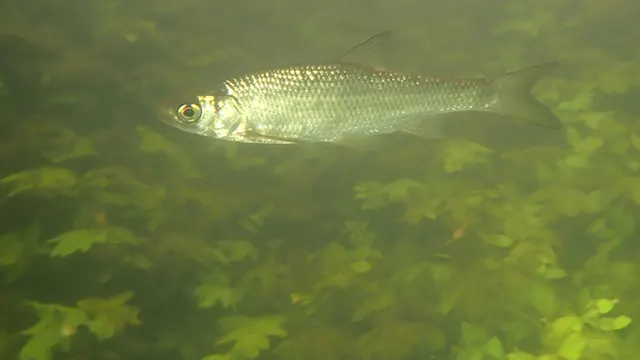 DaceThe standard dace bait, fished singly on a small hook. Dace take faster than any other British coarse fish, so a small hook and a light float are about hitting the bite rather than about hooking the fish.
- GudgeonSingle maggot on a small hook over disturbed gravel. Raking or stirring a gravel patch to release invertebrates is a traditional gudgeon technique and works for the reason the barbels exist.
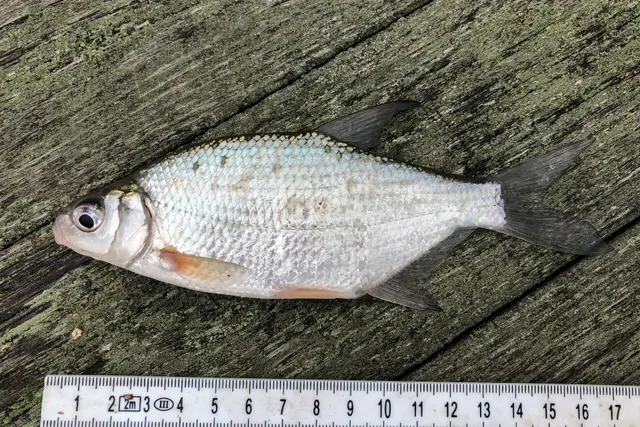 Silver breamMaggot and caster on float and feeder tackle over soft bottom.
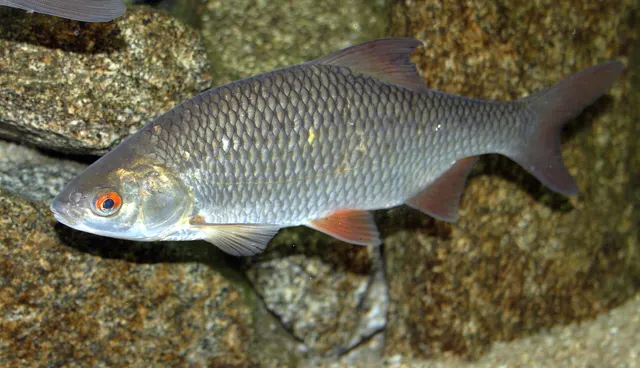 RoachThe most numerous and most frequently caught coarse fish across much of Europe, and the prey species that underpins the whole freshwater predator food web.
Finding and obtaining it
Maggots are farmed and bought, not collected — home production is unpleasant, unreliable and, where it involves keeping animal material for the purpose, subject to public health rules. They are sold by volume from tackle shops, usually riddled clean of the sawdust or maize meal they are transported in. Buy them fresh: a maggot's usable life is measured in days and the clock starts before you get them home.
Keeping and storing it
Cold, dry and ventilated. Maggots kept at a few degrees above freezing remain in usable condition for around a week and pupate very slowly; maggots kept warm will turn to casters within a day or two and then to flies. They must be able to breathe, so a sealed container is not an option — a lid with air holes, or a cloth, is essential. Keep them dry, because wet maggots suffocate and quickly turn into a sour mass. Refrigeration is the standard approach and is worth a dedicated container rather than the kitchen fridge, for reasons that will be immediately obvious.
Keeping it alive
Maggots do not need feeding for the period they are usually kept. What they need is to stay cold, dry and ventilated. Warmth accelerates development; damp suffocates them; a sealed container does both. Riddle them onto fresh dry bedding every couple of days if they are being kept for more than a few.
Preparing it
Riddle out the old bedding and add fresh maize meal or sawdust to keep them dry and clean. Sort out any that have already turned, which will otherwise accelerate the rest. Casters need floating off in water to separate the sinkers — which are hookbait grade — from the floaters, which have gone too far.
Using it
Hook a maggot once through the blunt tail end, through the tough skin beside the spiracles, so the body is free to move and the point stands clear. Hooking through the head kills it immediately and it stops moving, which discards most of the point. One maggot on a fine hook for shy fish; two or three on a larger hook for bigger fish. Casters are hooked by burying the hook inside the shell, which is soft enough to take it and rigid enough to hold.
Disposing of what is left
Do not tip unused maggots into the water at the end of a session. It is a substantial and unnecessary introduction of feed, it is prohibited at many fisheries, and where maggots are dumped repeatedly it changes how fish in that swim feed. Take them home, keep them for the next session, or dispose of them in domestic waste sealed so they cannot escape. Maggots released into the environment become flies.
Biosecurity
Maggots are farmed and pose little disease risk to fish. The real biosecurity issue is the WATER they travel in — bait tubs, riddles and buckets carry water and organic matter between fisheries, and that is a transfer route. Rinse and dry bait containers between waters like any other equipment.
Keeping maggots, and controlling what they turn into
Maggots are a stage rather than an animal, and storing them is really about controlling how fast they progress to the next one.
THE MECHANISM. A maggot is a fly larva feeding and growing towards pupation. Warmth accelerates it, cold slows it almost to a stop. At room temperature maggots will turn to casters within a few days; in a fridge at a few degrees they will hold for a fortnight or more with the process nearly suspended.
SO COLD IS THE WHOLE OF STORAGE. A fridge, a cool box with ice, or a cold shed. What is not acceptable is a warm car, which produces a bait tub of casters and a smell that ends domestic negotiations permanently.
MAGGOTS BREATHE and a sealed container suffocates them. Lids need holes, and a tub of maggots that has gone still and greasy has usually been sealed rather than starved.
SAWDUST OR MAIZE MEAL absorbs moisture and ammonia, and riddling the maggots out of dirty medium into fresh is what keeps them clean and lively. A maggot in wet, ammoniacal sawdust is a maggot losing condition.
THE FEED MATTERS AT THE END. Maggots that still hold food in the gut — the dark spot visible through the skin — are freshly delivered. Once that clears they are 'cleaned', which is what most anglers want for hooking, and from that point they are living on reserves and declining.
AND CASTERS ARE NOT A FAILURE. A maggot that has turned is a caster, which is a bait in its own right and in several situations a better one. Storing maggots badly does not waste them; it converts them, and knowing that turns an accident into a choice.
Bought rather than collected, and the three things worth checking before you pay
Maggots are the one bait on FishingHQ where the honest sourcing answer is that you should not obtain them yourself, and the reasons are practical, legal and unpleasant in roughly that order.
HOME PRODUCTION IS A BAD IDEA AND IT IS WORTH SAYING WHY. Producing maggots means keeping decomposing animal material for the purpose of breeding flies, which is unhygienic, difficult to control, produces an intense nuisance to anybody nearby, and where it is done at any scale falls under public-health and waste rules that vary by jurisdiction. Commercial maggot farming is a regulated industry precisely because of those problems. Nothing about the bait rewards doing it at home.
SO THE SOURCING QUESTION IS REALLY A BUYING QUESTION, and three things are worth checking. FRESHNESS FIRST: a maggot's usable life is measured in days and the clock started before you got there, so buying from a shop with turnover matters more than buying from the nearest one. Ask when they came in. SECOND, THE BEDDING: maggots should arrive riddled clean in dry maize meal or sawdust, not wet, not sour, and not in a bag of liquid. THIRD, THE GRADE: standard maggots, pinkies and squatts are different animals from different flies at different sizes, and buying a pint of the wrong one because the terminology was not clarified is a common and avoidable waste.
BUYING FOR THE SESSION RATHER THAN FOR THE MONTH is the practical rule, because the record's storage material explains that refrigeration slows the clock and does not stop it.
AND THE BIOSECURITY DIMENSION SITS ON THE CONTAINER, NOT THE BAIT. Farmed maggots pose little disease risk to fish. What moves between waters is the water, silt and organic matter in bait tubs, riddles and buckets, and rinsing and drying containers between fisheries is the control. Bait and its packaging are a recognised pathway for moving organisms between catchments.
FINALLY, WHAT IS PERMITTED VARIES AND IS NOT A DETAIL. Many fisheries restrict or prohibit particular baits, restrict quantities, or ban maggots outright at certain times; some jurisdictions restrict the transport of live bait between waters entirely. Those rules come from the fishery and the competent authority, and FishingHQ does not state what any of them are.
Official guidance — why, and the sources (2)
Stated by a fisheries authority, scientific institute or recognised angling body. Authoritative, but summarising rather than demonstrating.
- Coarse Fishing — A. & C. Black, 1912 (Specialist angling publication)Relied on for: Established coarse angling bait practice, obtaining, grading and care.States this directlyCitation checked — the work exists and is described correctly
- Check Clean Dry — biosecurity guidance for water users — GB Non-native Species Secretariat (Conservation authority)Relied on for: That traded bait, and the water and packaging it travels in, are a recognised transfer pathway between waters.States this directlyPassage read and verified
Check the rules before you fish
Fishing laws, bylaws, access rules, seasons, bait restrictions and permitted methods vary by location and can change. Check the current rules from the relevant authority and the water you intend to fish before fishing.
Check with:
- Current national or regional law for where you are fishing
- Current local bylaws
- The relevant fisheries authority
- The landowner, club or fishery whose water it is
- Any restrictions specific to the species or the method you intend to use
Where to go next
How it is fished
- Feeder fishingThe feeder carries the loose feed and the hook carries the same thing — that correspondence is the method.
- Float fishingThe bait a float is most often set to present.
- Pole fishingThe bait a pole rig's tiny shotting and fine hooks are scaled to.
- TrottingThe bait the running-water float was built for: loose-fed upstream and matched on the hook.
Understanding it
- Hook sizingFine-wire hooks in the smallest sizes exist because a maggot is a small, soft bait that a heavier hook sinks and distorts; the bait sets the hook size here, not the fish.
- What a bait imitates, and why that mattersThe maggot is the clearest case of the second mechanism: it imitates nothing in a British river and works because generations of fish have been taught that it is food.
Instead of this
- CastersThe same animal one stage later. Casters sink, do not wriggle, stay on a hook better and attract fewer small fish — which is a genuine set of trade-offs rather than an upgrade.
- Lobworms and wormsA larger, higher-protein alternative that selects for bigger fish and survives small ones for longer.
Sources and evidence
- Coarse Fishing — A. & C. Black, 1912 (Specialist angling publication)Relied on for: Established coarse angling practice for keeping, riddling and using maggots, and the relationship between temperature and the onset of pupation.States this directlyCitation checked — the work exists and is described correctly
- Check Clean Dry — biosecurity guidance for water users — GB Non-native Species Secretariat (Conservation authority)Relied on for: That traded bait, and the water it travels in, are a recognised transfer pathway between waters.FishingHQ's interpretation of what it saysPassage read and verified
Why the 12 connections on this page are here, and the sources
Fish it catches
What experienced anglers do — 4 connections
Widely and independently recommended by experienced anglers and specialist sources. This is real angling knowledge, not proof: controlled evidence for it is limited, and FishingHQ records it as convention rather than as a demonstrated effect.
Dace
A statement about bait convention for a species, which is practice rather than biology.
- Coarse Fishing — A. & C. Black, 1912 (Specialist angling publication)Relied on for: Established coarse angling practice, including method selection, presentation and the reasoning behind them.States this directlyCitation checked — the work exists and is described correctly
- Freshwater Fishing — Macdonald & Jane's, 1975 (Specialist angling publication)Relied on for: Freshwater angling technique and the principles behind method selection.States this directlyCitation checked — the work exists and is described correctly
- General angling website restatements of established technique — Various (Credible secondary source)Relied on for: Widely restated angling practice, recorded as consensus rather than as scholarship.Background and mechanism onlyCitation checked — the work exists and is described correctly
Gudgeon
A statement about bait convention for a species, which is practice rather than biology.
- Coarse Fishing — A. & C. Black, 1912 (Specialist angling publication)Relied on for: Established coarse angling practice, including method selection, presentation and the reasoning behind them.States this directlyCitation checked — the work exists and is described correctly
- Freshwater Fishing — Macdonald & Jane's, 1975 (Specialist angling publication)Relied on for: Freshwater angling technique and the principles behind method selection.States this directlyCitation checked — the work exists and is described correctly
- General angling website restatements of established technique — Various (Credible secondary source)Relied on for: Widely restated angling practice, recorded as consensus rather than as scholarship.Background and mechanism onlyCitation checked — the work exists and is described correctly
Silver bream
A practitioner claim about tackle commonly used for Blicca bjoerkna.
- General angling website restatements of established technique — Various (Credible secondary source)Relied on for: Widely restated practitioner accounts of this presentation for silver bream.Citation checked — the work exists and is described correctly
- Angling Times — Bauer Media (Specialist angling publication)Relied on for: Practitioner treatment of comparable presentations for the species group.Citation checked — the work exists and is described correctly
Roach
The standard general coarse bait, independently described.
- Coarse Fishing — A. & C. Black, 1912 (Specialist angling publication)Relied on for: Maggot and gentle baits for coarse fish.Citation checked — the work exists and is described correctly
- Angling Times — Bauer Media (Specialist angling publication)Relied on for: Contemporary maggot practice for silver fish.Citation checked — the work exists and is described correctly
How it is fished
What experienced anglers do — 4 connections
Widely and independently recommended by experienced anglers and specialist sources. This is real angling knowledge, not proof: controlled evidence for it is limited, and FishingHQ records it as convention rather than as a demonstrated effect.
Feeder fishing
A feeder deposits bait at the hook rather than near it, and the technique depends on the hook bait being indistinguishable from what the feeder released. Maggots are the bait that is both the feed and the hookbait without alteration.
- Coarse Fishing — A. & C. Black, 1912 (Specialist angling publication)Relied on for: Specialist treatment of which bait or lure family this technique is fished with.States this directlyCitation checked — the work exists and is described correctly
- Angling Times — Bauer Media (Specialist angling publication)Relied on for: The independently restated practitioner pairing of this technique with this family.Background and mechanism onlyCitation checked — the work exists and is described correctly
Float fishing
The float-fishing page describes controlling depth and presentation, and the maggot page describes the bait whose whole use is being presented at a controlled depth.
- Sea Angler — Bauer Media (Specialist angling publication)Relied on for: Practitioner treatment of which lure or bait family this technique is fished with.States this directlyCitation checked — the work exists and is described correctly
- General angling website restatements of established technique — Various (Credible secondary source)Relied on for: The widely restated practitioner pairing of this technique with this family.Background and mechanism onlyCitation checked — the work exists and is described correctly
Pole fishing
A pole rig is built around hook sizes and shot weights an order below rod-and-line coarse tackle. That scale is chosen for a bait of a maggot's size and weight, and is the reason pole fishing and maggots are taught together.
- Coarse Fishing — A. & C. Black, 1912 (Specialist angling publication)Relied on for: Specialist treatment of which bait or lure family this technique is fished with.States this directlyCitation checked — the work exists and is described correctly
- Angling Times — Bauer Media (Specialist angling publication)Relied on for: The independently restated practitioner pairing of this technique with this family.Background and mechanism onlyCitation checked — the work exists and is described correctly
Trotting
Trotting works by matching the hook bait to a stream of loose feed travelling at the same pace as the float. That requires a bait that can be introduced by the handful and is identical to the one on the hook, which is what maggots are for.
- Coarse Fishing — A. & C. Black, 1912 (Specialist angling publication)Relied on for: Specialist treatment of which bait or lure family this technique is fished with.States this directlyCitation checked — the work exists and is described correctly
- Angling Times — Bauer Media (Specialist angling publication)Relied on for: The independently restated practitioner pairing of this technique with this family.Background and mechanism onlyCitation checked — the work exists and is described correctly
Understanding it
What experienced anglers do — 2 connections
Widely and independently recommended by experienced anglers and specialist sources. This is real angling knowledge, not proof: controlled evidence for it is limited, and FishingHQ records it as convention rather than as a demonstrated effect.
Hook sizing
Sizing to the bait rather than to the fish is the standing convention in coarse fishing.
- IGFA International Angling Rules and World Record Requirements — International Game Fish Association (Angling or fisheries organisation)Relied on for: Tackle definitions and the dimensions by which tackle is specified.Background and mechanism onlyPassage read and verified
- Freshwater Fishing — Macdonald & Jane's, 1975 (Specialist angling publication)Relied on for: British freshwater practice on tackle selection and its reasoning.States this directlyCitation checked — the work exists and is described correctly
What a bait imitates, and why that matters
Why it works, resting on practice reported consistently across independent angling traditions rather than on experiment.
- Coarse Fishing — A. & C. Black, 1912 (Specialist angling publication)Relied on for: Classical coarse angling practice: baits, hooking, loose feed, presentation and swim selection.States this directlyCitation checked — the work exists and is described correctly
- Sea Angler — Bauer Media (Specialist angling publication)Relied on for: Contemporary UK sea angling practice as reported by practitioners, including bait preparation, hooking and presentation.States this directlyCitation checked — the work exists and is described correctly
Instead of this
What experienced anglers do — 2 connections
Widely and independently recommended by experienced anglers and specialist sources. This is real angling knowledge, not proof: controlled evidence for it is limited, and FishingHQ records it as convention rather than as a demonstrated effect.
Casters
A practitioner comparison between two forms of the same bait organism.
- Coarse Fishing — A. & C. Black, 1912 (Specialist angling publication)Relied on for: Early practitioner treatment of the relationship between maggots and casters.Citation checked — the work exists and is described correctly
- Angling Times — Bauer Media (Specialist angling publication)Relied on for: Contemporary practitioner treatment of when casters are preferred to maggots.Citation checked — the work exists and is described correctly
Lobworms and worms
The functional distinction is standard in coarse practice.
- Coarse Fishing — A. & C. Black, 1912 (Specialist angling publication)Relied on for: The comparative use of worm and maggot baits.Citation checked — the work exists and is described correctly
- Angling Times — Bauer Media (Specialist angling publication)Relied on for: Contemporary bait selection between worm and maggot.Citation checked — the work exists and is described correctly
How FishingHQ labels evidence is explained in the evidence policy.