Silver bream
Fish · Last reviewed 2026-08-10
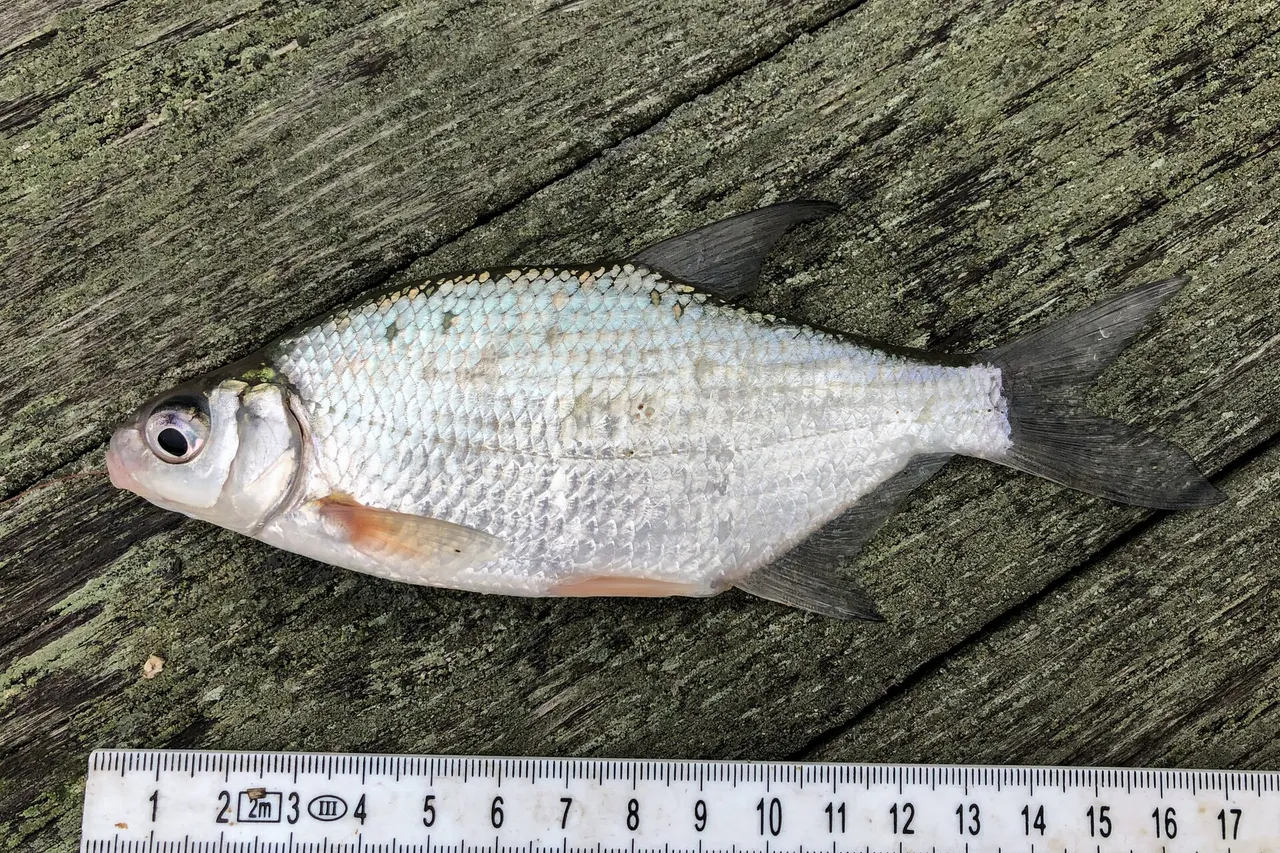
A small deep-bodied cyprinid separated from common bream by large eyes, orange-based paired fins and a shorter anal fin.
How this was identified, and who took it
Identified by: Identified on the two characters separating Blicca bjoerkna from a juvenile Abramis brama, both legible: the eye is proportionally very large relative to the head, and the base of the pectoral and pelvic fins carries a distinct orange-red wash where a common bream's are grey. Deep body, long anal fin and forked tail are consistent with both and do no diagnostic work. The rule in frame gives roughly 15 cm, which is supporting evidence in itself.mikaelnyman — CC BY 4.0, via Wikimedia Commons — source, licence
Catching Silver bream
Everything here on fishing for it. Each entry opens the page behind it.
Silver bream is the fish that makes bream identification harder than it looks. A small common bream and an adult silver bream overlap in size, share the deep compressed body, and are found in the same swims — and the two hybridise with each other and with roach.
The reliable characters are the eye and the fins. A silver bream's eye is large relative to its head, noticeably larger than a common bream's of the same length, and the paired fins carry an orange or reddish flush at the base where a common bream's are uniformly grey. The anal fin is also shorter, with fewer rays.
It is a smaller fish than common bream throughout, and a specimen silver bream is a fish of well under a kilogram.
How it is caught
- Feeder fishingFloat and feeder tackle with small baits, usually alongside common bream.
- Float fishingFloat and feeder tackle with small baits, usually alongside common bream.
- Pole fishingA small, shoaling, bottom-feeding fish taken over a bed of fine feed on light tackle — the conditions the pole was developed for.
Gear for this fish
Identification
- Scientific name
- Blicca bjoerkna
- Family
- Leuciscidae
- Water
- Freshwater
- Conservation status
- Least Concern
- Regions
- Britain & Ireland, Western Europe, Central & Eastern Europe, Northern Europe
- Large eye relative to head size — noticeably larger than a common bream of the same length.
- Orange or reddish flush at the base of the pectoral and pelvic fins, where common bream's are plain grey.
- Shorter anal fin with fewer rays than a common bream's long-based anal fin.
- Bright silver flank rather than the bronze of an adult common bream, with large scales.
Size
- Typical
- 100–350 g (3.5–12 oz)
- Large
- 500–800 g (1.1–1.8 lb)
Exceptional: FishBase records a maximum of 45.5 cm and 1 kg
Slow lowland water, and a shoaling fish of the middle depths
Silver bream occupy slow-moving and still lowland fresh water across Europe, in habitat that overlaps closely with common bream without being identical.
SLOW OR STILL, WARM, PRODUCTIVE WATER IS THE REQUIREMENT — lowland rivers, canals, oxbows, lakes and gravel pits with soft bottoms and reasonable weed growth.
THEY PREFER SLIGHTLY SHALLOWER, WEEDIER WATER than common bream in systems holding both, and they associate more closely with vegetation. Where the two co-occur, silver bream tend to the margins and the plant beds while common bream work the deeper soft bottom.
SOFT SUBSTRATE AND INVERTEBRATE PRODUCTION MATTER, because they feed on bottom invertebrates, zooplankton and plant material, sifting soft sediment.
THEY SHOAL, and shoals are size-sorted, occupying the middle and lower water column and moving between feeding areas.
THEY TOLERATE LOW OXYGEN AND WARM WATER reasonably well, which suits them to enriched lowland systems.
JUVENILES USE VEGETATED MARGINS AND BACKWATERS, and floodplain and marginal connectivity supports recruitment.
AND HYBRIDISATION IS A HABITAT-RELEVANT COMPLICATION. Silver bream hybridise with common bream and roach where they share water, and the hybrids are common enough that identification in mixed fisheries is a genuine difficulty — which matters when reading any account of where the species occurs.
Backed by research — why, and the sources (2)
Supported by peer-reviewed research or fisheries science. The sources are listed and can be checked.
- Freshwater Fishes of the British Isles — HarperCollins (New Naturalist 75), 1992 (Reference work)Relied on for: Distribution, habitat association, spawning requirements and ecology of European freshwater fishes.States this directlyCitation checked — the work exists and is described correctly
- FishBase: a global information system on fishes — Froese, R. and D. Pauly, eds. — FishBase Consortium (Scientific institute)Relied on for: Distribution, habitat association, depth range, size, reproduction and life-history parameters recorded for the species.States this directlyPassage read and verified
How big a silver bream gets, and why the size is the identification
Silver bream size is unusually load-bearing, because the species' whole identification problem is that it looks like a young common bream.
A TYPICAL SILVER BREAM IS 100 TO 300 GRAMS AND 15 TO 25 CENTIMETRES. Over 500 grams is a large one, and the species' reported maximum is around 35 centimetres.
COMMON BREAM REACH SEVERAL KILOGRAMS AND WELL OVER 50 CENTIMETRES. So a silver bream is, at full size, roughly the size of a common bream that is not yet an adult — and that overlap is exactly where the confusion lives.
WHICH IS WHY SIZE IS EVIDENCE AND NOT PROOF. A very large deep silver fish is a common bream. A small one is either. The characters that settle it are the eye — proportionally much larger in silver bream, roughly the diameter of the snout length — the reddish tint at the base of the pectoral and pelvic fins, and the pharyngeal tooth arrangement that only a specialist will check. Scale counts along the lateral line separate them reliably and are worth learning for anybody who fishes a water holding both.
GROWTH IS SLOW AND THE FISH IS SHORT-LIVED relative to common bream, maturing at three to four years.
AND THE THIRD COMPLICATION IS HYBRIDS. Silver bream hybridise with roach, rudd and common bream, and hybrid populations are widespread. In a water holding all four species, a proportion of the deep silver fish being caught cannot be named confidently by any field character, and a guide that offered a clean key would be offering false certainty. The honest position is that the species is distinguishable, that it is distinguished by a combination rather than a single mark, and that some individual fish are genuinely not identifiable on the bank.
Backed by research — why, and the sources (2)
Supported by peer-reviewed research or fisheries science. The sources are listed and can be checked.
- Freshwater Fishes of the British Isles — HarperCollins (New Naturalist 75), 1992 (Reference work)Relied on for: Distribution, habitat association, life history, growth and conservation position of the freshwater fishes of the British Isles.States this directlyCitation checked — the work exists and is described correctly
- FishBase: a global information system on fishes — Froese, R. and D. Pauly, eds. — FishBase Consortium (Scientific institute)Relied on for: Distribution, habitat association, depth range, growth, maximum size and reproductive parameters recorded for the species.States this directlyPassage read and verified
The silver bream year
Silver bream run to a calendar close to the common bream's, and the small differences are worth knowing because they affect what is caught when.
SPAWNING IS IN LATE SPRING AND EARLY SUMMER, in shallow warm water over dense vegetation, with adhesive eggs attached to plants. Spawning is often noisy and visible, with fish rolling and splashing in the margins over several days.
THE OVERLAP WITH ROACH, RUDD AND COMMON BREAM SPAWNING IS WHY HYBRIDS ARE SO COMMON. Where several species use the same weed beds at the same water temperature, eggs and milt mix, and the resulting fish are intermediate. A water with a warm, weedy, shallow spawning area holding all four species will produce hybrids reliably.
THROUGH SUMMER THEY SHOAL AND FEED IN OPEN WATER over soft bottom, and are caught in numbers by anglers fishing for roach and bream over groundbait.
AUTUMN IS OFTEN THE BEST PERIOD, as the fish feed hard in cooling water and shoals become more predictable in their movements.
WINTER SLOWS THEM SUBSTANTIALLY. Silver bream are less reliable in cold water than roach, and shoals become both harder to locate and less willing. This is a smaller and more delicate fish than common bream, and it shows in how it responds to cold.
THE PRACTICAL CONSEQUENCE IS THAT SILVER BREAM ARE MOSTLY A SUMMER AND AUTUMN CATCH, and that a fish taken in midwinter from a water holding both bream species is somewhat more likely to be a common bream than the summer ratio would suggest.
Backed by research — why, and the sources (3)
Supported by peer-reviewed research or fisheries science. The sources are listed and can be checked.
- Freshwater Fishes of the British Isles — HarperCollins (New Naturalist 75), 1992 (Reference work)Relied on for: Distribution, habitat association, life history, growth and conservation position of the freshwater fishes of the British Isles.States this directlyCitation checked — the work exists and is described correctly
- FishBase: a global information system on fishes — Froese, R. and D. Pauly, eds. — FishBase Consortium (Scientific institute)Relied on for: Distribution, habitat association, depth range, growth, maximum size and reproductive parameters recorded for the species.States this directlyPassage read and verified
- Coarse Fishing — A. & C. Black, 1912 (Specialist angling publication)Relied on for: Established coarse angling practice, including method, bait, presentation and the reasoning behind them.States this directlyCitation checked — the work exists and is described correctly
Fine tackle on the bottom, and a fish most anglers catch without knowing
Silver bream methods are essentially roach methods applied slightly deeper, and the more useful part of the answer is how to know you have caught one.
THE FISH IS SMALL AND THE MOUTH IS SMALL, so the approach is fine float fishing or light feeder fishing with small hooks and small baits on or near the bottom. Maggot, caster, worm and small pieces of bread all work, and nothing about the species requires anything specialised.
SHOALS ARE THE UNIT AND THEY HAVE TO BE HELD. Silver bream shoal, and a swim fed regularly with small quantities of bait keeps a shoal in place and feeding — the same little-and-often principle that governs roach fishing, for the same reason.
THEY FEED HARD IN WARM WATER and are most reliably caught in the warmer months in the still and slow lowland waters the record's habitat material describes. In cold water they become far less active than roach do, which is a genuine practical difference.
THE IDENTIFICATION IS THE REAL SUBJECT, because a great many silver bream are recorded as small common bream or as roach × bream hybrids. The eye is large relative to the head and larger than a common bream's; the fish is silver rather than bronze at every size; and the anal fin ray count and pharyngeal tooth arrangement settle it where the appearance does not. Anglers who catch a lot of small 'skimmers' have almost certainly caught this species without recording it.
WHICH MATTERS BEYOND PEDANTRY. Silver bream are localised and in some regions uncommon, and under-recording a species because it resembles a commoner one is how a distribution map ends up wrong. Where a specimen claim is made, it should rest on the characters rather than on the weight.
AND THE FISH IS DELICATE. Small, soft-scaled and easily damaged by dry hands and hard surfaces, which is why wet hands and a quick return matter more than the modest size suggests. Keepnet rules and close seasons on any water are set by the fishery and the competent authority.
What experienced anglers do — why, and the sources (2)
Widely and independently recommended by experienced anglers and specialist sources. This is real angling knowledge, not proof: controlled evidence for it is limited, and FishingHQ records it as convention rather than as a demonstrated effect.
- Coarse Fishing — A. & C. Black, 1912 (Specialist angling publication)Relied on for: Established coarse angling practice, including method, presentation and the reasoning behind them.States this directlyCitation checked — the work exists and is described correctly
- Freshwater Fishing — Macdonald & Jane's, 1975 (Specialist angling publication)Relied on for: Freshwater angling technique and the principles behind method selection.States this directlyCitation checked — the work exists and is described correctly
Lifecycle and reproduction
Short-lived and small relative to its close relatives, maturing early. Hybridises readily with common bream and roach, and mixed populations contain intermediate fish that defeat identification by any single character.
Spawns in late spring and early summer over weed in shallow water, in batches, scattering adhesive eggs with no parental care.
Feeding and senses
A bottom feeder taking insect larvae, small molluscs and crustaceans from soft substrate, along with plant material. Feeds by sifting rather than by hunting.
Works soft bottom in low light using touch and taste more than sight, which is why it is caught most reliably at dawn, dusk and after dark.
Through the year
Shoals through the warmer months and feeds in short intense bursts; activity falls considerably in cold water, though winter catches occur in deeper still waters.
Distribution
Europe and Asia: North, Baltic, White, Black (south to Rioni drainage) and Caspian Sea basins, Atlantic basin southward to Adour drainage (France; possibly introduced southward of Loire) and Mediterranean basin in France (Hérault and Rhône drainages). In Aral, Marmara and Anatolian Black Sea basins west of Ankara. Naturally absent from Iberian Peninsula, Italy, Adriatic basin, Crimea, Great Britain (except southeast), Scandinavia north of Sundsvall (Sweden) and 65° N (Finland). Locally introduced in Spain and northeastern Italy; in France, apparently introduced in smal coastal drainages of Var
This is a biological range — where the species occurs, not a prediction that you will catch one. To browse the fishing geography FishingHQ holds, start at fishing places.
Why anglers care
A common coarse-fishing catch in still waters and slow rivers, taken on maggot, worm, caster and groundbait on float and feeder tackle. Its significance is largely as a species anglers need to be able to name: match anglers and specimen anglers both need to distinguish it from small common bream, and it is a frequent source of misidentified catch returns.
Handling and returning
A small, soft-scaled and easily damaged fish. Wet hands, unhook over a mat, keep out of dry grass, and return quickly. Handle with the same care as roach rather than the more robust larger bream.
Going further
- Silver bream vs Common bream — how to tell them apart.
Where to go next
Where it lives
Understanding this fish
Told apart from
Sources and evidence
- FishBase: a global information system on fishes — Froese, R. and D. Pauly, eds. — FishBase Consortium (Scientific institute)Relied on for: Family, maximum size, depth and environment, distribution and the IUCN assessment for Blicca bjoerkna.States this directlyPassage read and verified
- The IUCN Red List of Threatened Species — International Union for Conservation of Nature (Conservation authority)Relied on for: The Least Concern assessment for Blicca bjoerkna, assessed 27 May 2022.States this directlyCitation checked — the work exists and is described correctly
Why the 8 connections on this page are here, and the sources
How it is caught
What experienced anglers do — 3 connections
Widely and independently recommended by experienced anglers and specialist sources. This is real angling knowledge, not proof: controlled evidence for it is limited, and FishingHQ records it as convention rather than as a demonstrated effect.
Feeder fishing
A practitioner claim about how Blicca bjoerkna is commonly fished, following from where and how it feeds.
- General angling website restatements of established technique — Various (Credible secondary source)Relied on for: Widely restated practitioner accounts of fishing for silver bream.Citation checked — the work exists and is described correctly
- Sea Angler — Bauer Media (Specialist angling publication)Relied on for: Practitioner treatment of the methods used for silver bream and comparable species.Citation checked — the work exists and is described correctly
Float fishing
A practitioner claim about how Blicca bjoerkna is commonly fished, following from where and how it feeds.
- General angling website restatements of established technique — Various (Credible secondary source)Relied on for: Widely restated practitioner accounts of fishing for silver bream.Citation checked — the work exists and is described correctly
- Sea Angler — Bauer Media (Specialist angling publication)Relied on for: Practitioner treatment of the methods used for silver bream and comparable species.Citation checked — the work exists and is described correctly
Pole fishing
Established angling practice for this species, recorded as convention. The note states the property of the animal or its water that makes the method the answer.
- Coarse Fishing — A. & C. Black, 1912 (Specialist angling publication)Relied on for: Established coarse-angling technique and its application to the species.States this directlyCitation checked — the work exists and is described correctly
- Angling Times — Bauer Media (Specialist angling publication)Relied on for: Contemporary British coarse practice for this species.Background and mechanism onlyCitation checked — the work exists and is described correctly
Gear for this fish
What experienced anglers do — 1 connection
Widely and independently recommended by experienced anglers and specialist sources. This is real angling knowledge, not proof: controlled evidence for it is limited, and FishingHQ records it as convention rather than as a demonstrated effect.
Maggots
A practitioner claim about tackle commonly used for Blicca bjoerkna.
- General angling website restatements of established technique — Various (Credible secondary source)Relied on for: Widely restated practitioner accounts of this presentation for silver bream.Citation checked — the work exists and is described correctly
- Angling Times — Bauer Media (Specialist angling publication)Relied on for: Practitioner treatment of comparable presentations for the species group.Citation checked — the work exists and is described correctly
Where it lives
Backed by research — 2 connections
Supported by peer-reviewed research or fisheries science. The sources are listed and can be checked.
Lowland rivers
A habitat association for Blicca bjoerkna taken from the environment and distribution data on its FishBase summary.
- FishBase: a global information system on fishes — Froese, R. and D. Pauly, eds. — FishBase Consortium (Scientific institute)Relied on for: The environment, depth range and habitat description recorded for Blicca bjoerkna.States this directlyPassage read and verified
Lowland stillwaters
A habitat association for Blicca bjoerkna taken from the environment and distribution data on its FishBase summary.
- FishBase: a global information system on fishes — Froese, R. and D. Pauly, eds. — FishBase Consortium (Scientific institute)Relied on for: The environment, depth range and habitat description recorded for Blicca bjoerkna.States this directlyPassage read and verified
Understanding this fish
Backed by research — 1 connection
Supported by peer-reviewed research or fisheries science. The sources are listed and can be checked.
Feeding windows
A link from a species to the mechanism that explains how it lives, written only where the species is a worked example of that mechanism rather than merely subject to it.
- Freshwater Fishes of the British Isles — HarperCollins (New Naturalist 75), 1992 (Reference work)Relied on for: Life history, habitat requirement, physiological tolerance and seasonal behaviour of European freshwater fishes.States this directlyCitation checked — the work exists and is described correctly
- FishBase: a global information system on fishes — Froese, R. and D. Pauly, eds. — FishBase Consortium (Scientific institute)Relied on for: Recorded environment, depth range, temperature and oxygen tolerance, feeding biology and distribution of the species named.States this directlyPassage read and verified
Told apart from
Backed by research — 1 connection
Supported by peer-reviewed research or fisheries science. The sources are listed and can be checked.
Common bream
An identification comparison naming both binomials: Blicca bjoerkna and Abramis brama.
- FishBase: a global information system on fishes — Froese, R. and D. Pauly, eds. — FishBase Consortium (Scientific institute)Relied on for: Morphological and distributional data for Blicca bjoerkna and for Abramis brama.States this directlyPassage read and verified
- The IUCN Red List of Threatened Species — International Union for Conservation of Nature (Conservation authority)Relied on for: Separate assessments treating Blicca bjoerkna and Abramis brama as distinct species.States this directlyCitation checked — the work exists and is described correctly
An identification link between two species readers genuinely mistake for one another, resting on published identification keys rather than on angling lore. It names the character that separates them, which is what makes it useful rather than merely adjacent.
- Freshwater Fishes of the British Isles — HarperCollins (New Naturalist 75), 1992 (Reference work)Relied on for: Identification, distinguishing features and confusable species among the freshwater fishes of the British Isles, together with their distribution and habitat.States this directlyCitation checked — the work exists and is described correctly
- The Fishes of the British Isles and North-West Europe — Macmillan, 1969 (Reference work)Relied on for: Morphological identification features and identification keys for the fishes of the British Isles and north-west Europe, including the characters separating confusable species.States this directlyCitation checked — the work exists and is described correctly
How FishingHQ labels evidence is explained in the evidence policy.