How to identify silver bream
Blicca bjoerkna · Leuciscidae
The characters that identify silver bream, ranked by how far each one can be trusted on its own.
How this was identified, and who took it
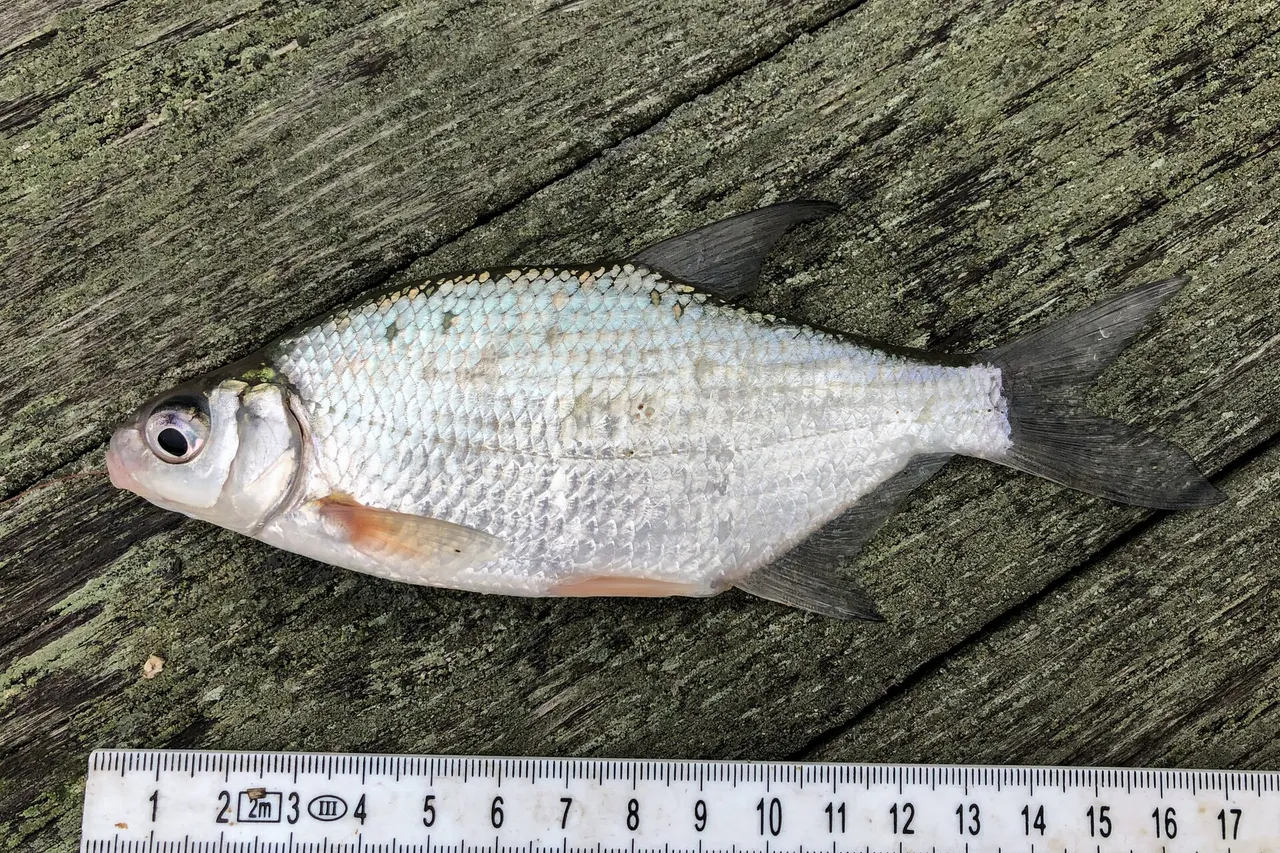
Identified by: Identified on the two characters separating Blicca bjoerkna from a juvenile Abramis brama, both legible: the eye is proportionally very large relative to the head, and the base of the pectoral and pelvic fins carries a distinct orange-red wash where a common bream's are grey. Deep body, long anal fin and forked tail are consistent with both and do no diagnostic work. The rule in frame gives roughly 15 cm, which is supporting evidence in itself.mikaelnyman — CC BY 4.0, via Wikimedia Commons — source, licenceLook at this first
Look at the eye against the snout. In a silver bream the eye is very large — roughly as wide as the snout is long — where in a common bream of the same size the eye is proportionally much smaller. Then check the base of the pectoral and pelvic fins for a reddish flush.
Diagnostic — settles it on its own
Each of these settles the identification on its own. If one is clear, you have your answer.
A proportionally very large eye
The eye diameter is close to the length of the snout in front of it. In a common bream — including a young one of exactly this size, which is the confusion — the eye is distinctly smaller relative to the head. It is the most reliable single character available without counting anything.
Supporting — use with other characters
Real characters that are not conclusive by themselves. Use two or three together.
A reddish or orange flush at the base of the paired fins
The pectoral and pelvic fins carry an orange-red tint at their base, strongest in fish in good condition. A common bream's paired fins are grey throughout. It is real, it is useful and it fades on a dead or stressed fish, which is why it sits second rather than first.
Large, clearly-defined scales
Silver bream have noticeably larger scales than common bream, and the lateral-line scale count is lower — the count settles disputed fish and is worth learning for anybody fishing a water with both. Bringing a fish to a count is a specialist step and the page does not pretend otherwise.
Suggestive only — varies with condition
Hints only. These vary with condition, season, water and how long the fish has been out of it, and a fish that contradicts them is still the same species.
A bright silver flank without the bronze of an adult bream
Silver bream stay bright silver throughout life. Common bream darken to a deep bronze as they mature — but a young common bream is silver too, which is exactly why the confusion exists. Useful only for excluding a large bronze fish, and worthless for the small silver ones.
What it gets confused with
- Young common bream, which is the whole problem. Read the eye against the snout, then the base of the paired fins.
- Roach × bream hybrids, which are intermediate in every character used here and are common in waters holding both.
- Large roach, which is rounder in section with a red iris and a much shorter anal fin.
Side by side: Silver bream vs Common bream.
Where this stops working
Silver bream hybridise with roach, rudd and common bream, and hybrid populations are widespread in waters holding several of them. A proportion of the deep silver fish caught in such a water genuinely cannot be named by any field character, and this page will not name them. Where a fish matters — a record claim, a survey — the lateral-line scale count and the pharyngeal tooth arrangement are what settle it, and both require the fish in hand and someone who has done it before.
The full record
This page covers identification only. The Silver bream record covers behaviour, lifecycle, distribution, handling and the sources behind all of it.
Reviewed 2026-08-15.
More about this fish
Telling it apart is one question. Here are the others.
How it is caught
- Feeder fishingFloat and feeder tackle with small baits, usually alongside common bream.
- Float fishingFloat and feeder tackle with small baits, usually alongside common bream.
- Pole fishingA small, shoaling, bottom-feeding fish taken over a bed of fine feed on light tackle — the conditions the pole was developed for.
Where it lives
Why the 5 connections on this page are here, and the sources
How it is caught
What experienced anglers do — 3 connections
Widely and independently recommended by experienced anglers and specialist sources. This is real angling knowledge, not proof: controlled evidence for it is limited, and FishingHQ records it as convention rather than as a demonstrated effect.
Feeder fishing
A practitioner claim about how Blicca bjoerkna is commonly fished, following from where and how it feeds.
- General angling website restatements of established technique — Various (Credible secondary source)Relied on for: Widely restated practitioner accounts of fishing for silver bream.Citation checked — the work exists and is described correctly
- Sea Angler — Bauer Media (Specialist angling publication)Relied on for: Practitioner treatment of the methods used for silver bream and comparable species.Citation checked — the work exists and is described correctly
Float fishing
A practitioner claim about how Blicca bjoerkna is commonly fished, following from where and how it feeds.
- General angling website restatements of established technique — Various (Credible secondary source)Relied on for: Widely restated practitioner accounts of fishing for silver bream.Citation checked — the work exists and is described correctly
- Sea Angler — Bauer Media (Specialist angling publication)Relied on for: Practitioner treatment of the methods used for silver bream and comparable species.Citation checked — the work exists and is described correctly
Pole fishing
Established angling practice for this species, recorded as convention. The note states the property of the animal or its water that makes the method the answer.
- Coarse Fishing — A. & C. Black, 1912 (Specialist angling publication)Relied on for: Established coarse-angling technique and its application to the species.States this directlyCitation checked — the work exists and is described correctly
- Angling Times — Bauer Media (Specialist angling publication)Relied on for: Contemporary British coarse practice for this species.Background and mechanism onlyCitation checked — the work exists and is described correctly
Where it lives
Backed by research — 2 connections
Supported by peer-reviewed research or fisheries science. The sources are listed and can be checked.
Lowland rivers
A habitat association for Blicca bjoerkna taken from the environment and distribution data on its FishBase summary.
- FishBase: a global information system on fishes — Froese, R. and D. Pauly, eds. — FishBase Consortium (Scientific institute)Relied on for: The environment, depth range and habitat description recorded for Blicca bjoerkna.States this directlyPassage read and verified
Lowland stillwaters
A habitat association for Blicca bjoerkna taken from the environment and distribution data on its FishBase summary.
- FishBase: a global information system on fishes — Froese, R. and D. Pauly, eds. — FishBase Consortium (Scientific institute)Relied on for: The environment, depth range and habitat description recorded for Blicca bjoerkna.States this directlyPassage read and verified