Trotting
Method · Last reviewed 2026-08-18
Running a float downstream at the speed of the current, with the line controlled by hand and the bait travelling as a loose item of food would — the oldest way of fishing a river and still the most effective in many of them.
Trotting is float fishing in moving water, and it is a different technique from stillwater float fishing in almost every respect except that both use a float.
WHAT IT IS. A float is set to fish the bait at a chosen depth and allowed to travel downstream with the current, while the angler pays out line, controls the speed and holds the terminal tackle in a straight line below the rod. The bait travels as a piece of loose food travels, which is what a fish holding station in current is expecting to see.
THE CONTROL IS THE WHOLE SKILL. Line between rod tip and float is the thing being managed: too much and the current pulls the float off line and drags the bait unnaturally; too little and the float is checked and the bait swings up in the water. Mending, feathering, holding back and letting the float run are all names for adjustments to that one problem.
HOLDING BACK IS THE TECHNIQUE MOST WORTH LEARNING. Slowing the float slightly against the current makes the bait swing UP and forward ahead of the float, which is frequently the moment a fish takes. Doing it deliberately at the point where fish are holding converts a drift into a presentation.
FEEDING IS PART OF THE METHOD RATHER THAN PREPARATION FOR IT. Loose feed introduced regularly at the head of the swim travels down with the current and establishes a line of food that fish move up into; the float is run through that line. Trotting without feeding is fishing a river with one bait in it.
WHY THE REEL MATTERS MORE HERE THAN ANYWHERE. A trotted float needs line to leave the reel freely, at the speed of the current, against almost no resistance — which is exactly what a centrepin does and what a fixed spool with a closed bail does not. That is why the discipline kept a reel design the rest of fishing abandoned, and why a fixed spool trotting rig is fished with the bail open and the line controlled by a finger.
WHERE IT WORKS. Rivers with steady, even, moderate flow and a reasonably uniform bed — the classic British trotting swim is a smooth glide of a metre or two deep. It struggles in slack water, in very fast broken water and where the bed is so uneven that a set depth is wrong every few metres.
AND WHAT IT CATCHES. Roach, dace, chub, grayling, barbel, trout and perch, most of them at ranges a modern angler would consider short — a great deal of trotting happens within twenty metres, which makes it a method for reading water rather than for casting it.
What it is
Float fishing in moving water, in which the float is allowed to travel downstream with the current while the angler controls the line between rod tip and float. The bait travels at the speed of the water, which is how a loose item of food travels and therefore what a fish holding station in a current is expecting to see. It is the oldest way of fishing a river and remains the most effective in a great many of them.
What it is for
It solves the problem of presenting a bait naturally in moving water at a range where casting is irrelevant and control is everything. A ledgered bait in current is static and a lure is travelling under power; a trotted float is the only common method in which the bait moves exactly as the water moves. Combined with loose feed introduced at the head of a swim, it also lets an angler establish a line of food and fish through it, which draws fish up rather than searching for them.
Setting it up
- Set the depth to fish just off the bottom, and expect to change it down the swim, because a river bed is not level.
- Shot the float so that only the tip shows, which is what makes a take visible and what stops a fish feeling resistance.
- Keep the line between rod tip and float short and off the water, which is why a long rod and a high rod position are conventional.
- Feed at the head of the swim at a steady rate so that the float runs through moving food rather than through empty water.
- Use a reel that gives line freely at the speed of the current — a centrepin, or a fixed spool with the bail open and the line controlled by a finger.
What it catches
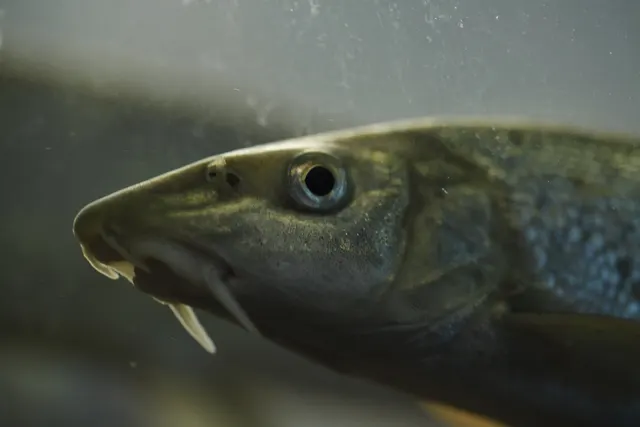 BarbelTaken on a trotted bait in steadier water as well as on a static ledger, and the fish that most tests a centrepin's palmed drag in current.
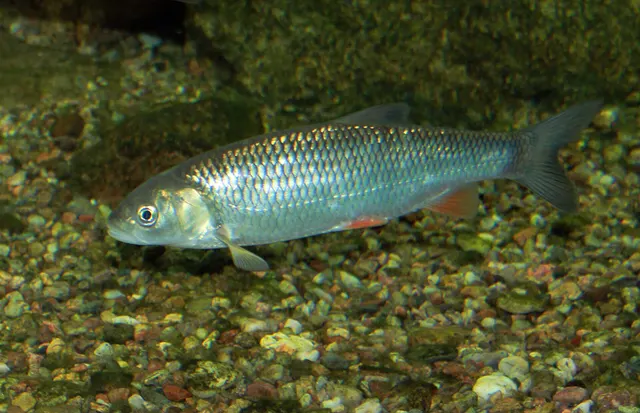 ChubHolds in and beside the current under structure and takes a trotted bait confidently, which makes it the species a beginner most often catches first on a river.
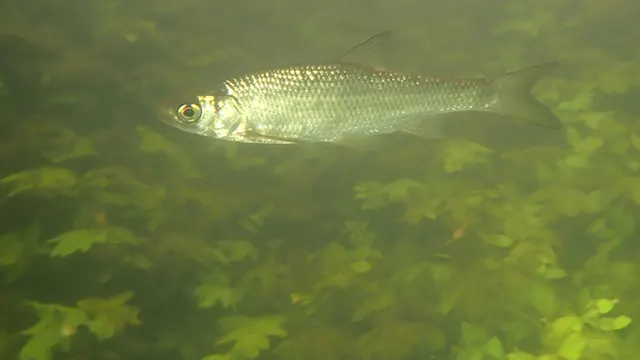 DaceA fish of fast, clean, shallow water and quick takes, which is what makes it the species most anglers learn line control on.
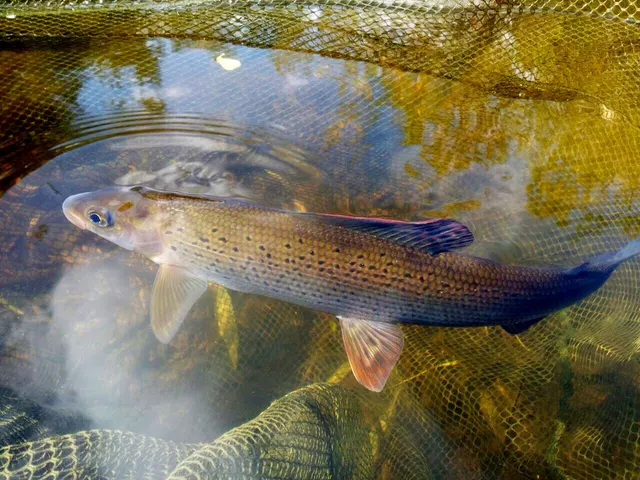 GraylingA winter fish of steady clean glides that responds to a bait travelling at the speed of the water, and the reason a great deal of trotting happens in the cold half of the year.
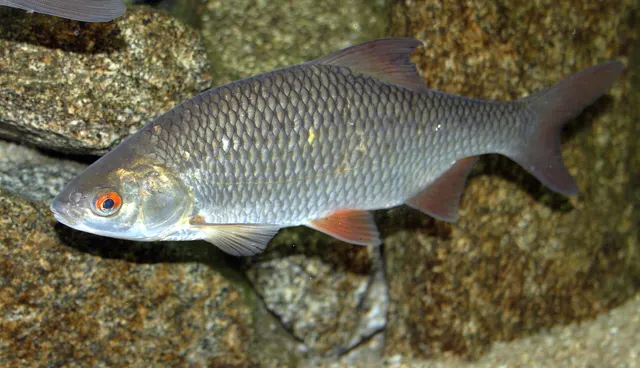 RoachThe classic catch of a British trotting swim, holding in a defined line in steady flow and fed up the swim rather than searched for.
What you fish it with
- CastersThe bait that sinks at the speed of the feed, which is what a long trot is trying to imitate.
- Centrepin reelsThe method and the reel exist for each other: a free-running drum gives line at the speed of the current, which is the whole requirement, and a fixed spool cannot do it without the angler feeding line by hand.
- FloatsA float attached top and bottom, shotted so that only the tip shows, is what makes the presentation controllable and the take visible in moving water.
- Luncheon meatThe chub and barbel bait rolled down a swim on a trotted rig.
- MaggotsThe bait the running-water float was built for: loose-fed upstream and matched on the hook.
- Stick float rigTrotting is the method and the stick float is the arrangement that makes it possible: a bait travelling downstream at a speed the angler sets, rather than at the speed of the water.
How it works
The float is set so that the bait fishes at a chosen depth, usually just off the bottom, and released to run. Line is paid out as it goes, and the whole skill is in what happens to that line: too much on the water and the current bellies it, dragging the float off its line and the bait unnaturally; too little and the float is checked so hard that the bait swings up and the presentation dies. Holding back slightly against the current lifts the bait forward and upward ahead of the float, which is frequently the moment a fish takes, and doing it deliberately where fish are holding converts a drift into a presentation.
Conditions
At its best on a smooth glide of a metre or two deep with steady moderate flow and a reasonably uniform bed, at ranges typically inside twenty metres. Rising or coloured water shortens the effective range and pushes fish to the margins; very low clear water makes fish wary enough that the line on the surface becomes the limiting factor. Wind across the river is worse than wind along it, because it bellies the line sideways off the feed line.
Common mistakes
- Fishing with too much line on the water, so the current bellies it and drags the float off the feed line and the bait unnaturally.
- Not feeding, or feeding in one lump. The method depends on a steady line of loose food travelling with the float, and a single handful either scatters fish or fills them.
- Setting the depth once and never changing it. River beds are uneven and the productive depth changes down a swim.
- Striking at the float dipping rather than at it going under and staying under, which in fast water is usually the bait touching bottom.
- Trotting a swim from the top and walking down it, which pushes fish ahead. The convention is to feed the head and fish the run below it.
Advantages
- The most natural presentation available in moving water, because the bait travels at the speed of the food a fish is already eating.
- Covers a long stretch of river from one standing position, which finds fish rather than waiting for them.
- Works at short range with light tackle, which suits a great many British and European rivers better than any distance method.
- The angler is in continuous contact and continuously adjusting, so a take is registered immediately.
Limitations
- Needs steady, even, moderate flow. Slack water, very fast broken water and a highly uneven bed all defeat it.
- Requires continuous attention and continuous feeding, so it is not a method that can be left.
- Range is limited by line control rather than by casting, so it is a short-range method whatever tackle is used.
- Wind on the line ruins the presentation more completely than it ruins most methods.
Terms you will meet
- Holding back
- Slowing the float slightly against the current so that the bait swings up and forward ahead of it. Frequently the moment a fish takes, and the single technique most worth learning in the method.
- Trotting down
- Letting the float run further and further down the swim on successive casts, covering new water each time rather than fishing the same few metres repeatedly.
- Stick float
- A float attached at top and bottom, designed for controlled work in moving water at close range. The float most associated with the method and the one that responds best to being held back.
Where to go next
Related techniques
Skills behind it
- Getting bait where you want itFeeding is part of the method rather than preparation for it: loose feed at the head of the swim travels down with the current and establishes the line the float is run through.
- Reading a river for fishA trotted float covers a swim from top to bottom, so choosing which swim and where in it to feed is the decision the method turns on.
- River levels, and what a flood changesThe method most sensitive to river level, because it depends on a readable surface and a controllable line. A rising, coloured, pushing river takes away both, and the practical response is heavier float, more shot, shorter trots and closer water rather than the same approach applied harder.
Sources and evidence
- Coarse Fishing — A. & C. Black, 1912 (Specialist angling publication)Relied on for: Classical British coarse angling practice: float work in rivers and stillwaters, shotting, bait delivery and the reels and rods used for each.States this directlyCitation checked — the work exists and is described correctly
- Freshwater Fishing — Macdonald & Jane's, 1975 (Specialist angling publication)Relied on for: Comprehensive British freshwater angling practice including river float fishing, surface presentation, terminal arrangements and the equipment for each.States this directlyCitation checked — the work exists and is described correctly
- Angling Times — Bauer Media (Specialist angling publication)Relied on for: Contemporary UK coarse, match, carp and specimen practice as reported by practitioners, including bait delivery, surface tactics and river float work.FishingHQ's interpretation of what it saysCitation checked — the work exists and is described correctly
- General angling website restatements of established technique — Various (Credible secondary source)Relied on for: Widely restated descriptions of contemporary freshwater technique and equipment convention, recorded as practitioner consensus rather than as scholarship.Background and mechanism onlyCitation checked — the work exists and is described correctly
Why the 15 connections on this page are here, and the sources
What it catches
What experienced anglers do — 5 connections
Widely and independently recommended by experienced anglers and specialist sources. This is real angling knowledge, not proof: controlled evidence for it is limited, and FishingHQ records it as convention rather than as a demonstrated effect.
Barbel
That a species is conventionally fished for by this method, drawn from angling literature and from widely restated practitioner description rather than from testing.
- Coarse Fishing — A. & C. Black, 1912 (Specialist angling publication)Relied on for: Classical British coarse angling practice: river float work, shotting, bait delivery and the reels and rods used for each.States this directlyCitation checked — the work exists and is described correctly
- Freshwater Fishing — Macdonald & Jane's, 1975 (Specialist angling publication)Relied on for: Comprehensive British freshwater angling practice including river float fishing, surface presentation and the equipment for each.States this directlyCitation checked — the work exists and is described correctly
Chub
That a species is conventionally fished for by this method, drawn from angling literature and from widely restated practitioner description rather than from testing.
- Coarse Fishing — A. & C. Black, 1912 (Specialist angling publication)Relied on for: Classical British coarse angling practice: river float work, shotting, bait delivery and the reels and rods used for each.States this directlyCitation checked — the work exists and is described correctly
- Freshwater Fishing — Macdonald & Jane's, 1975 (Specialist angling publication)Relied on for: Comprehensive British freshwater angling practice including river float fishing, surface presentation and the equipment for each.States this directlyCitation checked — the work exists and is described correctly
Dace
That a species is conventionally fished for by this method, drawn from angling literature and from widely restated practitioner description rather than from testing.
- Coarse Fishing — A. & C. Black, 1912 (Specialist angling publication)Relied on for: Classical British coarse angling practice: river float work, shotting, bait delivery and the reels and rods used for each.States this directlyCitation checked — the work exists and is described correctly
- Freshwater Fishing — Macdonald & Jane's, 1975 (Specialist angling publication)Relied on for: Comprehensive British freshwater angling practice including river float fishing, surface presentation and the equipment for each.States this directlyCitation checked — the work exists and is described correctly
Grayling
That a species is conventionally fished for by this method, drawn from angling literature and from widely restated practitioner description rather than from testing.
- Coarse Fishing — A. & C. Black, 1912 (Specialist angling publication)Relied on for: Classical British coarse angling practice: river float work, shotting, bait delivery and the reels and rods used for each.States this directlyCitation checked — the work exists and is described correctly
- Freshwater Fishing — Macdonald & Jane's, 1975 (Specialist angling publication)Relied on for: Comprehensive British freshwater angling practice including river float fishing, surface presentation and the equipment for each.States this directlyCitation checked — the work exists and is described correctly
Roach
That a species is conventionally fished for by this method, drawn from angling literature and from widely restated practitioner description rather than from testing.
- Coarse Fishing — A. & C. Black, 1912 (Specialist angling publication)Relied on for: Classical British coarse angling practice: river float work, shotting, bait delivery and the reels and rods used for each.States this directlyCitation checked — the work exists and is described correctly
- Freshwater Fishing — Macdonald & Jane's, 1975 (Specialist angling publication)Relied on for: Comprehensive British freshwater angling practice including river float fishing, surface presentation and the equipment for each.States this directlyCitation checked — the work exists and is described correctly
Related techniques
What experienced anglers do — 1 connection
Widely and independently recommended by experienced anglers and specialist sources. This is real angling knowledge, not proof: controlled evidence for it is limited, and FishingHQ records it as convention rather than as a demonstrated effect.
Coarse fishing
Which branch of fishing the practice or equipment sits in.
- Coarse Fishing — A. & C. Black, 1912 (Specialist angling publication)Relied on for: Classical British coarse angling practice: river float work, shotting, bait delivery and the reels and rods used for each.States this directlyCitation checked — the work exists and is described correctly
- Freshwater Fishing — Macdonald & Jane's, 1975 (Specialist angling publication)Relied on for: Comprehensive British freshwater angling practice including river float fishing, surface presentation and the equipment for each.States this directlyCitation checked — the work exists and is described correctly
What you fish it with
What experienced anglers do — 6 connections
Widely and independently recommended by experienced anglers and specialist sources. This is real angling knowledge, not proof: controlled evidence for it is limited, and FishingHQ records it as convention rather than as a demonstrated effect.
Casters
A caster sinks rather than swims, so a caster on the hook falls at the same rate as the casters loose-fed above it. In flowing water that correspondence is the whole technique, and a maggot's own movement works against it.
- Coarse Fishing — A. & C. Black, 1912 (Specialist angling publication)Relied on for: Specialist treatment of which bait or lure family this technique is fished with.States this directlyCitation checked — the work exists and is described correctly
- Angling Times — Bauer Media (Specialist angling publication)Relied on for: The independently restated practitioner pairing of this technique with this family.Background and mechanism onlyCitation checked — the work exists and is described correctly
Centrepin reels
That a practice conventionally depends on a piece of equipment.
- Coarse Fishing — A. & C. Black, 1912 (Specialist angling publication)Relied on for: Classical British coarse angling practice: river float work, shotting, bait delivery and the reels and rods used for each.States this directlyCitation checked — the work exists and is described correctly
- Freshwater Fishing — Macdonald & Jane's, 1975 (Specialist angling publication)Relied on for: Comprehensive British freshwater angling practice including river float fishing, surface presentation and the equipment for each.States this directlyCitation checked — the work exists and is described correctly
Floats
That a practice conventionally depends on a piece of equipment.
- Coarse Fishing — A. & C. Black, 1912 (Specialist angling publication)Relied on for: Classical British coarse angling practice: river float work, shotting, bait delivery and the reels and rods used for each.States this directlyCitation checked — the work exists and is described correctly
- Freshwater Fishing — Macdonald & Jane's, 1975 (Specialist angling publication)Relied on for: Comprehensive British freshwater angling practice including river float fishing, surface presentation and the equipment for each.States this directlyCitation checked — the work exists and is described correctly
Luncheon meat
The meat page names rolling a cube downstream on light terminal tackle as the classic barbel and chub presentation. Trotted under a float is the same drift with the depth controlled, and is how the bait is fished where the bottom is snaggy.
- Coarse Fishing — A. & C. Black, 1912 (Specialist angling publication)Relied on for: Specialist treatment of which bait or lure family this technique is fished with.States this directlyCitation checked — the work exists and is described correctly
- Angling Times — Bauer Media (Specialist angling publication)Relied on for: The independently restated practitioner pairing of this technique with this family.Background and mechanism onlyCitation checked — the work exists and is described correctly
Maggots
Trotting works by matching the hook bait to a stream of loose feed travelling at the same pace as the float. That requires a bait that can be introduced by the handful and is identical to the one on the hook, which is what maggots are for.
- Coarse Fishing — A. & C. Black, 1912 (Specialist angling publication)Relied on for: Specialist treatment of which bait or lure family this technique is fished with.States this directlyCitation checked — the work exists and is described correctly
- Angling Times — Bauer Media (Specialist angling publication)Relied on for: The independently restated practitioner pairing of this technique with this family.Background and mechanism onlyCitation checked — the work exists and is described correctly
Stick float rig
That a method conventionally uses this terminal arrangement, drawn from published description of practice rather than from any claim that it must.
- Coarse Fishing — A. & C. Black, 1912 (Specialist angling publication)Relied on for: Classical coarse angling practice: terminal arrangements, shotting, float attachment and bite registration in still and running water.States this directlyCitation checked — the work exists and is described correctly
- Angling Times — Bauer Media (Specialist angling publication)Relied on for: Contemporary UK coarse and match angling practice as reported by practitioners, including pole, float and surface rig convention.States this directlyCitation checked — the work exists and is described correctly
Skills behind it
What experienced anglers do — 3 connections
Widely and independently recommended by experienced anglers and specialist sources. This is real angling knowledge, not proof: controlled evidence for it is limited, and FishingHQ records it as convention rather than as a demonstrated effect.
Getting bait where you want it
A link from a practice or a piece of equipment to the mechanism or explanation it rests on.
- Coarse Fishing — A. & C. Black, 1912 (Specialist angling publication)Relied on for: Classical British coarse angling practice: river float work, shotting, bait delivery and the reels and rods used for each.States this directlyCitation checked — the work exists and is described correctly
- Freshwater Fishing — Macdonald & Jane's, 1975 (Specialist angling publication)Relied on for: Comprehensive British freshwater angling practice including river float fishing, surface presentation and the equipment for each.States this directlyCitation checked — the work exists and is described correctly
Reading a river for fish
A link from a practice or a piece of equipment to the mechanism or explanation it rests on.
- Coarse Fishing — A. & C. Black, 1912 (Specialist angling publication)Relied on for: Classical British coarse angling practice: river float work, shotting, bait delivery and the reels and rods used for each.States this directlyCitation checked — the work exists and is described correctly
- Freshwater Fishing — Macdonald & Jane's, 1975 (Specialist angling publication)Relied on for: Comprehensive British freshwater angling practice including river float fishing, surface presentation and the equipment for each.States this directlyCitation checked — the work exists and is described correctly
River levels, and what a flood changes
Written only where the method's own conduct changes because of the condition — a different rig, depth, retrieve, or a decision to move or stop. Every condition is true of every method, so an edge that merely records that would distinguish nothing.
- Sea Angler — Bauer Media (Specialist angling publication)Relied on for: British sea angling practice: how tide, wind, swell and water clarity change where and how a mark is fished.FishingHQ's interpretation of what it saysCitation checked — the work exists and is described correctly
- Freshwater Fishing — Macdonald & Jane's, 1975 (Specialist angling publication)Relied on for: Comprehensive angling practice across disciplines, including water reading, seasonal condition and the tackle each demands.States this directlyCitation checked — the work exists and is described correctly
How FishingHQ labels evidence is explained in the evidence policy.