Dace
Fish · Last reviewed 2026-08-15
A small, quick, silver river cyprinid separated from chub by the shape of one fin — the anal fin is concave in a dace and convex in a chub, and nothing else settles it as reliably.
Safety: fish welfare — can cause injury needing treatment. 2 more points apply here.
How this was identified, and who took it
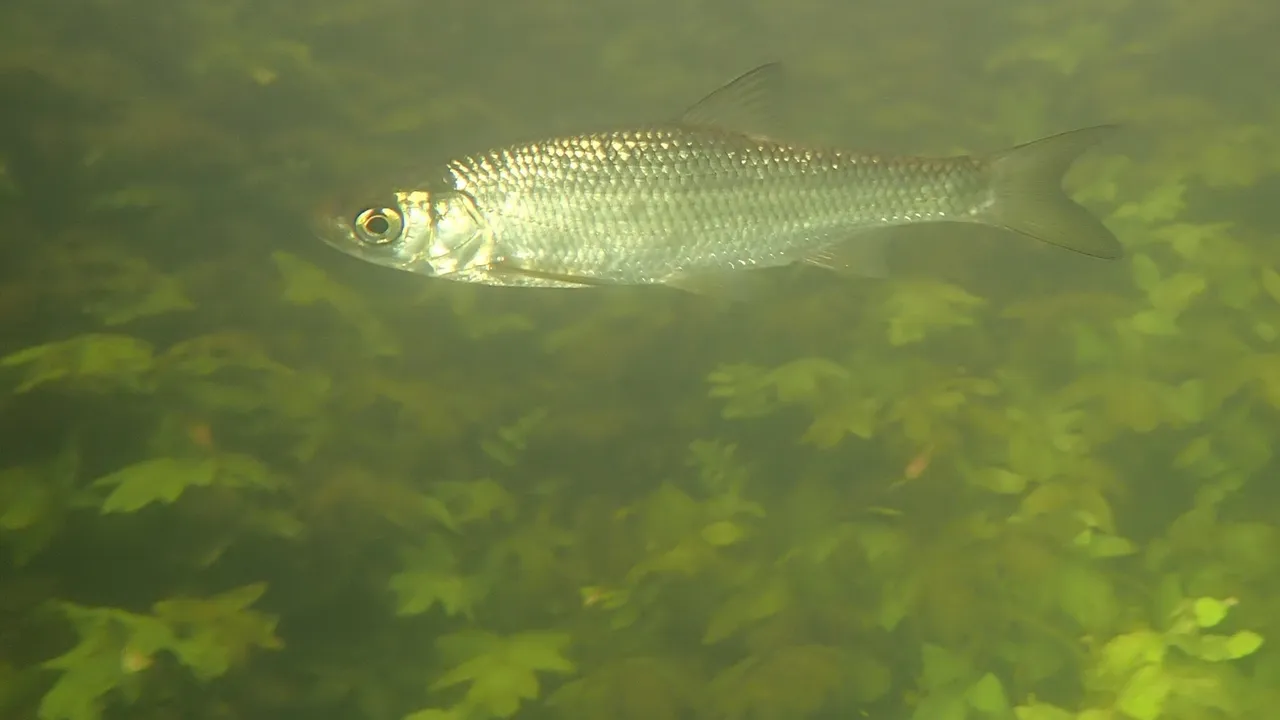
Identified by: The chub separation the record cares about reads clearly. The head is small and pointed with a small, slightly subterminal mouth, where a chub of the same length carries a broad blunt head and a wide terminal mouth. The dorsal fin margin is distinctly CONCAVE — the dace fin shape — and the anal fin below the rear body reads concave too. Bright silver flank, yellow iris, forked tail. Research grade with agreeing identifications and none disagreeing.Nicola Crockford — CC BY, via iNaturalist — source, licenceCatching Dace
Everything here on fishing for it. Each entry opens the page behind it.
- Where
- 2 places FishingHQ documents — strongest claim anywhere: regular local target · From the shore
Dace are the fish that make a river feel alive: small, fast, shoaling, and everywhere in clean flowing water across northern Europe.
THEY ARE MISTAKEN FOR SMALL CHUB CONSTANTLY, and the confusion matters because a small chub and a good dace look almost identical to somebody who has not been shown the difference. THE ANAL FIN SETTLES IT. Hold the fish and look at the trailing edge of the anal fin: in a dace it is CONCAVE, curving inwards; in a chub it is CONVEX, bulging outwards. The same test works on the dorsal fin more weakly. It is one character, it is diagnostic, and it works at any size.
TWO SUPPORTING CHARACTERS BACK IT UP. A dace's mouth is small and neat, reaching nowhere near the eye; a chub's is large and blunt, giving the fish its heavy-headed look. And dace fins are typically pale yellow or greyish where a chub of the same size shows orange-red in the pelvic and anal fins. Neither is diagnostic alone — colour varies with water — and both are worth checking after the fin shape rather than before it.
AGAINST ROACH the separation is easier and still catches people out. A roach is deeper-bodied with a distinctly red iris and reddish fins; a dace is slimmer, brighter silver, with a pale yellow iris. The two shoal together in the same runs.
WHAT THEY ARE LIKE TO FISH FOR is out of proportion to their size. Dace take a bait faster than almost any coarse fish, which makes them the traditional teacher of striking; they rise freely to a fly; and they shoal in numbers that make a good run genuinely busy. A pound dace is a specimen anywhere in Europe, and most are a quarter of that.
How it is caught
- Dry fly fishingDace rise freely to small dry flies, and are one of the very few British coarse fish a fly angler catches on purpose rather than by accident.
- Float fishingTrotting a light float through a streamy run is the classic dace method and is classic because it matches the fish: a shoal holding in current, taking items as they drift past.
- Pole fishingThe river match approach: a pole gives the bait control at the pace of the current that a running line cannot, which is exactly what a fish taking drifting food demands.
- TrottingA fish of fast, clean, shallow water and quick takes, which is what makes it the species most anglers learn line control on.
Gear for this fish
- BreadPunched bread and liquidised bread feed hold a dace shoal in a run and are the traditional winter approach when maggots stop working.
- MaggotsThe standard dace bait, fished singly on a small hook. Dace take faster than any other British coarse fish, so a small hook and a light float are about hitting the bite rather than about hooking the fish.
- Stick float rigA fast-biting shoal fish of running water, and the species that most rewards the held-back presentation because it takes a rising bait.
Where Dace is documented
Places where public sources describe this species as fished, with how it is fished and how strongly the evidence supports it. This is not a range map and it is not a recommendation — it is what has been written down about a fishery rather than a record of any individual catch, and being listed is never permission to fish.
The River Thames
2 documented places
River reach
Regular local target
From the shore
River reach
Regular local target
From the shore
What these strengths mean
- Regular local target
- Fishing sources describe this as a normal local target here, not merely as caught.
Identification
- Scientific name
- Leuciscus leuciscus
- Family
- Leuciscidae
- Water
- Freshwater
- Conservation status
- Least Concern
- Regions
- Britain & Ireland, Western Europe, Northern Europe, Central & Eastern Europe
- THE ANAL FIN IS CONCAVE — its trailing edge curves inwards. In a chub the same fin is convex and bulges outwards. This is the diagnostic character and it works at every size.
- A small, neat mouth that does not extend back towards the eye. A chub's mouth is large and blunt, and gives the head a heavy look a dace never has.
- Fins pale yellow, grey or faintly olive. A chub of comparable size shows orange-red in the pelvic and anal fins; dace do not, though colour alone is supporting rather than diagnostic.
- Slender, bright silver body with a pale yellow iris. Roach are deeper-bodied with a red iris and reddish fins.
- Small overall: an adult dace is rarely much beyond 25 cm, which is itself a clue when the fish is beside a chub.
Size
- Typical
- 60–150 g (2–5 oz) and 15–22 cm for rod-caught fish.
- Large
- Over 250 g (9 oz) is a very good dace on most rivers.
Exceptional: Around 40 cm is the widely reported maximum for the species; fish approaching half a kilo are exceptional and most claimed monsters are small chub.
Where dace live: clean gravel and moving water
Dace are a running-water fish and the qualification matters, because a great many people look for them in the wrong part of a river they are in.
THE REQUIREMENT IS FLOW OVER CLEAN GRAVEL. Dace hold in streamy runs, glides and the tails of pools — water with steady pace and a bottom that has not silted. They are scarce in the slow deep sections of the same river, where roach and bream take over, and they disappear entirely from reaches that have been impounded or heavily silted.
THIS PUTS THEM IN THE UPPER AND MIDDLE RIVER more than the lower, and it makes the southern chalk streams close to ideal habitat: clean gravel, steady flow, high invertebrate production and clear water. On those rivers dace are abundant and are frequently caught by trout anglers who did not want them.
THEY ARE ALSO A CANAL FISH where the canal is connected to a river system, though far less characteristically than roach. A canal dace population usually indicates a connection to flowing water rather than a preference for still.
WITHIN A RUN THEY OCCUPY THE FASTER LAYERS. A dace shoal will sit in water a chub would find too quick and hold higher in it than a barbel or a gudgeon would. That vertical position is worth knowing because it decides how a bait is presented — a dace shoal takes food drifting past at mid-depth, not lying on the bottom.
AND THE SPAWNING REQUIREMENT DECIDES WHERE THE POPULATION CAN PERSIST AT ALL. Dace spawn early, in late winter or early spring, on clean shallow gravel. Fine sediment washed off farmland fills that gravel over winter, and dace recruitment fails there before anything else visibly changes — which makes the species a useful early indicator of a catchment going wrong.
Backed by research — why, and the sources (2)
Supported by peer-reviewed research or fisheries science. The sources are listed and can be checked.
- Freshwater Fishes of the British Isles — HarperCollins (New Naturalist 75), 1992 (Reference work)Relied on for: Distribution, habitat association, life history, growth and conservation position of the freshwater fishes of the British Isles.States this directlyCitation checked — the work exists and is described correctly
- FishBase: a global information system on fishes — Froese, R. and D. Pauly, eds. — FishBase Consortium (Scientific institute)Relied on for: Distribution, habitat association, depth range, growth, maximum size and reproductive parameters recorded for the species.States this directlyPassage read and verified
How big a dace gets, and how long it takes
Dace are small and the numbers are worth being precise about, because 'a good dace' means something specific and it is not what a newcomer expects.
MOST DACE ARE TWO TO FIVE OUNCES — roughly 60 to 150 grams, and 15 to 22 centimetres. That is the fish that makes up a shoal and the fish that fills a match net.
EIGHT OUNCES IS A VERY GOOD DACE on most rivers, and a pound is a specimen anywhere in Europe. British records sit a little over a pound and are contested precisely because a large dace and a small chub are so easily confused — a claimed record dace is checked on the anal fin before anything else.
THE REPORTED MAXIMUM FOR THE SPECIES IS AROUND 40 CENTIMETRES, and fish approaching that are rare, old and mostly continental. Anything much beyond a pound should be looked at very carefully.
GROWTH IS FAST AND LIFE IS SHORT by cyprinid standards. Dace mature at two to three years and rarely exceed ten, which is a very different arithmetic from a carp or a barbel. It means a dace population is dominated by a few year classes at a time, and it means a river can hold enormous numbers of one size and very few of another.
THAT YEAR-CLASS STRUCTURE IS WHY DACE FISHING CHANGES BETWEEN YEARS rather than gradually. A strong spawning year produces a wave of fish that works through the fishery over four or five seasons; a run of failed springs produces a river that still holds dace but holds fewer and larger ones. An angler who fished a run three seasons ago and finds it different has usually met a year class rather than a decline.
Backed by research — why, and the sources (2)
Supported by peer-reviewed research or fisheries science. The sources are listed and can be checked.
- Freshwater Fishes of the British Isles — HarperCollins (New Naturalist 75), 1992 (Reference work)Relied on for: Distribution, habitat association, life history, growth and conservation position of the freshwater fishes of the British Isles.States this directlyCitation checked — the work exists and is described correctly
- FishBase: a global information system on fishes — Froese, R. and D. Pauly, eds. — FishBase Consortium (Scientific institute)Relied on for: Distribution, habitat association, depth range, growth, maximum size and reproductive parameters recorded for the species.States this directlyPassage read and verified
The dace year: an early spawner and a winter fish
Dace run to a calendar of their own, and both ends of it are useful.
THEY SPAWN EARLY — often from late February through April, ahead of most other coarse fish and while the river is still cold. Shoals gather on shallow gravel riffles, and the fish are conspicuous, concentrated and vulnerable in a way they are at no other time. Males develop tubercles on the head and flanks that make them rough to the touch, which is the visible sign that a shoal is on the point of spawning.
THE EARLY TIMING IS THE SPECIES' STRATEGY AND ITS WEAKNESS. Spawning before the river warms puts fry into the system ahead of most competition; it also means the eggs sit in gravel that has to remain clean and oxygenated through the end of winter, which is exactly when run-off delivers most fine sediment.
THEY FEED THROUGH THE WHOLE YEAR, INCLUDING COLD WATER, which makes dace one of very few reliable river species in midwinter. On a January afternoon when nothing else is moving, a dace shoal in a streamy run will still take a maggot — and it is the reason dace matter to river anglers out of all proportion to their size.
HIGH WATER MOVES THEM RATHER THAN STOPPING THEM. In a flood dace drop into slacker, deeper water at the edges and behind features, and return to the faster runs as the level falls. A river that has just dropped and cleared after a spate is close to ideal dace conditions.
AND SUMMER PUTS THEM ON THE SURFACE. Warm evenings bring dace up to take insects in the film, which is when they become a genuine dry-fly target and when their presence in a trout river becomes obvious to everybody fishing it.
Backed by research — why, and the sources (3)
Supported by peer-reviewed research or fisheries science. The sources are listed and can be checked.
- Freshwater Fishes of the British Isles — HarperCollins (New Naturalist 75), 1992 (Reference work)Relied on for: Distribution, habitat association, life history, growth and conservation position of the freshwater fishes of the British Isles.States this directlyCitation checked — the work exists and is described correctly
- FishBase: a global information system on fishes — Froese, R. and D. Pauly, eds. — FishBase Consortium (Scientific institute)Relied on for: Distribution, habitat association, depth range, growth, maximum size and reproductive parameters recorded for the species.States this directlyPassage read and verified
- General angling website restatements of established technique — Various (Credible secondary source)Relied on for: Widely restated descriptions of species behaviour and regional angling practice, recorded as consensus rather than as scholarship.Background and mechanism onlyCitation checked — the work exists and is described correctly
Handling dace: the problem is the hook, not the fish
A dace is a small, soft, thin-skinned fish and almost nothing about handling one is difficult. What is difficult is everything that happened before it reached the hand, and that is where the mortality in this species actually comes from.
THE CORE PROBLEM IS THAT DACE ARE CAUGHT BY ACCIDENT ON TACKLE MEANT FOR SOMETHING ELSE. They take a bait intended for chub, roach or trout, they take it fast, and a hook sized for a fish four times their weight goes past the mouth. A deep-hooked dace is a dead dace regardless of what happens next, and the fix is entirely in the tackle rather than in the unhooking: a smaller hook, a bait the fish can actually take into its mouth, and a faster response to the bite.
THE SECOND PROBLEM IS THE SCALES AND THE SLIME. Dace are bright silver because of a fine reflective scale layer over a mucus coat, and both are removed by dry hands, dry nets, grass and stones. A fish that looks dulled or patchy after handling has lost the barrier that keeps infection out.
SO THE PRACTICE IS SHORT AND SPECIFIC. Wet hands before touching. Unhook over water or over a wet surface rather than on the bank. Keep air exposure to seconds rather than tens of seconds. Support the fish rather than gripping it — a dace squeezed hard enough to hold still has already been damaged internally.
AND THE FLY-CAUGHT DACE DESERVES A NOTE OF ITS OWN. Dace feed readily at the surface and are the fish that most often eats a trout angler's dry fly. A barbless hook, a small pattern and unhooking in the net solve almost the whole problem, and it is worth doing rather than treating the fish as an interruption.
What experienced anglers do — why, and the sources (3)
Widely and independently recommended by experienced anglers and specialist sources. This is real angling knowledge, not proof: controlled evidence for it is limited, and FishingHQ records it as convention rather than as a demonstrated effect.
- Do we need species-specific guidelines for catch-and-release recreational angling? — Biodiversity and Conservation 14:1195–1209, 2005 (Scientific literature)Relied on for: That catch-and-release outcomes are species-specific, that handling, air exposure and physiological state drive post-release mortality, and that general guidelines under-serve species with particular vulnerabilities.States this directlyCitation checked — the work exists and is described correctly
- Understanding the Complexity of Catch-and-Release in Recreational Fishing — Reviews in Fisheries Science 15:75–167, 2007 (Scientific literature)Relied on for: The mechanisms of post-release mortality in recreational fisheries, including handling damage, air exposure, exhaustion and thermal stress.States this directlyCitation checked — the work exists and is described correctly
- General angling website restatements of established technique — Various (Credible secondary source)Relied on for: Widely restated descriptions of established angling practice for the species named, recorded as practitioner consensus rather than as scholarship.Background and mechanism onlyCitation checked — the work exists and is described correctly
Methods for dace: fine, quick, and mostly on the drop
Dace are caught by three approaches, and the choice between them is decided by where in the water column the fish are feeding rather than by preference.
TROTTING A FLOAT IS THE CLASSIC AND STILL THE BEST. A stick float or a light waggler set to run a bait through a steady glide at the speed of the current, held back slightly so the bait lifts and swings, covers the water dace actually occupy. The bite is famously fast — a dace takes and ejects a bait in a fraction of a second — so the float is watched for a dip rather than a burial, and the strike is immediate.
WHICH EXPLAINS THE TACKLE. Fine lines, small hooks, light floats and a rod with a soft enough tip to protect a hooklength on a fast strike. Everything is scaled to a fish of a hundred grams that bites like a fish of ten.
FEEDING IS THE OTHER HALF OF TROTTING. A steady trickle of loose feed — maggots, casters, hemp — drawing a shoal up the swim and holding it there, with the bait arriving among the feed. Dace shoal, and a shoal that has been fed stays; a shoal that has not moves on.
LIGHT LEDGERING WORKS IN HIGH OR COLD WATER, when the fish have dropped to steadier deeper runs and a float cannot be controlled. A small feeder or a light bomb with a short hooklength, fished on a quivertip, is the winter answer and is why dace are one of the few reliable river species in January.
AND FLY FISHING IS LEGITIMATE RATHER THAN INCIDENTAL. Dace take drifting nymphs and emergers through the column and rise freely to terrestrials and small duns. A size 18 or 20 dry fly on fine tippet, fished upstream to a rising shoal on a summer evening, is a genuine fishery and not merely something that happens while trout fishing.
WHAT DOES NOT WORK is anything heavy. Large baits, heavy hooks and coarse presentation catch chub from the same swim and leave the dace uncaught, which is why an angler catching only chub on a dace river is usually fishing too big rather than in the wrong place.
What experienced anglers do — why, and the sources (3)
Widely and independently recommended by experienced anglers and specialist sources. This is real angling knowledge, not proof: controlled evidence for it is limited, and FishingHQ records it as convention rather than as a demonstrated effect.
- General angling website restatements of established technique — Various (Credible secondary source)Relied on for: Widely restated descriptions of established angling practice for the species named, recorded as practitioner consensus rather than as scholarship.Background and mechanism onlyCitation checked — the work exists and is described correctly
- Freshwater Fishes of the British Isles — HarperCollins (New Naturalist 75), 1992 (Reference work)Relied on for: Distribution, ecology, life history, spawning timing and conservation status of the British and European freshwater and migratory fishes named.States this directlyCitation checked — the work exists and is described correctly
- The Fishes of the British Isles and North-West Europe — Macmillan, 1969 (Reference work)Relied on for: Biology, habitat association and life history of the fishes of the British Isles and north-west Europe named here.States this directlyCitation checked — the work exists and is described correctly
Lifecycle and reproduction
Fast-growing, short-lived by cyprinid standards, maturing at two to three years and rarely exceeding ten. Shoals are strongly year-class structured, so a river can hold enormous numbers of one size and few of another, which is why dace fishing changes character between years rather than gradually.
Spawns early — often late February to April, ahead of most coarse fish — on clean gravel in moderate flow, the shoal gathering on shallow riffles and scattering adhesive eggs. Early spawning ties the species to gravel that is clean at the end of winter, which is why siltation from run-off damages dace recruitment before it visibly damages anything else.
Feeding and senses
Takes invertebrates through the whole water column and readily at the surface: drifting nymphs, emerging insects, terrestrials falling in, and bottom fauna picked from gravel. The willingness to feed at the surface is what makes dace a legitimate fly-fishing catch and what makes them the fish that eats a trout angler's dry fly.
A daylight sight feeder in clear flowing water, taking a drifting item with a speed that is the species' defining characteristic to anybody who has fished for them. Bites are extremely fast and are the traditional reason dace are recommended for learning to strike.
Through the year
Feeds through the whole year including cold conditions, which makes it one of the few reliable winter river species. Shoals move to deeper, steadier water in high flows and return to the faster runs as the river drops. Pre-spawning shoals gather on shallow gravel in late winter and are conspicuous and vulnerable then.
Distribution
Widespread across northern and central Europe from Ireland and Britain eastward through France, the Low Countries, Germany and Scandinavia into Russia and Siberia. Absent from most of Iberia, Italy and Greece. In Britain naturally distributed in England and Wales with introduced populations elsewhere; in Ireland introduced and locally abundant.
This is a biological range — where the species occurs, not a prediction that you will catch one. To browse the fishing geography FishingHQ holds, start at fishing places.
Why anglers care
A river match and pleasure species of long standing, fished on light float tackle trotted through streamy water and increasingly on fly tackle. Its practical significance is as a teacher: dace take faster than any other British coarse fish, so an angler who can hit dace bites can hit anything. It is also a genuine winter species on rivers where little else feeds.
Handling and returning
Small, soft-scaled and easily damaged. Wet hands, minimal air time, and unhook over water or a wet surface. Dace are frequently caught on small hooks intended for larger fish and are deep-hooked as a result; a smaller hook and a faster strike prevent it.
Safety
Fish welfare — Can cause injury needing treatment
Both species are small, soft-scaled and are caught overwhelmingly by anglers fishing for something larger. The specific failure is a hook too big for the fish, taken deep, followed by handling with dry hands on a hard surface — three avoidable things compounding on an animal that weighs a few ounces.
What reduces it: Match the hook to the fish rather than to the hope: a small fine-wire hook hooks these species in the mouth and comes out easily. Wet hands, unhook over water or a wet surface, and return promptly. Carry a disgorger.
Worse when:
- Large hooks and static baits left while attention is elsewhere
- Handling on gravel, concrete or a dry bank
- Warm low water, where a played small fish recovers slowly
Precautions that always apply here
- Wet your hands before touching a fish. Dry hands strip the protective mucus layer that keeps infection out.
- Check, clean and dry your kit between different waters — the published guidance is 48 hours’ drying, in sunlight where possible, because a number of invasive species survive over two weeks in damp conditions. Nets, boots and wet mats move invasive species and disease more effectively than anything else anglers do.
Check the rules before you fish
Fishing laws, bylaws, access rules, seasons, bait restrictions and permitted methods vary by location and can change. Check the current rules from the relevant authority and the water you intend to fish before fishing.
Check with:
- Current national or regional law for where you are fishing
- Current local bylaws
- The relevant fisheries authority
- The landowner, club or fishery whose water it is
- Any restrictions specific to the species or the method you intend to use
Where to go next
Where it lives
- CanalsPresent in canals connected to river systems and in the faster canalised reaches, though far less characteristic of still canal water than roach.
- Chalk streamsAbundant in the southern chalk streams, where clean gravel, steady flow and a heavy invertebrate drift suit the species exactly — and where they are frequently caught by trout anglers who did not want them.
- Lowland riversThe core habitat: clean, moderately flowing water over gravel, in the streamy runs rather than the slow deeps. Dace are a running-water fish and are scarce or absent in the still sections of the same river.
Where you will find it
Told apart from
- BleakTwo small silver river fish taken from the same swim and constantly confused. Bleak are slimmer, have a distinctly upturned mouth for surface feeding, and a long anal fin; dace are deeper-bodied with a terminal mouth and a shorter anal fin. Bleak also shoal at the surface where dace hold lower.
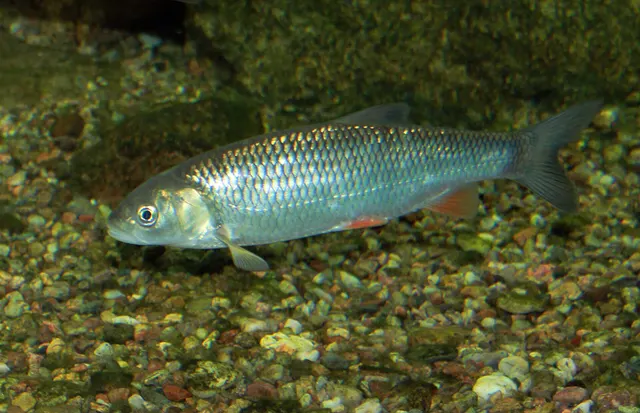 ChubThe confusion this page exists for. The anal fin is CONCAVE in a dace and CONVEX in a chub, at any size; the mouth is small and neat in one and large and blunt in the other. Colour and fin tint are supporting only.
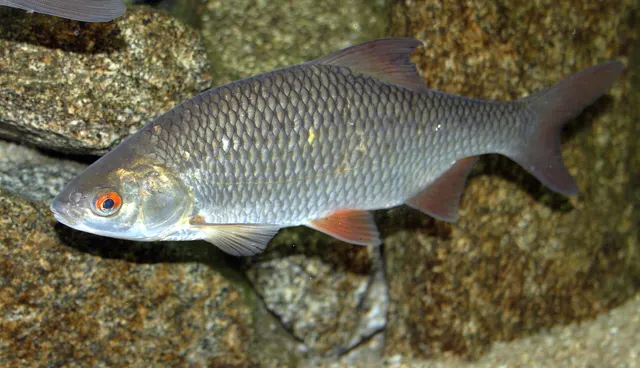 RoachSlimmer and brighter than a roach, with a pale yellow iris where a roach's is red. The two shoal together in the same runs, which is why the pair comes up constantly.
Sources and evidence
- Freshwater Fishes of the British Isles — HarperCollins (New Naturalist 75), 1992 (Reference work)Relied on for: Distribution, habitat association, identification characters, life history and conservation position of the freshwater fishes of the British Isles.States this directlyCitation checked — the work exists and is described correctly
- FishBase: a global information system on fishes — Froese, R. and D. Pauly, eds. — FishBase Consortium (Scientific institute)Relied on for: Distribution, habitat association, depth range, diet, growth and reproductive parameters recorded for the species.States this directlyPassage read and verified
- The Fishes of the British Isles and North-West Europe — Macmillan, 1969 (Reference work)Relied on for: Distribution, habitat, identification characters and biology of the fishes of the British Isles and north-west Europe.States this directlyCitation checked — the work exists and is described correctly
- Coarse Fishing — A. & C. Black, 1912 (Specialist angling publication)Relied on for: Established coarse angling practice, including method, presentation and the reasoning behind them.States this directlyCitation checked — the work exists and is described correctly
- General angling website restatements of established technique — Various (Credible secondary source)Relied on for: Widely restated descriptions of species behaviour and regional angling practice, recorded as consensus rather than as scholarship.Background and mechanism onlyCitation checked — the work exists and is described correctly
Why the 14 connections on this page are here, and the sources
How it is caught
What experienced anglers do — 4 connections
Widely and independently recommended by experienced anglers and specialist sources. This is real angling knowledge, not proof: controlled evidence for it is limited, and FishingHQ records it as convention rather than as a demonstrated effect.
Dry fly fishing
A statement about how a species is fished, which is angling convention rather than biology and is labelled as such.
- Coarse Fishing — A. & C. Black, 1912 (Specialist angling publication)Relied on for: Established coarse angling practice, including method selection, presentation and the reasoning behind them.States this directlyCitation checked — the work exists and is described correctly
- Freshwater Fishing — Macdonald & Jane's, 1975 (Specialist angling publication)Relied on for: Freshwater angling technique and the principles behind method selection.States this directlyCitation checked — the work exists and is described correctly
- General angling website restatements of established technique — Various (Credible secondary source)Relied on for: Widely restated angling practice, recorded as consensus rather than as scholarship.Background and mechanism onlyCitation checked — the work exists and is described correctly
Float fishing
A statement about how a species is fished, which is angling convention rather than biology and is labelled as such.
- Coarse Fishing — A. & C. Black, 1912 (Specialist angling publication)Relied on for: Established coarse angling practice, including method selection, presentation and the reasoning behind them.States this directlyCitation checked — the work exists and is described correctly
- Freshwater Fishing — Macdonald & Jane's, 1975 (Specialist angling publication)Relied on for: Freshwater angling technique and the principles behind method selection.States this directlyCitation checked — the work exists and is described correctly
- General angling website restatements of established technique — Various (Credible secondary source)Relied on for: Widely restated angling practice, recorded as consensus rather than as scholarship.Background and mechanism onlyCitation checked — the work exists and is described correctly
Pole fishing
A statement about how a species is fished, which is angling convention rather than biology and is labelled as such.
- Coarse Fishing — A. & C. Black, 1912 (Specialist angling publication)Relied on for: Established coarse angling practice, including method selection, presentation and the reasoning behind them.States this directlyCitation checked — the work exists and is described correctly
- Freshwater Fishing — Macdonald & Jane's, 1975 (Specialist angling publication)Relied on for: Freshwater angling technique and the principles behind method selection.States this directlyCitation checked — the work exists and is described correctly
- General angling website restatements of established technique — Various (Credible secondary source)Relied on for: Widely restated angling practice, recorded as consensus rather than as scholarship.Background and mechanism onlyCitation checked — the work exists and is described correctly
Trotting
That a species is conventionally fished for by this method, drawn from angling literature and from widely restated practitioner description rather than from testing.
- Coarse Fishing — A. & C. Black, 1912 (Specialist angling publication)Relied on for: Classical British coarse angling practice: river float work, shotting, bait delivery and the reels and rods used for each.States this directlyCitation checked — the work exists and is described correctly
- Freshwater Fishing — Macdonald & Jane's, 1975 (Specialist angling publication)Relied on for: Comprehensive British freshwater angling practice including river float fishing, surface presentation and the equipment for each.States this directlyCitation checked — the work exists and is described correctly
Gear for this fish
What experienced anglers do — 3 connections
Widely and independently recommended by experienced anglers and specialist sources. This is real angling knowledge, not proof: controlled evidence for it is limited, and FishingHQ records it as convention rather than as a demonstrated effect.
Bread
A statement about bait convention for a species, which is practice rather than biology.
- Coarse Fishing — A. & C. Black, 1912 (Specialist angling publication)Relied on for: Established coarse angling practice, including method selection, presentation and the reasoning behind them.States this directlyCitation checked — the work exists and is described correctly
- Freshwater Fishing — Macdonald & Jane's, 1975 (Specialist angling publication)Relied on for: Freshwater angling technique and the principles behind method selection.States this directlyCitation checked — the work exists and is described correctly
- General angling website restatements of established technique — Various (Credible secondary source)Relied on for: Widely restated angling practice, recorded as consensus rather than as scholarship.Background and mechanism onlyCitation checked — the work exists and is described correctly
Maggots
A statement about bait convention for a species, which is practice rather than biology.
- Coarse Fishing — A. & C. Black, 1912 (Specialist angling publication)Relied on for: Established coarse angling practice, including method selection, presentation and the reasoning behind them.States this directlyCitation checked — the work exists and is described correctly
- Freshwater Fishing — Macdonald & Jane's, 1975 (Specialist angling publication)Relied on for: Freshwater angling technique and the principles behind method selection.States this directlyCitation checked — the work exists and is described correctly
- General angling website restatements of established technique — Various (Credible secondary source)Relied on for: Widely restated angling practice, recorded as consensus rather than as scholarship.Background and mechanism onlyCitation checked — the work exists and is described correctly
Stick float rig
That anglers conventionally choose this arrangement when targeting this fish. It is a claim about practice rather than about the fish, and it does not assert that the arrangement is necessary or that it will succeed.
- Coarse Fishing — A. & C. Black, 1912 (Specialist angling publication)Relied on for: Classical coarse angling practice: terminal arrangements, shotting, float attachment and bite registration in still and running water.States this directlyCitation checked — the work exists and is described correctly
- Angling Times — Bauer Media (Specialist angling publication)Relied on for: Contemporary UK coarse and match angling practice as reported by practitioners, including pole, float and surface rig convention.States this directlyCitation checked — the work exists and is described correctly
Where it lives
Backed by research — 3 connections
Supported by peer-reviewed research or fisheries science. The sources are listed and can be checked.
Canals
A distributional claim about where a species is found, which is a claim about the world and rests on regional reference works rather than on angling report.
- Freshwater Fishes of the British Isles — HarperCollins (New Naturalist 75), 1992 (Reference work)Relied on for: Distribution, habitat association, identification and life history of the freshwater fishes of the British Isles.States this directlyCitation checked — the work exists and is described correctly
- FishBase: a global information system on fishes — Froese, R. and D. Pauly, eds. — FishBase Consortium (Scientific institute)Relied on for: Distribution, habitat association, depth range, diet and reproductive parameters recorded for the species.States this directlyPassage read and verified
Chalk streams
A distributional claim about where a species is found, which is a claim about the world and rests on regional reference works rather than on angling report.
- Freshwater Fishes of the British Isles — HarperCollins (New Naturalist 75), 1992 (Reference work)Relied on for: Distribution, habitat association, identification and life history of the freshwater fishes of the British Isles.States this directlyCitation checked — the work exists and is described correctly
- FishBase: a global information system on fishes — Froese, R. and D. Pauly, eds. — FishBase Consortium (Scientific institute)Relied on for: Distribution, habitat association, depth range, diet and reproductive parameters recorded for the species.States this directlyPassage read and verified
Lowland rivers
A distributional claim about where a species is found, which is a claim about the world and rests on regional reference works rather than on angling report.
- Freshwater Fishes of the British Isles — HarperCollins (New Naturalist 75), 1992 (Reference work)Relied on for: Distribution, habitat association, identification and life history of the freshwater fishes of the British Isles.States this directlyCitation checked — the work exists and is described correctly
- FishBase: a global information system on fishes — Froese, R. and D. Pauly, eds. — FishBase Consortium (Scientific institute)Relied on for: Distribution, habitat association, depth range, diet and reproductive parameters recorded for the species.States this directlyPassage read and verified
Where you will find it
Backed by research — 1 connection
Supported by peer-reviewed research or fisheries science. The sources are listed and can be checked.
The River Trent
A claim that a place contains the ground, water and seasonal conditions the species is associated with. It is a distributional statement about the world, it rests on the regional reference literature, and it deliberately asserts nothing about access, permission or catch.
- Freshwater Fishes of the British Isles — HarperCollins (New Naturalist 75), 1992 (Reference work)Relied on for: Distribution, habitat and conservation status of British freshwater fishes, including the isolated glacial-relict populations of northern England.States this directlyCitation checked — the work exists and is described correctly
- Environment Agency fisheries management, byelaws and rod licensing information — Environment Agency (Government fisheries body)Relied on for: Fisheries monitoring, water quality and species distribution in English rivers and still waters.States this directlyCitation checked — the work exists and is described correctly
Told apart from
Backed by research — 3 connections
Supported by peer-reviewed research or fisheries science. The sources are listed and can be checked.
Bleak
An identification link between two species readers genuinely mistake for one another, resting on published identification keys rather than on angling lore. It names the character that separates them, which is what makes it useful rather than merely adjacent.
- Freshwater Fishes of the British Isles — HarperCollins (New Naturalist 75), 1992 (Reference work)Relied on for: Identification, distinguishing features and confusable species among the freshwater fishes of the British Isles, together with their distribution and habitat.States this directlyCitation checked — the work exists and is described correctly
- The Fishes of the British Isles and North-West Europe — Macmillan, 1969 (Reference work)Relied on for: Morphological identification features and identification keys for the fishes of the British Isles and north-west Europe, including the characters separating confusable species.States this directlyCitation checked — the work exists and is described correctly
Chub
A claim that two species are genuinely confused and are separated by stated characters. It rests on the identification literature rather than on the observation that both exist.
- Freshwater Fishes of the British Isles — HarperCollins (New Naturalist 75), 1992 (Reference work)Relied on for: Distribution, habitat association, identification and life history of the freshwater fishes of the British Isles.States this directlyCitation checked — the work exists and is described correctly
- FishBase: a global information system on fishes — Froese, R. and D. Pauly, eds. — FishBase Consortium (Scientific institute)Relied on for: Distribution, habitat association, depth range, diet and reproductive parameters recorded for the species.States this directlyPassage read and verified
Roach
A claim that two species are genuinely confused and are separated by stated characters. It rests on the identification literature rather than on the observation that both exist.
- Freshwater Fishes of the British Isles — HarperCollins (New Naturalist 75), 1992 (Reference work)Relied on for: Distribution, habitat association, identification and life history of the freshwater fishes of the British Isles.States this directlyCitation checked — the work exists and is described correctly
- FishBase: a global information system on fishes — Froese, R. and D. Pauly, eds. — FishBase Consortium (Scientific institute)Relied on for: Distribution, habitat association, depth range, diet and reproductive parameters recorded for the species.States this directlyPassage read and verified
How FishingHQ labels evidence is explained in the evidence policy.