How to identify dace
Leuciscus leuciscus · Leuciscidae
The characters that identify dace, ranked by how far each one can be trusted on its own.
Safety: fish welfare — can cause injury needing treatment.
How this was identified, and who took it
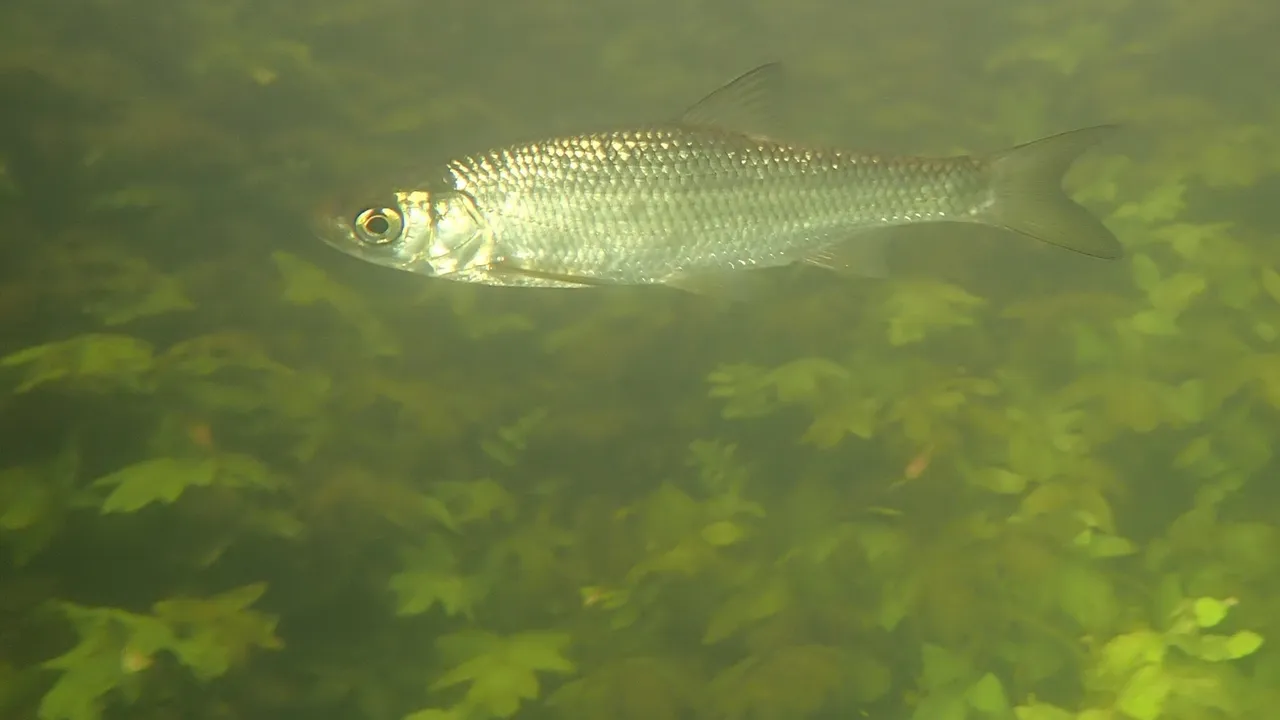
Identified by: The chub separation the record cares about reads clearly. The head is small and pointed with a small, slightly subterminal mouth, where a chub of the same length carries a broad blunt head and a wide terminal mouth. The dorsal fin margin is distinctly CONCAVE — the dace fin shape — and the anal fin below the rear body reads concave too. Bright silver flank, yellow iris, forked tail. Research grade with agreeing identifications and none disagreeing.Nicola Crockford — CC BY, via iNaturalist — source, licenceAbout the image above: The photograph is an in-water frame with a green cast, and the anal fin, which the page leads on, reads less crisply than the dorsal fin above it. Look at the dorsal margin in the image and apply the same test to the anal fin on your own fish.
Look at this first
Look at the back edge of the anal fin and decide which way it curves. On a dace it is scooped inwards; on a chub of the same length it bulges outwards. That one line settles the commonest identification mistake on an English river, it works on a fish of four inches and a fish of fourteen, and it does not care how bright the fish is or how long it has been out of the water.
Diagnostic — settles it on its own
Each of these settles the identification on its own. If one is clear, you have your answer.
The trailing edge of the anal fin curves inwards
Hold the fish so the underside is lit and let the fin stand. A dace's rear margin is scooped, like the trailing edge of a scythe. A chub's swells outwards into a rounded lobe. The dorsal fin does the same thing on the same fish and is easier to see in the water, so if you are looking at a fish you cannot handle, read the dorsal first and the anal second. Both are structural, both hold from fry to adult, and neither is affected by spawning condition.
A small neat mouth that stops well short of the eye
Look along the jaw line. On a dace the gape ends far in front of the eye and the whole head looks fine-boned and pointed. A chub's jaw runs back towards the eye and gives the head a broad, heavy, almost frog-like look. This is the character that works at distance and through water when the fins cannot be read, and it is the one to use when a fish is on the surface taking flies.
Supporting — use with other characters
Real characters that are not conclusive by themselves. Use two or three together.
A pale yellow iris, not a red one
The eye ring is straw to pale gold. A roach of similar build carries a distinctly red or orange iris and a deeper body, and roach is the other fish a small silver river fish gets called. Eye colour survives handling better than flank colour but it dulls after death, so it confirms rather than decides.
Size class as a cross-check
A rod-caught dace of twenty centimetres is a good one and anything approaching thirty is remarkable. If a silver fish in the net is comfortably over thirty centimetres and looks like a dace, the odds have shifted hard towards a small chub, and the fin margins should be checked again rather than assumed.
Suggestive only — varies with condition
Hints only. These vary with condition, season, water and how long the fish has been out of it, and a fish that contradicts them is still the same species.
Fins pale and cool rather than warm
The lower fins are cool in tone — straw, grey or a faint olive wash — where a chub of the same length puts real warmth into its pelvics and anal fin and a roach puts frank red there. It is a genuine difference between the three, it reads best on a fish straight out of the water, and it is also the very first thing to fade once one has been on the bank for an hour. Treat it as a hint that agrees with the fin shape rather than as evidence in its own right.
What it gets confused with
- Chub, overwhelmingly. Small chub and adult dace overlap in size and share a silver flank; the fin margins and the size of the mouth separate them and colour does not.
- Roach, which is deeper in the body with a red iris and red fins, and whose dorsal fin sits over the pelvic origin rather than behind it.
- Bleak, which is smaller, more slender still, with a distinctly upturned mouth and a longer anal fin, and which shoals at the surface where dace hold lower in the flow.
- Silver bream and small hybrids in slower reaches, where a fish carrying intermediate fin shapes is genuinely undecidable in the hand.
Where this stops working
Dace hybridise with roach, chub and bleak where they share a river, and hybrid fish routinely carry fin margins that are neither properly concave nor properly convex. A fish that reads intermediate on the fin, intermediate on the mouth and intermediate on the eye is most likely a hybrid, and the honest answer is that it cannot be named from a photograph. Continental Europe holds several further Leuciscus species that a British key does not cover at all. Where the identification has to be certain — a record claim, a survey, a translocation question — the fish needs somebody with the specimen and a scale count, not a page.
The full record
This page covers identification only. The Dace record covers behaviour, lifecycle, distribution, handling and the sources behind all of it.
Reviewed 2026-08-16.
More about this fish
Telling it apart is one question. Here are the others.
How it is caught
- Dry fly fishingDace rise freely to small dry flies, and are one of the very few British coarse fish a fly angler catches on purpose rather than by accident.
- Float fishingTrotting a light float through a streamy run is the classic dace method and is classic because it matches the fish: a shoal holding in current, taking items as they drift past.
- Pole fishingThe river match approach: a pole gives the bait control at the pace of the current that a running line cannot, which is exactly what a fish taking drifting food demands.
- TrottingA fish of fast, clean, shallow water and quick takes, which is what makes it the species most anglers learn line control on.
Where it lives
- CanalsPresent in canals connected to river systems and in the faster canalised reaches, though far less characteristic of still canal water than roach.
- Chalk streamsAbundant in the southern chalk streams, where clean gravel, steady flow and a heavy invertebrate drift suit the species exactly — and where they are frequently caught by trout anglers who did not want them.
- Lowland riversThe core habitat: clean, moderately flowing water over gravel, in the streamy runs rather than the slow deeps. Dace are a running-water fish and are scarce or absent in the still sections of the same river.
Where you will find it
Why the 8 connections on this page are here, and the sources
How it is caught
What experienced anglers do — 4 connections
Widely and independently recommended by experienced anglers and specialist sources. This is real angling knowledge, not proof: controlled evidence for it is limited, and FishingHQ records it as convention rather than as a demonstrated effect.
Dry fly fishing
A statement about how a species is fished, which is angling convention rather than biology and is labelled as such.
- Coarse Fishing — A. & C. Black, 1912 (Specialist angling publication)Relied on for: Established coarse angling practice, including method selection, presentation and the reasoning behind them.States this directlyCitation checked — the work exists and is described correctly
- Freshwater Fishing — Macdonald & Jane's, 1975 (Specialist angling publication)Relied on for: Freshwater angling technique and the principles behind method selection.States this directlyCitation checked — the work exists and is described correctly
- General angling website restatements of established technique — Various (Credible secondary source)Relied on for: Widely restated angling practice, recorded as consensus rather than as scholarship.Background and mechanism onlyCitation checked — the work exists and is described correctly
Float fishing
A statement about how a species is fished, which is angling convention rather than biology and is labelled as such.
- Coarse Fishing — A. & C. Black, 1912 (Specialist angling publication)Relied on for: Established coarse angling practice, including method selection, presentation and the reasoning behind them.States this directlyCitation checked — the work exists and is described correctly
- Freshwater Fishing — Macdonald & Jane's, 1975 (Specialist angling publication)Relied on for: Freshwater angling technique and the principles behind method selection.States this directlyCitation checked — the work exists and is described correctly
- General angling website restatements of established technique — Various (Credible secondary source)Relied on for: Widely restated angling practice, recorded as consensus rather than as scholarship.Background and mechanism onlyCitation checked — the work exists and is described correctly
Pole fishing
A statement about how a species is fished, which is angling convention rather than biology and is labelled as such.
- Coarse Fishing — A. & C. Black, 1912 (Specialist angling publication)Relied on for: Established coarse angling practice, including method selection, presentation and the reasoning behind them.States this directlyCitation checked — the work exists and is described correctly
- Freshwater Fishing — Macdonald & Jane's, 1975 (Specialist angling publication)Relied on for: Freshwater angling technique and the principles behind method selection.States this directlyCitation checked — the work exists and is described correctly
- General angling website restatements of established technique — Various (Credible secondary source)Relied on for: Widely restated angling practice, recorded as consensus rather than as scholarship.Background and mechanism onlyCitation checked — the work exists and is described correctly
Trotting
That a species is conventionally fished for by this method, drawn from angling literature and from widely restated practitioner description rather than from testing.
- Coarse Fishing — A. & C. Black, 1912 (Specialist angling publication)Relied on for: Classical British coarse angling practice: river float work, shotting, bait delivery and the reels and rods used for each.States this directlyCitation checked — the work exists and is described correctly
- Freshwater Fishing — Macdonald & Jane's, 1975 (Specialist angling publication)Relied on for: Comprehensive British freshwater angling practice including river float fishing, surface presentation and the equipment for each.States this directlyCitation checked — the work exists and is described correctly
Where it lives
Backed by research — 3 connections
Supported by peer-reviewed research or fisheries science. The sources are listed and can be checked.
Canals
A distributional claim about where a species is found, which is a claim about the world and rests on regional reference works rather than on angling report.
- Freshwater Fishes of the British Isles — HarperCollins (New Naturalist 75), 1992 (Reference work)Relied on for: Distribution, habitat association, identification and life history of the freshwater fishes of the British Isles.States this directlyCitation checked — the work exists and is described correctly
- FishBase: a global information system on fishes — Froese, R. and D. Pauly, eds. — FishBase Consortium (Scientific institute)Relied on for: Distribution, habitat association, depth range, diet and reproductive parameters recorded for the species.States this directlyPassage read and verified
Chalk streams
A distributional claim about where a species is found, which is a claim about the world and rests on regional reference works rather than on angling report.
- Freshwater Fishes of the British Isles — HarperCollins (New Naturalist 75), 1992 (Reference work)Relied on for: Distribution, habitat association, identification and life history of the freshwater fishes of the British Isles.States this directlyCitation checked — the work exists and is described correctly
- FishBase: a global information system on fishes — Froese, R. and D. Pauly, eds. — FishBase Consortium (Scientific institute)Relied on for: Distribution, habitat association, depth range, diet and reproductive parameters recorded for the species.States this directlyPassage read and verified
Lowland rivers
A distributional claim about where a species is found, which is a claim about the world and rests on regional reference works rather than on angling report.
- Freshwater Fishes of the British Isles — HarperCollins (New Naturalist 75), 1992 (Reference work)Relied on for: Distribution, habitat association, identification and life history of the freshwater fishes of the British Isles.States this directlyCitation checked — the work exists and is described correctly
- FishBase: a global information system on fishes — Froese, R. and D. Pauly, eds. — FishBase Consortium (Scientific institute)Relied on for: Distribution, habitat association, depth range, diet and reproductive parameters recorded for the species.States this directlyPassage read and verified
Where you will find it
Backed by research — 1 connection
Supported by peer-reviewed research or fisheries science. The sources are listed and can be checked.
The River Trent
A claim that a place contains the ground, water and seasonal conditions the species is associated with. It is a distributional statement about the world, it rests on the regional reference literature, and it deliberately asserts nothing about access, permission or catch.
- Freshwater Fishes of the British Isles — HarperCollins (New Naturalist 75), 1992 (Reference work)Relied on for: Distribution, habitat and conservation status of British freshwater fishes, including the isolated glacial-relict populations of northern England.States this directlyCitation checked — the work exists and is described correctly
- Environment Agency fisheries management, byelaws and rod licensing information — Environment Agency (Government fisheries body)Relied on for: Fisheries monitoring, water quality and species distribution in English rivers and still waters.States this directlyCitation checked — the work exists and is described correctly
Safety
Fish welfare — Can cause injury needing treatment
Both species are small, soft-scaled and are caught overwhelmingly by anglers fishing for something larger. The specific failure is a hook too big for the fish, taken deep, followed by handling with dry hands on a hard surface — three avoidable things compounding on an animal that weighs a few ounces.
What reduces it: Match the hook to the fish rather than to the hope: a small fine-wire hook hooks these species in the mouth and comes out easily. Wet hands, unhook over water or a wet surface, and return promptly. Carry a disgorger.
Worse when:
- Large hooks and static baits left while attention is elsewhere
- Handling on gravel, concrete or a dry bank
- Warm low water, where a played small fish recovers slowly