Chub vs Dace
How to tell them apart, and what follows from getting it right.
Why they get confused
Small chub and dace are silver river fish of the same water, often caught on the same trotted bait, and a young chub sits squarely in a dace's size range. Fin colour overlaps and flank shine overlaps; the shape of two fins and the size of the mouth do not.
Chub
Squalius cephalus — Leuciscidae
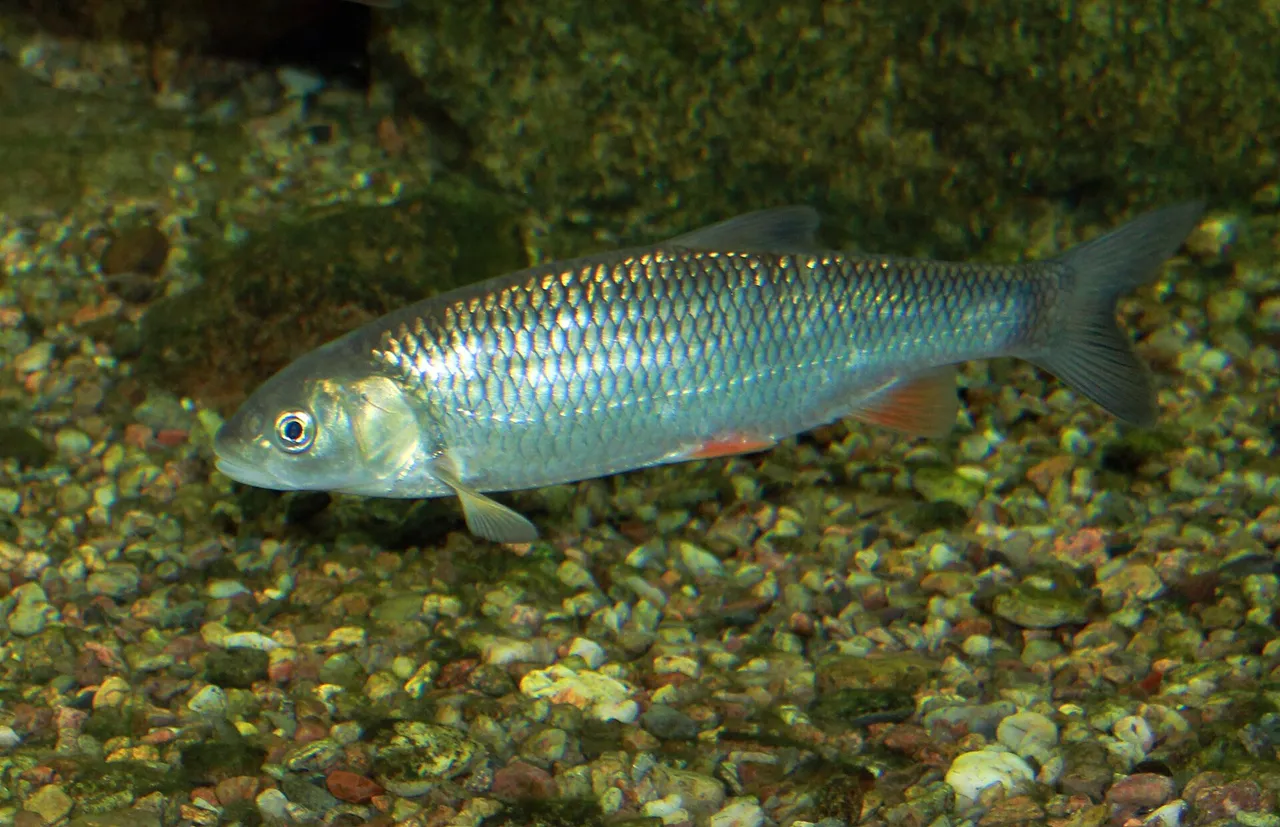
Photo: Karelj, via Wikimedia Commons, public domain. Resized and converted to WebP for the web; not otherwise altered.

Dace
Leuciscus leuciscus — Leuciscidae
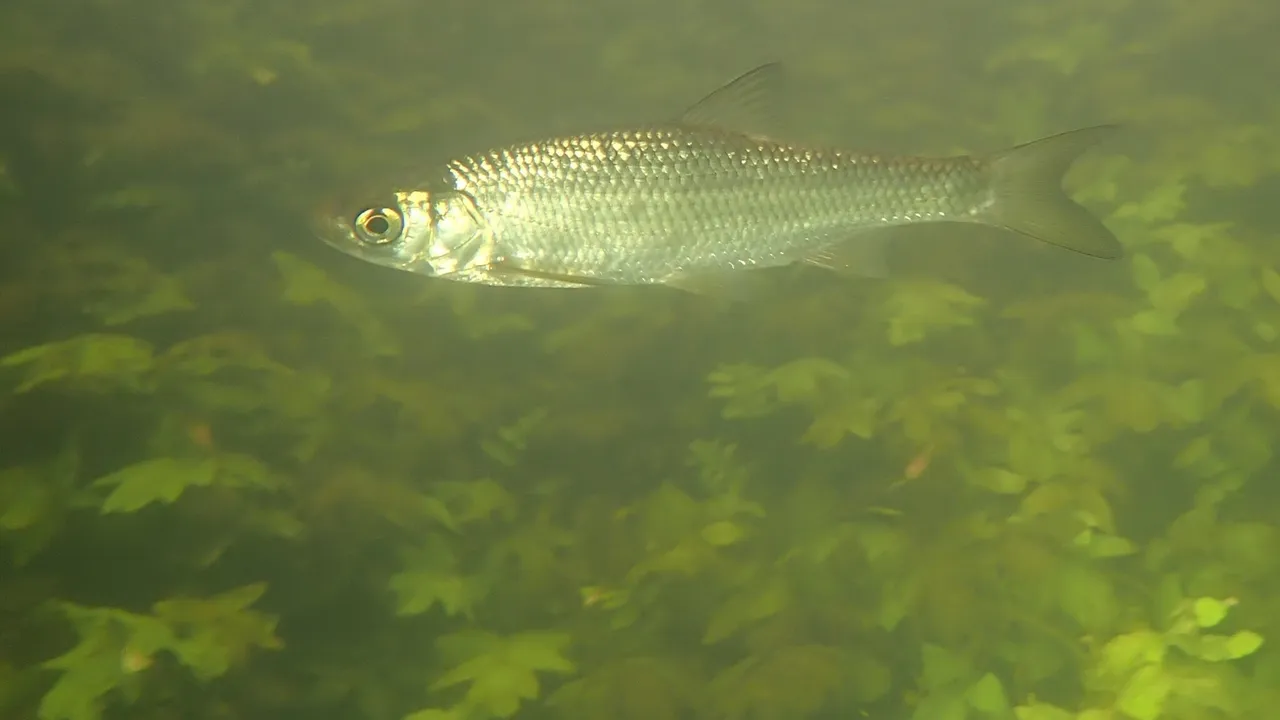
Photo: Nicola Crockford, via iNaturalist, CC BY. Resized and converted to WebP for the web; not otherwise altered.
The differences
Each difference is marked with how far it can be trusted on its own. A single diagnostic character settles the identification; suggestive ones only narrow it.
| Character | Chub | Dace | Reliability |
|---|---|---|---|
| The edge of the anal finIdentification | Convex: the outer edge curves outward into a rounded lobe. The dorsal fin does the same. | Concave: the trailing edge curves inward, like the edge of a scythe. The dorsal fin does the same, and it works at every size. | Diagnostic on its own |
| Mouth and headIdentification | A large mouth in a blunt, rounded head, wide enough to take a small fish or a crayfish; the old name is loggerhead. | A small neat mouth that stops well short of the eye, on a fine-boned, pointed head. | Diagnostic on its own |
| Lower finsIdentification | Orange-red pelvic and anal fins, vivid in fish from clear water and muted elsewhere. | Pale yellow, grey or faintly olive fins, cool rather than warm in tone. | Suggestive only — varies |
| SizeSize | Typically 25–40 cm and 0.5–1.5 kg; over 50 cm is a large fish. | Typically 15–22 cm for rod-caught fish; around 40 cm is the widely reported maximum. | Supporting — use with others |
Why it matters
Mostly it matters for honest records and for handling: dace are small, soft-scaled and easily damaged, often deep-hooked on hooks meant for bigger fish, while chub are robust and unhook easily but have soft mouths that tear under pressure. A silver fish well over 30 cm that looks like a dace is very likely a small chub; check the fins.
The full species pages
This page compares two species. Each of them has a full page covering biology, behaviour, handling and the evidence behind all of it.
More about chub
Where it lives, how it is caught, and what else it is confused with.
Similar and related fish
- IdeSeparated by the concave against convex outer edge of the anal fin, and by mouth size.
How it is caught
- Float fishingTrotting a float down a run covers the length of a swim and presents a bait moving at the pace of the current, which is how a chub expects its food to arrive.
- LedgeringThe standard winter approach: a chub in cold water holds deep under cover and will not move far, so the bait goes to the fish rather than the fish coming to the bait.
- SpinningChub take small lures readily, and spinning is how a river's chub lies are covered quickly on a walk rather than one swim at a time.
2 more
- Surface fishing for coarse fish Method
- Trotting Method
Gear for this fish
- HooksChub have hard mouths and are frequently fished with large baits in current, which pushes hook choice towards a strong wide-gape pattern rather than a fine-wire one.
- Luncheon meatWidely used for chub for the same reasons it suits barbel, and often fished on the bottom in the same swims.
- Running legerA chub in flowing water takes a static bait cautiously and drops it the moment it feels resistance, which is the situation a running arrangement exists for.
4 more
- Spinners Lure
- Stick float rig Rig
- Surface controller rig Rig
- Surface lures Lure
Where it lives
- Lowland riversChub hold in and under cover in flowing water — undercut banks, trailing branches, streamer weed — and are among the most reliably present predators of small lowland rivers.
Why the 14 connections on this page are here, and the sources
Similar and related fish
Backed by research — 1 connection
Supported by peer-reviewed research or fisheries science. The sources are listed and can be checked.
Ide
An identification comparison naming both binomials: Leuciscus idus and Squalius cephalus.
- FishBase: a global information system on fishes — Froese, R. and D. Pauly, eds. — FishBase Consortium (Scientific institute)Relied on for: Morphological and distributional data for Leuciscus idus and for Squalius cephalus.States this directlyPassage read and verified
- The IUCN Red List of Threatened Species — International Union for Conservation of Nature (Conservation authority)Relied on for: Separate assessments treating Leuciscus idus and Squalius cephalus as distinct species.States this directlyCitation checked — the work exists and is described correctly
How it is caught
What experienced anglers do — 5 connections
Widely and independently recommended by experienced anglers and specialist sources. This is real angling knowledge, not proof: controlled evidence for it is limited, and FishingHQ records it as convention rather than as a demonstrated effect.
Float fishing
Established angling practice for this species, recorded as convention. The note states the property of the animal or its water that makes the method the answer.
- Coarse Fishing — A. & C. Black, 1912 (Specialist angling publication)Relied on for: Established coarse-angling technique and its application to the species.States this directlyCitation checked — the work exists and is described correctly
- Angling Times — Bauer Media (Specialist angling publication)Relied on for: Contemporary British coarse practice for this species.Background and mechanism onlyCitation checked — the work exists and is described correctly
Ledgering
Established angling practice for this species, recorded as convention. The note states the property of the animal or its water that makes the method the answer.
- Coarse Fishing — relied on for: Established coarse-angling technique and its application to the species.
- Angling Times — relied on for: Contemporary British coarse practice for this species.
Spinning
Established angling practice for this species, recorded as convention. The note states the property of the animal or its water that makes the method the answer.
- Coarse Fishing — relied on for: Established coarse-angling technique and its application to the species.
- Angling Times — relied on for: Contemporary British coarse practice for this species.
Surface fishing for coarse fish
That a species is conventionally fished for by this method, drawn from angling literature and from widely restated practitioner description rather than from testing.
- Coarse Fishing — relied on for: Classical British coarse angling practice: river float work, shotting, bait delivery and the reels and rods used for each.
- Freshwater Fishing — Macdonald & Jane's, 1975 (Specialist angling publication)Relied on for: Comprehensive British freshwater angling practice including river float fishing, surface presentation and the equipment for each.States this directlyCitation checked — the work exists and is described correctly
Trotting
That a species is conventionally fished for by this method, drawn from angling literature and from widely restated practitioner description rather than from testing.
- Coarse Fishing — relied on for: Classical British coarse angling practice: river float work, shotting, bait delivery and the reels and rods used for each.
- Freshwater Fishing — relied on for: Comprehensive British freshwater angling practice including river float fishing, surface presentation and the equipment for each.
Gear for this fish
What experienced anglers do — 7 connections
Widely and independently recommended by experienced anglers and specialist sources. This is real angling knowledge, not proof: controlled evidence for it is limited, and FishingHQ records it as convention rather than as a demonstrated effect.
Hooks
Hook requirement for a species is angling convention, reported consistently across independent coarse-angling sources.
- Coarse Fishing — relied on for: Classical coarse angling practice: baits, terminal arrangements, presentation and swim selection for river species.
- Angling Times — relied on for: Contemporary UK coarse angling practice as reported by practitioners, including rig and tackle convention.
Luncheon meat
Established angling convention about what a bait is used for. Convention is what this is, and labelling it as convention is what stops it being read as a tested result.
- Coarse Fishing — relied on for: Classical coarse angling practice: baits, presentation, swim selection and the reasoning behind them.
- Angling Times — relied on for: Contemporary UK coarse and match angling practice as reported by practitioners, including bait convention and rig use.
Running leger
Terminal arrangement for a species is angling convention, reported consistently by independent practitioner sources across the classical and contemporary coarse literature.
- Coarse Fishing — relied on for: Classical coarse angling practice: baits, terminal arrangements, presentation and swim selection for river species.
- Angling Times — relied on for: Contemporary UK coarse angling practice as reported by practitioners, including rig and tackle convention.
Spinners
A practitioner claim about which lure family answers this species' feeding or holding behaviour.
- Freshwater Fishing — relied on for: Lure and spinning practice for freshwater predators in Britain and northern Europe.
- Angling Times — relied on for: Contemporary British and European lure practice for this species in the weekly angling press.
Stick float rig
That anglers conventionally choose this arrangement when targeting this fish. It is a claim about practice rather than about the fish, and it does not assert that the arrangement is necessary or that it will succeed.
- Coarse Fishing — relied on for: Classical coarse angling practice: terminal arrangements, shotting, float attachment and bite registration in still and running water.
- Angling Times — relied on for: Contemporary UK coarse and match angling practice as reported by practitioners, including pole, float and surface rig convention.
Surface controller rig
That anglers conventionally choose this arrangement when targeting this fish. It is a claim about practice rather than about the fish, and it does not assert that the arrangement is necessary or that it will succeed.
- Coarse Fishing — relied on for: Classical coarse angling practice: terminal arrangements, shotting, float attachment and bite registration in still and running water.
- Angling Times — relied on for: Contemporary UK coarse and match angling practice as reported by practitioners, including pole, float and surface rig convention.
Surface lures
A practitioner claim about which lure family answers this species' feeding or holding behaviour.
- Freshwater Fishing — relied on for: Lure and spinning practice for freshwater predators in Britain and northern Europe.
- Angling Times — relied on for: Contemporary British and European lure practice for this species in the weekly angling press.
Where it lives
Backed by research — 1 connection
Supported by peer-reviewed research or fisheries science. The sources are listed and can be checked.
Lowland rivers
A habitat claim held to an authoritative standard because it is about where a species is actually found rather than about how to catch it.
- Freshwater Fishes of the British Isles — HarperCollins (New Naturalist 75), 1992 (Reference work)Relied on for: Habitat use of Squalius cephalus in European rivers.States this directlyCitation checked — the work exists and is described correctly
- FishBase: a global information system on fishes — relied on for: Recorded habitat for Squalius cephalus.
Reviewed 2026-10-19. FishingHQ does not state what any rule is or where any rule applies. Where this page says the two species are managed differently, that is a reason to check the authority for the water you are on — not a statement of what it requires.