Ide
Fish · Last reviewed 2026-08-10
A large, fast-growing shoaling cyprinid of northern and central European rivers, also kept ornamentally as golden orfe, and a genuine surface-feeding target.
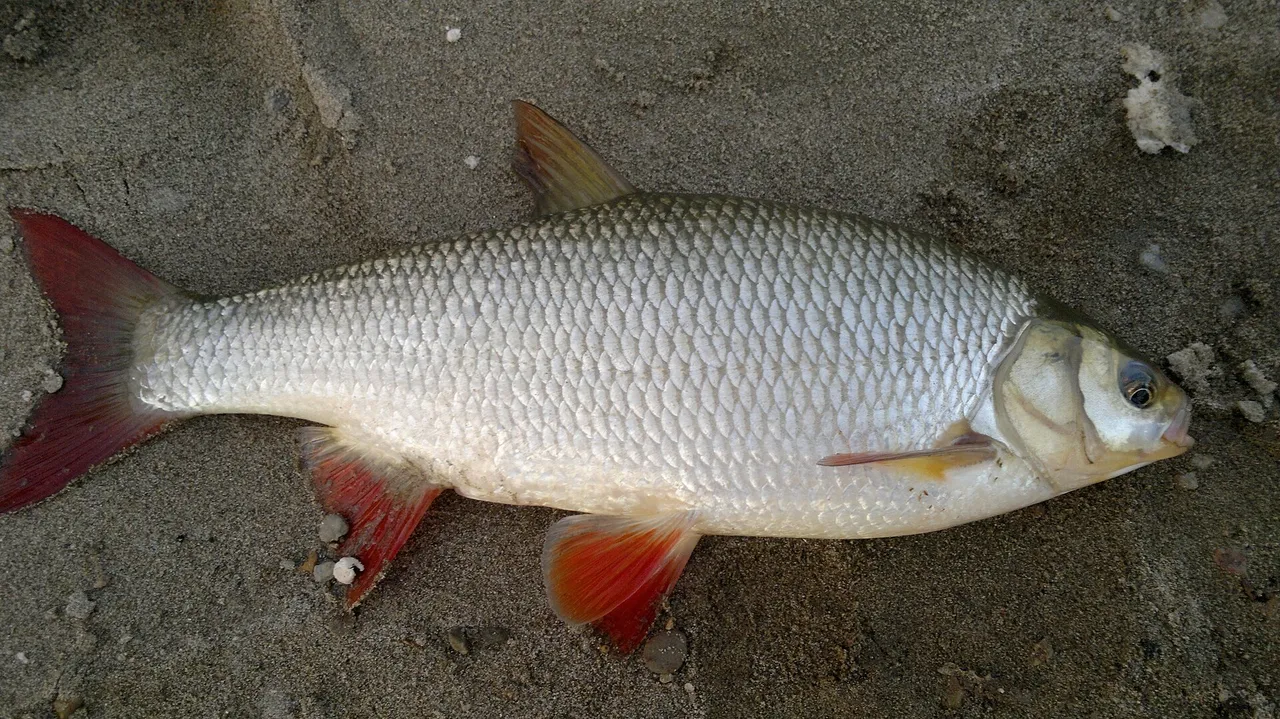
How this was identified, and who took it
Identified by: No single character is diagnostic and the identification rests on a combination, stated rather than disguised. The body is deep and thick-set with a distinctly SMALL blunt head and a small slightly oblique mouth — the head and mouth proportions carry the weight, because chub, the usual confusion, has a markedly larger terminal mouth and a more cylindrical body. The red-orange lower fins are SUPPORTING only: roach also carries red fins and fin colour varies with water and season.Kristian Kostov (kriki) — CC BY-SA 3.0, via Wikimedia Commons — source, licenceCatching Ide
Everything here on fishing for it. Each entry opens the page behind it.
- Ground
Ide is a big, powerful cyprinid of the larger rivers and lakes of northern and central Europe, and one that British anglers mostly know in the wrong form — as the ornamental golden orfe of garden ponds, which is a colour variety of this fish.
Wild ide are silver with a bluish back, deep-bodied in older fish, with reddish lower fins and a small slightly downturned mouth. They shoal, they feed both on the bottom and at the surface, and they grow considerably larger than the chub and dace they are often taken alongside.
They tolerate brackish water and are found in Baltic coastal areas as well as far inland, which is unusual for a cyprinid of this size.
How it is caught
Identification
- Scientific name
- Leuciscus idus
- Family
- Leuciscidae
- Water
- Freshwater, Brackish
- Conservation status
- Least Concern
- Regions
- Northern Europe, Central & Eastern Europe, Western Europe
- Deep-bodied silver cyprinid with a bluish-grey back and distinctly reddish pelvic, anal and lower tail lobes.
- Small mouth angled slightly downward, unlike the large level mouth of a chub.
- Anal fin with a concave outer edge; a chub's is convex — the standard separation between the two.
- Large eye and comparatively small head relative to the deep body of an adult.
Size
- Typical
- 0.5–1.5 kg (1.1–3.3 lb)
- Large
- 2–4 kg (4.4–8.8 lb)
Exceptional: FishBase records a maximum of 85 cm and 4 kg
Big lowland rivers, and a cyprinid that uses the whole channel
Ide occupy large lowland rivers and connected still waters across northern and eastern Europe, and they use a broader range of the channel than most cyprinids.
LARGE SLOW RIVERS ARE THE CORE HABITAT, along with connected lakes, backwaters and brackish coastal water in the Baltic — which is unusual: ide tolerate low salinity and occur in the brackish Baltic in numbers.
THEY USE OPEN WATER MORE THAN MOST CYPRINIDS, shoaling in the main channel and mid-water rather than hugging the margins, particularly as adults.
THEY FEED ACROSS THE COLUMN — invertebrates, molluscs and plant material as juveniles and smaller fish, with larger ide taking small fish and becoming partly predatory. That dietary breadth is why they are taken on both bait and lure.
STRUCTURE MATTERS AS A FLOW BREAK — bridge piers, weir pools, confluences and slack behind obstructions — and ide shoal in such places.
JUVENILES USE MARGINAL AND BACKWATER HABITAT with vegetation, and floodplain connectivity supports recruitment.
THEY NEED CLEAN, OXYGENATED WATER and are more sensitive than roach or bream to poor conditions, which makes them a reasonable indicator of river health.
AND THE ORNAMENTAL FORM COMPLICATES THE PICTURE. The golden orfe of ornamental ponds is the same species, and escapees establish in the wild in some regions — so an unexpected ide in a still water may be an aquarium fish rather than a river one.
Backed by research — why, and the sources (2)
Supported by peer-reviewed research or fisheries science. The sources are listed and can be checked.
- Freshwater Fishes of the British Isles — HarperCollins (New Naturalist 75), 1992 (Reference work)Relied on for: Distribution, habitat association, spawning requirements and ecology of European freshwater fishes.States this directlyCitation checked — the work exists and is described correctly
- FishBase: a global information system on fishes — Froese, R. and D. Pauly, eds. — FishBase Consortium (Scientific institute)Relied on for: Distribution, habitat association, depth range, size, reproduction and life-history parameters recorded for the species.States this directlyPassage read and verified
How ide are fished, and why
A shoaling river cyprinid that feeds through the whole water column and takes insects at the surface, which is why the method list crosses from coarse into fly fishing.
FLOAT FISHING is the traditional approach because ide shoal in flowing water and a bait trotted down at the pace of the current covers the shoal naturally.
SPINNING works because larger ide are genuinely predatory on small fish, which surprises anglers who file the species with roach and bream.
DRY FLY FISHING works because ide rise freely to surface insects, and in some European rivers they are a serious fly-fishing catch rather than an incidental one.
WHAT THIS SAYS ABOUT THE FISH. A species that can be caught on a maggot under a float, a small spinner and a dry fly is a genuine omnivore feeding at every level, and the practical implication is that the question is which level it is feeding at today rather than which method is correct.
What experienced anglers do — why, and the sources (2)
Widely and independently recommended by experienced anglers and specialist sources. This is real angling knowledge, not proof: controlled evidence for it is limited, and FishingHQ records it as convention rather than as a demonstrated effect.
- FishBase: a global information system on fishes — Froese, R. and D. Pauly, eds. — FishBase Consortium (Scientific institute)Relied on for: Habitat association, depth range, feeding ecology and prey of the species, from which the method association follows.Background and mechanism onlyPassage read and verified
- IGFA International Angling Rules and World Record Requirements — International Game Fish Association (Angling or fisheries organisation)Relied on for: Recognised angling methods and the tackle classes used for them internationally.Background and mechanism onlyPassage read and verified
Lifecycle and reproduction
Fast-growing and long-lived for a cyprinid, with adults reaching a size well beyond most river cyprinids of the same water. Populations move considerable distances within river systems.
Migrates upstream in spring to spawn over gravel and vegetation in shallow flowing water, scattering adhesive eggs. The spawning migration is substantial and is disrupted by barriers.
Feeding and senses
Omnivorous — insects, crustaceans, molluscs, plant material and small fish — taken from the bottom, in midwater and at the surface. Large ide become notably piscivorous.
A daylight sight feeder that works the whole water column, and one of the few large cyprinids that will rise confidently to surface food.
Through the year
Undertakes spring spawning migrations, feeds strongly through summer and autumn, and remains catchable in cold water in deeper river reaches.
Distribution
Europe and Asia: Baltic, Black, northern Caspian and North Sea basins, Atlantic basin southward to Seine and lower Loire drainages (France). Absent in Scandinavia north of 69°N. In Asia, eastward to Lena drainage and Aral basin. Introduced to Great Britain and northern Italy . Transported to several countries in Europe and the United States for ornament
This is a biological range — where the species occurs, not a prediction that you will catch one. To browse the fishing geography FishingHQ holds, start at fishing places.
Why anglers care
An important sport fish across Scandinavia, the Baltic states and central Europe, taken on float and feeder tackle, on lures for larger fish, and on dry flies — ide are among the few large European cyprinids regularly caught on the surface with fly tackle. In Britain it exists mainly as an introduced ornamental, and moving it into open water is both damaging and generally prohibited.
Handling and returning
A powerful fish with soft scales that come away easily under dry handling. Wet hands, use a large net and an unhooking mat, and return promptly. Where the species is not native, never move a fish between waters.
Going further
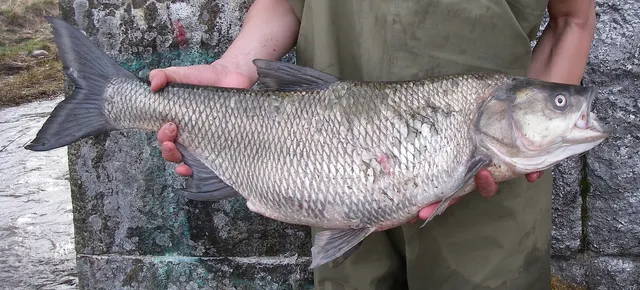
- Ide vs Asp — how to tell them apart.
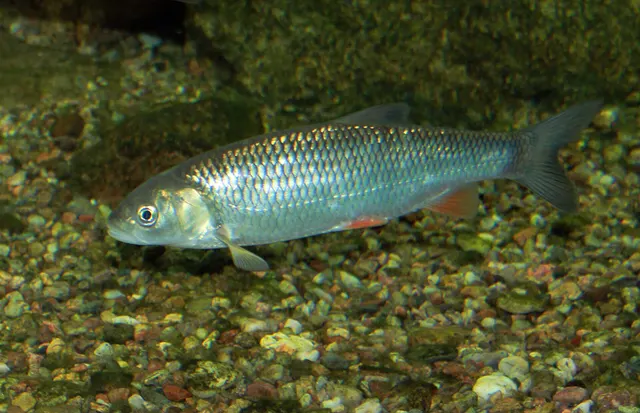
- Ide vs Chub — how to tell them apart.
Where to go next
Similar and related fish

Where it lives
Understanding this fish
Sources and evidence
- FishBase: a global information system on fishes — Froese, R. and D. Pauly, eds. — FishBase Consortium (Scientific institute)Relied on for: Family, maximum size, depth and environment, distribution and the IUCN assessment for Leuciscus idus.States this directlyPassage read and verified
- The IUCN Red List of Threatened Species — International Union for Conservation of Nature (Conservation authority)Relied on for: The Least Concern assessment for Leuciscus idus, assessed 22 October 2023.States this directlyCitation checked — the work exists and is described correctly
Why the 8 connections on this page are here, and the sources
Similar and related fish
Backed by research — 2 connections
Supported by peer-reviewed research or fisheries science. The sources are listed and can be checked.
Asp
An identification comparison naming both binomials: Leuciscus aspius and Leuciscus idus.
- FishBase: a global information system on fishes — Froese, R. and D. Pauly, eds. — FishBase Consortium (Scientific institute)Relied on for: Morphological and distributional data for Leuciscus aspius and for Leuciscus idus.States this directlyPassage read and verified
- The IUCN Red List of Threatened Species — International Union for Conservation of Nature (Conservation authority)Relied on for: Separate assessments treating Leuciscus aspius and Leuciscus idus as distinct species.States this directlyCitation checked — the work exists and is described correctly
Chub
An identification comparison naming both binomials: Leuciscus idus and Squalius cephalus.
- FishBase: a global information system on fishes — Froese, R. and D. Pauly, eds. — FishBase Consortium (Scientific institute)Relied on for: Morphological and distributional data for Leuciscus idus and for Squalius cephalus.States this directlyPassage read and verified
- The IUCN Red List of Threatened Species — International Union for Conservation of Nature (Conservation authority)Relied on for: Separate assessments treating Leuciscus idus and Squalius cephalus as distinct species.States this directlyCitation checked — the work exists and is described correctly
How it is caught
What experienced anglers do — 3 connections
Widely and independently recommended by experienced anglers and specialist sources. This is real angling knowledge, not proof: controlled evidence for it is limited, and FishingHQ records it as convention rather than as a demonstrated effect.
Dry fly fishing
A practitioner claim about how Leuciscus idus is commonly fished, following from where and how it feeds.
- General angling website restatements of established technique — Various (Credible secondary source)Relied on for: Widely restated practitioner accounts of fishing for ide.Citation checked — the work exists and is described correctly
- Sea Angler — Bauer Media (Specialist angling publication)Relied on for: Practitioner treatment of the methods used for ide and comparable species.Citation checked — the work exists and is described correctly
Float fishing
A practitioner claim about how Leuciscus idus is commonly fished, following from where and how it feeds.
- General angling website restatements of established technique — Various (Credible secondary source)Relied on for: Widely restated practitioner accounts of fishing for ide.Citation checked — the work exists and is described correctly
- Sea Angler — Bauer Media (Specialist angling publication)Relied on for: Practitioner treatment of the methods used for ide and comparable species.Citation checked — the work exists and is described correctly
Spinning
A practitioner claim about how Leuciscus idus is commonly fished, following from where and how it feeds.
- General angling website restatements of established technique — Various (Credible secondary source)Relied on for: Widely restated practitioner accounts of fishing for ide.Citation checked — the work exists and is described correctly
- Sea Angler — Bauer Media (Specialist angling publication)Relied on for: Practitioner treatment of the methods used for ide and comparable species.Citation checked — the work exists and is described correctly
Gear for this fish
What experienced anglers do — 1 connection
Widely and independently recommended by experienced anglers and specialist sources. This is real angling knowledge, not proof: controlled evidence for it is limited, and FishingHQ records it as convention rather than as a demonstrated effect.
Lobworms and worms
A practitioner claim about tackle commonly used for Leuciscus idus.
- General angling website restatements of established technique — Various (Credible secondary source)Relied on for: Widely restated practitioner accounts of this presentation for ide.Citation checked — the work exists and is described correctly
- Angling Times — Bauer Media (Specialist angling publication)Relied on for: Practitioner treatment of comparable presentations for the species group.Citation checked — the work exists and is described correctly
Where it lives
Backed by research — 1 connection
Supported by peer-reviewed research or fisheries science. The sources are listed and can be checked.
Lowland rivers
A habitat association for Leuciscus idus taken from the environment and distribution data on its FishBase summary.
- FishBase: a global information system on fishes — Froese, R. and D. Pauly, eds. — FishBase Consortium (Scientific institute)Relied on for: The environment, depth range and habitat description recorded for Leuciscus idus.States this directlyPassage read and verified
Understanding this fish
Backed by research — 1 connection
Supported by peer-reviewed research or fisheries science. The sources are listed and can be checked.
Water temperature and fish activity
A link from a species to the mechanism that explains how it lives, written only where the species is a worked example of that mechanism rather than merely subject to it.
- Freshwater Fishes of the British Isles — HarperCollins (New Naturalist 75), 1992 (Reference work)Relied on for: Life history, habitat requirement, physiological tolerance and seasonal behaviour of European freshwater fishes.States this directlyCitation checked — the work exists and is described correctly
- FishBase: a global information system on fishes — Froese, R. and D. Pauly, eds. — FishBase Consortium (Scientific institute)Relied on for: Recorded environment, depth range, temperature and oxygen tolerance, feeding biology and distribution of the species named.States this directlyPassage read and verified
How FishingHQ labels evidence is explained in the evidence policy.