Asp
Fish · Last reviewed 2026-08-10
Europe's largest predatory cyprinid, a fast open-water hunter that smashes into baitfish shoals at the surface and is fished like a saltwater predator.
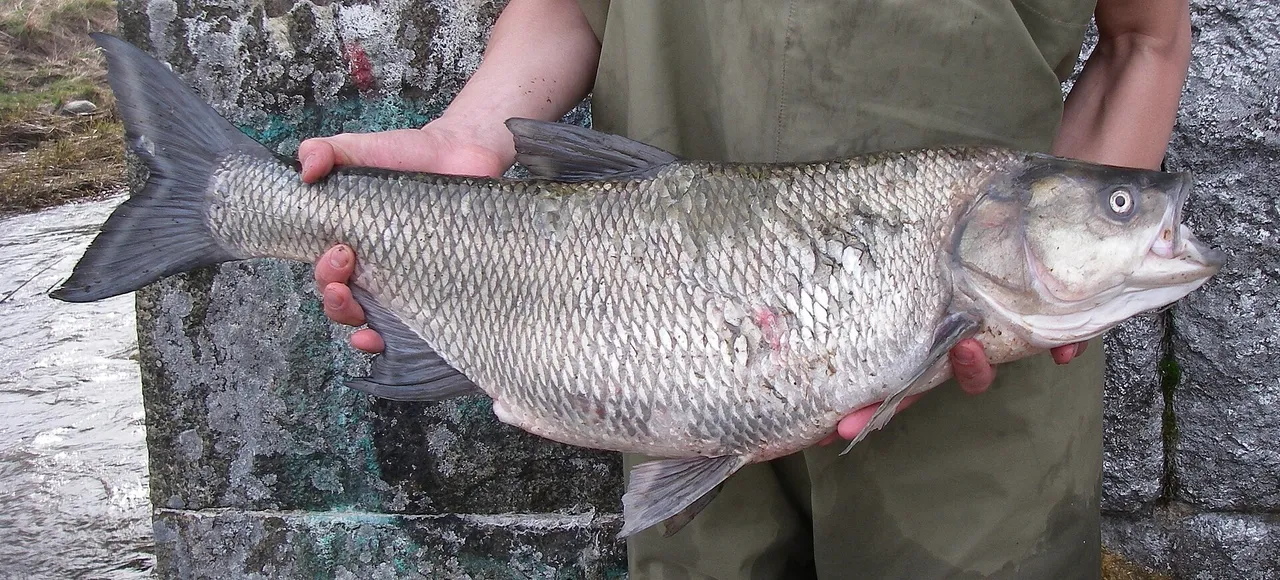
How this was identified, and who took it
Identified by: The identification rests on the jaw, which is legible here. The mouth is large and set obliquely, and the LOWER JAW PROJECTS beyond the upper — the arrangement that distinguishes asp from every other large cyprinid in range. Chub, the nearest confusion by size and silhouette, has a large but terminal rounded mouth with no projecting lower jaw. The streamlined body is supporting only, since a large chub in current looks similar. Found dead in the Sävjaån, Uppsala län, Sweden.Jenny Glans — CC BY-SA 3.0, via Wikimedia Commons — source, licence
Catching Asp
Everything here on fishing for it. Each entry opens the page behind it.
- Ground
Asp is the cyprinid that behaves like a bass. It has no teeth in its jaws — no cyprinid does — but it has a large upturned mouth, a streamlined body and the speed to run down small fish in open water, and it hunts by charging into surface shoals with an audible smash.
That behaviour is the whole basis of the fishery. Asp are located by the sound and disturbance of feeding fish and cast to with fast lures and surface plugs, in a style much closer to sea-bass fishing than to anything else in European fresh water.
It is a fish of large rivers and connected lakes across central and eastern Europe, expanding westward, and it reaches a substantial size.
How it is caught
Gear for this fish
Identification
- Scientific name
- Leuciscus aspius
- Family
- Leuciscidae
- Water
- Freshwater, Brackish
- Conservation status
- Least Concern
- Regions
- Central & Eastern Europe, Northern Europe, Western Europe
- Streamlined silver body with a large upturned mouth and a projecting lower jaw with a knob that fits into the upper.
- No barbels and no teeth in the jaws — it is a cyprinid, despite being wholly predatory.
- Sharp keel along the belly between the pelvic fins and the vent.
- Grey-blue back over bright silver flanks, with greyish fins lacking the strong red of ide or rudd.
Size
- Typical
- 1.5–4 kg (3.3–8.8 lb)
- Large
- 5–9 kg (11–20 lb)
Exceptional: FishBase records a maximum of 120 cm and 9 kg
Open water in a big river, and the surface above it
Asp are among the few European cyprinids that hunt as open-water predators, and their habitat reflects that unusual role.
THEY OCCUPY LARGE RIVERS AND CONNECTED LAKES, in the main channel and open water rather than in the marginal vegetation most cyprinids use. Large lowland rivers, big reservoirs and the lower reaches of major systems are their water.
THEY HUNT AT AND NEAR THE SURFACE, driving small fish upward and taking them in fast slashing attacks, frequently in shallow fast water over gravel or at the tail of a weir pool. Surface disturbance is the classic sign and it is how the fish are located.
CURRENT AND STRUCTURE THAT CONCENTRATES BAIT are the features: weir pools, bridge piers, gravel bars, confluences and the seams between fast and slack water.
THEY NEED WELL-OXYGENATED WATER and are not a fish of stagnant backwaters, though they use slower deeper water outside feeding periods.
JUVENILES USE SHALLOWER MARGINAL HABITAT and shoal, becoming progressively more solitary and more open-water as they grow.
AND THE HABITAT IS SHARED WITH SPECIES THEY EAT. Asp distribution tracks the availability of small shoaling cyprinids and bleak, so a river reach with a strong forage population holds them and one without does not, regardless of how the water looks.
Backed by research — why, and the sources (2)
Supported by peer-reviewed research or fisheries science. The sources are listed and can be checked.
- Freshwater Fishes of the British Isles — HarperCollins (New Naturalist 75), 1992 (Reference work)Relied on for: Distribution, habitat association, spawning requirements and ecology of European freshwater fishes.States this directlyCitation checked — the work exists and is described correctly
- FishBase: a global information system on fishes — Froese, R. and D. Pauly, eds. — FishBase Consortium (Scientific institute)Relied on for: Distribution, habitat association, depth range, size, reproduction and life-history parameters recorded for the species.States this directlyPassage read and verified
Lifecycle and reproduction
Fast-growing and long-lived, with adults occupying open water in large rivers and reservoirs. Juveniles feed on invertebrates before switching almost entirely to fish.
Migrates upstream in early spring to spawn over gravel in flowing water, often in the same places year after year. The migration is early — before most cyprinids — and is blocked by weirs and dams.
Feeding and senses
An open-water piscivore taking bleak, roach and other small shoaling fish, herding them to the surface and striking hard. It has no jaw teeth and relies on pharyngeal teeth and a sheer engulfing charge.
A fast daylight visual hunter of open water and current seams, keying on the flash and movement of shoaling prey near the surface.
Through the year
Spawns early in spring, hunts hard through the warm months in fast open water and at current edges, and becomes far less active in cold conditions.
Distribution
Europe and Asia: large rivers draining to North Sea (Weser, Elbe), Baltic Sea (southern tributaries, Norway east of Oslo, southern Sweden, Kokemären drainage in southern Finland), Black Sea, Sea of Azov and Caspian Sea; Aegean Sea basin, from Maritza to Lake Volvi drainages. Absent in Black Sea basin south of Danube and Rioni (Georgia) drainages, but present in Turkey west of Ankara. Introduced in Rhine, Northern Dvina and Lake Balkhash (Asia) . The subspecies Aspius aspius iblioides was previously recognised by authors for the Aral Sea
This is a biological range — where the species occurs, not a prediction that you will catch one. To browse the fishing geography FishingHQ holds, start at fishing places.
Why anglers care
A major lure-fishing target across central and eastern Europe and increasingly in the west, taken on fast-retrieved spinners, small metals, poppers and streamer flies cast at feeding fish. Its significance is that it provides genuine fast predator lure fishing in fresh water on tackle and in a style otherwise associated with the sea. Practitioner consensus is that speed of retrieve matters more than lure choice.
Handling and returning
Powerful, deep-bodied and easily damaged around the mouth and scales. Use a large net, wet hands, support the fish horizontally, and return promptly. Long fights in warm summer water leave asp slow to recover, so they should be released with care.
Going further
- Asp vs Ide — how to tell them apart.
Where to go next
Similar and related fish
Where it lives
Where you will find it
- Central and eastern European river fishingA large predatory cyprinid that hunts small fish visibly at the surface — a fishery with no British equivalent because Britain has no such fish.
- HungaryA surface-feeding cyprinid predator of the large rivers, hunted on lures in a way that has no close equivalent in British or Irish freshwater and is worth understanding before travelling.
- The DanubeA large predatory cyprinid of the middle and lower river, hunting in open water in a way few European cyprinids do.
- The Danube basinOccupies the faster open water of the middle river, hunting small fish at and near the surface in current.
Understanding this fish
Sources and evidence
- FishBase: a global information system on fishes — Froese, R. and D. Pauly, eds. — FishBase Consortium (Scientific institute)Relied on for: Family, maximum size, depth and environment, distribution and the IUCN assessment for Leuciscus aspius.States this directlyPassage read and verified
- The IUCN Red List of Threatened Species — International Union for Conservation of Nature (Conservation authority)Relied on for: The Least Concern assessment for Leuciscus aspius, assessed 28 May 2022.States this directlyCitation checked — the work exists and is described correctly
Why the 11 connections on this page are here, and the sources
Similar and related fish
Backed by research — 1 connection
Supported by peer-reviewed research or fisheries science. The sources are listed and can be checked.
Ide
An identification comparison naming both binomials: Leuciscus aspius and Leuciscus idus.
- FishBase: a global information system on fishes — Froese, R. and D. Pauly, eds. — FishBase Consortium (Scientific institute)Relied on for: Morphological and distributional data for Leuciscus aspius and for Leuciscus idus.States this directlyPassage read and verified
- The IUCN Red List of Threatened Species — International Union for Conservation of Nature (Conservation authority)Relied on for: Separate assessments treating Leuciscus aspius and Leuciscus idus as distinct species.States this directlyCitation checked — the work exists and is described correctly
How it is caught
What experienced anglers do — 2 connections
Widely and independently recommended by experienced anglers and specialist sources. This is real angling knowledge, not proof: controlled evidence for it is limited, and FishingHQ records it as convention rather than as a demonstrated effect.
Popping and stickbaiting
A practitioner claim about how Leuciscus aspius is commonly fished, following from where and how it feeds.
- General angling website restatements of established technique — Various (Credible secondary source)Relied on for: Widely restated practitioner accounts of fishing for asp.Citation checked — the work exists and is described correctly
- Sea Angler — Bauer Media (Specialist angling publication)Relied on for: Practitioner treatment of the methods used for asp and comparable species.Citation checked — the work exists and is described correctly
Spinning
A practitioner claim about how Leuciscus aspius is commonly fished, following from where and how it feeds.
- General angling website restatements of established technique — Various (Credible secondary source)Relied on for: Widely restated practitioner accounts of fishing for asp.Citation checked — the work exists and is described correctly
- Sea Angler — Bauer Media (Specialist angling publication)Relied on for: Practitioner treatment of the methods used for asp and comparable species.Citation checked — the work exists and is described correctly
Gear for this fish
What experienced anglers do — 2 connections
Widely and independently recommended by experienced anglers and specialist sources. This is real angling knowledge, not proof: controlled evidence for it is limited, and FishingHQ records it as convention rather than as a demonstrated effect.
Spinners
A practitioner claim about tackle commonly used for Leuciscus aspius.
- General angling website restatements of established technique — Various (Credible secondary source)Relied on for: Widely restated practitioner accounts of this presentation for asp.Citation checked — the work exists and is described correctly
- Angling Times — Bauer Media (Specialist angling publication)Relied on for: Practitioner treatment of comparable presentations for the species group.Citation checked — the work exists and is described correctly
Surface lures
A practitioner claim about which lure family answers this species' feeding or holding behaviour.
- Freshwater Fishing — Macdonald & Jane's, 1975 (Specialist angling publication)Relied on for: Lure and spinning practice for freshwater predators in Britain and northern Europe.States this directlyCitation checked — the work exists and is described correctly
- Angling Times — Bauer Media (Specialist angling publication)Relied on for: Contemporary British and European lure practice for this species in the weekly angling press.Background and mechanism onlyCitation checked — the work exists and is described correctly
Where it lives
Backed by research — 1 connection
Supported by peer-reviewed research or fisheries science. The sources are listed and can be checked.
Lowland rivers
A habitat association for Leuciscus aspius taken from the environment and distribution data on its FishBase summary.
- FishBase: a global information system on fishes — Froese, R. and D. Pauly, eds. — FishBase Consortium (Scientific institute)Relied on for: The environment, depth range and habitat description recorded for Leuciscus aspius.States this directlyPassage read and verified
Where you will find it
Backed by research — 4 connections
Supported by peer-reviewed research or fisheries science. The sources are listed and can be checked.
Central and eastern European river fishing
A distributional claim taken from reference sources on the species rather than from angling report. It states presence and asserts nothing about a fishery.
- FishBase: a global information system on fishes — Froese, R. and D. Pauly, eds. — FishBase Consortium (Scientific institute)Relied on for: Distribution, habitat association, depth range and life history recorded for the species concerned.States this directlyPassage read and verified
- The IUCN Red List of Threatened Species — International Union for Conservation of Nature (Conservation authority)Relied on for: Global distribution, population trend and extinction-risk assessment for the species concerned.States this directlyCitation checked — the work exists and is described correctly
Hungary
That a species occurs in these waters, drawn from distribution science and stock assessment. It is a statement about where the animal lives and is not a statement that anybody will catch one, still less where.
- Freshwater Fishes of the British Isles — HarperCollins (New Naturalist 75), 1992 (Reference work)Relied on for: Distribution, habitat requirement and life history of European freshwater fishes, including their occurrence across the continental range named.States this directlyCitation checked — the work exists and is described correctly
- FishBase: a global information system on fishes — Froese, R. and D. Pauly, eds. — FishBase Consortium (Scientific institute)Relied on for: Recorded distribution and habitat association of the freshwater and migratory species named.States this directlyPassage read and verified
The Danube
A distributional claim taken from reference works and databases on the fishes of the region rather than from angling report. It states presence and asserts nothing about a fishery.
- FishBase: a global information system on fishes — Froese, R. and D. Pauly, eds. — FishBase Consortium (Scientific institute)Relied on for: Distribution, habitat association, life history and size recorded for the species concerned.States this directlyPassage read and verified
- Freshwater Fishes of the British Isles — HarperCollins (New Naturalist 75), 1992 (Reference work)Relied on for: Biology, distribution, life history and conservation status of northern European freshwater and diadromous fishes.States this directlyCitation checked — the work exists and is described correctly
The Danube basin
A distribution association between an animal and a kind of water, rather than a claim about any named mark.
- Freshwater Fishes of the British Isles — HarperCollins (New Naturalist 75), 1992 (Reference work)Relied on for: Distribution and habitat association of European freshwater fishes, including occurrence in the river system concerned.States this directlyCitation checked — the work exists and is described correctly
- FishBase: a global information system on fishes — Froese, R. and D. Pauly, eds. — FishBase Consortium (Scientific institute)Relied on for: Distribution and habitat association recorded for the species.States this directlyPassage read and verified
Understanding this fish
What experienced anglers do — 1 connection
Widely and independently recommended by experienced anglers and specialist sources. This is real angling knowledge, not proof: controlled evidence for it is limited, and FishingHQ records it as convention rather than as a demonstrated effect.
Fly fishing for predators: pike, bass and beyond
A fish or a water joined to the fly-fishing mechanism it is a worked example of, written only where the subject's own behaviour or physical character is what this page explains. The direction is the one FishingHQ writes this kind of connection in, and the one it already uses 176 times, and it is also the semantically correct one: the mechanism explains the fish, not the reverse.
- Freshwater Fishes of the British Isles — HarperCollins (New Naturalist 75), 1992 (Reference work)Relied on for: Life history, feeding biology, habitat requirement and seasonal behaviour of the freshwater fishes of the British Isles.States this directlyCitation checked — the work exists and is described correctly
- FishBase: a global information system on fishes — Froese, R. and D. Pauly, eds. — FishBase Consortium (Scientific institute)Relied on for: Recorded environment, depth range, feeding biology and distribution of the species named.States this directlyPassage read and verified
- Still Water Fly-Fishing — Andre Deutsch, 1952 (Specialist angling publication)Relied on for: Stillwater fly practice: line density and depth, leader construction, fly selection against the food present, and the behaviour of stocked and wild trout in still water.States this directlyCitation checked — the work exists and is described correctly
- Trout & Salmon — Bauer Media (Specialist angling publication)Relied on for: Long-running published description of British game angling practice: river and stillwater trout, grayling and salmon fishing, and the presentation each demands.States this directlyCitation checked — the work exists and is described correctly
How FishingHQ labels evidence is explained in the evidence policy.