How to identify asp
Leuciscus aspius · Leuciscidae
The characters that identify asp, ranked by how far each one can be trusted on its own.
How this was identified, and who took it
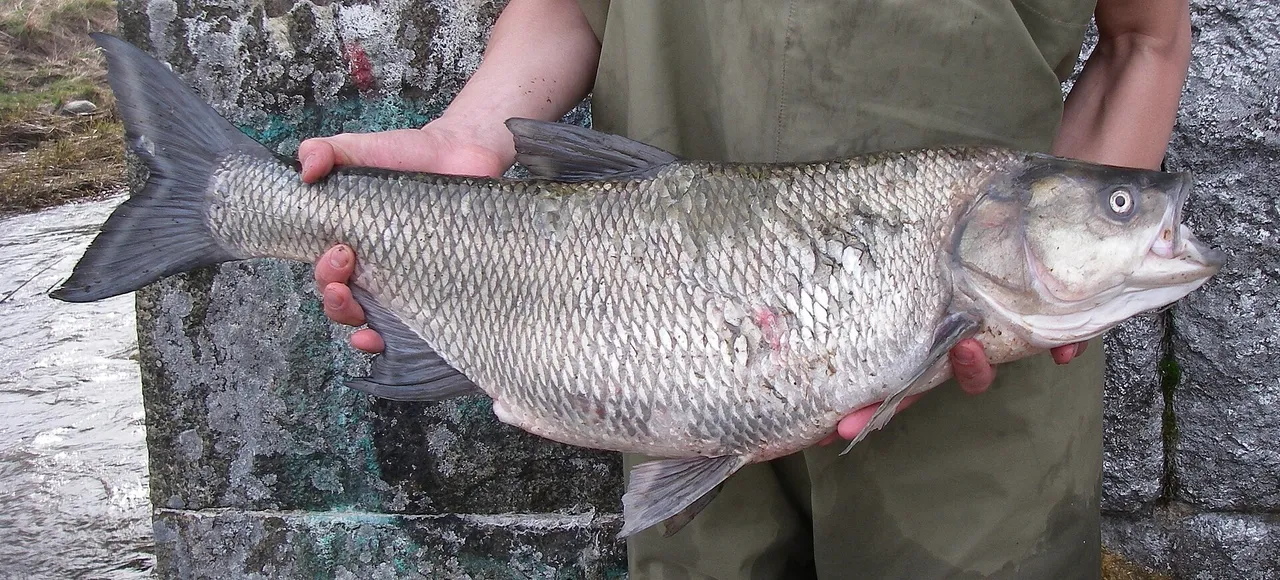
Identified by: The identification rests on the jaw, which is legible here. The mouth is large and set obliquely, and the LOWER JAW PROJECTS beyond the upper — the arrangement that distinguishes asp from every other large cyprinid in range. Chub, the nearest confusion by size and silhouette, has a large but terminal rounded mouth with no projecting lower jaw. The streamlined body is supporting only, since a large chub in current looks similar. Found dead in the Sävjaån, Uppsala län, Sweden.Jenny Glans — CC BY-SA 3.0, via Wikimedia Commons — source, licenceLook at this first
Look at the mouth. An asp's lower jaw sticks out beyond the upper and angles upward, so the fish looks like it is scowling. No other big European cyprinid has that. If the mouth is large but the jaws meet level, or the upper overhangs, you are looking at something else.
Diagnostic — settles it on its own
Each of these settles the identification on its own. If one is clear, you have your answer.
The projecting lower jaw
The lower jaw extends beyond the upper and rises into a notch in it, giving a large, obliquely set mouth built for taking fish at speed. This is a skeletal arrangement, visible on any fish of any size in any condition, and it is the whole identification. Chub — the fish asp is most often confused with — has a large mouth whose jaws meet level.
Supporting — use with other characters
Real characters that are not conclusive by themselves. Use two or three together.
A long, laterally compressed body
Asp are streamlined and flattened side-to-side with a pointed head, built like a predator rather than like a heavy-bodied cyprinid. Chub is rounder in cross-section and blunter in the head. Useful at a distance and unreliable alone, because a large chub in fast water reads similarly in outline.
A keel between the pelvic fins and the vent
There is a distinct scaleless keel along the belly behind the pelvic fins. It is a real structural character and it requires the fish in hand to check, which is why it sits below the jaw rather than beside it.
Suggestive only — varies with condition
Hints only. These vary with condition, season, water and how long the fish has been out of it, and a fish that contradicts them is still the same species.
Grey fins and a silver flank
Asp are plain: silver flanks, grey to dusky fins, no red. That is worth knowing mainly as a negative — a large silvery cyprinid with strongly red lower fins is far more likely to be an ide or a chub than an asp. Condition and season shift all of it.
What it gets confused with
- Chub, across almost the whole shared range. Read the jaws: projecting lower jaw for asp, level for chub.
- Ide, which is deeper-bodied with a small blunt head and a small mouth, and is the opposite error.
- Large dace in the smaller sizes, though the mouth arrangement separates them immediately.
Side by side: Asp vs Ide.
Where this stops working
Small asp are much harder than large ones, because the jaw arrangement is less exaggerated and the body has not yet elongated. The identification also carries a consequence: asp are protected, regulated or subject to specific measures in a number of European jurisdictions and are a species of conservation interest in parts of the range, so a fish taken in mistake for a chub is not a neutral error. Where an angler is unsure and the fish is alive, the answer is to return it rather than to resolve the identification afterwards.
The full record
This page covers identification only. The Asp record covers behaviour, lifecycle, distribution, handling and the sources behind all of it.
Reviewed 2026-08-13.
More about this fish
Telling it apart is one question. Here are the others.
Similar and related fish
How it is caught
Where it lives
Where you will find it
- Central and eastern European river fishingA large predatory cyprinid that hunts small fish visibly at the surface — a fishery with no British equivalent because Britain has no such fish.
- HungaryA surface-feeding cyprinid predator of the large rivers, hunted on lures in a way that has no close equivalent in British or Irish freshwater and is worth understanding before travelling.
- The DanubeA large predatory cyprinid of the middle and lower river, hunting in open water in a way few European cyprinids do.
- The Danube basinOccupies the faster open water of the middle river, hunting small fish at and near the surface in current.
Why the 8 connections on this page are here, and the sources
Similar and related fish
Backed by research — 1 connection
Supported by peer-reviewed research or fisheries science. The sources are listed and can be checked.
Ide
An identification comparison naming both binomials: Leuciscus aspius and Leuciscus idus.
- FishBase: a global information system on fishes — Froese, R. and D. Pauly, eds. — FishBase Consortium (Scientific institute)Relied on for: Morphological and distributional data for Leuciscus aspius and for Leuciscus idus.States this directlyPassage read and verified
- The IUCN Red List of Threatened Species — International Union for Conservation of Nature (Conservation authority)Relied on for: Separate assessments treating Leuciscus aspius and Leuciscus idus as distinct species.States this directlyCitation checked — the work exists and is described correctly
How it is caught
What experienced anglers do — 2 connections
Widely and independently recommended by experienced anglers and specialist sources. This is real angling knowledge, not proof: controlled evidence for it is limited, and FishingHQ records it as convention rather than as a demonstrated effect.
Popping and stickbaiting
A practitioner claim about how Leuciscus aspius is commonly fished, following from where and how it feeds.
- General angling website restatements of established technique — Various (Credible secondary source)Relied on for: Widely restated practitioner accounts of fishing for asp.Citation checked — the work exists and is described correctly
- Sea Angler — Bauer Media (Specialist angling publication)Relied on for: Practitioner treatment of the methods used for asp and comparable species.Citation checked — the work exists and is described correctly
Spinning
A practitioner claim about how Leuciscus aspius is commonly fished, following from where and how it feeds.
- General angling website restatements of established technique — Various (Credible secondary source)Relied on for: Widely restated practitioner accounts of fishing for asp.Citation checked — the work exists and is described correctly
- Sea Angler — Bauer Media (Specialist angling publication)Relied on for: Practitioner treatment of the methods used for asp and comparable species.Citation checked — the work exists and is described correctly
Where it lives
Backed by research — 1 connection
Supported by peer-reviewed research or fisheries science. The sources are listed and can be checked.
Lowland rivers
A habitat association for Leuciscus aspius taken from the environment and distribution data on its FishBase summary.
- FishBase: a global information system on fishes — Froese, R. and D. Pauly, eds. — FishBase Consortium (Scientific institute)Relied on for: The environment, depth range and habitat description recorded for Leuciscus aspius.States this directlyPassage read and verified
Where you will find it
Backed by research — 4 connections
Supported by peer-reviewed research or fisheries science. The sources are listed and can be checked.
Central and eastern European river fishing
A distributional claim taken from reference sources on the species rather than from angling report. It states presence and asserts nothing about a fishery.
- FishBase: a global information system on fishes — Froese, R. and D. Pauly, eds. — FishBase Consortium (Scientific institute)Relied on for: Distribution, habitat association, depth range and life history recorded for the species concerned.States this directlyPassage read and verified
- The IUCN Red List of Threatened Species — International Union for Conservation of Nature (Conservation authority)Relied on for: Global distribution, population trend and extinction-risk assessment for the species concerned.States this directlyCitation checked — the work exists and is described correctly
Hungary
That a species occurs in these waters, drawn from distribution science and stock assessment. It is a statement about where the animal lives and is not a statement that anybody will catch one, still less where.
- Freshwater Fishes of the British Isles — HarperCollins (New Naturalist 75), 1992 (Reference work)Relied on for: Distribution, habitat requirement and life history of European freshwater fishes, including their occurrence across the continental range named.States this directlyCitation checked — the work exists and is described correctly
- FishBase: a global information system on fishes — Froese, R. and D. Pauly, eds. — FishBase Consortium (Scientific institute)Relied on for: Recorded distribution and habitat association of the freshwater and migratory species named.States this directlyPassage read and verified
The Danube
A distributional claim taken from reference works and databases on the fishes of the region rather than from angling report. It states presence and asserts nothing about a fishery.
- FishBase: a global information system on fishes — Froese, R. and D. Pauly, eds. — FishBase Consortium (Scientific institute)Relied on for: Distribution, habitat association, life history and size recorded for the species concerned.States this directlyPassage read and verified
- Freshwater Fishes of the British Isles — HarperCollins (New Naturalist 75), 1992 (Reference work)Relied on for: Biology, distribution, life history and conservation status of northern European freshwater and diadromous fishes.States this directlyCitation checked — the work exists and is described correctly
The Danube basin
A distribution association between an animal and a kind of water, rather than a claim about any named mark.
- Freshwater Fishes of the British Isles — HarperCollins (New Naturalist 75), 1992 (Reference work)Relied on for: Distribution and habitat association of European freshwater fishes, including occurrence in the river system concerned.States this directlyCitation checked — the work exists and is described correctly
- FishBase: a global information system on fishes — Froese, R. and D. Pauly, eds. — FishBase Consortium (Scientific institute)Relied on for: Distribution and habitat association recorded for the species.States this directlyPassage read and verified