The Danube
Fishing regions · Last reviewed 2026-08-15
Europe's second-longest river, crossing or bordering ten countries, holding the continent's largest freshwater predators and its most serious freshwater conservation failure — and the clearest possible demonstration that a river's rules change at every border.
Safety: boat traffic and being seen — can cause serious injury or death. 2 more points apply here.
Being listed here is not permission to fish. What that meansClose
Access, fishing rights, seasons, licences, local bylaws and permitted methods vary and can change. Check current access, permission, local regulations, closures and restrictions before you travel or fish. FishingHQ describes what the ground is and names who holds the answer; it does not hold the answer itself.
Find the authority for a jurisdiction · What FishingHQ does and does not cover
The Danube rises in the German Black Forest and runs east and south for well over two and a half thousand kilometres to a great delta on the Black Sea, crossing or bordering ten countries and draining parts of many more. It is the most international river basin in the world.
ITS CHARACTER CHANGES COMPLETELY ALONG ITS LENGTH. The upper river in Germany and Austria is a cold, fast Alpine-fed river, heavily impounded by hydroelectric barrages. The middle river through the Hungarian plain broadens, warms and slows across a vast floodplain. The lower river through the Balkans is a huge, turbid, powerful waterway. And the delta in Romania and Ukraine is one of the largest wetlands in Europe.
THE FISH ARE THE CONTINENT'S HEAVYWEIGHTS. Wels catfish reach their greatest sizes in this basin, of which they are native. Zander and pike are widespread. The Danube's own endemic salmonid, the huchen or Danube salmon, is one of the largest salmonids in the world and is assessed as at serious risk. And the basin's sturgeons — beluga among them, historically the largest freshwater-entering fish in Europe — are the subject of the continent's gravest freshwater conservation problem.
THE STURGEON STORY IS THE ONE THAT MATTERS MOST. Migratory sturgeon once ran far up the Danube from the Black Sea. Dams — the Iron Gates barrages above all — cut the migration, and fishing pressure driven substantially by the caviar trade did the rest. Populations collapsed. Several species are assessed at the highest levels of extinction risk, and the remaining fish are the subject of intensive protection, international agreement and continuing illegal exploitation.
AND THE JURISDICTION IS THE HARDEST IN EUROPE. An international commission co-ordinates the basin's water management across all the riparian states. It does not issue fishing licences. Every country on the river administers fishing separately, several devolve it further internally, and there is no such thing as a Danube fishing permission.
What fishing here is like
A continental river of enormous scale and completely changing character, from a cold impounded Alpine-fed upper river through a broad warm plain river to a huge turbid lower river and a vast delta. Heavily engineered along much of its length, with barrages, navigation works and flood defence shaping the habitat.
The angling cultures along it are as varied as the countries — an Austrian and German upper-river culture organised around clubs and stretches, a Hungarian and Serbian plain-river culture with strong catfish and predator traditions, and a Romanian delta culture that is closer to a wetland fishery than to a river one.
What dominates
Wels catfish fishing across the middle and lower river, including the clonk and vertical boat methods that are native to this basin rather than imported to it. Predator fishing for zander and pike, which is the everyday angling of much of the river. Huchen fishing on specific upper tributaries, a highly specialised and heavily restricted winter discipline for a threatened fish. Feeder and match fishing for the river's abundant cyprinids. Carp fishing on the impoundments and side arms. Delta fishing in Romania, which is boat-based wetland angling for pike, perch, catfish and carp among reedbeds.
The water available
A cold fast upper river with extensive hydroelectric impoundment. Barrage headwaters and tailwaters, each a distinct habitat. A broad slow middle river across a great plain, with side arms, oxbows and gravel islands. Extensive floodplain and inundation areas where these survive. The Iron Gates gorge and its impoundments. A huge turbid lower river. A delta of channels, reedbeds, lakes and lagoons meeting the Black Sea. Major tributaries — the Tisza, Sava, Drava, Prut — that are substantial rivers in their own right.
How the rules are structured
There is no Danube fishing licence and no single Danube authority for angling. The river crosses or borders ten states, each of which administers fishing under its own law, and several of which devolve it further to regional bodies or delegate it to angling federations. An international commission co-ordinates water management, pollution and navigation across the basin, and that co-ordination does not extend to issuing angling permission. Protected species rules are the point of greatest consequence and greatest variation: the basin's sturgeons are subject to national protection, to international trade controls and to specific prohibitions, and huchen is a threatened endemic salmonid under heavy restriction where it occurs. Rules on retention, on live bait, on boat use, on night fishing and on the clonk differ between neighbouring countries on the same water. Border stretches raise the further question of which bank and which channel. FishingHQ does not state what any current rule is: identify the specific country and, within it, the specific administering body for the stretch, obtain permission from it, and ask directly about protected species before fishing anywhere on this river.
Who to ask
- The national fisheries authority of the specific country whose stretch you intend to fish — there are ten on this river and no shared angling permission exists
- The regional authority or delegated angling federation within that country, which in several Danube states is the body that actually issues the document
- The international commission for the Danube basin, for water management, pollution and basin-wide condition, but not for fishing permission
- The national CITES management authority and customs, for anything involving sturgeon, sturgeon products or caviar
- The delta or protected-area administration, for the Romanian and Ukrainian delta and other designated sites along the river
Words you will meet
- Harcsa, som, somn
- The wels catfish in Hungarian, Serbian and Romanian respectively. The same fish under different names on adjoining stretches of one river — which is itself the Danube's defining characteristic.
- Huchen
- The Danube salmon, a large endemic salmonid of the upper basin's fast tributaries, assessed as at serious risk and fished only under heavy restriction where fishing is permitted at all.
- Iron Gates
- The gorge on the Serbian–Romanian border and the barrages built through it. The single most consequential structure on the river: it cut the sturgeon migration and created a vast impoundment.
- Delta canal and gârlă
- The channels of the Romanian delta — some engineered for navigation, some natural. The delta is navigated and fished by channel, and the distinction between the two kinds governs both depth and flow.
Conditions and hazards
The Danube is a working commercial waterway along most of its length, and that is the first hazard. Barge traffic is heavy, wash from a passing vessel arrives as a genuine wave against a bank or a small boat, and the navigation channel is not a place to anchor.
Barrages create fast water, undertow and abrupt level changes below them, and release schedules move water without weather.
The river is large, powerful and cold enough in the upper reaches to produce cold-water shock, and turbid enough in the lower ones that depth and obstruction are invisible.
Bank access is frequently steep, eroding or overgrown, and floodplain ground can be soft and deeply cut.
The delta is a wetland maze where getting lost by boat is a real possibility and mobile signal is unreliable.
Mosquito-borne disease is a genuine consideration in the lower river and delta in season, and is a medical question to raise before travelling.
And border stretches carry the additional consideration that crossing a river boundary in a boat is crossing a state frontier.
One name, four rivers
Calling the Danube a river understates what changes along it.
THE UPPER RIVER in Germany and Austria is cold, fast and Alpine-fed, and it is heavily impounded — a chain of hydroelectric barrages converts much of it into a series of managed pools with distinct headwater and tailwater habitats.
THE MIDDLE RIVER across the Hungarian plain broadens and slows dramatically. Side arms, oxbows, gravel islands and floodplain define it, and where the floodplain still functions it is among the most productive freshwater habitat in Europe.
THE LOWER RIVER through the Balkans is huge, turbid and powerful, running between low banks across a wide valley, with the Iron Gates gorge and its barrages as the great interruption.
THE DELTA in Romania and Ukraine is one of Europe's largest wetlands: a maze of channels, reed islands, lakes and lagoons where the river meets the Black Sea, and functionally a different kind of water entirely.
AND THE TRIBUTARIES ARE MAJOR RIVERS. The Tisza, Sava, Drava and Prut would each be a significant river anywhere else, and each brings its own water, fish and jurisdiction to the main stem.
Backed by research — why, and the sources (2)
Supported by peer-reviewed research or fisheries science. The sources are listed and can be checked.
- FishBase: a global information system on fishes — Froese, R. and D. Pauly, eds. — FishBase Consortium (Scientific institute)Relied on for: Distribution, habitat association, life history, size and feeding behaviour recorded for the species concerned.States this directlyPassage read and verified
- The IUCN Red List of Threatened Species — International Union for Conservation of Nature (Conservation authority)Relied on for: Global extinction-risk assessment, population trend and identified threats for the species concerned.States this directlyCitation checked — the work exists and is described correctly
Europe's largest freshwater fish, and its most serious losses
WELS CATFISH are native here, and this basin is where they reach their greatest sizes. On the Ebro they are an introduction; on the Danube they are the river's own.
ZANDER AND PIKE are widespread and are the everyday predator fishing of most of the river.
CYPRINIDS are abundant and varied — bream, barbel, asp, nase and many others — and support both a match tradition and a substantial forage base.
HUCHEN, the Danube salmon, is a large endemic salmonid of the fast upper tributaries, one of the largest salmonids in the world, and assessed as at serious risk. Where it is fished at all it is fished under heavy restriction.
THE STURGEONS ARE THE HARD PART. Migratory sturgeons — beluga, Russian, stellate and others — once ran far up this river from the Black Sea, and beluga was the largest fish to enter European fresh water. Barrages cut the migration routes, and exploitation driven substantially by the caviar trade removed much of what remained. Several are assessed among the most threatened fishes in the world.
THIS IS NOT HISTORY. Protection is active, international trade controls apply, illegal fishing continues, and any encounter with sturgeon or sturgeon products on this river is a matter for the authorities rather than for an angler's judgement.
Backed by research — why, and the sources (2)
Supported by peer-reviewed research or fisheries science. The sources are listed and can be checked.
- The IUCN Red List of Threatened Species — International Union for Conservation of Nature (Conservation authority)Relied on for: Global extinction-risk assessment, population trend and identified threats for the species concerned.States this directlyCitation checked — the work exists and is described correctly
- FishBase: a global information system on fishes — Froese, R. and D. Pauly, eds. — FishBase Consortium (Scientific institute)Relied on for: Distribution, habitat association, life history, size and feeding behaviour recorded for the species concerned.States this directlyPassage read and verified
The catfish methods that were invented here
CATFISH FISHING IS THE DANUBE'S NATIVE DISCIPLINE, and the methods that travelled to the Ebro and elsewhere came from this basin.
CLONKING — striking a shaped tool on the water surface over deep water from a boat to draw catfish up — is a Danube-basin technique of long standing. Its permissibility varies between the countries on the river.
VERTICAL FISHING over marked fish in deep water, using a sounder and a boat held on station, is the modern development of the same idea.
STATIC BANK FISHING with large baits works the side arms, confluences and deeper margins and is how most visitors start.
PREDATOR FISHING for zander and pike, on lures and on baits, is the everyday angling of the river, and the zander fishing in particular is among the best in Europe.
HUCHEN FISHING is a specialised winter discipline on specific upper tributaries, with large lures, heavy tackle, long walks and very few fish — and it is restricted to a degree that reflects the species' status.
DELTA FISHING is a boat-based wetland discipline among reeds and channels, closer to fishing a marsh than a river.
AND FEEDER AND MATCH FISHING for the river's cyprinids is a large, organised and skilful part of the angling culture in several Danube countries.
What experienced anglers do — why, and the sources (2)
Widely and independently recommended by experienced anglers and specialist sources. This is real angling knowledge, not proof: controlled evidence for it is limited, and FishingHQ records it as convention rather than as a demonstrated effect.
- General angling website restatements of established technique — Various (Credible secondary source)Relied on for: Widely restated descriptions of European venue character and method convention, recorded as practitioner consensus rather than as scholarship.Background and mechanism onlyCitation checked — the work exists and is described correctly
- FAO fishing gear types and fishing technology information — Food and Agriculture Organization of the United Nations (Scientific institute)Relied on for: Classification and description of fishing gear and method, including inland and small-scale gear types.States this directlyCitation checked — the work exists and is described correctly
A year that arrives at different times along the river
The Danube is long enough that the same season means different things at its ends.
SPRING brings snowmelt and high water from the Alps and the Carpathians, and the upper and middle river can run hard and coloured well into the season. As it drops, catfish and predator activity builds.
SUMMER is the catfish period on the middle and lower river: warm water, high activity, night fishing, and the clonk and vertical methods at their most effective. The lower river and delta are hot, and mosquitoes are a serious consideration.
AUTUMN is widely regarded as the strongest predator period. Zander and pike feed heavily as water cools and forage shoals concentrate, and the fishing is more comfortable than high summer.
WINTER slows the catfish almost entirely and is the huchen season on the upper tributaries — a cold, demanding, low-catch fishery for a fish under restriction.
AND HIGH WATER IS THE REAL CALENDAR. This river's fishing is governed more by level and colour than by month, and level is driven by melt, by rainfall across an enormous catchment, and by barrage operation.
CLOSED SEASONS AND PERMITTED PERIODS DIFFER BY COUNTRY and are not stated here.
What experienced anglers do — why, and the sources (2)
Widely and independently recommended by experienced anglers and specialist sources. This is real angling knowledge, not proof: controlled evidence for it is limited, and FishingHQ records it as convention rather than as a demonstrated effect.
- General angling website restatements of established technique — Various (Credible secondary source)Relied on for: Widely restated descriptions of European venue character and method convention, recorded as practitioner consensus rather than as scholarship.Background and mechanism onlyCitation checked — the work exists and is described correctly
- Pike: Biology and Exploitation — Chapman & Hall (Fish and Fisheries Series 19), 1996 (Scientific literature)Relied on for: The biology, growth, feeding ecology and population dynamics of pike across its Holarctic range.States this directlyCitation checked — the work exists and is described correctly
The same fish under a different name every few hundred kilometres
THE RIVER'S OWN NAME CHANGES: Donau, Duna, Dunav, Dunărea. A visitor searching for information about a stretch needs the local form of the name to find anything useful about it.
HARCSA, SOM, SOMN name the wels catfish in Hungarian, Serbian and Romanian. The same fish, the same river, three words within a few hundred kilometres.
HUCHEN is the Danube salmon and is worth knowing precisely because a visitor should recognise it if they encounter it — it is a protected concern rather than a target.
IRON GATES names the gorge on the Serbian–Romanian border and the barrages through it, and it is the most consequential single structure on the river.
GÂRLĂ and CANAL distinguish natural channels from engineered ones in the Romanian delta, which governs both flow and depth and is how the delta is navigated.
AND THE PRACTICAL LESSON IS THE TERMINOLOGY ITSELF. On a river with ten jurisdictions and a dozen languages, the assumption that information found in one language applies to the stretch you are standing on is the most common and most expensive mistake a visitor makes.
What experienced anglers do — why, and the sources (2)
Widely and independently recommended by experienced anglers and specialist sources. This is real angling knowledge, not proof: controlled evidence for it is limited, and FishingHQ records it as convention rather than as a demonstrated effect.
- General angling website restatements of established technique — Various (Credible secondary source)Relied on for: Widely restated descriptions of European venue character and method convention, recorded as practitioner consensus rather than as scholarship.Background and mechanism onlyCitation checked — the work exists and is described correctly
- FishBase: a global information system on fishes — Froese, R. and D. Pauly, eds. — FishBase Consortium (Scientific institute)Relied on for: Distribution, habitat association, life history, size and feeding behaviour recorded for the species concerned.States this directlyPassage read and verified
Ten countries, one commission, and no Danube licence
THERE IS NO SUCH THING AS A DANUBE FISHING PERMISSION, and understanding why is the most useful thing on this page.
TEN STATES cross or border this river. Each administers fishing under its own law. Several devolve it to regional bodies, and several delegate the issuing of documents to national angling federations rather than to a ministry. So the operative question is never 'what are the Danube rules' but 'which country, which region, which body, for this stretch'.
AN INTERNATIONAL COMMISSION co-ordinates the basin — water quality, pollution, flood risk, navigation, basin-wide condition. That work is substantial and it does not issue angling permission. Confusing the two is easy and leads nowhere useful.
PROTECTED SPECIES ARE WHERE THE CONSEQUENCES ARE GRAVEST. Sturgeons in this basin are subject to national protection, to international trade controls, and to specific prohibitions; huchen is under heavy restriction where it occurs. These are not rules to discover by being caught breaking them.
METHOD RULES DIFFER ACROSS BORDERS on the same water: retention, live bait, boat use, night fishing and the clonk are all treated differently by neighbouring states.
AND BORDER STRETCHES ADD A FRONTIER QUESTION. On reaches where the river is the boundary, crossing the channel in a boat may be crossing a state frontier.
FISHINGHQ STATES NO CURRENT RULE. Identify the country, then the administering body within it, obtain permission from that body, and ask it directly about protected species before fishing.
Official guidance — why, and the sources (2)
Stated by a fisheries authority, scientific institute or recognised angling body. Authoritative, but summarising rather than demonstrating.
- Code of Conduct for Responsible Fisheries — Food and Agriculture Organization of the United Nations, Rome, 1995 (Standards body)Relied on for: International principles for responsible fisheries, including the layering of national and regional authority and the management of shared and transboundary waters.States this directlyCitation checked — the work exists and is described correctly
- The IUCN Red List of Threatened Species — International Union for Conservation of Nature (Conservation authority)Relied on for: Global extinction-risk assessment, population trend and identified threats for the species concerned.States this directlyCitation checked — the work exists and is described correctly
A river that carried empires, and the fishery that went with them
The Danube has been a frontier, a trade route and a food supply for as long as there have been states in Europe, and its fishery reflects all three.
THE STURGEON FISHERY WAS ANCIENT AND ENORMOUS. Migratory sturgeon running from the Black Sea supported fisheries far up the river for millennia, and the caviar trade that grew from them was economically significant across the region. That fishery is effectively gone, and the reason it is gone — barrages cutting migration, compounded by exploitation — is the clearest illustration in Europe of what happens when a migratory fish loses its route.
THE MEDIEVAL AND EARLY-MODERN PATTERN of the basin followed the wider European one: fisheries as tenured property, weirs and traps as fixed capital, and monastic and seigneurial rights over defined stretches, with fish moving into towns as a managed supply.
THE MODERN ANGLING CULTURES are national and distinct. An Austrian club-and-stretch tradition on the upper river, a Hungarian and Serbian catfish and predator culture on the plain, a Romanian delta tradition among the reeds — each with its own methods, its own vocabulary and its own relationship to the same water.
AND THE ENGINEERING IS THE MODERN HISTORY. The twentieth century's barrages, navigation works and flood defences reshaped the habitat more comprehensively than anything before them, and the fishing that exists today is a consequence of those decisions.
What experienced anglers do — why, and the sources (2)
Widely and independently recommended by experienced anglers and specialist sources. This is real angling knowledge, not proof: controlled evidence for it is limited, and FishingHQ records it as convention rather than as a demonstrated effect.
- Fishers' Craft and Lettered Art: Tracts on Fishing from the End of the Middle Ages — University of Toronto Press, 1997 (Scientific literature)Relied on for: Medieval and early-modern European fishing practice, fishery organisation, and the legal and tenurial arrangements governing rivers, lakes and ponds.States this directlyCitation checked — the work exists and is described correctly
- The IUCN Red List of Threatened Species — International Union for Conservation of Nature (Conservation authority)Relied on for: Global extinction-risk assessment, population trend and identified threats for the species concerned.States this directlyCitation checked — the work exists and is described correctly
Draw-down: what a barge does to the water you are standing in
The Danube is the busiest inland waterway in Europe and the hazard that follows from that is not the one people picture. The danger is not being run down; it is what a large vessel does to the water at the bank hundreds of metres away from it.
THE MECHANISM IS DISPLACEMENT AND IT IS PREDICTABLE. A loaded barge convoy moving through a confined channel has to push a very large volume of water out of its way, and in a river that water has nowhere to go except sideways and backwards. What an angler at the bank experiences is a DRAW-DOWN: the water level at the margin drops noticeably — often by a substantial fraction of a metre — and the flow near the bank reverses and runs backwards for some seconds. Then it comes back, all at once, as a surge that can be waist-high on a shallow shelf.
WHY THAT HURTS PEOPLE. Somebody wading a margin, standing on a shelf, or working from low steps is briefly on ground that has just drained and is about to be refilled fast. The draw-down looks like the river doing something interesting; the return is what takes footing away. Gear on a low bank goes in. A person on a shallow shelf is knocked down into deeper water. And it happens quietly, from a vessel that may be barely audible and some distance off.
SO THE RULE ON A COMMERCIAL RIVER IS TO WATCH FOR SHIPPING RATHER THAN FOR WEATHER. See a convoy coming, get off the shelf, move gear up, and wait. It costs a few minutes and it is the whole of the mitigation.
THE SECOND HAZARD IS THE RIVER'S OWN FLOW AND IT IS EASY TO UNDERESTIMATE because a large river looks slow. The Danube carries an enormous volume, its bank-side eddies and returns are strong enough to hold a swimmer, and much of the channel is engineered with groynes, revetment and training walls that create powerful and invisible local circulations. Water moving at what looks like walking pace over a big cross-section is carrying far more force than a small fast river that looks more dangerous.
AND THE THIRD IS BIOSECURITY, WHICH IS A HAZARD TO THE RIVER RATHER THAN TO THE ANGLER. This is a single connected system across ten countries and it has been the principal route by which several invasive species crossed Europe. Wet gear moved between catchments is the vector. Check, clean and dry, every time, without exception.
Official guidance — why, and the sources (2)
Stated by a fisheries authority, scientific institute or recognised angling body. Authoritative, but summarising rather than demonstrating.
- RNLI water safety guidance: cold water shock and Float to Live — Royal National Lifeboat Institution (Water-safety or diver-training authority)Relied on for: Cold water shock and the immersion response, tidal cut-off, and water-safety guidance for shore anglers and small-craft users.States this directlyPassage read and verified
- General angling website restatements of established technique — Various (Credible secondary source)Relied on for: Widely restated descriptions of how these waters are conventionally fished and what local practice treats as dangerous, recorded as practitioner consensus rather than as scholarship.Background and mechanism onlyCitation checked — the work exists and is described correctly
Some of what lives here
Fish recorded here that FishingHQ holds a reviewed photograph of. It is not a complete list of what The Danube holds, and it is not a prediction that you will catch any of them — it is a way in to the ones we can show you.
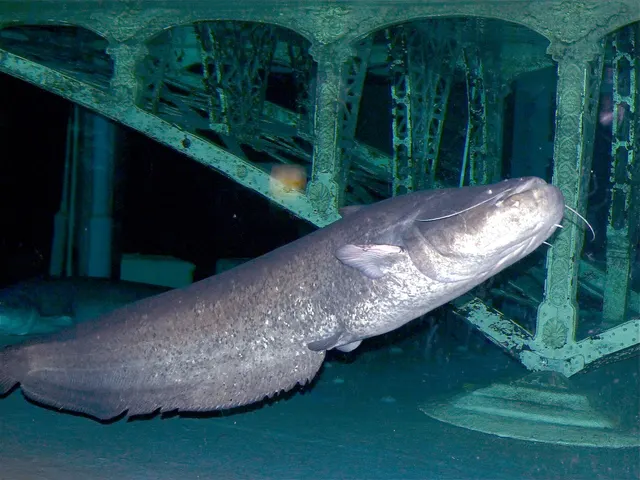 Wels catfishEurope's largest freshwater fish, reaching well over two metres, and an expanding introduced range that has made it one of the continent's most contested species.
Bernard DUPONT from FRANCE — CC BY-SA 2.0, via Wikimedia Commons
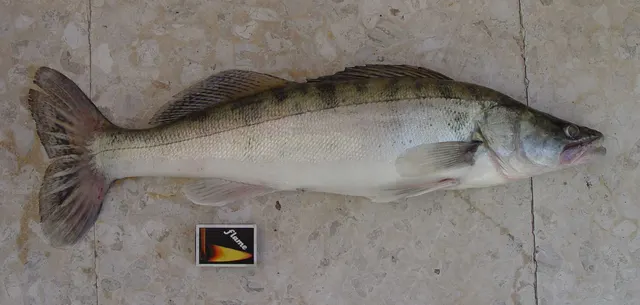 ZanderA shoaling freshwater predator built for hunting in low light and coloured water, and the fish that made a virtue of the conditions pike find difficult.
eLNuko — Public domain, via Wikimedia Commons
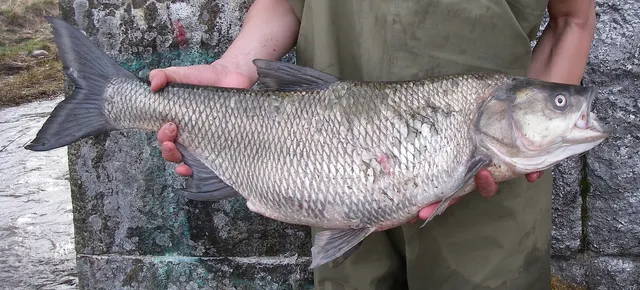 AspEurope's largest predatory cyprinid, a fast open-water hunter that smashes into baitfish shoals at the surface and is fished like a saltwater predator.
Jenny Glans — CC BY-SA 3.0, via Wikimedia Commons
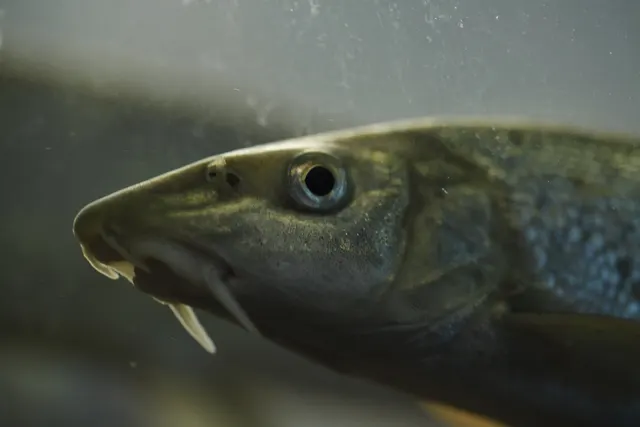 BarbelA powerful, streamlined river cyprinid built for holding station in fast water — and the hardest-fighting freshwater fish most British anglers will meet.
Pmau, CC BY-SA 4.0, via Wikimedia Commons
Safety
Boat traffic and being seen — Can cause serious injury or death
The Danube is a working commercial waterway along most of its length. Barge convoys are large, fast and unable to manoeuvre or stop for small craft, and the wash from a passing vessel arrives as a genuine wave that can swamp a small boat or sweep an angler off a low bank.
What reduces it: Stay out of the navigation channel, never anchor in it, keep well clear of moored and moving commercial vessels, expect wash after every passing barge and secure gear and footing before it arrives, and be visible — lights and a marker on a small boat are not optional here.
Moving water and currents — Can cause serious injury or death
Barrages create fast water, powerful undertow and abrupt level changes below them, and releases move water on an operational schedule with no weather to warn of it. The lower river is turbid enough that depth, obstruction and current line are all invisible from the surface.
What reduces it: Keep well downstream of barrage structures, establish the release regime for an impounded stretch before fishing below it, do not wade a large turbid river, and treat a rising level as a reason to leave rather than a change in conditions.
Biosecurity and disease transfer — Can cause injury needing treatment
Mosquito-borne disease is a genuine consideration on the lower river and in the delta in season, and the delta is a wetland maze where mobile signal is unreliable and becoming lost by boat is a real possibility rather than a remote one.
What reduces it: Take medical advice on the lower river and delta before travelling, use effective repellent and cover up at dawn and dusk, and in the delta go with local knowledge, carry navigation that does not depend on signal, and tell someone your route and return time.
Further safety reading
- Boat safety for anglers — A working commercial waterway along most of its length, where barge convoys cannot stop for small craft and the wash from a passing vessel arrives as a genuine wave against a bank or a small boat.
Check the rules before you fish
Fishing laws, bylaws, access rules, seasons, bait restrictions and permitted methods vary by location and can change. Check the current rules from the relevant authority and the water you intend to fish before fishing.
Check with:
- Current national or regional law for where you are fishing
- Current local bylaws
- The relevant fisheries authority
- The landowner, club or fishery whose water it is
- Any restrictions specific to the species or the method you intend to use
Where to go next
What swims here
- AspA large predatory cyprinid of the middle and lower river, hunting in open water in a way few European cyprinids do.
- BarbelPresent through the faster gravel reaches, part of a cyprinid fauna that is both a fishery and the forage base for the river's predators.
- Wels catfishNative here, and reaching its greatest sizes in this basin. The contrast with the Ebro is the whole difference between a native fish and an introduced one.
- ZanderNative and widespread through the middle and lower river, supporting some of the best zander fishing in Europe.
How people fish here
Local knowledge
- Reading a river for fishA river that changes from cold impounded Alpine water to a vast turbid lowland channel over its length is four reading problems rather than one, and the same water sense does not transfer between them.
- Why fish migrateThe Danube's sturgeons ran from the Black Sea far up the river, and barrages cut the route. Migration is not a detail of their biology here — it is the thing that was taken away.
How this compares
- The River EbroThe Ebro's catfish came from the Danube basin, where they are native. Reading the two records together is the clearest way to see what an introduction is: the same fish, celebrated as a destination on one river and unremarkable on the other.
- The Soča and Slovenia's Adriatic riversThe comparison that explains the biology. The Soča drains SOUTH to the Adriatic where the Danube runs east to the Black Sea, and that isolation is why the marble trout exists here and almost nowhere else.
Rules and access
Environment and conservation
Sources and evidence
- The IUCN Red List of Threatened Species — International Union for Conservation of Nature (Conservation authority)Relied on for: Global extinction-risk assessment, population trend and identified threats for the species concerned.States this directlyCitation checked — the work exists and is described correctly
- FishBase: a global information system on fishes — Froese, R. and D. Pauly, eds. — FishBase Consortium (Scientific institute)Relied on for: Distribution, habitat association, life history, size and feeding behaviour recorded for the species concerned.States this directlyPassage read and verified
- Code of Conduct for Responsible Fisheries — Food and Agriculture Organization of the United Nations, Rome, 1995 (Standards body)Relied on for: International principles for responsible fisheries, including the layering of national and regional authority and the management of shared and transboundary waters.States this directlyCitation checked — the work exists and is described correctly
Why the 12 connections on this page are here, and the sources
What swims here
Backed by research — 4 connections
Supported by peer-reviewed research or fisheries science. The sources are listed and can be checked.
Asp
A distributional claim taken from reference works and databases on the fishes of the region rather than from angling report. It states presence and asserts nothing about a fishery.
- FishBase: a global information system on fishes — Froese, R. and D. Pauly, eds. — FishBase Consortium (Scientific institute)Relied on for: Distribution, habitat association, life history and size recorded for the species concerned.States this directlyPassage read and verified
- Freshwater Fishes of the British Isles — HarperCollins (New Naturalist 75), 1992 (Reference work)Relied on for: Biology, distribution, life history and conservation status of northern European freshwater and diadromous fishes.States this directlyCitation checked — the work exists and is described correctly
Barbel
A distributional claim taken from reference works and databases on the fishes of the region rather than from angling report. It states presence and asserts nothing about a fishery.
- FishBase: a global information system on fishes — Froese, R. and D. Pauly, eds. — FishBase Consortium (Scientific institute)Relied on for: Distribution, habitat association, life history and size recorded for the species concerned.States this directlyPassage read and verified
- Freshwater Fishes of the British Isles — HarperCollins (New Naturalist 75), 1992 (Reference work)Relied on for: Biology, distribution, life history and conservation status of northern European freshwater and diadromous fishes.States this directlyCitation checked — the work exists and is described correctly
Wels catfish
A distributional claim taken from reference works and databases on the fishes of the region rather than from angling report. It states presence and asserts nothing about a fishery.
- FishBase: a global information system on fishes — Froese, R. and D. Pauly, eds. — FishBase Consortium (Scientific institute)Relied on for: Distribution, habitat association, life history and size recorded for the species concerned.States this directlyPassage read and verified
- Freshwater Fishes of the British Isles — HarperCollins (New Naturalist 75), 1992 (Reference work)Relied on for: Biology, distribution, life history and conservation status of northern European freshwater and diadromous fishes.States this directlyCitation checked — the work exists and is described correctly
Zander
A distributional claim taken from reference works and databases on the fishes of the region rather than from angling report. It states presence and asserts nothing about a fishery.
- FishBase: a global information system on fishes — Froese, R. and D. Pauly, eds. — FishBase Consortium (Scientific institute)Relied on for: Distribution, habitat association, life history and size recorded for the species concerned.States this directlyPassage read and verified
- Freshwater Fishes of the British Isles — HarperCollins (New Naturalist 75), 1992 (Reference work)Relied on for: Biology, distribution, life history and conservation status of northern European freshwater and diadromous fishes.States this directlyCitation checked — the work exists and is described correctly
How people fish here
What experienced anglers do — 1 connection
Widely and independently recommended by experienced anglers and specialist sources. This is real angling knowledge, not proof: controlled evidence for it is limited, and FishingHQ records it as convention rather than as a demonstrated effect.
Predator fishing
Which branch of fishing dominates a water is a statement about practice rather than about the place, and is recorded as convention.
- General angling website restatements of established technique — Various (Credible secondary source)Relied on for: Widely restated descriptions of European venue character and method convention, recorded as consensus rather than as scholarship.Background and mechanism onlyCitation checked — the work exists and is described correctly
- Angling Times — Bauer Media (Specialist angling publication)Relied on for: Contemporary angling practice as reported by practitioners, including continental destination fishing undertaken from the UK.States this directlyCitation checked — the work exists and is described correctly
Local knowledge
What experienced anglers do — 2 connections
Widely and independently recommended by experienced anglers and specialist sources. This is real angling knowledge, not proof: controlled evidence for it is limited, and FishingHQ records it as convention rather than as a demonstrated effect.
Reading a river for fish
A place joined to the mechanism that explains what is distinctive about fishing there, which is what makes a location page transferable rather than local colour.
- General angling website restatements of established technique — Various (Credible secondary source)Relied on for: Widely restated descriptions of European venue character and method convention, recorded as consensus rather than as scholarship.Background and mechanism onlyCitation checked — the work exists and is described correctly
- Angling Times — Bauer Media (Specialist angling publication)Relied on for: Contemporary angling practice as reported by practitioners, including continental destination fishing undertaken from the UK.States this directlyCitation checked — the work exists and is described correctly
Why fish migrate
A place joined to the mechanism that explains what is distinctive about fishing there, which is what makes a location page transferable rather than local colour.
- The IUCN Red List of Threatened Species — International Union for Conservation of Nature (Conservation authority)Relied on for: Extinction-risk assessment, population trend and the threats identified for freshwater and diadromous species, including barriers to migration and exploitation.States this directlyCitation checked — the work exists and is described correctly
- Code of Conduct for Responsible Fisheries — Food and Agriculture Organization of the United Nations, Rome, 1995 (Standards body)Relied on for: International principles for responsible fisheries, including the management of shared and transboundary waters and of introduced species.States this directlyCitation checked — the work exists and is described correctly
How this compares
What experienced anglers do — 2 connections
Widely and independently recommended by experienced anglers and specialist sources. This is real angling knowledge, not proof: controlled evidence for it is limited, and FishingHQ records it as convention rather than as a demonstrated effect.
The River Ebro
Two records a reader will hold together, joined where the comparison teaches something neither states alone.
- General angling website restatements of established technique — Various (Credible secondary source)Relied on for: Widely restated descriptions of European venue character and method convention, recorded as consensus rather than as scholarship.Background and mechanism onlyCitation checked — the work exists and is described correctly
- Angling Times — Bauer Media (Specialist angling publication)Relied on for: Contemporary angling practice as reported by practitioners, including continental destination fishing undertaken from the UK.States this directlyCitation checked — the work exists and is described correctly
The Soča and Slovenia's Adriatic rivers
A navigational claim that two places pose the same problem differently and that a reader on one is likely to want the other.
- Angling Times — Bauer Media (Specialist angling publication)Relied on for: Contemporary British angling practice as reported week by week, across coarse, game and sea fishing, including which waters are fished for what.States this directlyCitation checked — the work exists and is described correctly
- General angling website restatements of established technique — Various (Credible secondary source)Relied on for: Widely restated descriptions of regional angling practice, recorded as consensus rather than as scholarship.Background and mechanism onlyCitation checked — the work exists and is described correctly
Safety reading
Official guidance — 1 connection
Stated by a fisheries authority, scientific institute or recognised angling body. Authoritative, but summarising rather than demonstrating.
Boat safety for anglers
A hazard characteristic of the water, joined to the topic that treats it in full, on guidance published by water safety bodies.
- RNLI water safety guidance: cold water shock and Float to Live — Royal National Lifeboat Institution (Water-safety or diver-training authority)Relied on for: Water safety guidance including immersion, cold water shock and the circumstances in which water users get into difficulty.States this directlyPassage read and verified
- RoSPA water safety information and UK accidental drowning statistics — Royal Society for the Prevention of Accidents (Water-safety or diver-training authority)Relied on for: Accident-prevention guidance on inland and open water, including small craft, banks, exposure and lone working.States this directlyPassage read and verified
Rules and access
Official guidance — 1 connection
Stated by a fisheries authority, scientific institute or recognised angling body. Authoritative, but summarising rather than demonstrating.
Who regulates fishing, and how to find your rules
This points to the kind of rule that applies rather than to a rule itself. The structure is described from published sources; what any current rule requires is a matter for the competent authority and is not stated here.
- Code of Conduct for Responsible Fisheries — Food and Agriculture Organization of the United Nations, Rome, 1995 (Standards body)Relied on for: International principles for responsible fisheries including the role, layering and co-ordination of national and regional authorities over shared waters.States this directlyCitation checked — the work exists and is described correctly
- Good Fish Guide — Marine Conservation Society (Conservation authority)Relied on for: Synthesis of stock and management information across jurisdictions, including how measures are set and revised.Background and mechanism onlyCitation checked — the work exists and is described correctly
Environment and conservation
Official guidance — 1 connection
Stated by a fisheries authority, scientific institute or recognised angling body. Authoritative, but summarising rather than demonstrating.
Fish stocks and sustainability
An environmental claim about a named water, limited to what the cited assessment and international guidance set out.
- The IUCN Red List of Threatened Species — International Union for Conservation of Nature (Conservation authority)Relied on for: Extinction-risk assessment, population trend and the threats identified for freshwater and diadromous species, including barriers to migration and exploitation.States this directlyCitation checked — the work exists and is described correctly
- Code of Conduct for Responsible Fisheries — Food and Agriculture Organization of the United Nations, Rome, 1995 (Standards body)Relied on for: International principles for responsible fisheries, including the management of shared and transboundary waters and of introduced species.States this directlyCitation checked — the work exists and is described correctly
How FishingHQ labels evidence is explained in the evidence policy.