Lobworms and worms
Bait · Last reviewed 2026-08-10
The oldest fishing bait there is, and still among the most effective for almost every freshwater species — and one nearly everybody can obtain.
- What it actually is
- Chiefly Lumbricus terrestris (lobworm), Eisenia hortensis (dendrobaena) and Eisenia fetida (brandling or tiger worm).
- How long it keeps
- Weeks to months in cool, damp bedding that is checked and cleaned periodically. Days at ambient summer temperature in a sealed tub, where they will die and foul quickly.
Worms have been catching fish for as long as anybody has been fishing, and they remain among the most reliable baits in fresh water. Almost every species will take one: perch and chub enthusiastically, barbel and tench readily, carp and bream regularly, and even trout and salmon in coloured water where it is permitted.
The reason is straightforward. A worm is a large, high-protein, strongly-scented item that moves, and it is something fish encounter naturally when rain washes soil into a river. That last point is the practical one: worms fish best when a river is rising and coloured, because that is exactly when fish expect them.
Several species are used and they behave quite differently. The lobworm is large, and it is the specimen bait. Dendrobaenas are tough, active and hold on a hook well. Brandlings are small, produce a yellow fluid when hooked, and are a good small-fish bait. Which one to use is a question about the size of fish rather than about the species of worm.
What it is
Lobworms are large — up to 20 cm extended — soft, pinkish-brown, with a pronounced saddle and a flattened tail. Dendrobaenas are shorter, thicker, banded and considerably tougher, which is why they stay on a hook better. Brandlings are small, strongly striped, and release a pungent yellow fluid when damaged, which some anglers regard as an attractant and others as a deterrent.
Fish it catches
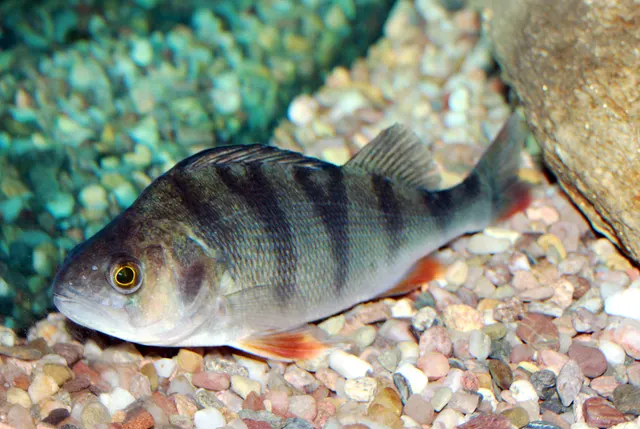 European perchA worm is the bait that catches a perch when nothing else will, and the one most people have access to.
- GudgeonA fragment of worm on a small hook, fished on the bottom, is the most reliable gudgeon bait there is — the barbels find it by scent in water where a sight feeder could not.
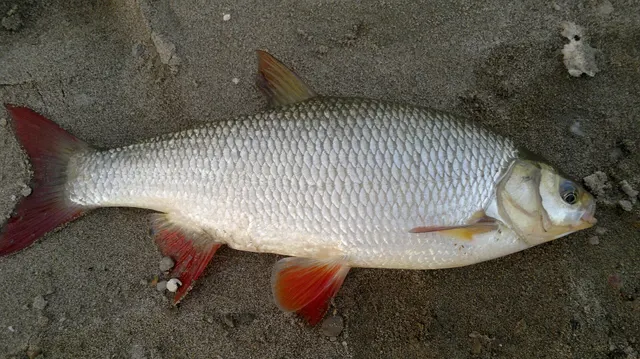 IdeWorm baits fished on float and feeder tackle in larger rivers.
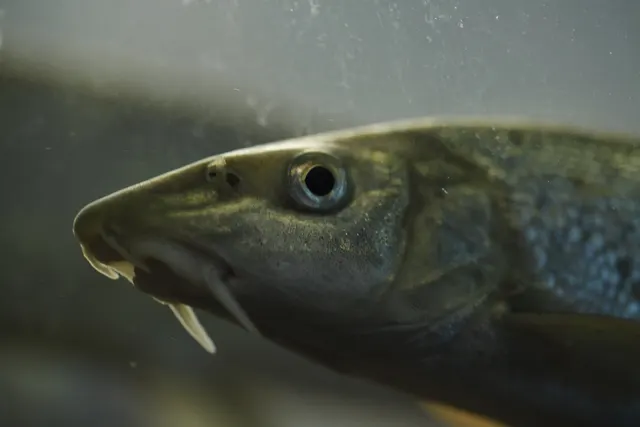 BarbelA powerful, streamlined river cyprinid built for holding station in fast water — and the hardest-fighting freshwater fish most British anglers will meet.
Finding and obtaining it
Dendrobaenas and brandlings are farmed and sold by weight; both are also readily cultivated at home in a wormery, which is by some distance the cheapest and most reliable supply. Lobworms are collected from short grass at night after rain, when they lie out on the surface — approached slowly with a dim, preferably red-filtered light and picked before they retract. Collect from your own ground or with permission; collecting from land you do not have permission to be on is trespass regardless of what you are collecting.
Keeping and storing it
Cool, dark, moist but not wet, in a container with air. Worms keep well for weeks in damp shredded newspaper, coir or leaf mould at a few degrees above freezing, and lobworms in particular toughen and become better bait after a week or two in clean damp bedding — a process anglers call scouring, which empties the gut and firms the body. Remove any dead worms promptly; one decaying worm will spoil a container.
Keeping it alive
Worms need damp bedding, air, cool temperatures and darkness. They do not need feeding over an angling timescale, though a wormery for long-term culture does. Never leave a bait box of worms in direct sun or in a car, which kills them within minutes.
Preparing it
Scour lobworms in damp moss or clean bedding for a week or two if you can; it toughens them, makes them lighter in colour and much livelier on the hook. Chop worms for feed where a strong scent trail is wanted — chopped worm is a distinct and very effective loose feed in its own right. Sort by size before a session so you are not searching for the right worm in the dark.
Using it
For a whole lobworm, hook it once through the saddle so both ends are free to move, or thread the head on and leave a long tail. For dendrobaenas, hook through the collar and let the body hang, or use two or three on a larger hook. For small fish, half a worm or a small brandling is enough. The commonest presentation error is burying the whole worm on the hook so that nothing moves — the movement is a large part of what a worm offers.
Disposing of what is left
Take unused worms home and keep them; they are the easiest bait of all to reuse. Do not release worms into the wild where you have been fishing. Composting or wormery species are frequently not local, and introducing non-local earthworm species has documented ecological effects in some regions — a consideration that matters far more in North America and northern Europe than most anglers realise. Unwanted worms go into a wormery or into domestic compost, not onto the bank.
Biosecurity
The worms themselves present a very low risk to fish. The bedding, the water in the tub and the container do not: rinse and dry between waters. Do not introduce worm bedding into a fishery.
Check the rules before you fish
Fishing laws, bylaws, access rules, seasons, bait restrictions and permitted methods vary by location and can change. Check the current rules from the relevant authority and the water you intend to fish before fishing.
Check with:
- Current national or regional law for where you are fishing
- Current local bylaws
- The relevant fisheries authority
- The landowner, club or fishery whose water it is
- Any restrictions specific to the species or the method you intend to use
Where to go next
How it is fished
Instead of this
More baits
Not related to this page — just the rest of the section. There is little else joined to this subject yet, and a short page should still lead somewhere.
Sources and evidence
Why the 7 connections on this page are here, and the sources
Fish it catches
What experienced anglers do — 4 connections
Widely and independently recommended by experienced anglers and specialist sources. This is real angling knowledge, not proof: controlled evidence for it is limited, and FishingHQ records it as convention rather than as a demonstrated effect.
European perch
Long-established and independently described.
- Coarse Fishing — A. & C. Black, 1912 (Specialist angling publication)Relied on for: Worm baits for perch and general coarse fishing.Citation checked — the work exists and is described correctly
- Angling Times — Bauer Media (Specialist angling publication)Relied on for: Contemporary worm practice for perch.Citation checked — the work exists and is described correctly
Gudgeon
A statement about bait convention for a species, which is practice rather than biology.
- Coarse Fishing — A. & C. Black, 1912 (Specialist angling publication)Relied on for: Established coarse angling practice, including method selection, presentation and the reasoning behind them.States this directlyCitation checked — the work exists and is described correctly
- Freshwater Fishing — Macdonald & Jane's, 1975 (Specialist angling publication)Relied on for: Freshwater angling technique and the principles behind method selection.States this directlyCitation checked — the work exists and is described correctly
- General angling website restatements of established technique — Various (Credible secondary source)Relied on for: Widely restated angling practice, recorded as consensus rather than as scholarship.Background and mechanism onlyCitation checked — the work exists and is described correctly
Ide
A practitioner claim about tackle commonly used for Leuciscus idus.
- General angling website restatements of established technique — Various (Credible secondary source)Relied on for: Widely restated practitioner accounts of this presentation for ide.Citation checked — the work exists and is described correctly
- Angling Times — Bauer Media (Specialist angling publication)Relied on for: Practitioner treatment of comparable presentations for the species group.Citation checked — the work exists and is described correctly
Barbel
Established river practice, independently described.
- Freshwater Fishing — Macdonald & Jane's, 1975 (Specialist angling publication)Relied on for: Worm baits for barbel and chub in rivers.Citation checked — the work exists and is described correctly
- Angling Times — Bauer Media (Specialist angling publication)Relied on for: Contemporary worm practice for barbel.Citation checked — the work exists and is described correctly
How it is fished
What experienced anglers do — 2 connections
Widely and independently recommended by experienced anglers and specialist sources. This is real angling knowledge, not proof: controlled evidence for it is limited, and FishingHQ records it as convention rather than as a demonstrated effect.
Float fishing
The worm record's stated presentation error is burying the worm so nothing moves. A float holds a worm clear of the bottom with both ends free, which is the presentation that error is defined against.
- Coarse Fishing — A. & C. Black, 1912 (Specialist angling publication)Relied on for: Specialist treatment of which bait or lure family this technique is fished with.States this directlyCitation checked — the work exists and is described correctly
- Angling Times — Bauer Media (Specialist angling publication)Relied on for: The independently restated practitioner pairing of this technique with this family.Background and mechanism onlyCitation checked — the work exists and is described correctly
Ledgering
The worm is the oldest bottom bait and needs no buoyancy or visibility to work. Ledgering presents it on the bottom in flow or at range, which are the two conditions the float page names as its own limitations.
- Coarse Fishing — A. & C. Black, 1912 (Specialist angling publication)Relied on for: Specialist treatment of which bait or lure family this technique is fished with.States this directlyCitation checked — the work exists and is described correctly
- Angling Times — Bauer Media (Specialist angling publication)Relied on for: The independently restated practitioner pairing of this technique with this family.Background and mechanism onlyCitation checked — the work exists and is described correctly
Instead of this
What experienced anglers do — 1 connection
Widely and independently recommended by experienced anglers and specialist sources. This is real angling knowledge, not proof: controlled evidence for it is limited, and FishingHQ records it as convention rather than as a demonstrated effect.
Maggots
The functional distinction is standard in coarse practice.
- Coarse Fishing — A. & C. Black, 1912 (Specialist angling publication)Relied on for: The comparative use of worm and maggot baits.Citation checked — the work exists and is described correctly
- Angling Times — Bauer Media (Specialist angling publication)Relied on for: Contemporary bait selection between worm and maggot.Citation checked — the work exists and is described correctly
How FishingHQ labels evidence is explained in the evidence policy.