Chalk streams
Habitat · Last reviewed 2026-08-10
Rivers fed by groundwater filtering through chalk — exceptionally clear, thermally stable, and globally rare.
- Water
- Freshwater
A chalk stream is fed not by surface run-off but by groundwater emerging from a chalk aquifer. The chalk acts as an enormous filter and reservoir: rainfall percolates through it slowly, emerges filtered clean, and emerges at a temperature very close to the annual average all year round.
That produces a river unlike almost any other. The water is extraordinarily clear. The flow is stable, without the flashy rise-and-fall of a rain-fed river. The temperature barely varies between summer and winter. The water is alkaline and mineral-rich. And the bed is clean gravel rather than silt.
The biological consequence is enormous productivity of exactly the right kind: dense beds of water crowfoot, prolific invertebrate life, and reliable insect hatches. That is why chalk streams became the crucible of dry fly fishing, and it is why they are among the most heavily protected freshwater habitats in Europe — there are very few of them in the world, and most are in southern England.
What characterises it
Groundwater-fed rivers rising from chalk aquifers. Water emerges filtered, alkaline, mineral-rich and at close to the local mean annual air temperature, giving remarkably stable flow and temperature through the year. Beds are typically clean gravel with dense stands of submerged crowfoot; banks are often low and the gradient gentle. Clarity is exceptional, and the same clarity that makes them famous makes the fish in them exceptionally difficult to approach.
What lives there
The combination of stable temperature, alkalinity and clean gravel produces very high invertebrate productivity — mayfly, caddis, shrimp and snails in dense populations — which in turn supports high densities of trout and grayling. Water crowfoot beds are structurally central: they oxygenate, trap silt, provide invertebrate habitat and create the varied flow that fish hold in. Chalk stream ecology is highly sensitive to two things above all: abstraction, which reduces the flow that keeps gravels clean, and siltation, which suffocates them.
Through the year
Far less seasonally variable than rain-fed rivers, which is the defining characteristic. Flow peaks in late winter and spring as the aquifer discharges and falls through summer and autumn. Insect hatches follow a well-documented calendar, with the large spring mayfly hatch being the most conspicuous event of the year. Weed growth accumulates through summer and is traditionally cut in managed fisheries. Because temperature is so stable, fish remain active year-round to a far greater degree than in a rain-fed river.
Some of what lives here
Fish recorded here that FishingHQ holds a reviewed photograph of. It is not a complete list of what Chalk streams holds, and it is not a prediction that you will catch any of them — it is a way in to the ones we can show you.
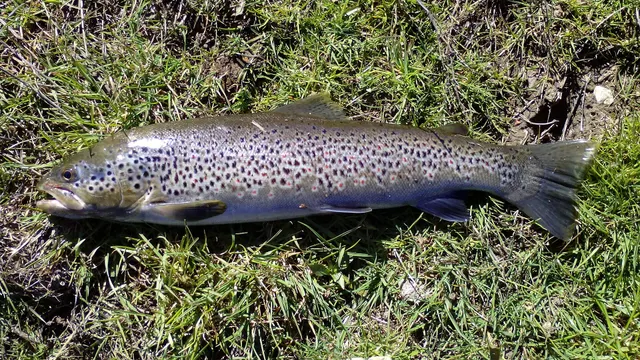 Brown troutA single, extraordinarily plastic species that appears as a tiny hill-stream fish, a deep-bodied loch trout and a silver sea-run migrant — all the same animal.
Robermix, CC0, via Wikimedia Commons
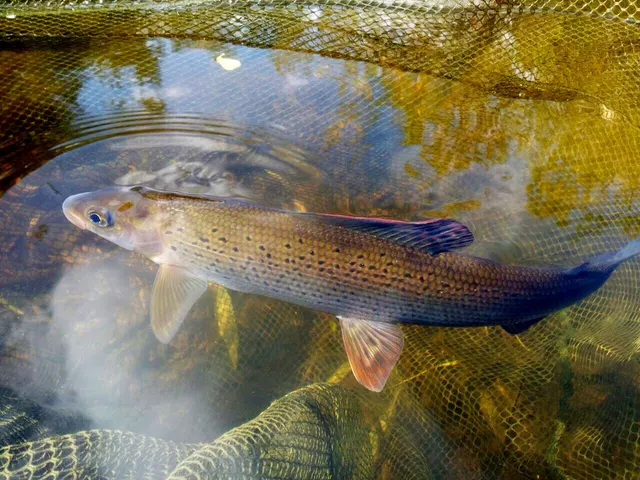 GraylingA salmonid with a sail for a dorsal fin that feeds hard through the winter — which makes it the game angler's season when the trout season has closed.
High Plains Grifter — CC BY-SA 4.0, via Wikimedia Commons
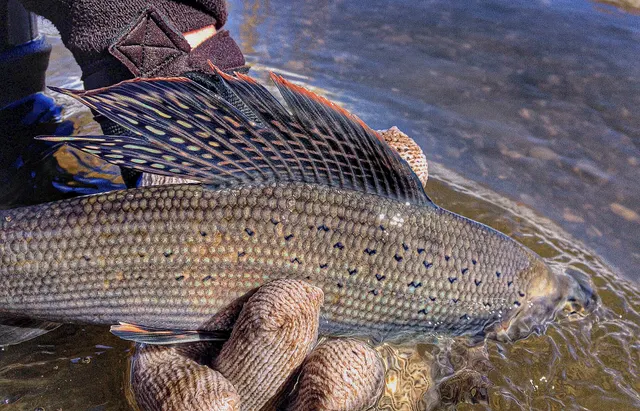 Arctic graylingA northern river salmonid with an enormous sail-like dorsal fin, feeding on drifting insects in cold clear water across Arctic North America and Siberia.
U.S. Fish and Wildlife Service — public domain, via Wikimedia Commons
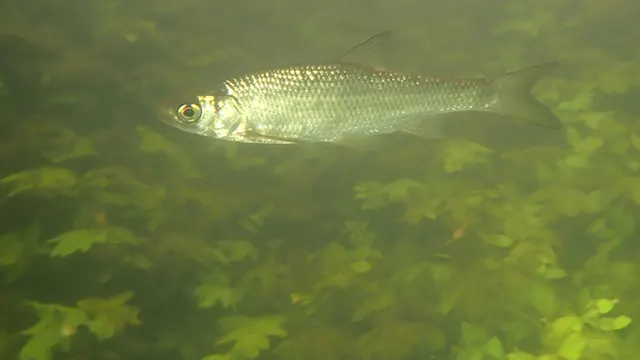 DaceA small, quick, silver river cyprinid separated from chub by the shape of one fin — the anal fin is concave in a dace and convex in a chub, and nothing else settles it as reliably.
Nicola Crockford — CC BY, via iNaturalist
Where to go next
Fish found here
- Arctic graylingHolds station in cold clear northern rivers intercepting drifting insects.
- AyuHolds and defends a feeding territory on algae-covered stones in clear rivers.
- Brown troutThe combination of stable temperature, alkalinity and clean gravel is close to ideal for trout, which is why chalk streams support the densities they do.
- DaceAbundant in the southern chalk streams, where clean gravel, steady flow and a heavy invertebrate drift suit the species exactly — and where they are frequently caught by trout anglers who did not want them.
- GraylingGrayling need clean, cool, well-oxygenated water over gravel, which is precisely what a chalk stream is — and their presence is treated as an indicator of it.
Reading this water
- Matching the hatch: what it means and when it is wrongWhere hatch matching works best and where the doctrine was written, which is also why it over-generalises. Clear shallow alkaline water with dense predictable hatches and visible feeding fish is the most favourable case in Britain, and a rule derived from the most favourable case travels badly to a spate river in coloured water.
- River levels, and what a flood changesThe counter-example, and the reason the record's spring-fed section exists: water filtered through porous rock produces a river that barely rises, barely colours and holds temperature — which is why its fishery is what it is.
- The insects fly fishing imitatesThe water that produced the discipline. Stable temperature, stable flow from an aquifer rather than from rainfall, and a weedy alkaline bed generate dense, predictable invertebrate populations and hatches that occur at a broadly forecastable time — which is what made matching a hatch a practical proposition rather than a hope.
How this compares
Sources and evidence
- JNCC species and habitat conservation advice — Joint Nature Conservation Committee (Conservation authority)Relied on for: The characterisation of chalk rivers as a distinct and highly protected habitat type dependent on groundwater-fed flow.FishingHQ's interpretation of what it saysCitation checked — the work exists and is described correctly
Why the 9 connections on this page are here, and the sources
Fish found here
Backed by research — 5 connections
Supported by peer-reviewed research or fisheries science. The sources are listed and can be checked.
Arctic grayling
A habitat association for Thymallus arcticus taken from the environment and distribution data on its FishBase summary.
- FishBase: a global information system on fishes — Froese, R. and D. Pauly, eds. — FishBase Consortium (Scientific institute)Relied on for: The environment, depth range and habitat description recorded for Thymallus arcticus.States this directlyPassage read and verified
Ayu
A habitat association for Plecoglossus altivelis taken from the environment and distribution data on its FishBase summary.
- FishBase: a global information system on fishes — Froese, R. and D. Pauly, eds. — FishBase Consortium (Scientific institute)Relied on for: The environment, depth range and habitat description recorded for Plecoglossus altivelis.States this directlyPassage read and verified
Brown trout
Habitat association and the ecological basis for it are documented.
- FishBase: a global information system on fishes — Froese, R. and D. Pauly, eds. — FishBase Consortium (Scientific institute)Relied on for: Habitat and water quality requirements for Salmo trutta.States this directlyPassage read and verified
- JNCC species and habitat conservation advice — Joint Nature Conservation Committee (Conservation authority)Relied on for: The characterisation of chalk rivers and their associated species.FishingHQ's interpretation of what it saysCitation checked — the work exists and is described correctly
Dace
A distributional claim about where a species is found, which is a claim about the world and rests on regional reference works rather than on angling report.
- Freshwater Fishes of the British Isles — HarperCollins (New Naturalist 75), 1992 (Reference work)Relied on for: Distribution, habitat association, identification and life history of the freshwater fishes of the British Isles.States this directlyCitation checked — the work exists and is described correctly
- FishBase: a global information system on fishes — Froese, R. and D. Pauly, eds. — FishBase Consortium (Scientific institute)Relied on for: Distribution, habitat association, depth range, diet and reproductive parameters recorded for the species.States this directlyPassage read and verified
Grayling
A habitat requirement claim held to a scientific standard, because it is used elsewhere in FishingHQ as an indicator of water quality and must be able to bear that weight.
- Freshwater Fishes of the British Isles — HarperCollins (New Naturalist 75), 1992 (Reference work)Relied on for: Habitat requirements of Thymallus thymallus in British and European rivers.States this directlyCitation checked — the work exists and is described correctly
- FishBase: a global information system on fishes — Froese, R. and D. Pauly, eds. — FishBase Consortium (Scientific institute)Relied on for: Habitat and water-quality preferences recorded for the species.States this directlyPassage read and verified
Reading this water
What experienced anglers do — 2 connections
Widely and independently recommended by experienced anglers and specialist sources. This is real angling knowledge, not proof: controlled evidence for it is limited, and FishingHQ records it as convention rather than as a demonstrated effect.
Matching the hatch: what it means and when it is wrong
A fish or a water joined to the fly-fishing mechanism it is a worked example of, written only where the subject's own behaviour or physical character is what this page explains. The direction is the one FishingHQ writes this kind of connection in, and the one it already uses 176 times, and it is also the semantically correct one: the mechanism explains the fish, not the reverse.
- Still Water Fly-Fishing — Andre Deutsch, 1952 (Specialist angling publication)Relied on for: Stillwater fly practice: line density and depth, leader construction, fly selection against the food present, and the behaviour of stocked and wild trout in still water.States this directlyCitation checked — the work exists and is described correctly
- Trout & Salmon — Bauer Media (Specialist angling publication)Relied on for: Long-running published description of British game angling practice: river and stillwater trout, grayling and salmon fishing, and the presentation each demands.States this directlyCitation checked — the work exists and is described correctly
The insects fly fishing imitates
A fish or a water joined to the fly-fishing mechanism it is a worked example of, written only where the subject's own behaviour or physical character is what this page explains. The direction is the one FishingHQ writes this kind of connection in, and the one it already uses 176 times, and it is also the semantically correct one: the mechanism explains the fish, not the reverse.
- Still Water Fly-Fishing — Andre Deutsch, 1952 (Specialist angling publication)Relied on for: Stillwater fly practice: line density and depth, leader construction, fly selection against the food present, and the behaviour of stocked and wild trout in still water.States this directlyCitation checked — the work exists and is described correctly
- Trout & Salmon — Bauer Media (Specialist angling publication)Relied on for: Long-running published description of British game angling practice: river and stillwater trout, grayling and salmon fishing, and the presentation each demands.States this directlyCitation checked — the work exists and is described correctly
Backed by research — 1 connection
Supported by peer-reviewed research or fisheries science. The sources are listed and can be checked.
River levels, and what a flood changes
A link from a practice, an environment or a geography to the mechanism it rests on. It asserts that the mechanism is load-bearing here rather than merely relevant, which is the test applied throughout this file.
- Freshwater Fishes of the British Isles — HarperCollins (New Naturalist 75), 1992 (Reference work)Relied on for: Ecology, habitat requirement and behaviour of European freshwater fishes in relation to flow, temperature, level and the modification of their waters.States this directlyCitation checked — the work exists and is described correctly
- The European Environment Agency's assessments of Europe's waters, seas and coasts — European Environment Agency, Copenhagen (Conservation authority)Relied on for: Assessment of Europe's surface waters, including regulation, abstraction, hydromorphological modification and the barriers those produce.States this directlyCitation checked — the work exists and is described correctly
How this compares
What experienced anglers do — 1 connection
Widely and independently recommended by experienced anglers and specialist sources. This is real angling knowledge, not proof: controlled evidence for it is limited, and FishingHQ records it as convention rather than as a demonstrated effect.
The Hampshire chalk streams
Two places or records a reader will hold together, joined where the comparison teaches something neither states alone.
- Trout & Salmon — Bauer Media (Specialist angling publication)Relied on for: Contemporary British game angling practice as reported by practitioners, including river condition and technique.States this directlyCitation checked — the work exists and is described correctly
- Freshwater Fishing — Macdonald & Jane's, 1975 (Specialist angling publication)Relied on for: Comprehensive British freshwater angling practice including river craft and the reasoning behind method choices.States this directlyCitation checked — the work exists and is described correctly
How FishingHQ labels evidence is explained in the evidence policy.