Arctic grayling
Fish · Last reviewed 2026-08-10
A northern river salmonid with an enormous sail-like dorsal fin, feeding on drifting insects in cold clear water across Arctic North America and Siberia.
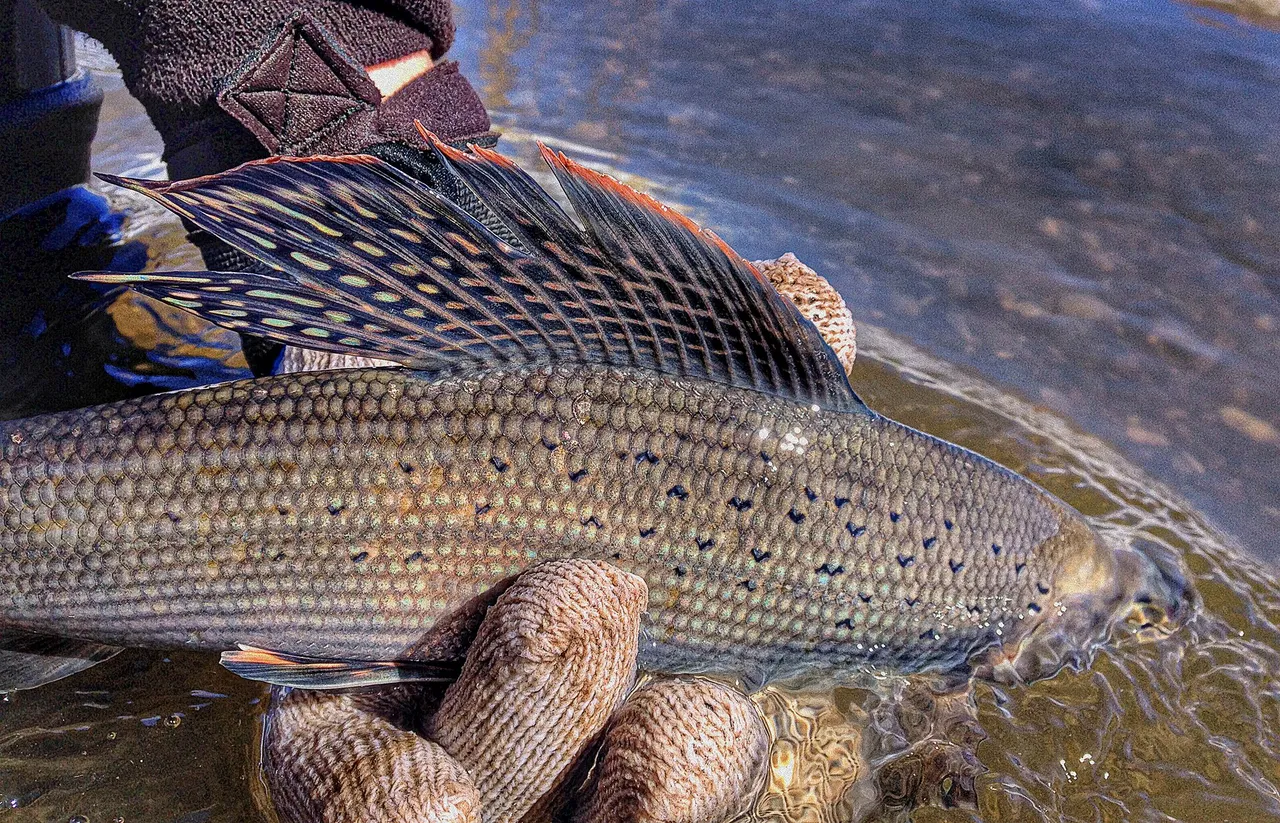
How this was identified, and who took it
Identified by: The genus is unambiguous: nothing else in range carries a dorsal of this size marked with rows of iridescent ocelli and fringed orange. Within Thymallus, the very large sail-like dorsal with multiple spot rows suits T. arcticus rather than the smaller-finned T. thymallus, and provenance — a male trapped on Red Rock Creek, Montana, by USFWS — is inside the native range and outside the European species' range. The dark shoulder chevrons are supporting only; their number varies.U.S. Fish and Wildlife Service — public domain, via Wikimedia Commons — source, licence
Catching Arctic grayling
Everything here on fishing for it. Each entry opens the page behind it.
Arctic grayling is the northern counterpart of the European grayling, and it carries the family's defining feature in an even more extravagant form: a huge sail-like dorsal fin, often spotted and edged in violet or orange, which the fish raises in display and in current.
It is a fish of cold, clear, fast rivers and lakes across northern North America and Siberia — one of the characteristic species of Arctic and sub-Arctic drainages, where it occupies the niche trout hold further south.
It feeds almost entirely on drifting invertebrates taken at or near the surface, which makes it an exceptional dry-fly target and an unusually reliable one in water that holds little else.
How it is caught
Gear for this fish
Identification
- Scientific name
- Thymallus arcticus
- Family
- Salmonidae
- Water
- Freshwater
- Conservation status
- Least Concern
- Regions
- North America, Arctic & Subarctic, East Asia
- A very large sail-like dorsal fin, spotted in rows and often edged with violet, orange or pink — larger than in any other salmonid.
- Adipose fin present, and a small terminal mouth suited to picking small prey from the drift.
- Silver-grey to purple-grey flanks with large scales and scattered dark spots on the forward body.
- Deeply forked tail and a slender body form.
Size
- Typical
- 0.3–0.8 kg (10 oz–1.8 lb)
- Large
- 1–1.6 kg (2.2–3.5 lb)
Exceptional: FishBase records a maximum of 76 cm and 3.8 kg
Cold clear northern rivers, and a fish that runs to find them
Arctic grayling habitat is a cold-water river specification with a migratory component that the European grayling does not share, and the migration is the interesting part.
THE WATER MUST BE COLD, CLEAN AND WELL OXYGENATED. Arctic grayling occupy rivers, streams and lakes across northern North America and northern Asia, and they require the cold, clear, low-nutrient conditions those systems provide. They are among the first species lost when a northern river warms, silts or is enriched.
WITHIN A RIVER THEY OCCUPY DRIFT-FEEDING POSITIONS, exactly as their European relative does: steady runs and glides over clean gravel, taking invertebrates carried on the current, shoaling rather than holding individual stations against cover.
BUT THEY MOVE BETWEEN HABITATS SEASONALLY, AND SUBSTANTIALLY. Many populations undertake three distinct movements a year — to spawning tributaries in spring, to summer feeding reaches, and to overwintering areas in deep pools, lakes or main-stem holes that do not freeze to the bed. Those three habitats may be far apart, and the fish must be able to reach all of them.
WHICH MAKES CONNECTIVITY THE CRITICAL HABITAT VARIABLE. A culvert, a dewatered reach, a road crossing or a low-flow barrier between summer feeding water and overwintering water removes a population from a river that still looks entirely suitable. This is the commonest way Arctic grayling are lost, and it is invisible in summer.
OVERWINTERING HABITAT IS THE SCARCEST OF THE THREE. In a northern river most shallow water freezes, and the number of places deep enough to hold fish through winter is limited — so a long stretch of excellent summer habitat may depend on one deep pool.
LAKE POPULATIONS EXIST AND BEHAVE DIFFERENTLY, using the lake for feeding and overwintering and running into inlet or outlet streams to spawn.
AND THE SPECIES IS A GOOD INDICATOR PRECISELY BECAUSE IT NEEDS ALL OF THIS: cold, clean, connected and complex. Where it has been lost from southern parts of its range, connectivity and temperature are usually the reasons.
Backed by research — why, and the sources (2)
Supported by peer-reviewed research or fisheries science. The sources are listed and can be checked.
- Freshwater Fishes of the British Isles — HarperCollins (New Naturalist 75), 1992 (Reference work)Relied on for: Habitat association, spawning behaviour, seasonal activity and ecology of freshwater fishes, including position within a water body.States this directlyCitation checked — the work exists and is described correctly
- FishBase: a global information system on fishes — Froese, R. and D. Pauly, eds. — FishBase Consortium (Scientific institute)Relied on for: Habitat association, spawning season, temperature tolerance and water-type tolerance recorded for the species.States this directlyPassage read and verified
Lifecycle and reproduction
Slow-growing in cold northern water and moderately long-lived, maturing late relative to its size. Populations are vulnerable to overharvest precisely because growth is slow and the fish are easily caught.
Spawns in spring shortly after ice-out, in gravel-bottomed tributaries, without building a redd — eggs are scattered and settle into the substrate. No parental care.
Feeding and senses
Feeds on drifting aquatic insects, terrestrial insects taken from the surface, and occasionally on eggs and small fish. Holds station in current and intercepts food carried past.
An acute visual feeder in clear cold water, keying on small items in the drift. That reliance on sight is why the species is so responsive to dry flies and so affected by turbidity.
Through the year
Moves into tributaries to spawn after ice-out, feeds heavily through the short northern summer, and drops back to deeper river and lake habitat to overwinter.
Distribution
North America: widespread in Arctic drainages from Hudson Bay, Canada to Alaska and in Arctic and Pacific drainages to central Alberta and British Columbia in Canada; upper Missouri River drainage in Montana, USA. Formerly in Great Lakes basin in Michigan, USA . Arctic Ocean basin in Siberia from Ob to Yenisei drainages and in Europe in some tributaries of Pechora (Usa, Kosyu, Kozhim), Korotaikha and Kara
This is a biological range — where the species occurs, not a prediction that you will catch one. To browse the fishing geography FishingHQ holds, start at fishing places.
Why anglers care
A prized fly-fishing target across Alaska, northern Canada and Siberia, taken on dry flies and small nymphs in cold clear rivers. Its significance is both sporting and practical — in much of its range it is the most reliably catchable fish present, and its willingness to rise makes it exceptional dry-fly water. Because growth is slow and populations are easily depleted in remote rivers, catch-and-release is the prevailing practice among visiting anglers.
Handling and returning
A delicate salmonid that suffers quickly from handling and from warm water. Use barbless hooks, keep the fish in the water, handle with wet hands, and support it facing into current until it swims off. The large dorsal fin is easily damaged and should not be gripped.
Going further
- Arctic grayling vs Grayling — how to tell them apart.
Where to go next
Similar and related fish
Where it lives
Where you will find it
- AlaskaOccupies interior and northern rivers, moving seasonally between spawning tributaries, summer feeding reaches and deep overwintering water.
- CanadaOccupies cold, clean, connected rivers across the north and west, requiring separate spawning, feeding and overwintering habitat within reach of one another.
Sources and evidence
- FishBase: a global information system on fishes — Froese, R. and D. Pauly, eds. — FishBase Consortium (Scientific institute)Relied on for: Family, maximum size, depth and environment, distribution and the IUCN assessment for Thymallus arcticus.States this directlyPassage read and verified
- The IUCN Red List of Threatened Species — International Union for Conservation of Nature (Conservation authority)Relied on for: The Least Concern assessment for Thymallus arcticus, assessed 01 January 2008.States this directlyCitation checked — the work exists and is described correctly
Why the 9 connections on this page are here, and the sources
Similar and related fish
Backed by research — 1 connection
Supported by peer-reviewed research or fisheries science. The sources are listed and can be checked.
Grayling
An identification comparison naming both binomials: Thymallus arcticus and Thymallus thymallus.
- FishBase: a global information system on fishes — Froese, R. and D. Pauly, eds. — FishBase Consortium (Scientific institute)Relied on for: Morphological and distributional data for Thymallus arcticus and for Thymallus thymallus.States this directlyPassage read and verified
- The IUCN Red List of Threatened Species — International Union for Conservation of Nature (Conservation authority)Relied on for: Separate assessments treating Thymallus arcticus and Thymallus thymallus as distinct species.States this directlyCitation checked — the work exists and is described correctly
How it is caught
What experienced anglers do — 2 connections
Widely and independently recommended by experienced anglers and specialist sources. This is real angling knowledge, not proof: controlled evidence for it is limited, and FishingHQ records it as convention rather than as a demonstrated effect.
Dry fly fishing
A practitioner claim about how Thymallus arcticus is commonly fished, following from where and how it feeds.
- General angling website restatements of established technique — Various (Credible secondary source)Relied on for: Widely restated practitioner accounts of fishing for arctic grayling.Citation checked — the work exists and is described correctly
- Sea Angler — Bauer Media (Specialist angling publication)Relied on for: Practitioner treatment of the methods used for arctic grayling and comparable species.Citation checked — the work exists and is described correctly
Nymphing
A practitioner claim about how Thymallus arcticus is commonly fished, following from where and how it feeds.
- General angling website restatements of established technique — Various (Credible secondary source)Relied on for: Widely restated practitioner accounts of fishing for arctic grayling.Citation checked — the work exists and is described correctly
- Sea Angler — Bauer Media (Specialist angling publication)Relied on for: Practitioner treatment of the methods used for arctic grayling and comparable species.Citation checked — the work exists and is described correctly
Gear for this fish
What experienced anglers do — 2 connections
Widely and independently recommended by experienced anglers and specialist sources. This is real angling knowledge, not proof: controlled evidence for it is limited, and FishingHQ records it as convention rather than as a demonstrated effect.
Dry flies
A practitioner claim about tackle commonly used for Thymallus arcticus.
- General angling website restatements of established technique — Various (Credible secondary source)Relied on for: Widely restated practitioner accounts of this presentation for arctic grayling.Citation checked — the work exists and is described correctly
- Angling Times — Bauer Media (Specialist angling publication)Relied on for: Practitioner treatment of comparable presentations for the species group.Citation checked — the work exists and is described correctly
Nymphs
A practitioner claim about tackle commonly used for Thymallus arcticus.
- General angling website restatements of established technique — Various (Credible secondary source)Relied on for: Widely restated practitioner accounts of this presentation for arctic grayling.Citation checked — the work exists and is described correctly
- Angling Times — Bauer Media (Specialist angling publication)Relied on for: Practitioner treatment of comparable presentations for the species group.Citation checked — the work exists and is described correctly
Where it lives
Backed by research — 2 connections
Supported by peer-reviewed research or fisheries science. The sources are listed and can be checked.
Chalk streams
A habitat association for Thymallus arcticus taken from the environment and distribution data on its FishBase summary.
- FishBase: a global information system on fishes — Froese, R. and D. Pauly, eds. — FishBase Consortium (Scientific institute)Relied on for: The environment, depth range and habitat description recorded for Thymallus arcticus.States this directlyPassage read and verified
Lowland rivers
A habitat association for Thymallus arcticus taken from the environment and distribution data on its FishBase summary.
- FishBase: a global information system on fishes — Froese, R. and D. Pauly, eds. — FishBase Consortium (Scientific institute)Relied on for: The environment, depth range and habitat description recorded for Thymallus arcticus.States this directlyPassage read and verified
Where you will find it
Backed by research — 2 connections
Supported by peer-reviewed research or fisheries science. The sources are listed and can be checked.
Alaska
A distribution association between an animal and a kind of water, rather than a claim about any named mark.
- FishBase: a global information system on fishes — Froese, R. and D. Pauly, eds. — FishBase Consortium (Scientific institute)Relied on for: Distribution, habitat association and depth range recorded for the species, including its occurrence in the water body concerned.States this directlyPassage read and verified
- The IUCN Red List of Threatened Species — International Union for Conservation of Nature (Conservation authority)Relied on for: Assessment and range account for the species, including the systems and coasts it occupies.Background and mechanism onlyCitation checked — the work exists and is described correctly
Canada
A distribution association between an animal and a kind of water, rather than a claim about any named mark.
- FishBase: a global information system on fishes — Froese, R. and D. Pauly, eds. — FishBase Consortium (Scientific institute)Relied on for: Distribution, habitat association and depth range recorded for the species, including its occurrence in the water body concerned.States this directlyPassage read and verified
- The IUCN Red List of Threatened Species — International Union for Conservation of Nature (Conservation authority)Relied on for: Assessment and range account for the species, including the systems and coasts it occupies.Background and mechanism onlyCitation checked — the work exists and is described correctly
How FishingHQ labels evidence is explained in the evidence policy.