Arctic grayling vs Grayling
How to tell them apart, and what follows from getting it right.
Why they get confused
They are congeners that look almost identical: the same outsized sail dorsal, the same small mouth, the same silver-grey flank with scattered dark chevrons. Anglers who fish both continents routinely photograph one and caption it the other, and no anatomical character available in the field separates them cleanly.
Arctic grayling
Thymallus arcticus — Salmonidae
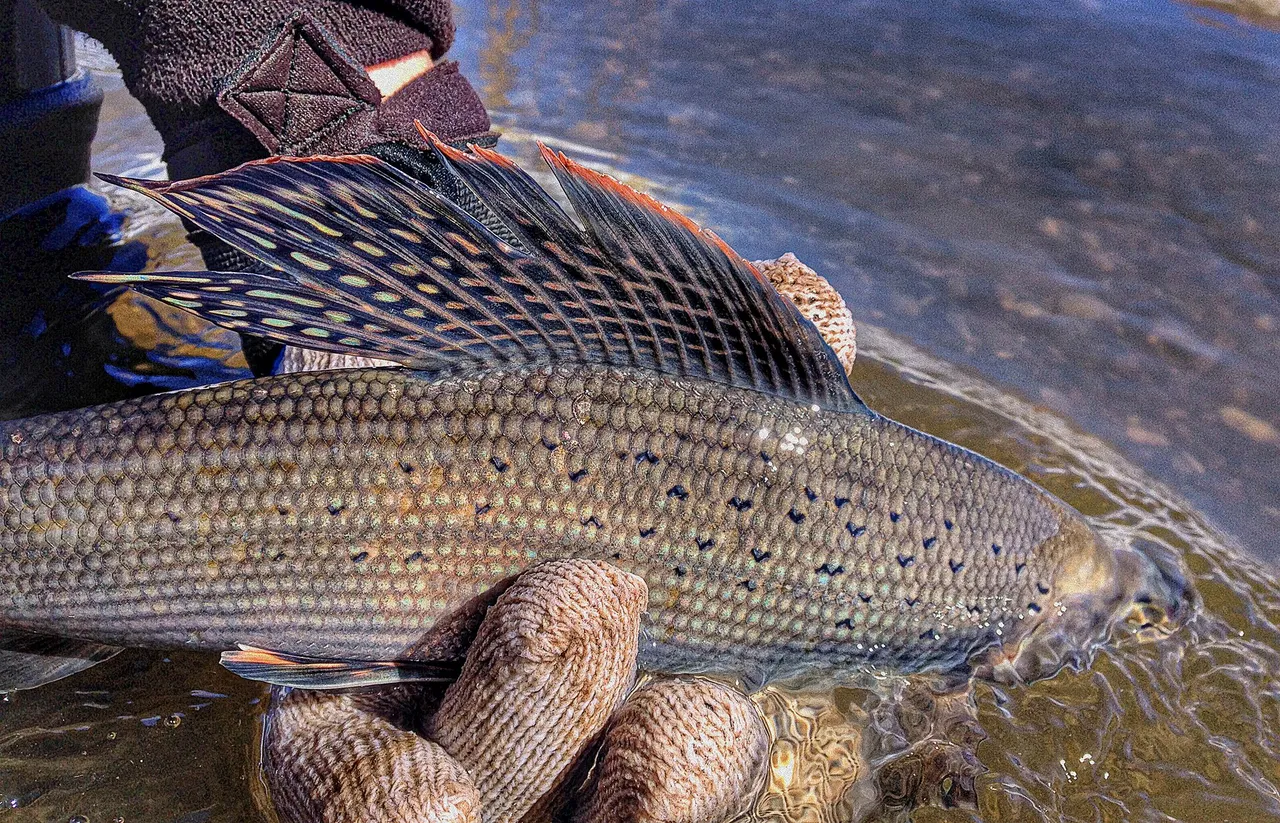
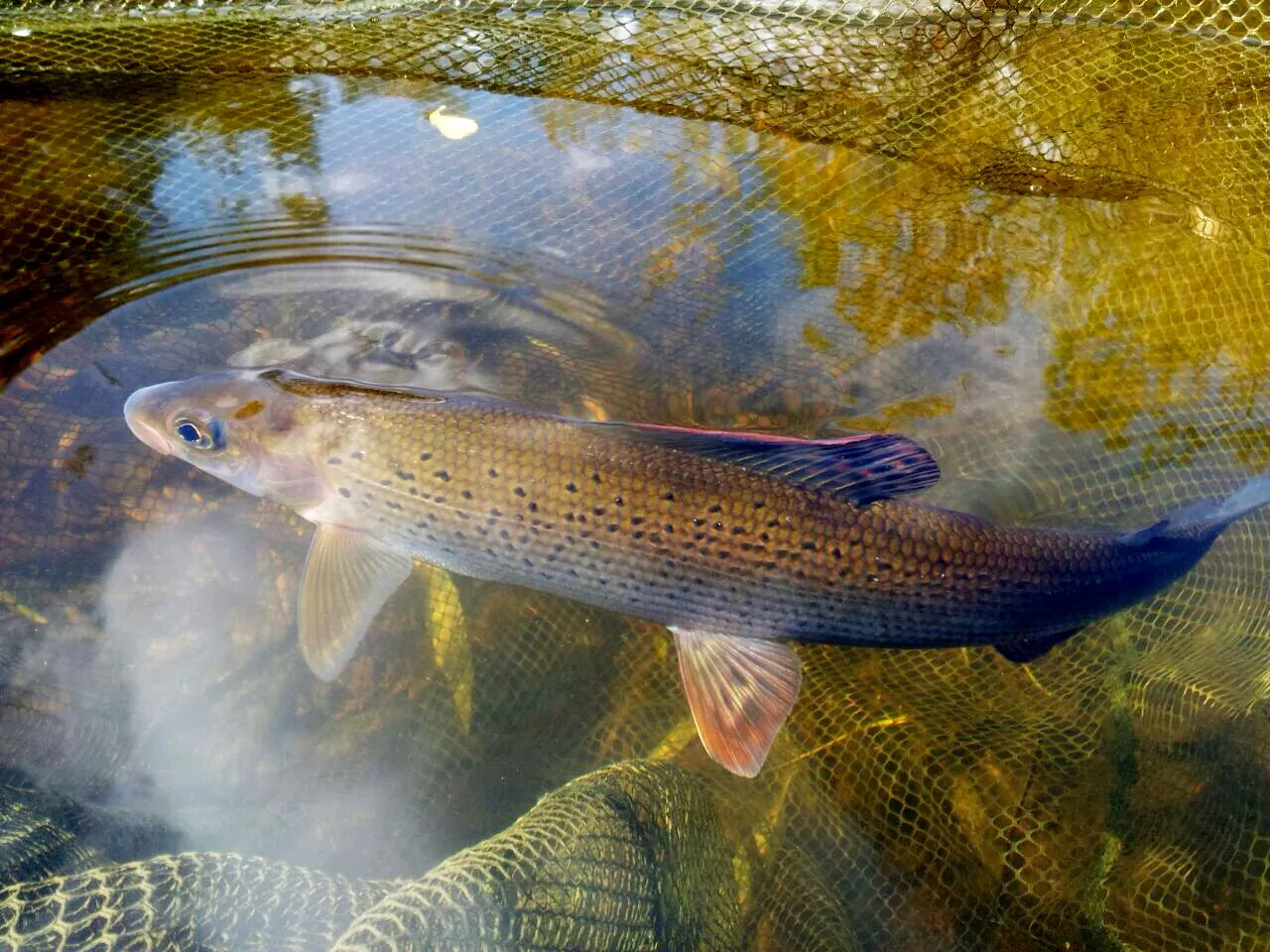


The differences
Each difference is marked with how far it can be trusted on its own. A single diagnostic character settles the identification; suggestive ones only narrow it.
| Character | Arctic grayling | Grayling | Reliability |
|---|---|---|---|
| Where the fish was caughtRange | Northern North America and northern Asia — Alaska, Yukon, the Northwest Territories, Siberia, and a relict population in Montana. | Europe, from Britain and France east into Russia. The two ranges do not overlap. | Diagnostic on its own |
| Size and shape of the dorsal finIdentification | Generally larger and taller with more rows of spots, and a stronger orange or red trailing margin, most pronounced in males. | Large but generally lower, with fewer spot rows and a less strongly coloured margin. | Supporting — use with others |
| Spotting on the forward flankIdentification | Dark V-shaped or irregular spots concentrated on the shoulder, variable in number. | Similar dark spots, generally sparser, and often nearly absent on older fish. | Suggestive only — varies |
| When it spawnsSpawning | Spring, over gravel, shortly after ice-out. | Spring, over clean gravel in shallow moderate current — the same strategy on the same schedule. | Suggestive only — varies |
Why it matters
Less than most pairs on this site, and the honest reason is worth stating: since the ranges do not overlap, an angler is never actually choosing between them in the field. What the pair is useful for is reading photographs and reading claims — a fish described as an Arctic grayling from a Yorkshire river is a European grayling, and a European grayling reported from Alaska is a misidentification rather than a record.
The full records
This page compares two species. Each of them has a complete record covering biology, behaviour, handling and the evidence behind all of it.
More about arctic grayling
Where it lives, how it is caught, and what else it is confused with.
Similar and related fish
How it is caught
Gear for this fish
Where it lives
Why the 7 connections on this page are here, and the sources
Similar and related fish
Backed by research — 1 connection
Supported by peer-reviewed research or fisheries science. The sources are listed and can be checked.
Grayling
An identification comparison naming both binomials: Thymallus arcticus and Thymallus thymallus.
- FishBase: a global information system on fishes — Froese, R. and D. Pauly, eds. — FishBase Consortium (Scientific institute)Relied on for: Morphological and distributional data for Thymallus arcticus and for Thymallus thymallus.States this directlyPassage read and verified
- The IUCN Red List of Threatened Species — International Union for Conservation of Nature (Conservation authority)Relied on for: Separate assessments treating Thymallus arcticus and Thymallus thymallus as distinct species.States this directlyCitation checked — the work exists and is described correctly
How it is caught
What experienced anglers do — 2 connections
Widely and independently recommended by experienced anglers and specialist sources. This is real angling knowledge, not proof: controlled evidence for it is limited, and FishingHQ records it as convention rather than as a demonstrated effect.
Dry fly fishing
A practitioner claim about how Thymallus arcticus is commonly fished, following from where and how it feeds.
- General angling website restatements of established technique — Various (Credible secondary source)Relied on for: Widely restated practitioner accounts of fishing for arctic grayling.Citation checked — the work exists and is described correctly
- Sea Angler — Bauer Media (Specialist angling publication)Relied on for: Practitioner treatment of the methods used for arctic grayling and comparable species.Citation checked — the work exists and is described correctly
Nymphing
A practitioner claim about how Thymallus arcticus is commonly fished, following from where and how it feeds.
- General angling website restatements of established technique — Various (Credible secondary source)Relied on for: Widely restated practitioner accounts of fishing for arctic grayling.Citation checked — the work exists and is described correctly
- Sea Angler — Bauer Media (Specialist angling publication)Relied on for: Practitioner treatment of the methods used for arctic grayling and comparable species.Citation checked — the work exists and is described correctly
Gear for this fish
What experienced anglers do — 2 connections
Widely and independently recommended by experienced anglers and specialist sources. This is real angling knowledge, not proof: controlled evidence for it is limited, and FishingHQ records it as convention rather than as a demonstrated effect.
Dry flies
A practitioner claim about tackle commonly used for Thymallus arcticus.
- General angling website restatements of established technique — Various (Credible secondary source)Relied on for: Widely restated practitioner accounts of this presentation for arctic grayling.Citation checked — the work exists and is described correctly
- Angling Times — Bauer Media (Specialist angling publication)Relied on for: Practitioner treatment of comparable presentations for the species group.Citation checked — the work exists and is described correctly
Nymphs
A practitioner claim about tackle commonly used for Thymallus arcticus.
- General angling website restatements of established technique — Various (Credible secondary source)Relied on for: Widely restated practitioner accounts of this presentation for arctic grayling.Citation checked — the work exists and is described correctly
- Angling Times — Bauer Media (Specialist angling publication)Relied on for: Practitioner treatment of comparable presentations for the species group.Citation checked — the work exists and is described correctly
Where it lives
Backed by research — 2 connections
Supported by peer-reviewed research or fisheries science. The sources are listed and can be checked.
Chalk streams
A habitat association for Thymallus arcticus taken from the environment and distribution data on its FishBase summary.
- FishBase: a global information system on fishes — Froese, R. and D. Pauly, eds. — FishBase Consortium (Scientific institute)Relied on for: The environment, depth range and habitat description recorded for Thymallus arcticus.States this directlyPassage read and verified
Lowland rivers
A habitat association for Thymallus arcticus taken from the environment and distribution data on its FishBase summary.
- FishBase: a global information system on fishes — Froese, R. and D. Pauly, eds. — FishBase Consortium (Scientific institute)Relied on for: The environment, depth range and habitat description recorded for Thymallus arcticus.States this directlyPassage read and verified
Reviewed 2026-08-13. FishingHQ does not state what any rule is or where any rule applies. Where this page says the two species are managed differently, that is a reason to check the authority for the water you are on — not a statement of what it requires.