Grayling
Fish · Last reviewed 2026-08-10
A salmonid with a sail for a dorsal fin that feeds hard through the winter — which makes it the game angler's season when the trout season has closed.
Safety: standing precautions apply on this water.
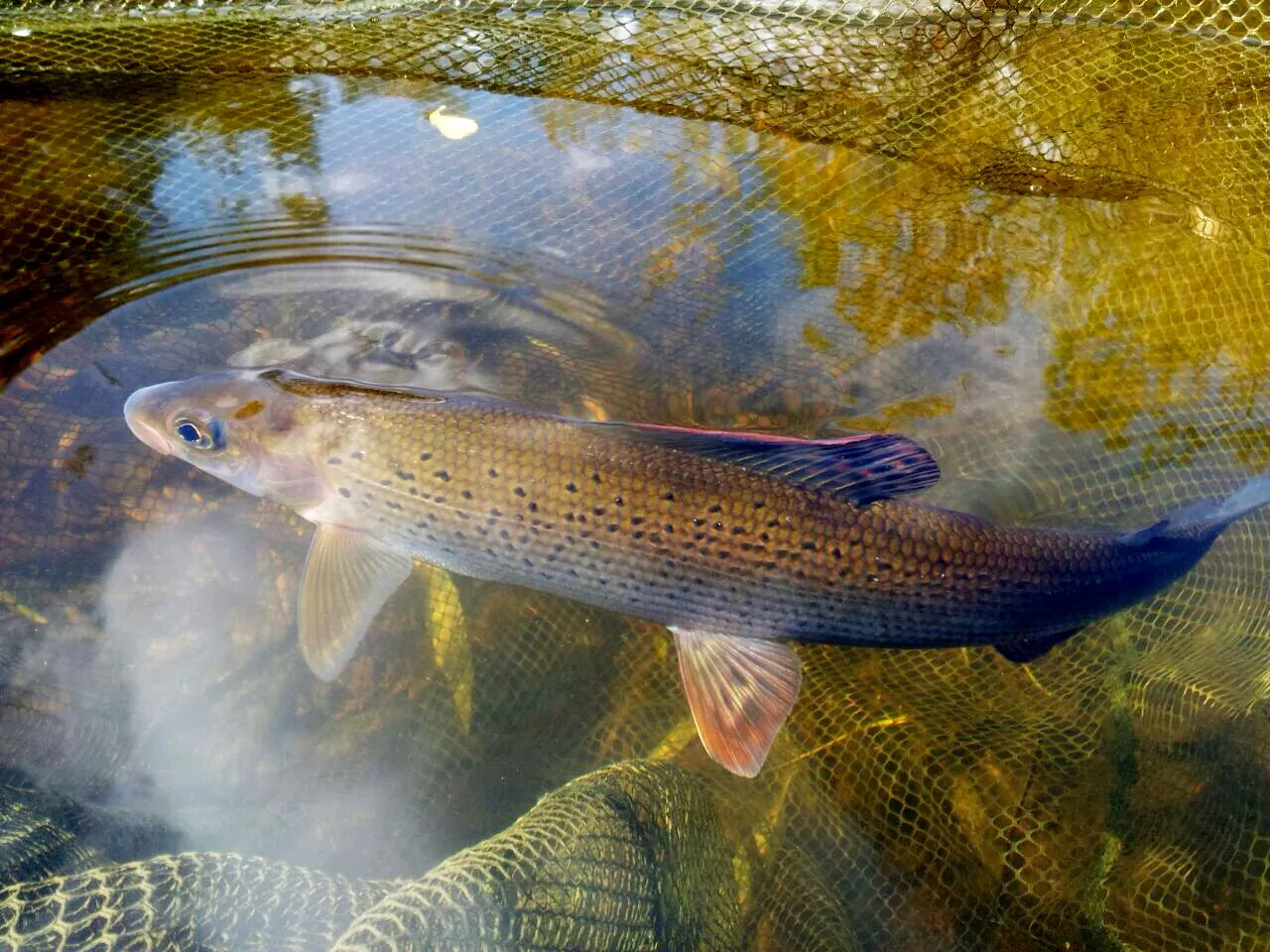
How this was identified, and who took it
Identified by: Lateral view of a fish held in a net in water. Adipose fin, large scales, small terminal mouth and anterior flank spotting are all clear. The sail dorsal is laid over rather than erect, so its extent is readable but its height is not.High Plains Grifter — CC BY-SA 4.0, via Wikimedia Commons — source, licenceCatching Grayling
Everything here on fishing for it. Each entry opens the page behind it.
- When
- Oct–Mar — months recorded at the places that document it, not a season for the whole range.
- Where
- 6 places FishingHQ documents — strongest claim anywhere: characteristic of this water · Fly fishing, From the shore
Grayling are salmonids, in the same family as trout and salmon, and they carry the family's adipose fin. Everything else about them is their own: an enormous sail-like dorsal fin, a small underslung mouth, large scales, and a faint scent of thyme that gives the genus its name.
Their practical significance to an angler is a matter of timing. Grayling spawn in spring, not autumn, which puts their feeding cycle out of phase with trout — and in much of their range they remain in condition and feeding hard through the months when trout are spawning and out of season. A river that is finished for the year in October is a grayling river in January.
They are also a demanding fish to catch well. Grayling feed close to the bottom on invertebrates, in cold clear water, in shoals that spook as a unit. The techniques built around them — long-trotted floats, weighted nymphs fished deep and close — exist because the fish demanded them.
How it is caught
- NymphingGrayling feed heavily on subsurface invertebrates and hold close to the bed in fast water, which is the exact situation nymphing was developed for.
- TenkaraShort-range drag-free presentation on broken water is exactly what grayling fishing demands, and the method transferred to European grayling rivers quickly.
- TrottingA winter fish of steady clean glides that responds to a bait travelling at the speed of the water, and the reason a great deal of trotting happens in the cold half of the year.
Gear for this fish
- Dry fliesGrayling rise steadily to small surface insects and continue doing so in cold weather long after trout have stopped, which is why the grayling season is a dry-fly season in months nothing else is.
- NymphsGrayling take subsurface invertebrates close to the bed, and a weighted nymph fished on a short line is the standard answer.
- Stick float rigTrotting is the traditional bait approach to grayling in winter, on the same fast even-paced water the rig is designed for.
- Terrestrial fly patternsGrayling take terrestrial insects blown onto the water readily, and a small foam or hackled terrestrial is a standard searching pattern on a river with wooded banks.
Where Grayling is documented
Places where public sources describe this species as fished, with how it is fished and how strongly the evidence supports it. This is not a range map and it is not a recommendation — it is what has been written down about a fishery rather than a record of any individual catch, and being listed is never permission to fish.
The River Tweed
2 documented places
Confluence
Characteristic of this water
From the shore
River reach
Characteristic of this water
From the shore
The River Wye
1 documented place
River reach
Seasonal
Fly fishing · From the shore
Around Nov, Dec, Jan, Feb
The Hampshire chalk streams
1 documented place
River reach
Seasonal
Fly fishing
Around Oct, Nov, Dec, Jan, Feb, Mar
What these strengths mean
- Seasonal
- Well supported, and concentrated in part of the year rather than spread through it.
- Recorded here
- At least one credible public account of this species being caught here. That is all it means.
- Characteristic of this water
- This water is strongly identified with this species by the sources that cover it.
Managed fisheries for grayling
These are private businesses rather than public water: you pay for a day, and the fishery sets its own rules on top of whatever the law requires. That is the opposite of the section above, where the places are public geography and being listed is never permission to fish. Nothing here is a recommendation, the order is alphabetical, and no price or opening hour is carried because both change faster than this page does.
The Fishing Passport
River or beat · Wales, the Welsh Marches and Scotland
A stretch of river fished under a permit or a rod let
A not-for-profit online day-ticket scheme run by a river trust, giving access to more than two hundred river and stillwater fisheries across Wales, the Marches and Scotland.
Named by the fishery as a species you can fish for. Also named here: Atlantic salmon, Brown trout, Common carp.
How you get a day: Book in advance, Membership or syndicate.
The fishery’s own conditions: Fly fishing permitted.
Season: Seasons are set per river and per beat by the fishery that owns it, and the scheme's search is organised by date for that reason.
The rules this fishery sets, in its own terms
- Rules, seasons and any catch-and-release conditions are set by each individual beat or fishery, not by the scheme, and must be read on the beat's own listing.
- Wild Streams beats are available either on a season permit or on a day ticket.
- Anglers are asked to submit a catch return after fishing, and previous returns are published against each beat.
Checked against the operator's own information. Last checked 2026-08-29.
A fishery’s own conditions — barbless hooks, no keepnets, no night fishing — are conditions of that water and not law. The licences and close seasons a jurisdiction requires are a separate matter and are set out by the fisheries authority, never here. Telephone before travelling, and see every fishing business FishingHQ lists.
Identification
- Scientific name
- Thymallus thymallus
- Family
- Salmonidae
- Water
- Freshwater, Brackish
- Conservation status
- Least Concern
- Regions
- Britain & Ireland, Northern Europe, Western Europe, Central & Eastern Europe
- An enormous sail-like dorsal fin, far larger than any other European freshwater fish's and unmistakable.
- A small adipose fin between dorsal and tail, marking it as a salmonid.
- Small, underslung mouth suited to feeding off the bottom, quite unlike a trout's terminal mouth.
- Large, clearly-defined scales over a silver-grey flank with fine dark spotting on the forward body.
- A faint smell of thyme on a freshly caught fish, which is where the genus name comes from.
Size
- Typical
- 25–35 cm and 250–500 g.
- Large
- Over 45 cm and 1.2 kg — a specimen anywhere in the range.
Exceptional: FishBase records a maximum of 60 cm and 6.7 kg. Fish approaching that are exceptional and come from large northern rivers rather than from the small chalk and freestone streams grayling are usually associated with.
A salmonid running on the opposite calendar, and the tradition built in the gap
Grayling are the fish that proves seasonality is a property of the animal rather than of the year, because they run almost exactly counter to the trout sharing their river.
THE INVERSION IS REPRODUCTIVE. Trout and salmon spawn in autumn and winter; grayling spawn in spring, on gravel, as water warms. Everything else follows from that single difference. A grayling in autumn is a fish in good condition with the whole of its reproductive investment still ahead of it, feeding hard to build reserves through the cold months. A trout in autumn is a fish preparing to spawn or already doing it. The two are in opposite phases of the same cycle in the same water.
SO GRAYLING FEED THROUGH THE COLD. They continue taking drifting invertebrates in water temperatures where trout have largely stopped, and they go on rising to small surface flies in conditions that look impossible — a grayling taking a size 20 dry in a January river is an ordinary event and a startling one the first time it is seen. Cold, low, clear water is when they are at their best rather than their worst.
AND THIS IS WHERE THE BRITISH GRAYLING TRADITION COMES FROM. It exists in the space the trout leave: when the trout fishing closes for the winter, the grayling fishing opens, on the same rivers, with the same tackle, for a fish that is in peak condition precisely then. That is a cultural pattern generated directly by a biological one, and it is why grayling occupy the position they do in English chalk-stream and northern river fishing.
SPRING IS WHEN THEY ARE BEST LEFT ALONE. Spawning grayling gather on gravel in shallow water and are conspicuous, catchable and doing the thing the population depends on. The biology is clear and the legal position varies: grayling have historically been treated as a coarse fish in some jurisdictions and a game fish in others, with quite different seasons attaching, and what applies on a given river is a current local matter this page does not attempt to state.
Backed by research — why, and the sources (4)
Supported by peer-reviewed research or fisheries science. The sources are listed and can be checked.
- Freshwater Fishes of the British Isles — HarperCollins (New Naturalist 75), 1992 (Reference work)Relied on for: Seasonal behaviour, spawning timing and temperature response of European freshwater fishes.States this directlyCitation checked — the work exists and is described correctly
- FishBase: a global information system on fishes — Froese, R. and D. Pauly, eds. — FishBase Consortium (Scientific institute)Relied on for: Temperature tolerance, depth range, spawning season and migratory behaviour recorded for the species.States this directlyPassage read and verified
- Coarse Fishing — A. & C. Black, 1912 (Specialist angling publication)Relied on for: Seasonal patterns in British coarse angling and the conditions that drive them.States this directlyCitation checked — the work exists and is described correctly
- Freshwater Fishes of the British Isles — HarperCollins (New Naturalist 75), 1992 (Reference work)Relied on for: Seasonal behaviour and temperature response of British freshwater fishes.States this directlyCitation checked — the work exists and is described correctly
Spring gravel spawning, and the specific water it needs
Grayling reproduction is worth describing precisely because it is unusually specific in its requirements and because its timing is the fact that defines the species' whole angling significance.
THE TIMING IS THE INVERSION. Grayling spawn in spring, unlike the trout and salmon they share rivers with, which spawn in autumn and winter. That single difference produces everything: a grayling in autumn is a fish in condition with its reproductive investment ahead of it, feeding hard through the cold months, which is why the winter grayling fishery exists at all and why it occupies the gap the trout leave.
THE REQUIREMENTS ARE NARROW. Grayling spawn over clean gravel in shallow water — a few tens of centimetres — on riffles or in moderate current of roughly half a metre per second. Each of those elements is doing a job. The gravel provides interstitial spaces for the eggs. The current keeps oxygenated water moving through them and prevents silt settling. The shallow depth puts the redd where light and warmth accelerate development. Take away any one and the site does not work.
WHICH MAKES THE SPECIES A SENSITIVE INDICATOR. A river reach that has been silted by agricultural run-off, impounded so the current has gone, or dredged so the gravel has, may still hold adult grayling and produce no recruitment at all. The adults are the visible part and the gravel is the part that determines whether there will be any more.
THE SPAWNING ITSELF IS LESS ELABORATE THAN A SALMON'S. Grayling do not cut a deep redd and bury the eggs the way a salmon does; the male displays with his outsized dorsal fin, pairs vibrate together over gravel, and the eggs are worked down into the surface layer of the substrate rather than deeply interred. They are correspondingly more exposed.
SPRING GRAYLING ARE CONSPICUOUS, CONCENTRATED AND ON SHALLOW GRAVEL, which is a straightforward statement about vulnerability. The legal position varies considerably — grayling have been treated as a game fish in some jurisdictions and a coarse fish in others, with quite different seasons attaching — and it is current local information rather than something this page states.
Backed by research — why, and the sources (4)
Supported by peer-reviewed research or fisheries science. The sources are listed and can be checked.
- Freshwater Fishes of the British Isles — HarperCollins (New Naturalist 75), 1992 (Reference work)Relied on for: Spawning habitat, timing, egg deposition and recruitment of European freshwater fishes.States this directlyCitation checked — the work exists and is described correctly
- FishBase: a global information system on fishes — Froese, R. and D. Pauly, eds. — FishBase Consortium (Scientific institute)Relied on for: Reproductive mode, spawning season and parental care recorded for the species.States this directlyPassage read and verified
- FishBase: a global information system on fishes — Froese, R. and D. Pauly, eds. — FishBase Consortium (Scientific institute)Relied on for: Reproductive mode, spawning season, fecundity, parental care, sex-change pattern and larval development recorded for the species.States this directlyPassage read and verified
- The IUCN Red List of Threatened Species — International Union for Conservation of Nature (Conservation authority)Relied on for: Assessment, population trend, and the life-history traits — age at maturity, longevity, reproductive strategy — that determine sensitivity to exploitation.States this directlyCitation checked — the work exists and is described correctly
A small-stream reputation and a big-river maximum
Grayling size carries a specific trap: the fish is associated in British minds with chalk streams and small freestone rivers, and the largest grayling in the world come from nothing of the sort.
THE FAMILIAR GRAYLING IS A SMALL-RIVER FISH AND IT IS MODEST. In a British chalk stream or a Welsh or northern freestone river, an ordinary grayling is a hand-and-a-half long, a good one is appreciably bigger, and a fish over the 'large' figure on this page is a specimen anybody would remember. That is the fish the tradition was built around and the fish most readers will meet.
THE MAXIMUM COMES FROM SOMEWHERE ELSE ENTIRELY. The FishBase figure reflects large northern and continental river systems — long, cold, productive rivers in Scandinavia and central and eastern Europe, where grayling have far more water, far more invertebrate drift and far more years. A fish approaching that maximum is not a big version of a chalk-stream grayling; it is a fish from a different kind of river.
GROWTH IS DRIFT-LIMITED AND THEREFORE FLOW-LIMITED. Grayling feed principally on invertebrates carried past them on the current, so a fish's intake is a function of how much water goes by and how much life is in it. A bigger, richer river feeds a grayling more, and a grayling in a small headwater is capped by the volume of drift available regardless of how healthy it is.
THEY ARE ALSO SHORTER-LIVED THAN THE TROUT THEY SHARE WATER WITH, which compresses the growth curve. There are fewer years in which to become large, so the largest fish are those that grew fast rather than those that simply persisted — the opposite of the chub case, and a useful contrast.
AND THE DORSAL FIN CONFUSES EVERY ESTIMATE. A grayling's sail makes the fish look substantially larger in the water and in the hand than its weight supports, and it is bigger and more extravagant in males. Weight estimates for this species run high more consistently than for almost anything else in a British river, and the length is the number to trust.
Backed by research — why, and the sources (2)
Supported by peer-reviewed research or fisheries science. The sources are listed and can be checked.
- Freshwater Fishes of the British Isles — HarperCollins (New Naturalist 75), 1992 (Reference work)Relied on for: Growth, age structure, maximum sizes and regional variation in British and European freshwater fishes.States this directlyCitation checked — the work exists and is described correctly
- FishBase: a global information system on fishes — Froese, R. and D. Pauly, eds. — FishBase Consortium (Scientific institute)Relied on for: Maximum recorded length and weight and reported longevity for the species.Background and mechanism onlyPassage read and verified
A soft mouth, a deep body and cold water: three reasons to fish lighter than instinct suggests
Grayling tackle is a study in restraint, and the reasons are anatomical and seasonal rather than sporting.
THE MOUTH IS SMALL AND SOFT AND HOOKS PULL. A grayling's mouth is underslung, small and considerably more fragile than a trout's, and a hard strike or a stiff rod tears it. That is the single reason grayling tackle runs soft: a forgiving tip and a light, well-set drag keep a hook in a mouth that will not hold one under sharp load.
THE BODY WORKS AGAINST YOU IN CURRENT. Grayling are deep-bodied with an enormous dorsal, and a hooked fish turns broadside and uses that surface area against the flow. The pressure a modest fish applies in fast water is surprising and it arrives suddenly, which is another argument for a rod that gives rather than one that resists.
SMALL FLIES AND FINE TIPPET FOLLOW FROM THE FEEDING. Grayling take small invertebrates off the bed, so the presentations that work are small, and fine tippet is required to let a small fly behave naturally in current rather than to defeat the fish's eyesight. The record's habitat and season sections explain why this happens in clear cold water, which sharpens the requirement further.
WHICH IS WHY THE EUROPEAN NYMPHING TECHNIQUES SUIT THEM SO WELL. Long light rods, fine level leaders and direct contact with a weighted fly on the bed are a mechanical fit for a fish that feeds low, in current, and needs the fly presented at the speed of the water — and they keep the connection soft enough not to tear.
COLD WATER IS THE SEASONAL COMPLICATION. Grayling are fished hardest in winter, which is easier on the fish physiologically than a summer trout fishery but harder on the angler: cold hands make fine tackle harder to use and unhooking slower, and slow unhooking is what damages a soft-mouthed fish.
AND BARBLESS HOOKS ARE THE NORM FOR EXACTLY THAT REASON. They come out quickly from a mouth that is easily torn, which is the whole of the handling argument. What is permitted on any river is set by the fishery and the competent authority.
What experienced anglers do — why, and the sources (2)
Widely and independently recommended by experienced anglers and specialist sources. This is real angling knowledge, not proof: controlled evidence for it is limited, and FishingHQ records it as convention rather than as a demonstrated effect.
- Freshwater Fishing — Macdonald & Jane's, 1975 (Specialist angling publication)Relied on for: Game angling technique and tackle, including the relationship between tackle choice and the water being fished.States this directlyCitation checked — the work exists and is described correctly
- Trout & Salmon — Bauer Media (Specialist angling publication)Relied on for: Contemporary game angling practice, tackle and presentation.States this directlyCitation checked — the work exists and is described correctly
The one salmonid where a lure competes with a nymph, and usually loses
Grayling lure fishing is worth treating honestly rather than enthusiastically: it works, it is legal in fewer places than people assume, and it is generally the second-best way to catch the fish.
THE FEEDING MODE IS THE PROBLEM. Grayling feed principally on small invertebrates taken off or just above the bed, in current, with a small underslung mouth. That is a poor match for a lure of any size, and the settled view among grayling anglers is that a weighted nymph fished on the bed accounts for far more fish on most grayling water than a spinner does. That is a strong practitioner consensus rather than a measured comparison, and it is recorded as one.
WHERE LURES DO WORK IS BIG WATER AND COLOURED WATER. On large northern rivers, in high or stained flows, and where grayling are taking small fish as well as invertebrates, a very small spinner or spoon worked slowly across and down the current takes fish reliably and covers water a nymph cannot. The record's size section explains that the largest grayling come from exactly those big-river systems.
SMALL IS NOT OPTIONAL. The gape limits what can be taken, and lures scaled to trout are refused or nipped. The successful presentations are at the smallest end of what can be cast.
SLOW AND DEEP BEATS FAST AND SHALLOW, because grayling hold low in the water and will not chase far, particularly in the cold conditions the winter fishery is conducted in. A lure travelling above the fish at speed passes unnoticed.
THE SOFT MOUTH IS THE PRACTICAL HAZARD AND IT ARGUES AGAINST TREBLES. The record's tackle section explains why hooks pull from a grayling's mouth; a treble multiplies both the damage and the unhooking time on a fish that is almost always returned. Single barbless hooks are the sensible substitution and cost very little.
AND PERMISSION IS THE REAL LIMIT. A great many grayling waters are fly-only, or restrict spinning by season, or treat grayling under a separate statutory regime from trout with different dates entirely — as the comparison with brown trout sets out. What is permitted on any river is a matter for the fishery and the competent authority, and it should be established before travelling rather than on the bank.
What experienced anglers do — why, and the sources (2)
Widely and independently recommended by experienced anglers and specialist sources. This is real angling knowledge, not proof: controlled evidence for it is limited, and FishingHQ records it as convention rather than as a demonstrated effect.
- Freshwater Fishing — Macdonald & Jane's, 1975 (Specialist angling publication)Relied on for: Game angling technique, including the relationship between method choice and the water being fished.States this directlyCitation checked — the work exists and is described correctly
- Trout & Salmon — Bauer Media (Specialist angling publication)Relied on for: Contemporary game angling practice, method and presentation.States this directlyCitation checked — the work exists and is described correctly
The glide below the riffle: a fish that lives where the drift is delivered
Grayling habitat is a specific hydraulic position within a river rather than a river type, and describing it properly is more useful than naming the water.
THE FISH FEEDS ON DRIFT AND THEREFORE LIVES WHERE DRIFT ARRIVES. Grayling take invertebrates carried past them on the current, principally at or near the bed, so the position that suits them is one that receives a steady supply of food without requiring the fish to swim hard. That is the smooth, moderately paced glide below a riffle: the riffle generates the invertebrate drift and the glide delivers it at a manageable speed.
SO THE HABITAT IS A CONVEYOR RATHER THAN A SHELTER. Unlike a trout holding station against a specific obstruction, grayling shoal in open water over clean gravel in steady flow, frequently in the middle of a river rather than at its edges. That is why grayling water often looks featureless and why anglers used to trout look in the wrong places.
THE SUBSTRATE IS CLEAN GRAVEL AND SMALL STONE, and it matters twice: it is where the invertebrates live, and it is the spawning substrate. A river that silts up loses both at once, and grayling are a recognised indicator of gravel condition for exactly that reason.
OXYGEN AND TEMPERATURE ARE COOL-WATER REQUIREMENTS, comparable to trout, which is why grayling are a fish of clean, cool, well-oxygenated rivers and why they disappear from reaches that warm or become enriched.
DEPTH USE IS SEASONAL AND SHOAL-BASED. Grayling shoal more tightly and move into deeper, steadier water as winter comes on, which is why the winter fishery concentrates on the deeper glides and pools rather than on the summer runs.
THEY SHARE WATER WITH TROUT AND PARTITION IT VERTICALLY AND SPATIALLY. Trout hold stations against cover in faster broken water and take drift higher in the column; grayling shoal lower and in the steadier flow. Where both are present, that separation is genuinely useful for working out which fish you are covering.
Backed by research — why, and the sources (2)
Supported by peer-reviewed research or fisheries science. The sources are listed and can be checked.
- Freshwater Fishes of the British Isles — HarperCollins (New Naturalist 75), 1992 (Reference work)Relied on for: Habitat association, spawning behaviour, seasonal activity and ecology of freshwater fishes, including position within a water body.States this directlyCitation checked — the work exists and is described correctly
- FishBase: a global information system on fishes — Froese, R. and D. Pauly, eds. — FishBase Consortium (Scientific institute)Relied on for: Habitat association, spawning season, temperature tolerance and water-type tolerance recorded for the species.States this directlyPassage read and verified
Lifecycle and reproduction
Grayling mature at two to four years and FishBase records a maximum age of 14. They are shorter-lived than brown trout and grow fastest in the well-oxygenated, moderately cold water they prefer. Populations respond quickly to habitat quality, which makes them a useful indicator of a river's condition.
Grayling spawn in SPRING, which is the fact that shapes their angling significance. They breed in shallow stretches of about 20 to 40 cm depth, or on riffles, in a moderate current of around half a metre per second over a clean gravel bottom. That spring timing is why they are in condition and feeding through the winter, while autumn-spawning trout are not.
Feeding and senses
Grayling feed mainly on insects, nymphs, small worms and crustaceans, taken predominantly close to or on the bottom — the underslung mouth is built for it. They will rise to a surface fly and do so freely in a good hatch, but the default feeding position is low in the water, which is why weighted nymphs fished deep account for so many of them.
Vision dominates, as in other salmonids, and grayling in clear winter water are notably sharp-eyed. They shoal, which changes the practical problem: spooking one fish frequently spooks the group, and a shoal that has been disturbed will often stop feeding entirely rather than moving a short distance as a solitary trout would.
Through the year
The reverse of a trout's. Grayling feed strongly through autumn and winter, are at their best in cold clear conditions, and are in spawning condition in spring when they are best left alone. Their winter availability is the whole basis of the British grayling fishing tradition, which exists in the gap the trout close season leaves.
Distribution
Native across Europe from the Barents Sea basin west of the Urals through the Caspian, Black, Baltic, White and North Sea basins, west to the Loire, and into the Rhône and the northern Adriatic. Associated with submontane river reaches with hard sand or stone bottoms and well-oxygenated, cold, fast-flowing water. The global IUCN category is Least Concern, assessed in October 2023.
This is a biological range — where the species occurs, not a prediction that you will catch one. To browse the fishing geography FishingHQ holds, start at fishing places.
Why anglers care
The winter game species, and the reason a game angler's year does not end with the trout season. Grayling also drove the development of a distinct body of technique — long trotting and heavy nymphing — which has since been carried back into trout fishing.
Handling and returning
Grayling are more delicate than they look and the large dorsal fin is easily damaged. Support the fish in the water, avoid gripping the dorsal, use barbless hooks, and keep them wet. In very cold conditions, minimising air exposure matters for a different reason from summer: wet hands and fins freeze.
Going further
- What does grayling eat? — feeding biology, kept separate from what anglers infer from it.
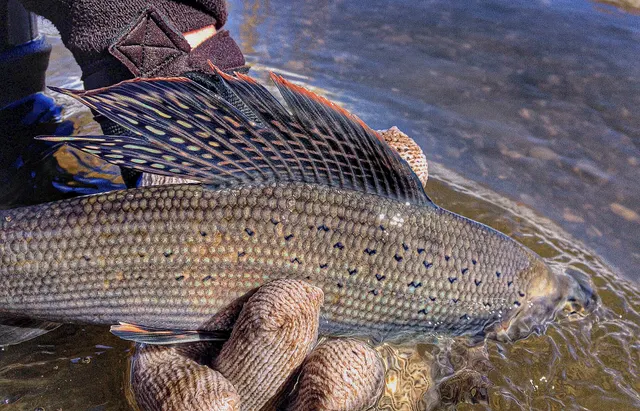
- Grayling vs Arctic grayling — how to tell them apart.
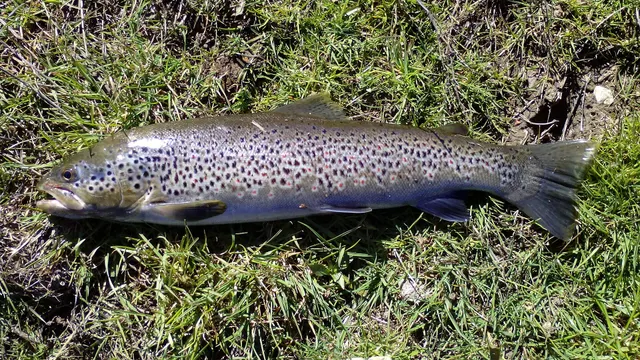
- Grayling vs Brown trout — how to tell them apart.
Safety
Precautions that always apply here
- Wet your hands before touching a fish. Dry hands strip the protective mucus layer that keeps infection out.
- Support the fish's weight along its body, keep it out of the water for as short a time as possible, and hold it over something soft.
- Wear a buoyancy aid or lifejacket. Cold water incapacitates strong swimmers within a minute, long before swimming ability matters.
- Do not wade alone. Judge depth and flow from the bank first, and turn back sooner than feels necessary.
Where to go next
Similar and related fish

Where it lives
- Chalk streamsGrayling need clean, cool, well-oxygenated water over gravel, which is precisely what a chalk stream is — and their presence is treated as an indicator of it.
- Spate riversOccupies the clean gravel runs and glides of many temperate spate rivers, where the coarse well-oxygenated bed suits it, though it is absent from the most acid catchments.
Where you will find it
- AustriaA defining species of the classic Austrian rivers and the reason a good deal of European dry-fly and nymphing technique was worked out on this water.
- Czechia and SlovakiaPresent through the cold clean middle reaches and central to the fly tradition here, where it is a target in its own right rather than a by-catch of trout fishing.
- The Danube basinOccupies the cold clean upper river and its Alpine tributaries, sharing that water with brown trout and huchen.
- The Hampshire chalk streamsGrayling extend chalk stream fishing through the winter after the trout season closes, and were historically treated as vermin on trout beats before being valued.
- The River SpeyPresent in the system and providing cold-weather fishing when the salmon season is closed.
- The River TayOn the middle and lower river through the colder months, a fishery that has grown substantially and that occupies the season when salmon fishing is closed or unproductive.
- The River TweedPresent through the system and now the basis of a substantial winter fly fishery that has extended the river's angling year.
- The Soča and Slovenia's Adriatic riversPresent and significant, with the Soča grayling fishery having its own following alongside the marble trout.
2 more
- The Welsh sewin rivers Fishing regions
- The Western Balkans Fishing regions
Understanding this fish
- Aquatic insect larvae as preyGrayling feed principally on drifting and benthic insect larvae, holding position on the bed and intercepting the drift, which is the behaviour that nymph fishing is built around.
- Choosing a fly size, and what the numbers meanWhere size genuinely decides the outcome. Grayling feed on small items, have small mouths relative to their body, and are routinely caught on hooks two or three sizes smaller than a trout angler would first tie on — which is a concrete case of the record's point that the number is about the hook rather than the insect.
- Strike indicators, and when they helpThe fish that makes the case for an indicator, and it is a detection problem rather than a presentation one. Grayling take a nymph near the bed, softly, often on a slack line in winter, and the take is frequently invisible and unfelt — which is exactly the situation this page says an indicator is for, and it is a narrower situation than the tackle industry implies.
- The insects fly fishing imitatesA worked example with a different emphasis from trout. Grayling feed heavily on nymphs and larvae taken close to the bed rather than off the surface, and they go on doing so through winter when the surface activity trout are famous for has stopped — which is why grayling fishing is where sub-surface entomology earns its place.
- Tippet size, and when to go finerThe clearest freshwater case for fine tippet, and for its cost. Clear low winter water, a small fly, and a fish that inspects — and simultaneously a fish that must be played and released in cold water where a long fight matters. The record's argument that going finer is a trade rather than an improvement is this fishery in one sentence.
- Trout, char and salmon: what the words actually meanA salmonid that is neither trout, char nor salmon, and which British tradition assigns to whichever category suits.
Sources and evidence
- FishBase: a global information system on fishes — Froese, R. and D. Pauly, eds. — FishBase Consortium (Scientific institute)Relied on for: Family (Salmonidae), maxima of 60 cm and 6.7 kg, maximum age 14 years, the submontane hard-bottomed cold fast-water habitat, spawning at 20–40 cm over clean gravel in about 0.5 m/s, the insect and nymph diet, and Least Concern assessed 12 October 2023. Read during source review.States this directlyPassage read and verified
Why the 27 connections on this page are here, and the sources
Similar and related fish
Backed by research — 2 connections
Supported by peer-reviewed research or fisheries science. The sources are listed and can be checked.
Arctic grayling
An identification comparison naming both binomials: Thymallus arcticus and Thymallus thymallus.
- FishBase: a global information system on fishes — Froese, R. and D. Pauly, eds. — FishBase Consortium (Scientific institute)Relied on for: Morphological and distributional data for Thymallus arcticus and for Thymallus thymallus.States this directlyPassage read and verified
- The IUCN Red List of Threatened Species — International Union for Conservation of Nature (Conservation authority)Relied on for: Separate assessments treating Thymallus arcticus and Thymallus thymallus as distinct species.States this directlyCitation checked — the work exists and is described correctly
Brown trout
A taxonomic claim held to a scientific standard, and one that matters practically because it explains both the habitat overlap and the regulatory oddity of a salmonid fished in the coarse season.
- The Fishes of the British Isles and North-West Europe — Macmillan, 1969 (Reference work)Relied on for: The placement of Thymallus thymallus within the Salmonidae alongside Salmo trutta and Salmo salar.States this directlyCitation checked — the work exists and is described correctly
- FishBase: a global information system on fishes — Froese, R. and D. Pauly, eds. — FishBase Consortium (Scientific institute)Relied on for: Family placement for Thymallus thymallus.States this directlyPassage read and verified
How it is caught
What experienced anglers do — 3 connections
Widely and independently recommended by experienced anglers and specialist sources. This is real angling knowledge, not proof: controlled evidence for it is limited, and FishingHQ records it as convention rather than as a demonstrated effect.
Nymphing
A method-to-species claim resting on practitioner literature rather than on science, and labelled accordingly. The underlying feeding behaviour is separately supported on the species page.
- Freshwater Fishing — Macdonald & Jane's, 1975 (Specialist angling publication)Relied on for: Nymph presentation for grayling in running water.Citation checked — the work exists and is described correctly
- Trout & Salmon — Bauer Media (Specialist angling publication)Relied on for: Contemporary practitioner treatment of grayling nymphing technique.Citation checked — the work exists and is described correctly
Tenkara
An established way this species is taken on small rivers.
- General angling website restatements of established technique — Various (Credible secondary source)Relied on for: Widely restated practice connecting this species, method or place, recorded as practitioner consensus rather than as tested fact.Background and mechanism onlyCitation checked — the work exists and is described correctly
- Fishers' Craft and Lettered Art: Tracts on Fishing from the End of the Middle Ages — University of Toronto Press, 1997 (Scientific literature)Relied on for: That fishing traditions develop around the water and fish available to them, and the historical method of reading such traditions.Background and mechanism onlyCitation checked — the work exists and is described correctly
Trotting
That a species is conventionally fished for by this method, drawn from angling literature and from widely restated practitioner description rather than from testing.
- Coarse Fishing — A. & C. Black, 1912 (Specialist angling publication)Relied on for: Classical British coarse angling practice: river float work, shotting, bait delivery and the reels and rods used for each.States this directlyCitation checked — the work exists and is described correctly
- Freshwater Fishing — Macdonald & Jane's, 1975 (Specialist angling publication)Relied on for: Comprehensive British freshwater angling practice including river float fishing, surface presentation and the equipment for each.States this directlyCitation checked — the work exists and is described correctly
Gear for this fish
What experienced anglers do — 4 connections
Widely and independently recommended by experienced anglers and specialist sources. This is real angling knowledge, not proof: controlled evidence for it is limited, and FishingHQ records it as convention rather than as a demonstrated effect.
Dry flies
A practitioner claim about which lure family answers this species' feeding or holding behaviour.
- Trout & Salmon — Bauer Media (Specialist angling publication)Relied on for: Fly categories and their application to river salmonids.States this directlyCitation checked — the work exists and is described correctly
- The Compleat Angler, or the Contemplative Man's Recreation — Richard Marriot, 1653 (Reference work)Relied on for: The long documentary record of artificial-fly fishing for trout and grayling in English rivers.Background and mechanism onlyPassage read and verified
Nymphs
A practitioner claim about a species-specific presentation.
- Trout & Salmon — Bauer Media (Specialist angling publication)Relied on for: Nymph presentation for grayling.Citation checked — the work exists and is described correctly
- Freshwater Fishing — Macdonald & Jane's, 1975 (Specialist angling publication)Relied on for: Grayling technique in running water.Citation checked — the work exists and is described correctly
Stick float rig
That anglers conventionally choose this arrangement when targeting this fish. It is a claim about practice rather than about the fish, and it does not assert that the arrangement is necessary or that it will succeed.
- Coarse Fishing — A. & C. Black, 1912 (Specialist angling publication)Relied on for: Classical coarse angling practice: terminal arrangements, shotting, float attachment and bite registration in still and running water.States this directlyCitation checked — the work exists and is described correctly
- Angling Times — Bauer Media (Specialist angling publication)Relied on for: Contemporary UK coarse and match angling practice as reported by practitioners, including pole, float and surface rig convention.States this directlyCitation checked — the work exists and is described correctly
Terrestrial fly patterns
A practitioner claim about which lure family answers this species' feeding or holding behaviour.
- Trout & Salmon — Bauer Media (Specialist angling publication)Relied on for: Fly categories and their application to river salmonids.States this directlyCitation checked — the work exists and is described correctly
- The Compleat Angler, or the Contemplative Man's Recreation — Richard Marriot, 1653 (Reference work)Relied on for: The long documentary record of artificial-fly fishing for trout and grayling in English rivers.Background and mechanism onlyPassage read and verified
Where it lives
Backed by research — 2 connections
Supported by peer-reviewed research or fisheries science. The sources are listed and can be checked.
Chalk streams
A habitat requirement claim held to a scientific standard, because it is used elsewhere in FishingHQ as an indicator of water quality and must be able to bear that weight.
- Freshwater Fishes of the British Isles — HarperCollins (New Naturalist 75), 1992 (Reference work)Relied on for: Habitat requirements of Thymallus thymallus in British and European rivers.States this directlyCitation checked — the work exists and is described correctly
- FishBase: a global information system on fishes — Froese, R. and D. Pauly, eds. — FishBase Consortium (Scientific institute)Relied on for: Habitat and water-quality preferences recorded for the species.States this directlyPassage read and verified
Spate rivers
A claim that the species uses rain-fed rivers on impermeable geology, resting on documented distribution and spawning habitat rather than on angling report.
- Freshwater Fishes of the British Isles — HarperCollins (New Naturalist 75), 1992 (Reference work)Relied on for: Distribution, habitat association, thermal requirements and life history of the freshwater fishes of the British Isles and north-west Europe.States this directlyCitation checked — the work exists and is described correctly
- FishBase: a global information system on fishes — Froese, R. and D. Pauly, eds. — FishBase Consortium (Scientific institute)Relied on for: Recorded depth range, temperature tolerance and habitat association for the species.States this directlyPassage read and verified
Where you will find it
Backed by research — 10 connections
Supported by peer-reviewed research or fisheries science. The sources are listed and can be checked.
Austria
That a species occurs in these waters, drawn from distribution science and stock assessment. It is a statement about where the animal lives and is not a statement that anybody will catch one, still less where.
- Freshwater Fishes of the British Isles — HarperCollins (New Naturalist 75), 1992 (Reference work)Relied on for: Distribution, habitat requirement and life history of European freshwater fishes, including their occurrence across the continental range named.States this directlyCitation checked — the work exists and is described correctly
- FishBase: a global information system on fishes — Froese, R. and D. Pauly, eds. — FishBase Consortium (Scientific institute)Relied on for: Recorded distribution and habitat association of the freshwater and migratory species named.States this directlyPassage read and verified
Czechia and Slovakia
That a species occurs in these waters, drawn from distribution science and stock assessment. It is a statement about where the animal lives and is not a statement that anybody will catch one, still less where.
- Freshwater Fishes of the British Isles — HarperCollins (New Naturalist 75), 1992 (Reference work)Relied on for: Distribution, habitat requirement and life history of European freshwater fishes, including their occurrence across the continental range named.States this directlyCitation checked — the work exists and is described correctly
- FishBase: a global information system on fishes — Froese, R. and D. Pauly, eds. — FishBase Consortium (Scientific institute)Relied on for: Recorded distribution and habitat association of the freshwater and migratory species named.States this directlyPassage read and verified
The Danube basin
A distribution association between an animal and a kind of water, rather than a claim about any named mark.
- Freshwater Fishes of the British Isles — HarperCollins (New Naturalist 75), 1992 (Reference work)Relied on for: Distribution and habitat association of European freshwater fishes, including occurrence in the river system concerned.States this directlyCitation checked — the work exists and is described correctly
- FishBase: a global information system on fishes — Froese, R. and D. Pauly, eds. — FishBase Consortium (Scientific institute)Relied on for: Distribution and habitat association recorded for the species.States this directlyPassage read and verified
The Hampshire chalk streams
A distributional claim taken from reference works on the fishes of the region rather than from angling report. It states presence and asserts nothing about a fishery.
- FishBase: a global information system on fishes — Froese, R. and D. Pauly, eds. — FishBase Consortium (Scientific institute)Relied on for: Distribution, habitat association, life history and depth range recorded for the species concerned.States this directlyPassage read and verified
- Freshwater Fishes of the British Isles — HarperCollins (New Naturalist 75), 1992 (Reference work)Relied on for: Biology, distribution and conservation status of British and Irish freshwater and diadromous fishes.States this directlyCitation checked — the work exists and is described correctly
- The Fishes of the British Isles and North-West Europe — Macmillan, 1969 (Reference work)Relied on for: Distribution, habitat and biology of the fishes of the British Isles and north-west Europe.States this directlyCitation checked — the work exists and is described correctly
The River Spey
A distributional claim about where a species occurs, which is a claim about the world and rests on the reference literature rather than on angling report.
- Freshwater Fishes of the British Isles — HarperCollins (New Naturalist 75), 1992 (Reference work)Relied on for: Distribution, habitat association and ecology of the freshwater fishes of the British Isles.States this directlyCitation checked — the work exists and is described correctly
- FishBase: a global information system on fishes — Froese, R. and D. Pauly, eds. — FishBase Consortium (Scientific institute)Relied on for: Distribution, habitat association and life history recorded for the species.States this directlyPassage read and verified
The River Tay
A claim that a place contains the ground, water and seasonal conditions the species is associated with. It is a distributional statement about the world, it rests on the regional reference literature, and it deliberately asserts nothing about access, permission or catch.
- Freshwater Fishes of the British Isles — HarperCollins (New Naturalist 75), 1992 (Reference work)Relied on for: Distribution, ecology and conservation status of the freshwater fishes of the British Isles, including in artificial and modified waters.States this directlyCitation checked — the work exists and is described correctly
- Environment Agency fisheries management, byelaws and rod licensing information — Environment Agency (Government fisheries body)Relied on for: Fisheries monitoring, water quality and species distribution in English rivers, canals and still waters.States this directlyCitation checked — the work exists and is described correctly
The River Tweed
A distribution association between an animal and a kind of water, rather than a claim about any named mark.
- Freshwater Fishes of the British Isles — HarperCollins (New Naturalist 75), 1992 (Reference work)Relied on for: Distribution, habitat association and ecology of British and Irish freshwater fishes, including occurrence in the water body concerned.States this directlyCitation checked — the work exists and is described correctly
- FishBase: a global information system on fishes — Froese, R. and D. Pauly, eds. — FishBase Consortium (Scientific institute)Relied on for: Distribution, habitat association and life history recorded for the species.Background and mechanism onlyPassage read and verified
The Soča and Slovenia's Adriatic rivers
A distributional claim about where a species occurs, which is a claim about the world and rests on the reference literature rather than on angling report.
- FishBase: a global information system on fishes — Froese, R. and D. Pauly, eds. — FishBase Consortium (Scientific institute)Relied on for: Distribution, habitat association and life history recorded for the species.States this directlyPassage read and verified
- The IUCN Red List of Threatened Species — International Union for Conservation of Nature (Conservation authority)Relied on for: Global conservation assessment, range and recorded threats for the species.States this directlyCitation checked — the work exists and is described correctly
The Welsh sewin rivers
A claim that a place contains the ground, water and seasonal conditions the species is associated with. It is a distributional statement about the world, it rests on the regional reference literature, and it deliberately asserts nothing about access, permission or catch.
- Freshwater Fishes of the British Isles — HarperCollins (New Naturalist 75), 1992 (Reference work)Relied on for: Distribution, ecology and conservation status of the freshwater fishes of the British Isles, including in artificial and modified waters.States this directlyCitation checked — the work exists and is described correctly
- Environment Agency fisheries management, byelaws and rod licensing information — Environment Agency (Government fisheries body)Relied on for: Fisheries monitoring, water quality and species distribution in English rivers, canals and still waters.States this directlyCitation checked — the work exists and is described correctly
The Western Balkans
That a species occurs in these waters, drawn from distribution science and stock assessment. It is a statement about where the animal lives and is not a statement that anybody will catch one, still less where.
- Freshwater Fishes of the British Isles — HarperCollins (New Naturalist 75), 1992 (Reference work)Relied on for: Distribution, habitat requirement and life history of European freshwater fishes, including their occurrence across the continental range named.States this directlyCitation checked — the work exists and is described correctly
- FishBase: a global information system on fishes — Froese, R. and D. Pauly, eds. — FishBase Consortium (Scientific institute)Relied on for: Recorded distribution and habitat association of the freshwater and migratory species named.States this directlyPassage read and verified
Understanding this fish
Backed by research — 2 connections
Supported by peer-reviewed research or fisheries science. The sources are listed and can be checked.
Aquatic insect larvae as prey
Recorded diet evidence identifies mayfly, caddis and chironomid larvae as a food item of this predator at group level rather than to species. The edge points at the taxon record for that reason, and encoding it as a species-level claim would assert something the source does not.
- FishBase: a global information system on fishes — Froese, R. and D. Pauly, eds. — FishBase Consortium (Scientific institute)Relied on for: Food items recorded for this predator, given as mayfly, caddis and chironomid larvae.States this directlyPassage read and verified
- FAO Species Identification Guides for Fishery Purposes and the FAO Species Catalogues — Food and Agriculture Organization of the United Nations (Scientific institute)Relied on for: Species account describing this predator's diet, recorded at the level of mayfly, caddis and chironomid larvae.Background and mechanism onlyCitation checked — the work exists and is described correctly
Trout, char and salmon: what the words actually mean
The species that most clearly exposes the categories as social rather than biological.
- FishBase: a global information system on fishes — Froese, R. and D. Pauly, eds. — FishBase Consortium (Scientific institute)Relied on for: Genus placement within Salmonidae for Salmo, Oncorhynchus and Salvelinus, and the species assigned to each.States this directlyPassage read and verified
What experienced anglers do — 4 connections
Widely and independently recommended by experienced anglers and specialist sources. This is real angling knowledge, not proof: controlled evidence for it is limited, and FishingHQ records it as convention rather than as a demonstrated effect.
Choosing a fly size, and what the numbers mean
A fish or a water joined to the fly-fishing mechanism it is a worked example of, written only where the subject's own behaviour or physical character is what this page explains. The direction is the one FishingHQ writes this kind of connection in, and the one it already uses 176 times, and it is also the semantically correct one: the mechanism explains the fish, not the reverse.
- Still Water Fly-Fishing — Andre Deutsch, 1952 (Specialist angling publication)Relied on for: Stillwater fly practice: line density and depth, leader construction, fly selection against the food present, and the behaviour of stocked and wild trout in still water.States this directlyCitation checked — the work exists and is described correctly
- Trout & Salmon — Bauer Media (Specialist angling publication)Relied on for: Long-running published description of British game angling practice: river and stillwater trout, grayling and salmon fishing, and the presentation each demands.States this directlyCitation checked — the work exists and is described correctly
- Freshwater Fishes of the British Isles — HarperCollins (New Naturalist 75), 1992 (Reference work)Relied on for: Life history, feeding biology, habitat requirement and seasonal behaviour of the freshwater fishes of the British Isles.States this directlyCitation checked — the work exists and is described correctly
- FishBase: a global information system on fishes — Froese, R. and D. Pauly, eds. — FishBase Consortium (Scientific institute)Relied on for: Recorded environment, depth range, feeding biology and distribution of the species named.States this directlyPassage read and verified
Strike indicators, and when they help
A fish or a water joined to the fly-fishing mechanism it is a worked example of, written only where the subject's own behaviour or physical character is what this page explains. The direction is the one FishingHQ writes this kind of connection in, and the one it already uses 176 times, and it is also the semantically correct one: the mechanism explains the fish, not the reverse.
- Still Water Fly-Fishing — Andre Deutsch, 1952 (Specialist angling publication)Relied on for: Stillwater fly practice: line density and depth, leader construction, fly selection against the food present, and the behaviour of stocked and wild trout in still water.States this directlyCitation checked — the work exists and is described correctly
- Trout & Salmon — Bauer Media (Specialist angling publication)Relied on for: Long-running published description of British game angling practice: river and stillwater trout, grayling and salmon fishing, and the presentation each demands.States this directlyCitation checked — the work exists and is described correctly
- Freshwater Fishes of the British Isles — HarperCollins (New Naturalist 75), 1992 (Reference work)Relied on for: Life history, feeding biology, habitat requirement and seasonal behaviour of the freshwater fishes of the British Isles.States this directlyCitation checked — the work exists and is described correctly
- FishBase: a global information system on fishes — Froese, R. and D. Pauly, eds. — FishBase Consortium (Scientific institute)Relied on for: Recorded environment, depth range, feeding biology and distribution of the species named.States this directlyPassage read and verified
The insects fly fishing imitates
A fish or a water joined to the fly-fishing mechanism it is a worked example of, written only where the subject's own behaviour or physical character is what this page explains. The direction is the one FishingHQ writes this kind of connection in, and the one it already uses 176 times, and it is also the semantically correct one: the mechanism explains the fish, not the reverse.
- Freshwater Fishes of the British Isles — HarperCollins (New Naturalist 75), 1992 (Reference work)Relied on for: Life history, feeding biology, habitat requirement and seasonal behaviour of the freshwater fishes of the British Isles.States this directlyCitation checked — the work exists and is described correctly
- FishBase: a global information system on fishes — Froese, R. and D. Pauly, eds. — FishBase Consortium (Scientific institute)Relied on for: Recorded environment, depth range, feeding biology and distribution of the species named.States this directlyPassage read and verified
- Still Water Fly-Fishing — Andre Deutsch, 1952 (Specialist angling publication)Relied on for: Stillwater fly practice: line density and depth, leader construction, fly selection against the food present, and the behaviour of stocked and wild trout in still water.States this directlyCitation checked — the work exists and is described correctly
- Trout & Salmon — Bauer Media (Specialist angling publication)Relied on for: Long-running published description of British game angling practice: river and stillwater trout, grayling and salmon fishing, and the presentation each demands.States this directlyCitation checked — the work exists and is described correctly
Tippet size, and when to go finer
A fish or a water joined to the fly-fishing mechanism it is a worked example of, written only where the subject's own behaviour or physical character is what this page explains. The direction is the one FishingHQ writes this kind of connection in, and the one it already uses 176 times, and it is also the semantically correct one: the mechanism explains the fish, not the reverse.
- Still Water Fly-Fishing — Andre Deutsch, 1952 (Specialist angling publication)Relied on for: Stillwater fly practice: line density and depth, leader construction, fly selection against the food present, and the behaviour of stocked and wild trout in still water.States this directlyCitation checked — the work exists and is described correctly
- Trout & Salmon — Bauer Media (Specialist angling publication)Relied on for: Long-running published description of British game angling practice: river and stillwater trout, grayling and salmon fishing, and the presentation each demands.States this directlyCitation checked — the work exists and is described correctly
- Freshwater Fishes of the British Isles — HarperCollins (New Naturalist 75), 1992 (Reference work)Relied on for: Life history, feeding biology, habitat requirement and seasonal behaviour of the freshwater fishes of the British Isles.States this directlyCitation checked — the work exists and is described correctly
- FishBase: a global information system on fishes — Froese, R. and D. Pauly, eds. — FishBase Consortium (Scientific institute)Relied on for: Recorded environment, depth range, feeding biology and distribution of the species named.States this directlyPassage read and verified
How FishingHQ labels evidence is explained in the evidence policy.