What does grayling eat?
What is established about how grayling feeds, kept separate from what anglers infer from it.
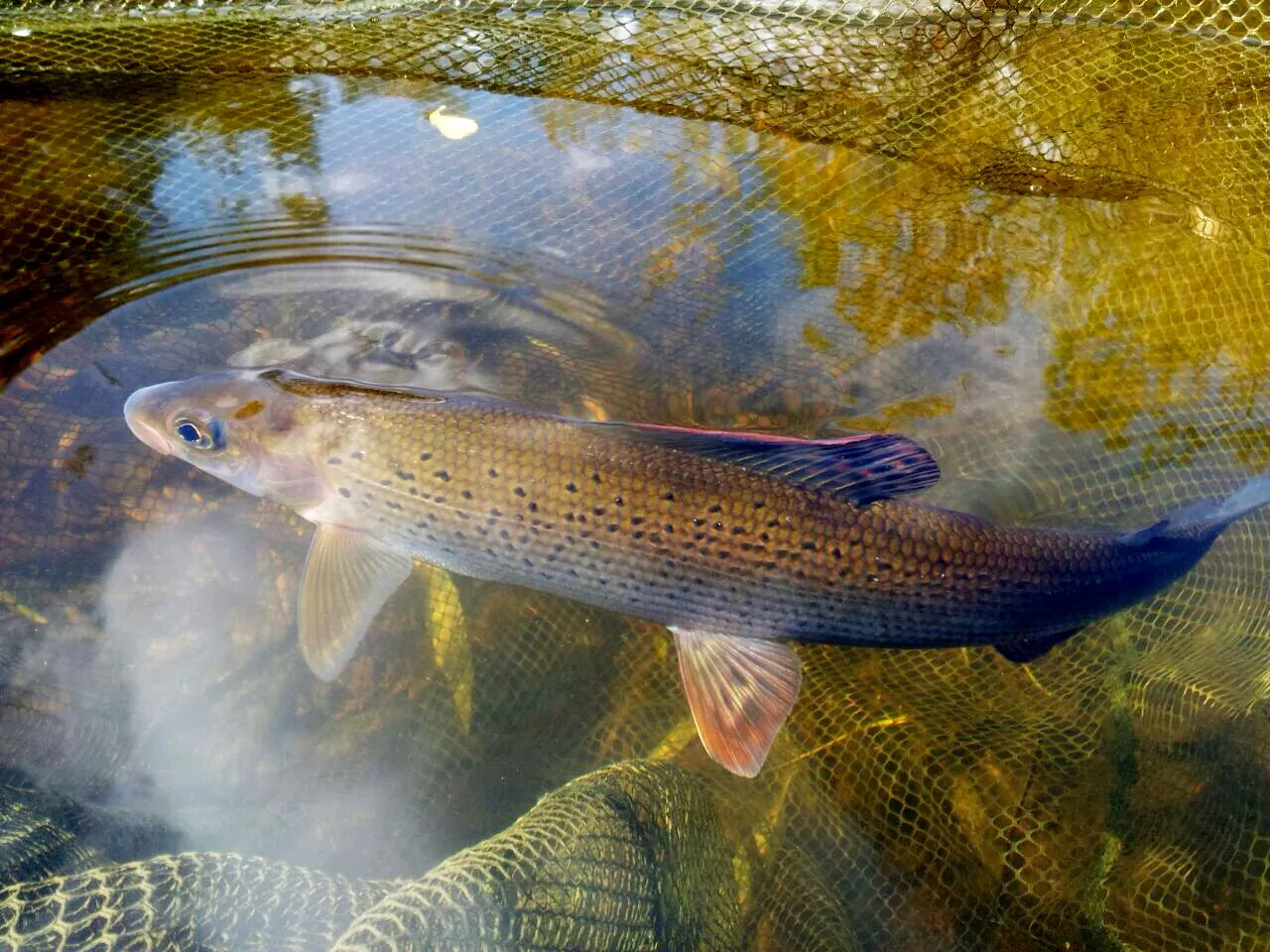
How this was identified, and who took it
Identified by: Lateral view of a fish held in a net in water. Adipose fin, large scales, small terminal mouth and anterior flank spotting are all clear. The sail dorsal is laid over rather than erect, so its extent is readable but its height is not.High Plains Grifter — CC BY-SA 4.0, via Wikimedia Commons — source, licenceWhat is known about how it feeds
The grayling's mouth is set underneath its head, and that settles where the fish feeds.
Despite being a salmonid that will rise freely to a surface hatch, the default feeding position is low in the water and frequently on the bed itself. The underslung mouth is built for taking nymphs, larvae and small crustaceans from and just above the gravel, and the fish holds station on the bottom in a way a trout in the same run does not.
The single verified relationship — aquatic insect larvae, at group level — is the mainstay, and in the clean, stony, well-oxygenated rivers grayling require it is mayfly, caddis and stonefly larvae that dominate.
Vision is the working sense and it is sharp, particularly in the clear low water of winter when the species is most fished for. Grayling shoal, which changes the practical situation in a specific way: the group responds to disturbance together, so a mistake costs more than one fish.
The seasonal position is unusual. Grayling spawn in spring and are in best condition in autumn and winter, which is the opposite of the trout they share water with, and it means the species is feeding actively through the coldest months when most of the food web has slowed.
They are also a sensitive indicator: grayling need cold, clean, oxygenated water, and their disappearance from a river usually says something about the river.
The food
Prey with a verified dietary link to this fish. Each entry carries its own evidence, and each is written at the precision the source actually used: a named species where the source named one, a group or food category where it said “polychaetes”, “crustaceans” or “detritus” and meant it. That is why this list is shorter than the animal’s real diet rather than longer.
- Aquatic insect larvae as prey — a group rather than a species: the evidence names the group
Grayling feed principally on drifting and benthic insect larvae, holding position on the bed and intercepting the drift, which is the behaviour that nymph fishing is built around.
Food with no page of its own here yet
These are real components of the diet, listed as plain text because FishingHQ has no page for them yet. Inventing pages to make the list look fuller would be the fabrication this whole approach exists to prevent.
- freshwater shrimp
- small snails
- fish eggs
- terrestrial insects, in summer
- small worms
What anglers do with this
Everything below is interpretation, not finding. It is what experienced anglers conclude from the biology above, and the reasoning is usually sound and almost never tested. It is separated from the biology deliberately.
The default low feeding position is the reasoning behind fishing weighted nymphs deep for grayling, and it is convention with a clear anatomical basis: the mouth is pointed at the bed.
The winter condition cycle converts into a season. Grayling angling is a cold-weather activity across most of the range precisely because the fish is in condition and feeding when the rest of the river has slowed, and that is a genuine biological fact rather than a tradition.
The shoaling behaviour is used to argue for careful approach and for moving after disturbance rather than persisting, which is practitioner reasoning from observed behaviour.
One welfare point: grayling are comparatively delicate and are often fished for in very cold conditions, where handling time and air exposure matter more than they do in summer.
What this does not establish
One group-level relationship for an invertebrate feeder with a broader diet than it represents. Composition varies with the invertebrate community of the river, which differs between chalk streams, freestone rivers and upland systems. Nothing here establishes proportions or describes the surface-feeding component.
Where this connects
These are the baits, lures, methods and explainers FishingHQ already joins to this fish — which is why the list is sometimes short. They are not chosen for this page, and a link here means an evidenced relationship exists, not that it follows from the diet.
Lures recorded for this species
Where it lives
This page covers feeding. The Grayling record covers identification, lifecycle, seasonal behaviour, handling and the sources behind all of it.
Reviewed 2026-08-12.