Terrestrial fly patterns
Lure · Last reviewed 2026-08-10
Flies imitating land insects that fall onto the water — the patterns that matter most in small streams, in summer, and whenever nothing is hatching.
Safety: standing precautions apply on this water.
Terrestrial patterns imitate insects that live on land and end up in the water by accident: grasshoppers, beetles, ants, crickets, cicadas and caterpillars. They are the most under-used category in fly fishing and, in certain conditions, by far the most productive.
The reasoning is straightforward. Aquatic insect hatches are episodic — a mayfly hatch happens for a period and then stops. Terrestrial insects fall into the water continuously through the warmer months, blown off bankside vegetation, and a trout in a small stream lined with grass and trees may take more of its summer diet from land insects than from anything hatching.
That produces a specific and useful rule: when nothing is hatching, and particularly in the middle of a warm windy day in high summer, a terrestrial is frequently the right answer where a hatch-matching approach has nothing to match. It is also why bankside vegetation matters as much as the water in small-stream fishing, and why the productive bank is usually the one with something growing over it.
The patterns themselves are generally larger, higher-floating and less delicate than hatch imitations, and they are usually fished with a deliberate plop rather than a delicate landing — because that is how a real grasshopper arrives.
At a glance
- Depth range
- The surface film, with beetle and ant patterns often fished partly submerged just beneath it. Sinking terrestrials fished as droppers extend this slightly.
What it does in the water
Terrestrials are inert. A land insect on the water surface struggles briefly and then floats helplessly, and the pattern's job is to sit in or on the surface film convincingly rather than to move. Foam and deer-hair bodies keep hoppers and beetles floating high; ant and beetle patterns often sit low or partly submerged, which is exactly how the real insects behave and why low-riding patterns frequently outfish high-floating ones.
How it is worked
Essentially none. A terrestrial is presented on a drag-free drift, exactly as a dry fly is, and left alone. The one deliberate departure is the arrival: terrestrials are frequently cast to land with an audible plop rather than delicately, because a grasshopper hitting the water makes a noise and trout learn to look at it. A small twitch to imitate a struggling insect is occasionally useful and is easily overdone.
Fish it catches
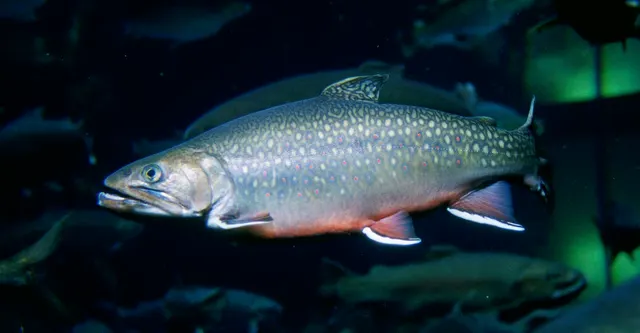 Brook troutSmall streams lined with grass and trees, where a trout may take more of its summer diet from insects blown off the bank than from anything hatching.
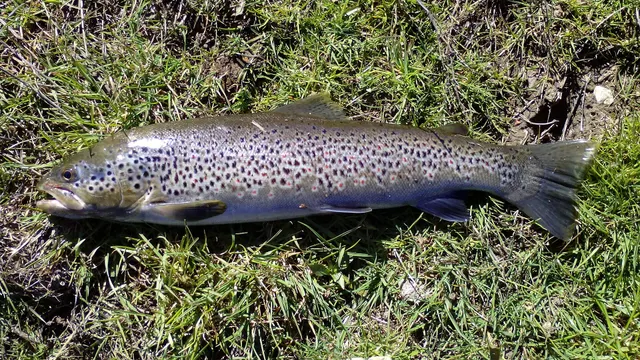 Brown troutTerrestrial patterns are fished for brown trout through the late summer, when land insects blown or washed in make up a larger share of what is available at the surface.
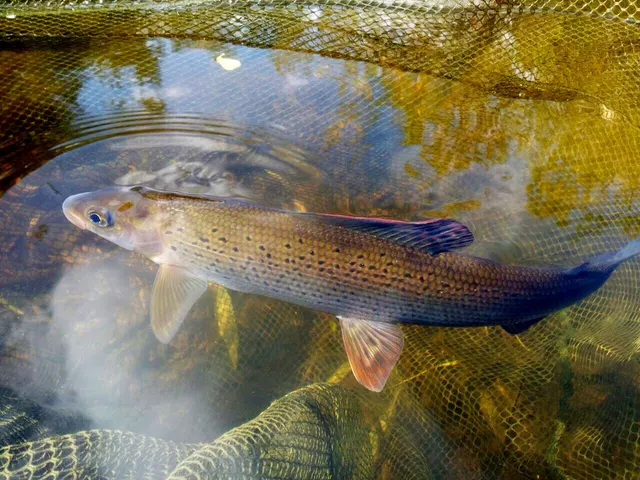 GraylingGrayling take terrestrial insects blown onto the water readily, and a small foam or hackled terrestrial is a standard searching pattern on a river with wooded banks.
What it imitates
Land insects that have fallen or been blown onto the water — grasshoppers, beetles, ants, crickets, cicadas and caterpillars. Unlike aquatic imitations, these do not need to match a hatch because there is no hatch: terrestrials arrive continuously through the warm months, which is why they work when nothing else is happening and why the productive water is usually beneath overhanging vegetation.
Where it stops working
- Seasonal: terrestrials are a warm-month approach and largely irrelevant in cold conditions when the insects are not active.
- Wind-dependent for the best fishing, since the insects arrive by being blown off vegetation.
- Large foam hopper patterns are wind-resistant and awkward to cast on fine tackle.
- Less effective on large open still waters, where there is no bankside vegetation to supply the insects.
- High-floating patterns can be too visible on hard-fished clear water, where a low-riding ant frequently outfishes an obvious hopper.
Safety
Precautions that always apply here
- If a hook goes past the barb into a person, cut the line, leave the hook where it is, and get medical help. Pulling it back out does far more damage than pushing it through under proper care.
Where to go next
Instead of this
More lures
Not related to this page — just the rest of the section. There is little else joined to this subject yet, and a short page should still lead somewhere.
Sources and evidence
- Freshwater Fishing — Macdonald & Jane's, 1975 (Specialist angling publication)Relied on for: Practitioner treatment of terrestrial insect patterns and their place in river fly fishing.FishingHQ's interpretation of what it saysCitation checked — the work exists and is described correctly
- Trout & Salmon — Bauer Media (Specialist angling publication)Relied on for: Contemporary practitioner treatment of hopper, beetle and ant patterns, and of the summer conditions in which they outfish hatch imitations.FishingHQ's interpretation of what it saysCitation checked — the work exists and is described correctly
Why the 6 connections on this page are here, and the sources
Fish it catches
What experienced anglers do — 3 connections
Widely and independently recommended by experienced anglers and specialist sources. This is real angling knowledge, not proof: controlled evidence for it is limited, and FishingHQ records it as convention rather than as a demonstrated effect.
Brook trout
A practitioner claim about a fly-species pairing, consistent with the species' verified feeding in headwater streams.
- Freshwater Fishing — Macdonald & Jane's, 1975 (Specialist angling publication)Relied on for: Practitioner treatment of terrestrial patterns in small stream fishing.Citation checked — the work exists and is described correctly
- Trout & Salmon — Bauer Media (Specialist angling publication)Relied on for: Contemporary practitioner treatment of hopper, beetle and ant patterns in summer conditions.Citation checked — the work exists and is described correctly
Brown trout
Late-season terrestrial fishing for brown trout is long-established practice in the game angling literature.
- Still Water Fly-Fishing — Andre Deutsch, 1952 (Specialist angling publication)Relied on for: Game angling reasoning on presentation and terminal tackle.Background and mechanism onlyCitation checked — the work exists and is described correctly
- Trout & Salmon — Bauer Media (Specialist angling publication)Relied on for: Contemporary game angling practice.States this directlyCitation checked — the work exists and is described correctly
Grayling
A practitioner claim about which lure family answers this species' feeding or holding behaviour.
- Trout & Salmon — Bauer Media (Specialist angling publication)Relied on for: Fly categories and their application to river salmonids.States this directlyCitation checked — the work exists and is described correctly
- The Compleat Angler, or the Contemplative Man's Recreation — Richard Marriot, 1653 (Reference work)Relied on for: The long documentary record of artificial-fly fishing for trout and grayling in English rivers.Background and mechanism onlyPassage read and verified
How it is worked
What experienced anglers do — 2 connections
Widely and independently recommended by experienced anglers and specialist sources. This is real angling knowledge, not proof: controlled evidence for it is limited, and FishingHQ records it as convention rather than as a demonstrated effect.
Dry fly fishing
The terrestrial record's claim is that these patterns carry the summer and the small stream, when no hatch supports an imitative dry. They are fished with identical technique, which is why they belong on this method rather than beside it.
- Still Water Fly-Fishing — Andre Deutsch, 1952 (Specialist angling publication)Relied on for: Specialist treatment of which bait or lure family this technique is fished with.States this directlyCitation checked — the work exists and is described correctly
- Trout & Salmon — Bauer Media (Specialist angling publication)Relied on for: The independently restated practitioner pairing of this technique with this family.Background and mechanism onlyCitation checked — the work exists and is described correctly
Fly fishing
The definitional relationship, framed by the condition in which the family matters.
- Freshwater Fishing — Macdonald & Jane's, 1975 (Specialist angling publication)Relied on for: Practitioner treatment of terrestrial insect patterns within the fly fishing tradition.Citation checked — the work exists and is described correctly
- Trout & Salmon — Bauer Media (Specialist angling publication)Relied on for: Contemporary treatment of terrestrial patterns and when they outfish hatch imitations.Citation checked — the work exists and is described correctly
Instead of this
What experienced anglers do — 1 connection
Widely and independently recommended by experienced anglers and specialist sources. This is real angling knowledge, not proof: controlled evidence for it is limited, and FishingHQ records it as convention rather than as a demonstrated effect.
Dry flies
The distinction between emergence and accidental fall is the basis of choosing between the two.
- Still Water Fly-Fishing — Andre Deutsch, 1952 (Specialist angling publication)Relied on for: Game angling reasoning on presentation and terminal tackle.Background and mechanism onlyCitation checked — the work exists and is described correctly
- Trout & Salmon — Bauer Media (Specialist angling publication)Relied on for: Contemporary game angling practice.States this directlyCitation checked — the work exists and is described correctly
How FishingHQ labels evidence is explained in the evidence policy.