Brook trout
Fish · Last reviewed 2026-08-10
A char rather than a true trout, native to cold clean eastern North American streams, and one of the most reliable indicators of water quality there is.
Safety: fish welfare — can cause injury needing treatment. 5 more points apply here.
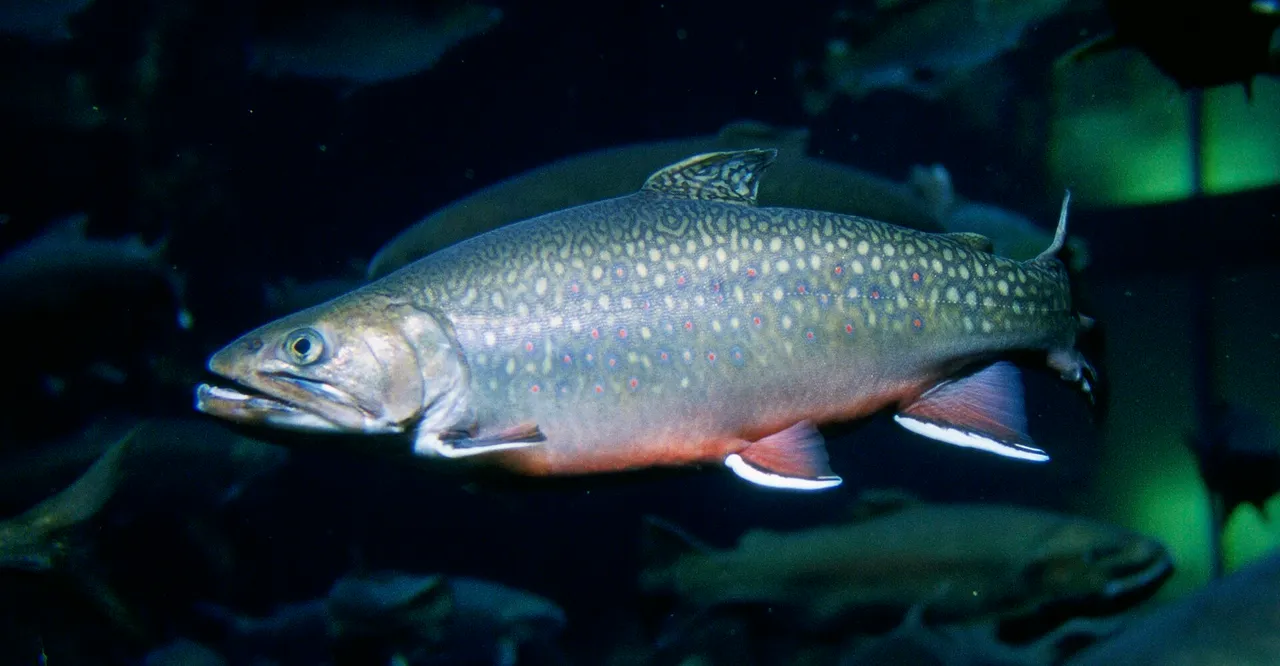
How this was identified, and who took it
Identified by: Every diagnostic character of the species in one frame: pale vermiculation over the back and dorsal fin, red spots with blue haloes, and white leading edges backed by black on the lower fins.Engbretson, Eric — Public domain, via Wikimedia Commons — source, licence
Catching Brook trout
Everything here on fishing for it. Each entry opens the page behind it.
- Ground
The brook trout is not a trout. It is a char, genus Salvelinus, and the distinction is visible the moment you know to look: char have PALE spots on a DARK ground, while true trout have dark spots on a pale ground. Once seen it cannot be unseen, and it separates brook trout from every brown and rainbow trout at a glance.
What defines it ecologically is intolerance. Brook trout need cold, clean, well-oxygenated water and they disappear from anywhere that stops providing it. That has made them a genuine bioindicator across their native eastern North American range — where brook trout have gone from a headwater stream, something has usually changed upstream — and it has also made them one of the species most exposed to warming water.
They are also strikingly beautiful, which is not usually a fishing-intelligence consideration and is in this case part of why the species matters culturally. The red spots ringed with blue haloes, the vermiculated back and the white-edged orange fins have made the brook trout the emblem of small-stream fly fishing in a way no other North American fish approaches.
Like the rainbow, it has been introduced widely and is a documented pressure on native fish in parts of the western United States, South America and Europe.
How it is caught
- Dry fly fishingBrook trout in their native headwaters rise freely and unselectively, which makes a dry fly both effective and the only practical way to fish tight, shallow, fast water without snagging.
- NymphingMost of a brook trout's food arrives as drifting invertebrates below the surface, and short-line nymphing matches the drift in the pocket water they hold in.
Gear for this fish
- NymphsBrook trout in their native headwaters feed mainly on drifting invertebrates in fast, cold, shaded water, and a small weighted nymph is the answer to that drift.
- SpinnersA small spinner is the traditional method on the tight, brushy headwater streams where a fly cast is impossible, and it is what most of this fishery is actually conducted with.
- Terrestrial fly patternsSmall streams lined with grass and trees, where a trout may take more of its summer diet from insects blown off the bank than from anything hatching.
Identification
- Scientific name
- Salvelinus fontinalis
- Family
- Salmonidae
- Water
- Freshwater, Brackish, Saltwater, Moves between fresh and salt water
- Conservation status
- Least Concern
- Regions
- North America, Arctic & Subarctic, Western Europe, Central & South America, New Zealand
- PALE spots on a dark ground — the char character, and the opposite of every true trout. Wavy pale vermiculation over the back and dorsal fin.
- Red spots ringed with distinct blue haloes along the flank.
- Lower fins orange to red with a clean white leading edge backed by a black line — unmistakable and present at all sizes.
- Squared-off tail, which is the origin of the name squaretail.
- Adipose fin present. Separated from brown trout by the pale-on-dark spotting and from rainbow by the absence of tail spots and the white fin edges.
Size
- Typical
- 150–400 g (5–14 oz)
- Large
- 0.8–1.5 kg (1.7–3.3 lb)
Exceptional: Over 3 kg (6.6 lb); maximum published weight 8 kg
The coldest, most acidic, smallest water a trout will accept
Brook trout are char rather than trout, and their habitat requirements are narrower and colder than the name suggests.
COLD IS THE ABSOLUTE REQUIREMENT. Brook trout need colder water than brown or rainbow trout and are excluded from anything that warms substantially in summer. In their native range this confines them increasingly to headwaters, spring-fed reaches and high-altitude water as downstream reaches warm.
GROUNDWATER INFLUENCE IS THE PRACTICAL PREDICTOR. Springs, seeps and groundwater-fed reaches keep summer temperature down and winter temperature up, and brook trout concentrate around them.
THEY TOLERATE ACIDIC WATER better than most salmonids, which is why they persist in peaty, softwater headwaters and mountain lakes where other trout do not.
SMALL STREAMS SUIT THEM. Brook trout thrive in narrow, shaded, structurally complex headwater streams with undercut banks, woody debris and plunge pools, and they dominate such water where they are native.
THEY LOSE TO BROWN TROUT IN LARGER, WARMER REACHES, which is the consistent pattern where the two coexist and part of why the native range has contracted upstream.
AND LAKE AND SEA-RUN FORMS EXIST. Some populations use lakes, and coastal populations run to salt water as salters, occupying estuary and nearshore habitat seasonally — the same species in an entirely different environment.
Backed by research — why, and the sources (2)
Supported by peer-reviewed research or fisheries science. The sources are listed and can be checked.
- NASCO conservation and management of North Atlantic salmon — North Atlantic Salmon Conservation Organization (Government fisheries body)Relied on for: Anadromous salmonid biology, run timing, spawning habitat requirements and the management principles applied to them.States this directlyCitation checked — the work exists and is described correctly
- FishBase: a global information system on fishes — Froese, R. and D. Pauly, eds. — FishBase Consortium (Scientific institute)Relied on for: Distribution, habitat association, depth range, size, reproduction and life-history parameters recorded for the species.States this directlyPassage read and verified
Autumn redds in groundwater seeps
Brook trout spawn in autumn in cold flowing water, and their site selection is unusually specific.
SPAWNING IS IN AUTUMN, triggered by falling water temperature and shortening days, generally earlier than brown trout in the same system.
THE FEMALE CUTS A REDD in clean gravel, and the site selection is the distinctive part: brook trout preferentially spawn where groundwater upwells through the gravel. Upwelling water is thermally stable and well oxygenated, which protects eggs from both freezing and suffocation over a long winter incubation.
THAT MAKES SPAWNING HABITAT SCARCE AND SPECIFIC. A stream with abundant gravel but no upwelling supports far less spawning than its appearance suggests, and disturbance of the groundwater connection — by abstraction, by road drainage, by sedimentation — removes spawning capacity without changing how the stream looks.
INCUBATION IS LONG because the water is cold, with fry emerging in late winter or spring.
MATURITY IS EARLY, frequently in the second year, and brook trout in small headwaters mature at a very small size — which is why a stunted-looking population may be entirely healthy.
AND HYBRIDISATION IS A CONSERVATION ISSUE WHERE THEY ARE INTRODUCED. Brook trout hybridise with bull trout, producing largely sterile offspring, so introduced brook trout impose a direct reproductive cost on the native char.
Backed by research — why, and the sources (2)
Supported by peer-reviewed research or fisheries science. The sources are listed and can be checked.
- NASCO conservation and management of North Atlantic salmon — North Atlantic Salmon Conservation Organization (Government fisheries body)Relied on for: Anadromous salmonid biology, run timing, spawning habitat requirements and the management principles applied to them.States this directlyCitation checked — the work exists and is described correctly
- FishBase: a global information system on fishes — Froese, R. and D. Pauly, eds. — FishBase Consortium (Scientific institute)Relied on for: Distribution, habitat association, depth range, size, reproduction and life-history parameters recorded for the species.States this directlyPassage read and verified
A small char in cold water, and why the net matters more than the grip
Brook trout handling is a fragility problem, and the fragility is not obvious because the fish are usually small.
THE SLIME COAT IS THE WHOLE THING. Salmonids rely on a mucus layer as their barrier against fungal and bacterial infection, and it comes off on anything dry: hands, shirts, grass, rock, a dry net. A brook trout returned looking perfect after being handled with dry hands frequently develops fungus days later, and nobody ever sees it. Wet hands and a knotless rubber or soft mesh net are not refinements; they are the technique.
KNOTTED NETS ARE THE COMMONEST AVOIDABLE INJURY. Knotted mesh abrades skin and removes scales in exactly the places the fish cannot afford it.
THE FISH IS NOT DANGEROUS. No spines of consequence, no cutting teeth. Small teeth in the jaw of a large one will mark a finger and nothing more.
AIR EXPOSURE AND TEMPERATURE. Brook trout are cold-water specialists with a narrower thermal tolerance than most salmonids, and they are frequently caught at the warm end of their range in small streams in summer. A fish taken from water that is already marginal for it, held in warm air, is being pushed past what it can take. In warm conditions the fish should not leave the water at all.
AND BIOSECURITY IS A REAL CONSIDERATION IN SMALL HEADWATERS. These are often isolated populations in small catchments, and waders, boots and nets moved between waters carry pathogens and invasive organisms. Cleaning and drying gear between waters protects populations that cannot be restocked from anywhere.
Official guidance — why, and the sources (3)
Stated by a fisheries authority, scientific institute or recognised angling body. Authoritative, but summarising rather than demonstrating.
- Angling Trust guidance for anglers — Angling Trust (Angling or fisheries organisation)Relied on for: Angler guidance on salmonid handling, net choice, wet hands and biosecurity between waters.Background and mechanism onlyCitation checked — the work exists and is described correctly
- Do we need species-specific guidelines for catch-and-release recreational angling? — Biodiversity and Conservation 14:1195–1209, 2005 (Scientific literature)Relied on for: That post-release mortality varies with species, capture depth, water temperature, air exposure and handling, and that species-specific guidance outperforms general guidance.States this directlyCitation checked — the work exists and is described correctly
- A review of catch-and-release angling mortality with implications for no-take reserves — Reviews in Fish Biology and Fisheries 15:129–154, 2005 (Scientific literature)Relied on for: Review of hooking and release mortality across fisheries, including the contribution of depth of capture and handling duration.States this directlyCitation checked — the work exists and is described correctly
An autumn spawner in cold water, and a summer that squeezes it into refuges
Brook trout seasonality is set by a narrow thermal tolerance at one end of the year and an autumn spawning migration at the other, and the summer constraint is the one that decides whether a population persists at all.
SUMMER IS A SURVIVAL PROBLEM. Brook trout require colder water than brown or rainbow trout and become stressed at temperatures those species tolerate. As a stream warms through summer, brook trout retreat into thermal refuges — spring seeps, tributary confluences, deep shaded pools, groundwater-fed reaches — and concentrate there. That concentration makes them findable and makes them fragile simultaneously: fish stacked in a cold pocket in August are the whole population of that reach, and playing and handling them in warm water is the most damaging thing that can happen to them.
WHICH MEANS THE FISHING SEASON AND THE FISH'S GOOD CONDITION ARE NOT THE SAME MONTHS. Spring and early summer, and again in early autumn, are when the fish are spread out, feeding and in condition. Midsummer is when they are least able to withstand being caught.
AUTUMN IS SPAWNING AND IT IS A MIGRATION. Brook trout spawn in autumn on clean gravel in flowing water, with groundwater upwelling being a strongly favoured feature of chosen redd sites — the upwelling keeps eggs oxygenated and buffers them against freezing. Fish move to reach those sites, often into small tributaries, and males colour dramatically. Many jurisdictions close the season around this period; whether and when is a matter for the competent authority.
WINTER IS SPENT SLOWLY AND UNDER ICE IN MUCH OF THE RANGE, with fish in deeper slower water and feeding at a low level. Egg development continues in the gravel throughout, so winter stream conditions — scouring floods, anchor ice, sediment — determine the next year class.
SEA-RUN AND LAKE POPULATIONS HAVE A DIFFERENT CALENDAR. Anadromous brook trout make seasonal movements between estuary and river, and pond and lake populations relate to thermal stratification much as lake trout do, occupying cold deep water in summer and the whole water body in cool seasons. The mechanism is the same thermal one; the pattern looks completely different.
AND THE SPECIES IS A CLIMATE INDICATOR because of the summer constraint. Where summer refuges disappear, brook trout disappear from reaches that still look and fish like brook trout water in May.
Backed by research — why, and the sources (2)
Supported by peer-reviewed research or fisheries science. The sources are listed and can be checked.
- Freshwater Fishes of the British Isles — HarperCollins (New Naturalist 75), 1992 (Reference work)Relied on for: Seasonal behaviour, spawning period and temperature-driven activity of freshwater fishes.Background and mechanism onlyCitation checked — the work exists and is described correctly
- FishBase: a global information system on fishes — Froese, R. and D. Pauly, eds. — FishBase Consortium (Scientific institute)Relied on for: Spawning season, temperature preference and seasonal behaviour for the species.States this directlyPassage read and verified
Small water, short rods and the tackle decision that is really about temperature
Brook trout tackle is the lightest game outfit on FishingHQ, and the specification comes almost entirely from the water rather than from the fish.
THE WATER IS SMALL AND OVERGROWN, WHICH SETS THE ROD. Brook trout streams are frequently narrow, wooded and tight, and the practical requirement is a short rod that can be cast between trees at close range with a roll cast or a bow-and-arrow cast. A long rod built for distance is an active hindrance. Where brook trout occupy ponds and lakes, the reverse applies and a longer rod earns its place — the same species, different water, different outfit.
THE FISH ARE SMALL AND WILLING, WHICH SETS EVERYTHING ELSE. Headwater brook trout are frequently a hand's length and are famously unselective, so fine tippet and small flies are about presentation in clear shallow water rather than about deceiving a difficult fish. Delicacy of delivery matters more than pattern.
SHORT CASTS AND CLOSE APPROACH MAKE CONCEALMENT THE REAL SKILL. In water this small the angler is close enough to be seen, and the tackle decision that helps most is whatever allows a cast from further back and lower down.
BUT THE DECIDING VARIABLE IS TEMPERATURE, AND IT OVERRIDES THE REST. Brook trout require colder water than the salmonids around them and are stressed at temperatures those species tolerate, so in high summer the population concentrates in cold refuges — spring seeps, tributary mouths, deep shaded pools — and those fish are the entire remaining stock of that reach. Playing and handling them in warm water is the most damaging thing that can be done, whatever the tackle.
SO THE HONEST TACKLE ANSWER IN MIDSUMMER IS FREQUENTLY NOT TO FISH, and where fishing continues, barbless hooks, a short fight, wet hands and unhooking in the water are what decide survival.
AND WHAT IS PERMITTED IS A LOCAL MATTER. Fly-only rules, barbless requirements, gear restrictions and closed seasons on brook trout water are common and are set by the fishery or the competent authority.
Official guidance — why, and the sources (2)
Stated by a fisheries authority, scientific institute or recognised angling body. Authoritative, but summarising rather than demonstrating.
- Understanding the Complexity of Catch-and-Release in Recreational Fishing — Reviews in Fisheries Science 15:75–167, 2007 (Scientific literature)Relied on for: Catch-and-release outcomes and the tackle and handling variables that govern post-release survival, including hooking location and fight duration.States this directlyCitation checked — the work exists and is described correctly
- Do we need species-specific guidelines for catch-and-release recreational angling? — Biodiversity and Conservation 14:1195–1209, 2005 (Scientific literature)Relied on for: Physiological consequences of capture and the effect of gear choice on injury, exhaustion and recovery.States this directlyCitation checked — the work exists and is described correctly
Small lures in small water, and a fish that will take almost anything presented well
Brook trout are the least selective salmonid on FishingHQ, which makes lure fishing for them a question of access and presentation rather than of pattern.
THE FISH IS OPPORTUNISTIC AND WILLING. Headwater brook trout live in nutrient-poor water where food is scarce and competition for a station is real, and they respond accordingly: a small spinner, spoon or soft bait passing a holding lie is usually investigated. Anglers who spend effort on lure selection here are optimising the wrong variable.
THE VARIABLE THAT ACTUALLY MATTERS IS GETTING THE LURE THERE UNSEEN. Brook trout streams are small, clear and shallow, the angler is close, and the fish has excellent reason to be nervous. Approach from downstream, keep low, and cast into the head of a pool or the seam beside a rock before the fish knows anything is there. A first cast into an undisturbed lie is worth ten afterwards.
SO THE LURES ARE SMALL AND LIGHT, and that is a casting problem in tight water rather than a fish-fooling one. Small spinners and spoons load a short rod adequately; anything larger cannot be cast accurately between trees and lands too hard in shallow water.
CURRENT DOES THE WORK IN A STREAM. A lure cast across and allowed to swing on the flow behaves like something the current has caught, which is what a fish holding a station is watching for. Working a lure hard against the flow is a fish-repelling action in water this size.
IN PONDS AND LAKES THE LOGIC INVERTS. There is no drift to imitate, so the angler supplies all the movement, and small spoons and spinners retrieved at varying depths become a searching tool — the same species, a completely different presentation.
AND THE CONSTRAINT THAT OVERRIDES EVERYTHING IS SUMMER TEMPERATURE. The record's tackle and season material sets it out: in warm water these fish concentrate in cold refuges and are the whole remaining stock of a reach. Barbless hooks, short fights and unhooking in the water are what allow the fishery to continue, and many waters are fly-only or restrict lure fishing entirely — a matter for the fishery and the competent authority.
What experienced anglers do — why, and the sources (2)
Widely and independently recommended by experienced anglers and specialist sources. This is real angling knowledge, not proof: controlled evidence for it is limited, and FishingHQ records it as convention rather than as a demonstrated effect.
- Freshwater Fishing — Macdonald & Jane's, 1975 (Specialist angling publication)Relied on for: Game angling technique, including the relationship between method choice and the water being fished.States this directlyCitation checked — the work exists and is described correctly
- Trout & Salmon — Bauer Media (Specialist angling publication)Relied on for: Contemporary game angling practice, method and presentation.States this directlyCitation checked — the work exists and is described correctly
Lifecycle and reproduction
Spawns in autumn over gravel in flowing water or over upwelling springs in lakes, the female cutting a redd. Most populations are small stream fish that mature early and live only a few years; where conditions allow — large lakes, or sea access in the northern part of the range — individuals grow far larger and live longer, with a maximum reported age of 24 years. Sea-run fish, called salters or coasters, are a distinct and much-reduced life history.
Autumn redd-spawning over gravel, frequently associated with groundwater upwelling, which is one reason the species is so tied to specific spring-fed reaches. Eggs overwinter in the gravel and hatch in spring, so the whole reproductive cycle depends on gravel staying clean and oxygenated through the coldest months — which is precisely what siltation from land use destroys.
Feeding and senses
Opportunistic in small streams, taking aquatic insect nymphs and larvae, terrestrial insects falling onto the water, crustaceans and small fish. In small headwater streams the terrestrial component is unusually important, which is why beetle, ant and hopper patterns work so well for this species and why overhanging bankside vegetation matters as much as the water.
Sight-dominant and, in the small clear streams it favours, extremely easy to spook. Brook trout in a headwater pool see an angler on the bank long before the angler sees the fish, which is why the fishing is a stalking fishery and why short accurate casts beat long ones. In stained water and at low light they feed more boldly.
Through the year
Governed by water temperature above everything else. Brook trout are active in cold water and stressed above the high teens, retreating to spring seeps and deep cold pockets as summer water warms — which concentrates them and makes them vulnerable at exactly the time they are least able to withstand being caught. Autumn brings spawning movement into small tributaries. The northern-hemisphere calendar applies to the native range; introduced southern populations run the reverse.
Distribution
Native to eastern North America from the Canadian Maritimes and Quebec west to the Great Lakes and south along the Appalachians to Georgia, with sea-run populations in the north. Introduced widely elsewhere in North America, in South America, Europe, Asia and Australasia, where it is established and in places a documented pressure on native fish.
This is a biological range — where the species occurs, not a prediction that you will catch one. To browse the fishing geography FishingHQ holds, start at fishing places.
Why anglers care
The emblematic small-stream fly-fishing target of eastern North America and the fish a very large number of American anglers learn on. Taken on dry fly, nymph, small spinner and bait. Highly regarded rather than large: a brook trout of a pound from a headwater stream is a good fish, and the appeal is the water and the fish rather than the size.
Handling and returning
A small, cold-water fish that handles warm water badly. Wet hands, keep the fish in the water, use barbless hooks and release quickly. In summer, when brook trout are concentrated in cold refuges, the responsible choice is frequently to fish elsewhere — a population crowded into a spring seep in August cannot absorb being caught repeatedly, however carefully each fish is handled.
Going further
- What does brook trout eat? — feeding biology, kept separate from what anglers infer from it.
- Brook trout vs Arctic char — how to tell them apart.
- Brook trout vs Bull trout — how to tell them apart.
- Brook trout vs Lake trout — how to tell them apart.
Safety
Fish welfare — Can cause injury needing treatment
Brook trout are among the least tolerant of warm water of any salmonid, and fish caught from summer thermal refuges frequently die after release even when handling is careful.
What reduces it: Do not fish for them in warm water. Where summer concentrations are known, leave them alone. Play quickly, keep the fish wet, use barbless hooks, and treat the water temperature as the deciding factor rather than the technique.
Biosecurity and disease transfer — Can cause injury needing treatment
Introduced brook trout displace native fish in parts of the western United States, South America and Europe, and stocking and equipment move pathogens between headwaters that are otherwise isolated.
What reduces it: Never move live fish or water between waters. Clean, drain and dry equipment between catchments — headwater streams are exactly the isolated systems that suffer most from an introduced pathogen.
Precautions that always apply here
- Wet your hands before touching a fish. Dry hands strip the protective mucus layer that keeps infection out.
- Support the fish's weight along its body, keep it out of the water for as short a time as possible, and hold it over something soft.
- Check, clean and dry your kit between different waters — the published guidance is 48 hours’ drying, in sunlight where possible, because a number of invasive species survive over two weeks in damp conditions. Nets, boots and wet mats move invasive species and disease more effectively than anything else anglers do.
- Never move live fish, live bait or water from one water to another.
Check the rules before you fish
Fishing laws, bylaws, access rules, seasons, bait restrictions and permitted methods vary by location and can change. Check the current rules from the relevant authority and the water you intend to fish before fishing.
Check with:
- Current national or regional law for where you are fishing
- Current local bylaws
- The relevant fisheries authority
- The landowner, club or fishery whose water it is
- Any restrictions specific to the species or the method you intend to use
Where to go next
Similar and related fish
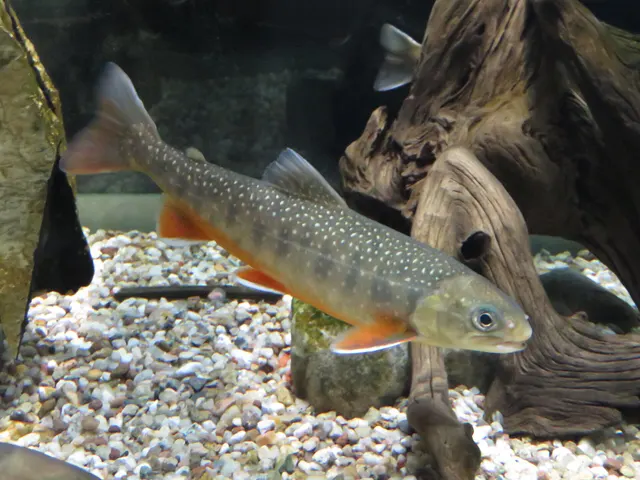 Arctic charCongeneric chars separated by vermiculation on the back and by tail shape.
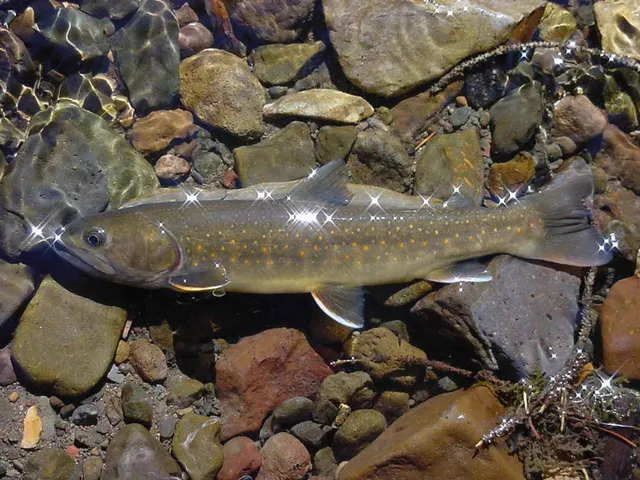 Bull troutBoth chars with pale spots on a dark ground, separated by vermiculation and by tail fork.
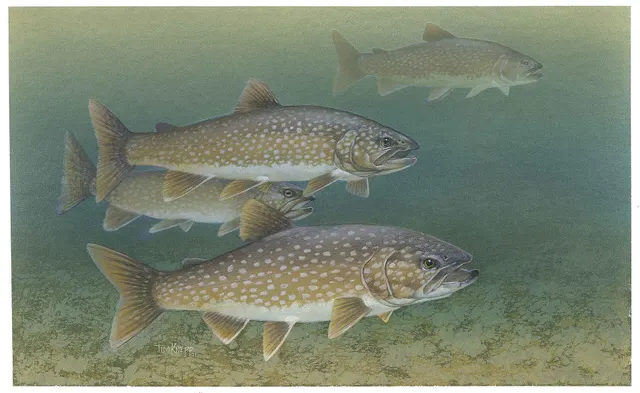 Lake troutBoth are char, genus Salvelinus, not trout — pale spots on a dark ground rather than the reverse. The tail separates them: brook trout squared, lake trout deeply forked.
- Rainbow smeltWhere smelt occur, larger brook trout feed on them heavily, which is what produces the exceptional sizes reached in some smelt lakes.
Where it lives
Where you will find it
Understanding this fish
- Aquatic insect larvae as preyIn streams the diet is dominated by aquatic insect larvae taken from the drift, as it is for stream salmonids generally.
- Trout, char and salmon: what the words actually meanA char rather than a trout, which is why it carries pale spots on a dark ground rather than the reverse.
Sources and evidence
- FishBase: a global information system on fishes — Froese, R. and D. Pauly, eds. — FishBase Consortium (Scientific institute)Relied on for: Scientific name, family placement in the Salmonidae, a maximum length of 86.0 cm SL, a maximum published weight of 8.0 kg, a maximum reported age of 24 years.States this directlyPassage read and verified
- FishBase: a global information system on fishes — Froese, R. and D. Pauly, eds. — FishBase Consortium (Scientific institute)Relied on for: Environment, climate zone and depth range as recorded: Marine; freshwater; brackish; benthopelagic; anadromous ; depth range 15 - 27 m . Temperate; 0°C - 25°C ; 61°N - 34°N, 124°W - 52°WStates this directlyPassage read and verified
- FishBase: a global information system on fishes — Froese, R. and D. Pauly, eds. — FishBase Consortium (Scientific institute)Relied on for: The IUCN Red List category for Salvelinus fontinalis — Least Concern, assessed 01 August 2021 — as republished by FishBase, the Red List itself being unreachable during review.States this directlyPassage read and verified
- Understanding the Complexity of Catch-and-Release in Recreational Fishing — Reviews in Fisheries Science 15:75–167, 2007 (Scientific literature)Relied on for: That water temperature and handling materially affect the survival of released fish.States this directlyCitation checked — the work exists and is described correctly
- Check Clean Dry — biosecurity guidance for water users — GB Non-native Species Secretariat (Conservation authority)Relied on for: The framework by which introduced salmonids are assessed and managed.FishingHQ's interpretation of what it saysPassage read and verified
Why the 13 connections on this page are here, and the sources
Similar and related fish
Backed by research — 4 connections
Supported by peer-reviewed research or fisheries science. The sources are listed and can be checked.
Arctic char
An identification comparison naming both binomials: Salvelinus alpinus and Salvelinus fontinalis.
- FishBase: a global information system on fishes — Froese, R. and D. Pauly, eds. — FishBase Consortium (Scientific institute)Relied on for: Morphological and distributional data for Salvelinus alpinus and for Salvelinus fontinalis.States this directlyPassage read and verified
- The IUCN Red List of Threatened Species — International Union for Conservation of Nature (Conservation authority)Relied on for: Separate assessments treating Salvelinus alpinus and Salvelinus fontinalis as distinct species.States this directlyCitation checked — the work exists and is described correctly
Bull trout
An identification comparison naming both binomials: Salvelinus confluentus and Salvelinus fontinalis.
- FishBase: a global information system on fishes — Froese, R. and D. Pauly, eds. — FishBase Consortium (Scientific institute)Relied on for: Morphological and distributional data for Salvelinus confluentus and for Salvelinus fontinalis.States this directlyPassage read and verified
- The IUCN Red List of Threatened Species — International Union for Conservation of Nature (Conservation authority)Relied on for: Separate assessments treating Salvelinus confluentus and Salvelinus fontinalis as distinct species.States this directlyCitation checked — the work exists and is described correctly
Lake trout
A taxonomic and identification comparison naming both binomials.
- FishBase: a global information system on fishes — Froese, R. and D. Pauly, eds. — FishBase Consortium (Scientific institute)Relied on for: That Salvelinus fontinalis and Salvelinus namaycush are congeners in the genus Salvelinus, distinct from the true trouts of Salmo and Oncorhynchus.States this directlyPassage read and verified
Rainbow smelt
Recorded diet evidence identifies Osmerus mordax as a food item of this predator at species level. The edge is written at that granularity and no further.
- FishBase: a global information system on fishes — Froese, R. and D. Pauly, eds. — FishBase Consortium (Scientific institute)Relied on for: Food items recorded for this predator, including Osmerus mordax.States this directlyPassage read and verified
- FAO Species Identification Guides for Fishery Purposes and the FAO Species Catalogues — Food and Agriculture Organization of the United Nations (Scientific institute)Relied on for: Species account describing the diet of this predator in the region where Osmerus mordax occurs.Background and mechanism onlyCitation checked — the work exists and is described correctly
How it is caught
What experienced anglers do — 2 connections
Widely and independently recommended by experienced anglers and specialist sources. This is real angling knowledge, not proof: controlled evidence for it is limited, and FishingHQ records it as convention rather than as a demonstrated effect.
Dry fly fishing
Established angling practice for this species, recorded as convention. The note states the property of the animal or its water that makes the method the answer.
- Trout & Salmon — Bauer Media (Specialist angling publication)Relied on for: Established salmonid angling technique and its application to this species.States this directlyCitation checked — the work exists and is described correctly
- General angling website restatements of established technique — Various (Credible secondary source)Relied on for: Widely restated practice connecting this species and method.Background and mechanism onlyCitation checked — the work exists and is described correctly
Nymphing
Established angling practice for this species, recorded as convention. The note states the property of the animal or its water that makes the method the answer.
- Trout & Salmon — Bauer Media (Specialist angling publication)Relied on for: Established salmonid angling technique and its application to this species.States this directlyCitation checked — the work exists and is described correctly
- General angling website restatements of established technique — Various (Credible secondary source)Relied on for: Widely restated practice connecting this species and method.Background and mechanism onlyCitation checked — the work exists and is described correctly
Gear for this fish
What experienced anglers do — 3 connections
Widely and independently recommended by experienced anglers and specialist sources. This is real angling knowledge, not proof: controlled evidence for it is limited, and FishingHQ records it as convention rather than as a demonstrated effect.
Nymphs
A practitioner claim about which lure family answers this species' feeding or holding behaviour.
- Trout & Salmon — Bauer Media (Specialist angling publication)Relied on for: Fly categories and their application to salmonids in running and still water.States this directlyCitation checked — the work exists and is described correctly
- Still Water Fly-Fishing — Andre Deutsch, 1952 (Specialist angling publication)Relied on for: Still-water fly categories, and the feeding observations they are chosen from.Background and mechanism onlyCitation checked — the work exists and is described correctly
Spinners
A practitioner claim about which lure family answers this species' feeding or holding behaviour.
- General angling website restatements of established technique — Various (Credible secondary source)Relied on for: Widely restated North American lure practice for this species.Background and mechanism onlyCitation checked — the work exists and is described correctly
- IGFA International Angling Rules and World Record Requirements — International Game Fish Association (Angling or fisheries organisation)Relied on for: Recognition of the species as an established sport fish taken on artificial lures, and the tackle conventions used for it.States this directlyPassage read and verified
Terrestrial fly patterns
A practitioner claim about a fly-species pairing, consistent with the species' verified feeding in headwater streams.
- Freshwater Fishing — Macdonald & Jane's, 1975 (Specialist angling publication)Relied on for: Practitioner treatment of terrestrial patterns in small stream fishing.Citation checked — the work exists and is described correctly
- Trout & Salmon — Bauer Media (Specialist angling publication)Relied on for: Contemporary practitioner treatment of hopper, beetle and ant patterns in summer conditions.Citation checked — the work exists and is described correctly
Where it lives
Backed by research — 1 connection
Supported by peer-reviewed research or fisheries science. The sources are listed and can be checked.
Lowland rivers
A habitat and tolerance claim held to a scientific standard because FishingHQ uses it as an indicator elsewhere.
- FishBase: a global information system on fishes — Froese, R. and D. Pauly, eds. — FishBase Consortium (Scientific institute)Relied on for: That Salvelinus fontinalis occupies marine, fresh and brackish benthopelagic habitat with an anadromous life history in part of the range, in temperate water from 0 to 25 degrees.States this directlyPassage read and verified
Where you will find it
Backed by research — 1 connection
Supported by peer-reviewed research or fisheries science. The sources are listed and can be checked.
Patagonia
A distribution association between an animal and a kind of water, rather than a claim about any named mark.
- The IUCN Red List of Threatened Species — International Union for Conservation of Nature (Conservation authority)Relied on for: Assessment and habitat account for the species, including the river or lake system it occupies and the pressures acting on it.States this directlyCitation checked — the work exists and is described correctly
- FishBase: a global information system on fishes — Froese, R. and D. Pauly, eds. — FishBase Consortium (Scientific institute)Relied on for: Distribution, habitat association, size and life history recorded for the species in the system concerned.States this directlyPassage read and verified
Understanding this fish
Backed by research — 2 connections
Supported by peer-reviewed research or fisheries science. The sources are listed and can be checked.
Aquatic insect larvae as prey
Recorded diet evidence identifies mayfly, caddis and stonefly larvae as a food item of this predator at group level rather than to species. The edge points at the taxon record for that reason, and encoding it as a species-level claim would assert something the source does not.
- FishBase: a global information system on fishes — Froese, R. and D. Pauly, eds. — FishBase Consortium (Scientific institute)Relied on for: Food items recorded for this predator, given as mayfly, caddis and stonefly larvae.States this directlyPassage read and verified
- FAO Species Identification Guides for Fishery Purposes and the FAO Species Catalogues — Food and Agriculture Organization of the United Nations (Scientific institute)Relied on for: Species account describing this predator's diet, recorded at the level of mayfly, caddis and stonefly larvae.Background and mechanism onlyCitation checked — the work exists and is described correctly
Trout, char and salmon: what the words actually mean
The clearest case where the common name predicts the wrong field character.
- FishBase: a global information system on fishes — Froese, R. and D. Pauly, eds. — FishBase Consortium (Scientific institute)Relied on for: Genus placement within Salmonidae for Salmo, Oncorhynchus and Salvelinus, and the species assigned to each.States this directlyPassage read and verified
How FishingHQ labels evidence is explained in the evidence policy.