Brook trout vs Bull trout
How to tell them apart, and what follows from getting it right.
Why they get confused
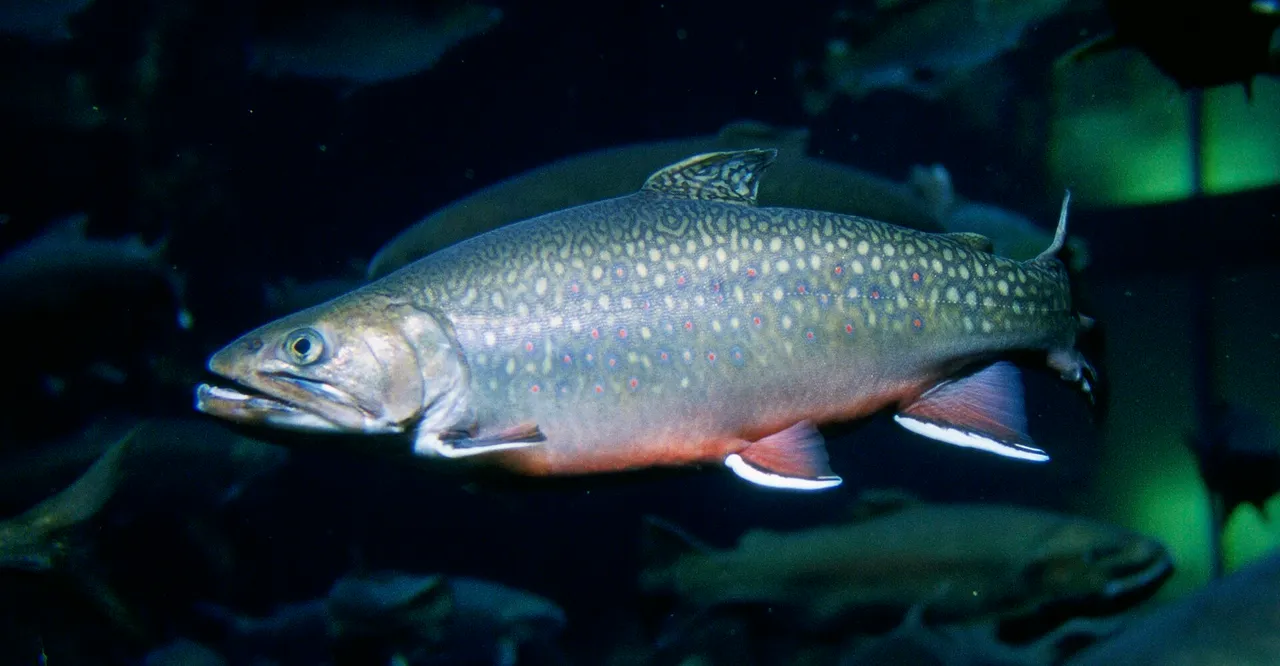
Both are char rather than trout, so both carry PALE spots on a DARK ground — the character that separates char from every true trout, and the character most anglers stop at. In the mountain rivers of western North America they occur in the same water, they are the same colours, and brook trout has frequently been stocked into bull trout country. A reader who has learned 'pale spots means char' has arrived at the hard part rather than finished.

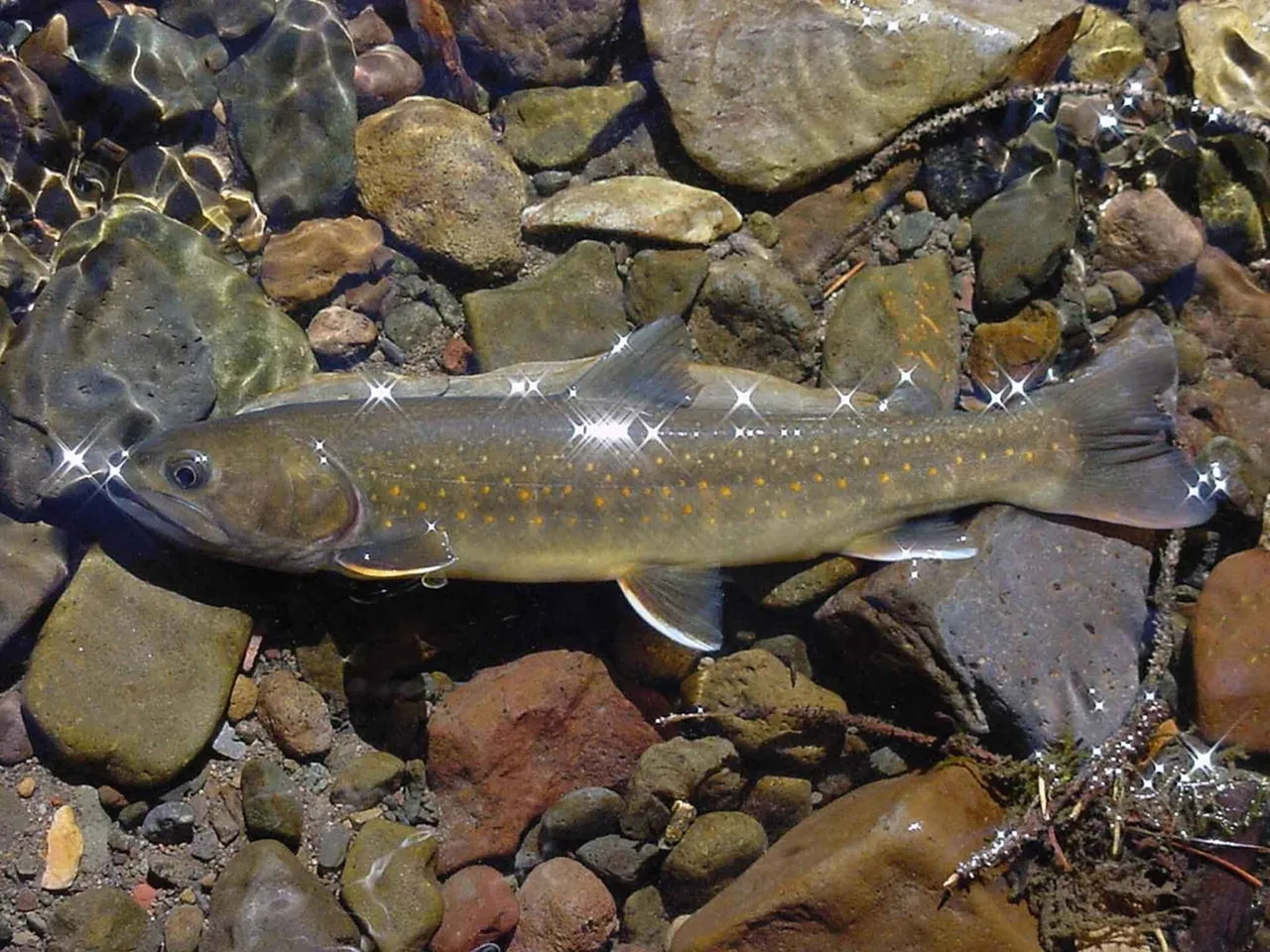
Bull trout
Salvelinus confluentus — Salmonidae

The differences
Each difference is marked with how far it can be trusted on its own. A single diagnostic character settles the identification; suggestive ones only narrow it.
| Character | Brook trout | Bull trout | Reliability |
|---|---|---|---|
| Wavy pale marbling over the back and dorsal finIdentification | Present and unmistakable: worm-like pale vermiculation runs over the dark back and continues onto the dorsal fin itself. Nothing else in the water carries it. | Absent entirely. The back is plain dark olive to brown, and the dorsal fin is unmarked. This single absence settles most fish on its own. | Diagnostic on its own |
| Any black spot anywhere on the fishIdentification | None, but red spots ringed with distinct blue haloes are scattered along the flank, which is a mark bull trout never carries. | None either, and the phrase local wardens use is that a bull trout has no black spots at all — pale cream, yellow or pink spots only, on an otherwise unmarked dark body. | Supporting — use with others |
| The white edge on the lower finsIdentification | A clean white leading edge backed immediately by a hard black line, on orange to red fins. The contrast is strong and it is present at every size. | A white leading edge is there, but the black backing is weak or missing and the fin behind it is duller. The same mark, with the contrast turned down. | Supporting — use with others |
| The shape of the tailIdentification | Squared off, square enough that squaretail is one of the fish's names. | Slightly forked. On a fish in the net this is easy to check and it agrees with everything else. | Supporting — use with others |
| The head against the bodyIdentification | Proportionate, with a normal salmonid head that does not draw attention to itself. | Broad, flattened and large relative to the body, which is where the name comes from. On a big fish it is the first thing that looks wrong for a brook trout. | Supporting — use with others |
| What each one eats as it growsFeeding | Stays broadly opportunistic — nymphs, larvae, terrestrial insects blown onto the water, crustaceans and small fish. In headwater streams the terrestrial component is unusually large. | Becomes strongly piscivorous with size, taking other fish including salmonids, and feeding concentrated in low light. A large char eating trout in a mountain river is a bull trout. | Supporting — use with others |
| The size the fish reachesSize | Most fish caught run 150–400 g, a good one is under one and a half kilos, and anything over three kilos is exceptional. | Ordinary fish run to two and a half kilos, large ones four to eight, and FishBase records a maximum of 103 cm and 14.5 kg. Size does not identify a small fish but it settles a big one. | Supporting — use with others |
| Where each one standsConservation status | Least concern globally, and outside its native eastern North American range it is an introduced species and in places a documented pressure on native fish. | Vulnerable, protected in many waters across its range, and one of the fish that brook trout introductions have pressed on. Incidental capture is frequently governed by a rule. | Supporting — use with others |
Why it matters
This is the pair where getting it wrong has a legal and a conservation consequence rather than an aesthetic one. Bull trout is vulnerable, protected across much of its range, and in many waters an incidental capture must be released without ever leaving the water. Brook trout in the same river is frequently the introduced animal that helped put it there. The two also hybridise, and hybrids are a recognised problem for bull trout rather than a curiosity: a fish showing faint vermiculation and a slightly forked tail is a real possibility, and neither page can name it. Where the identification is uncertain, the correct action is the one required for the protected fish.
The full records
This page compares two species. Each of them has a complete record covering biology, behaviour, handling and the evidence behind all of it.
More about brook trout
Where it lives, how it is caught, and what else it is confused with.
Similar and related fish
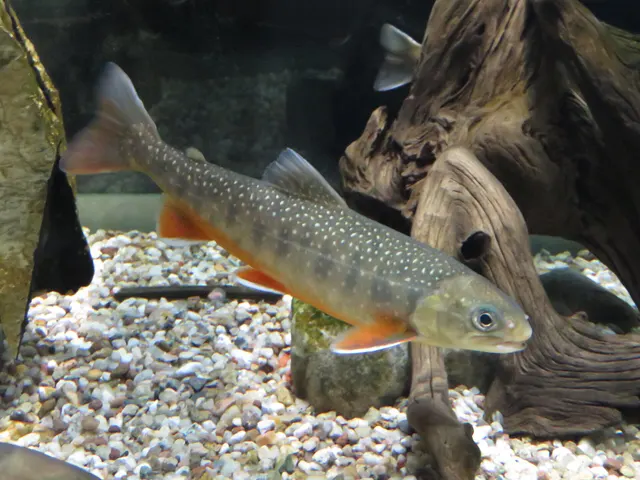 Arctic charCongeneric chars separated by vermiculation on the back and by tail shape.
 Bull troutBoth chars with pale spots on a dark ground, separated by vermiculation and by tail fork.
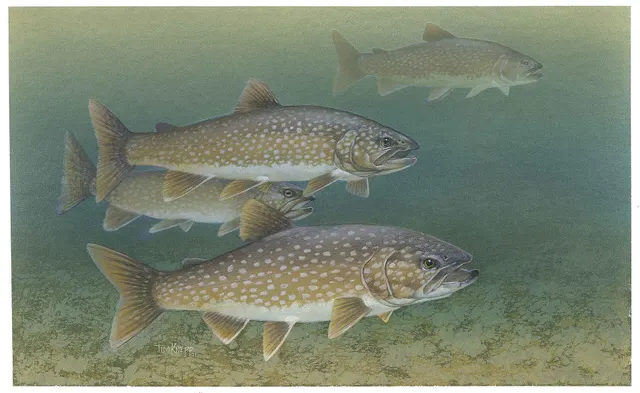 Lake troutBoth are char, genus Salvelinus, not trout — pale spots on a dark ground rather than the reverse. The tail separates them: brook trout squared, lake trout deeply forked.
- Rainbow smeltWhere smelt occur, larger brook trout feed on them heavily, which is what produces the exceptional sizes reached in some smelt lakes.
How it is caught
- Dry fly fishingBrook trout in their native headwaters rise freely and unselectively, which makes a dry fly both effective and the only practical way to fish tight, shallow, fast water without snagging.
- NymphingMost of a brook trout's food arrives as drifting invertebrates below the surface, and short-line nymphing matches the drift in the pocket water they hold in.
Gear for this fish
- NymphsBrook trout in their native headwaters feed mainly on drifting invertebrates in fast, cold, shaded water, and a small weighted nymph is the answer to that drift.
- SpinnersA small spinner is the traditional method on the tight, brushy headwater streams where a fly cast is impossible, and it is what most of this fishery is actually conducted with.
- Terrestrial fly patternsSmall streams lined with grass and trees, where a trout may take more of its summer diet from insects blown off the bank than from anything hatching.
Where it lives
Why the 10 connections on this page are here, and the sources
Similar and related fish
Backed by research — 4 connections
Supported by peer-reviewed research or fisheries science. The sources are listed and can be checked.
Arctic char
An identification comparison naming both binomials: Salvelinus alpinus and Salvelinus fontinalis.
- FishBase: a global information system on fishes — Froese, R. and D. Pauly, eds. — FishBase Consortium (Scientific institute)Relied on for: Morphological and distributional data for Salvelinus alpinus and for Salvelinus fontinalis.States this directlyPassage read and verified
- The IUCN Red List of Threatened Species — International Union for Conservation of Nature (Conservation authority)Relied on for: Separate assessments treating Salvelinus alpinus and Salvelinus fontinalis as distinct species.States this directlyCitation checked — the work exists and is described correctly
Bull trout
An identification comparison naming both binomials: Salvelinus confluentus and Salvelinus fontinalis.
- FishBase: a global information system on fishes — Froese, R. and D. Pauly, eds. — FishBase Consortium (Scientific institute)Relied on for: Morphological and distributional data for Salvelinus confluentus and for Salvelinus fontinalis.States this directlyPassage read and verified
- The IUCN Red List of Threatened Species — International Union for Conservation of Nature (Conservation authority)Relied on for: Separate assessments treating Salvelinus confluentus and Salvelinus fontinalis as distinct species.States this directlyCitation checked — the work exists and is described correctly
Lake trout
A taxonomic and identification comparison naming both binomials.
- FishBase: a global information system on fishes — Froese, R. and D. Pauly, eds. — FishBase Consortium (Scientific institute)Relied on for: That Salvelinus fontinalis and Salvelinus namaycush are congeners in the genus Salvelinus, distinct from the true trouts of Salmo and Oncorhynchus.States this directlyPassage read and verified
Rainbow smelt
Recorded diet evidence identifies Osmerus mordax as a food item of this predator at species level. The edge is written at that granularity and no further.
- FishBase: a global information system on fishes — Froese, R. and D. Pauly, eds. — FishBase Consortium (Scientific institute)Relied on for: Food items recorded for this predator, including Osmerus mordax.States this directlyPassage read and verified
- FAO Species Identification Guides for Fishery Purposes and the FAO Species Catalogues — Food and Agriculture Organization of the United Nations (Scientific institute)Relied on for: Species account describing the diet of this predator in the region where Osmerus mordax occurs.Background and mechanism onlyCitation checked — the work exists and is described correctly
How it is caught
What experienced anglers do — 2 connections
Widely and independently recommended by experienced anglers and specialist sources. This is real angling knowledge, not proof: controlled evidence for it is limited, and FishingHQ records it as convention rather than as a demonstrated effect.
Dry fly fishing
Established angling practice for this species, recorded as convention. The note states the property of the animal or its water that makes the method the answer.
- Trout & Salmon — Bauer Media (Specialist angling publication)Relied on for: Established salmonid angling technique and its application to this species.States this directlyCitation checked — the work exists and is described correctly
- General angling website restatements of established technique — Various (Credible secondary source)Relied on for: Widely restated practice connecting this species and method.Background and mechanism onlyCitation checked — the work exists and is described correctly
Nymphing
Established angling practice for this species, recorded as convention. The note states the property of the animal or its water that makes the method the answer.
- Trout & Salmon — Bauer Media (Specialist angling publication)Relied on for: Established salmonid angling technique and its application to this species.States this directlyCitation checked — the work exists and is described correctly
- General angling website restatements of established technique — Various (Credible secondary source)Relied on for: Widely restated practice connecting this species and method.Background and mechanism onlyCitation checked — the work exists and is described correctly
Gear for this fish
What experienced anglers do — 3 connections
Widely and independently recommended by experienced anglers and specialist sources. This is real angling knowledge, not proof: controlled evidence for it is limited, and FishingHQ records it as convention rather than as a demonstrated effect.
Nymphs
A practitioner claim about which lure family answers this species' feeding or holding behaviour.
- Trout & Salmon — Bauer Media (Specialist angling publication)Relied on for: Fly categories and their application to salmonids in running and still water.States this directlyCitation checked — the work exists and is described correctly
- Still Water Fly-Fishing — Andre Deutsch, 1952 (Specialist angling publication)Relied on for: Still-water fly categories, and the feeding observations they are chosen from.Background and mechanism onlyCitation checked — the work exists and is described correctly
Spinners
A practitioner claim about which lure family answers this species' feeding or holding behaviour.
- General angling website restatements of established technique — Various (Credible secondary source)Relied on for: Widely restated North American lure practice for this species.Background and mechanism onlyCitation checked — the work exists and is described correctly
- IGFA International Angling Rules and World Record Requirements — International Game Fish Association (Angling or fisheries organisation)Relied on for: Recognition of the species as an established sport fish taken on artificial lures, and the tackle conventions used for it.States this directlyPassage read and verified
Terrestrial fly patterns
A practitioner claim about a fly-species pairing, consistent with the species' verified feeding in headwater streams.
- Freshwater Fishing — Macdonald & Jane's, 1975 (Specialist angling publication)Relied on for: Practitioner treatment of terrestrial patterns in small stream fishing.Citation checked — the work exists and is described correctly
- Trout & Salmon — Bauer Media (Specialist angling publication)Relied on for: Contemporary practitioner treatment of hopper, beetle and ant patterns in summer conditions.Citation checked — the work exists and is described correctly
Where it lives
Backed by research — 1 connection
Supported by peer-reviewed research or fisheries science. The sources are listed and can be checked.
Lowland rivers
A habitat and tolerance claim held to a scientific standard because FishingHQ uses it as an indicator elsewhere.
- FishBase: a global information system on fishes — Froese, R. and D. Pauly, eds. — FishBase Consortium (Scientific institute)Relied on for: That Salvelinus fontinalis occupies marine, fresh and brackish benthopelagic habitat with an anadromous life history in part of the range, in temperate water from 0 to 25 degrees.States this directlyPassage read and verified
Reviewed 2026-08-16. FishingHQ does not state what any rule is or where any rule applies. Where this page says the two species are managed differently, that is a reason to check the authority for the water you are on — not a statement of what it requires.