Arctic char
Fish · Last reviewed 2026-08-10
The most northerly freshwater fish in the world, a cold-demanding char with brilliant orange-red spawning bellies and highly distinct landlocked populations.
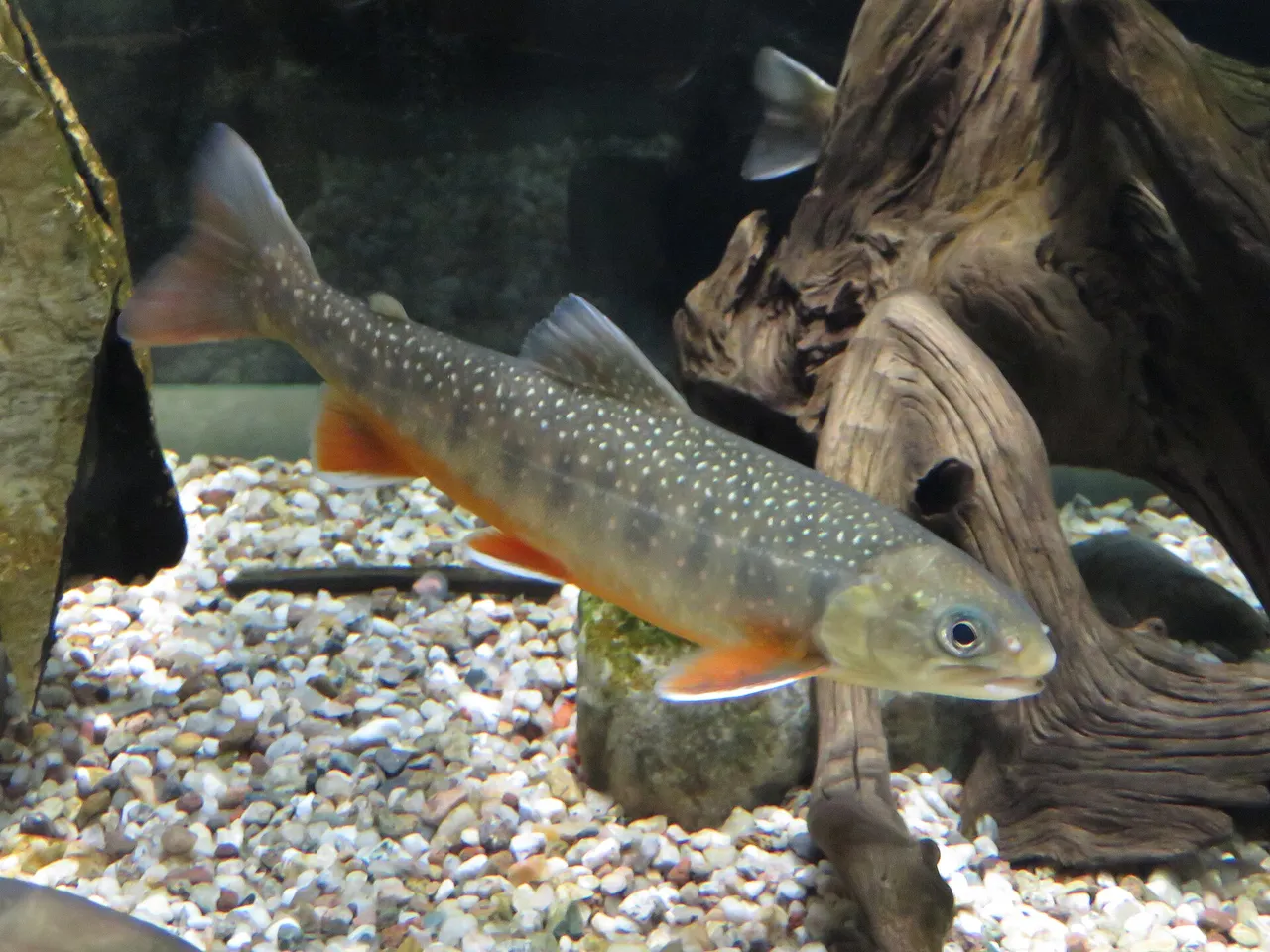
How this was identified, and who took it
Identified by: Two characters place it in Salvelinus and both are legible: the spots are PALE, cream and pink, on a darker ground, the reverse of the dark-on-light spotting of trout and salmon; and the paired fins are orange with a sharp white leading edge. Within Salvelinus, the absence of vermiculation on back and dorsal separates it from brook trout, the confusion that matters where both are present. Provenance names a Lake Inari population at the Arctic Centre, Lapland.Xepheid — CC BY-SA 4.0, via Wikimedia Commons — source, licence
Catching Arctic char
Everything here on fishing for it. Each entry opens the page behind it.
- When
- Apr–Jun — months recorded at the places that document it, not a season for the whole range.
- Where
- 8 places FishingHQ documents — strongest claim anywhere: characteristic of this water · From a boat
Arctic char lives further north than any other freshwater fish, and it exists in two very different forms: sea-run populations that behave like sea trout, and landlocked populations isolated in deep cold lakes since the last glaciation.
Those landlocked populations are the interesting part. Isolated for thousands of years, many have diverged into locally distinctive forms — different sizes, different feeding niches, sometimes several forms within a single lake. Britain and Ireland hold a number of such relict populations in deep upland lakes, and they are vulnerable to warming water and to nutrient enrichment.
In spawning condition the underside turns brilliant orange to blood red, and the white leading edges on the lower fins are unmistakable.
How it is caught
- SpinningFlies, small spoons and trolled lures, fished deep in summer and shallow at the margins of the season.
- Stillwater fly fishingFlies, small spoons and trolled lures, fished deep in summer and shallow at the margins of the season.
- TrollingFlies, small spoons and trolled lures, fished deep in summer and shallow at the margins of the season.
Gear for this fish
Where Arctic char is documented
Places where public sources describe this species as fished, with how it is fished and how strongly the evidence supports it. This is not a range map and it is not a recommendation — it is what has been written down about a fishery rather than a record of any individual catch, and being listed is never permission to fish.
Scotland
3 documented places
Loch
Recorded here
From a boat
Loch
Recorded here
From a boat
Loch
Characteristic of this water
From a boat
The Lake District lakes
3 documented places
Lake
Seasonal
From a boat
Around Apr, May, Jun
Lake
Recorded here
From a boat
Lake
Recorded here
From a boat
What these strengths mean
- Seasonal
- Well supported, and concentrated in part of the year rather than spread through it.
- Recorded here
- At least one credible public account of this species being caught here. That is all it means.
- Characteristic of this water
- This water is strongly identified with this species by the sources that cover it.
Identification
- Scientific name
- Salvelinus alpinus
- Family
- Salmonidae
- Water
- Freshwater, Saltwater, Moves between fresh and salt water
- Conservation status
- Least Concern
- Regions
- Arctic & Subarctic, Northern Europe, Britain & Ireland, North America
- Pale pink, cream or red spots on a darker ground, and no black spots anywhere — the character separating char from trout.
- Brilliant white leading edges on the pelvic, pectoral and anal fins.
- Belly turning orange to deep red in spawning condition, particularly in males.
- Small scales, a deeply forked tail, and a slender body form.
Size
- Typical
- 0.3–1.5 kg (10 oz–3.3 lb)
- Large
- 2–5 kg (4.4–11 lb)
Exceptional: FishBase records a maximum of 107 cm and 15 kg
How arctic char are fished, and why
Char are a cold-water salmonid that spends most of its life in open water rather than against structure, and every method that works for them follows from that.
STILLWATER FLY FISHING works because char feed heavily on invertebrates and small fish in the upper water column, and because the lakes they occupy are often clear enough that a fly presented at the right depth is the least alarming thing an angler can offer.
SPINNING covers water, which is the actual problem: char shoal and move, so the difficulty is finding them rather than persuading them. A small spoon or spinner searches a large volume quickly.
TROLLING is the same logic mechanised, and it is the standard answer on the large, deep lakes where char sit well below the surface for much of the year and shore-based methods cannot reach them.
WHAT THIS TELLS YOU GENERALLY. A shoaling open-water fish in a large body of water is a search problem before it is a presentation problem, and the methods that dominate are the ones that cover volume.
What experienced anglers do — why, and the sources (2)
Widely and independently recommended by experienced anglers and specialist sources. This is real angling knowledge, not proof: controlled evidence for it is limited, and FishingHQ records it as convention rather than as a demonstrated effect.
- FishBase: a global information system on fishes — Froese, R. and D. Pauly, eds. — FishBase Consortium (Scientific institute)Relied on for: Habitat association, depth range, feeding ecology and prey of the species, from which the method association follows.Background and mechanism onlyPassage read and verified
- IGFA International Angling Rules and World Record Requirements — International Game Fish Association (Angling or fisheries organisation)Relied on for: Recognised angling methods and the tackle classes used for them internationally.Background and mechanism onlyPassage read and verified
The northernmost freshwater fish, and the relict populations left behind by ice
Arctic char occupy the coldest freshwater habitat on earth and, in the southern part of their range, occupy it as isolated remnants — which makes their habitat description a piece of glacial history as much as a piece of ecology.
THE THERMAL REQUIREMENT IS THE MOST EXTREME OF ANY SALMONID. Char tolerate and prefer colder water than trout or salmon, which is why they are the freshwater fish found furthest north — occurring in lakes and rivers well inside the Arctic where nothing else persists. Cold is not merely tolerated; it is required, and warm water excludes them from habitat that other salmonids use comfortably.
WHICH PRODUCES THE RELICT PATTERN IN THE SOUTH. As the ice sheets retreated after the last glaciation, char were left in deep, cold lakes across Britain, Ireland, the Alps and Scandinavia — waters that stayed cold enough for them while the surrounding country warmed. Those populations have been isolated ever since, in individual lakes, for thousands of years. They have diverged: many are morphologically and genetically distinct, some lakes hold multiple forms differing in size, diet and spawning time, and the taxonomy of the group is correspondingly contested. A lake's char are frequently found nowhere else at all.
WITHIN A LAKE THEY ARE DEEP AND COLD. Char occupy the cold hypolimnion below the thermocline in summer, feeding on zooplankton and benthic invertebrates, and move shallower in cold seasons and to spawn on gravel. In the far north, where whole lakes stay cold, they use the entire water body and become the dominant predator.
SEA-RUN POPULATIONS EXIST IN THE NORTH and are a different proposition — anadromous fish feeding in coastal Arctic waters and returning to fresh water, growing far larger than landlocked ones on much richer marine feeding.
AND THE SOUTHERN RELICTS ARE THE MOST CLIMATE-EXPOSED FISH IN EUROPE. A population confined to the cold deep water of one lake has nowhere to go if that water warms or if the oxygen in it fails — which is what nutrient enrichment does to a deep cold layer. Several such populations have already been lost.
Backed by research — why, and the sources (2)
Supported by peer-reviewed research or fisheries science. The sources are listed and can be checked.
- FishBase: a global information system on fishes — Froese, R. and D. Pauly, eds. — FishBase Consortium (Scientific institute)Relied on for: Habitat association, depth range, substrate preference, salinity tolerance and temperature range recorded for the species.States this directlyPassage read and verified
- The IUCN Red List of Threatened Species — International Union for Conservation of Nature (Conservation authority)Relied on for: Assessment and habitat account, including the habitats on which the species depends and the threats to them.Background and mechanism onlyCitation checked — the work exists and is described correctly
Lifecycle and reproduction
Slow-growing in cold water and long-lived. Sea-run fish grow much larger than landlocked ones, and isolated lake populations often mature at very small sizes. Repeat spawning is normal, unlike Pacific salmon.
Spawns in autumn or early winter over gravel in lakes or in tributary streams, with females cutting redds. Spawning temperature and substrate requirements are narrow, which is why populations are sensitive to habitat change.
Feeding and senses
Takes zooplankton, insect larvae, crustaceans and fish depending on the population and the life stage. In lakes with several distinct forms, those forms often occupy different feeding niches.
A cold-water visual feeder operating well in low light and at depth, which is why char are caught deep in summer and shallow in the low light of early and late season.
Through the year
Holds in deep cold water through summer, moves shallow to spawn in autumn, and is accessible to shore anglers mainly in the cold months and at the margins of the season.
Distribution
Europe and North America: Circumpolar . Iceland, Scandinavia, northern Russia (absent in rivers draining to Baltic and White Seas), Jan Mayen, Spitzberg, Kolguev, Bear and New Zemblia islands, northern Siberia, Alaska, Canada and Greenland; absent in the Alps . North America: coastal areas in Atlantic, Arctic and Pacific drainages from Newfoundland and Labrador in Canada to Alaska; south along Alantic Slope to Maine, USA . Landlocked populations in Quebec, Canada and in Maine and New Hampshire in USA
This is a biological range — where the species occurs, not a prediction that you will catch one. To browse the fishing geography FishingHQ holds, start at fishing places.
Why anglers care
A prized northern target across Scandinavia, Iceland, Greenland, northern Canada and the deep lakes of Britain and Ireland, taken on flies, small spoons and trolled lures. Its significance is as the emblematic fish of Arctic water and, in Britain, as a relict glacial species of considerable conservation interest. Some populations are protected and several are monitored as climate indicators.
Handling and returning
A cold-water salmonid intolerant of warm water and long fights. Keep the fish in the water, use barbless hooks, handle with wet hands, and release facing into current or with gentle support until it swims off. Relict lake populations warrant particular care and, in many waters, complete release.
Going further
- Arctic char vs Brook trout — how to tell them apart.
Where to go next
Similar and related fish
Where it lives
- Deep cold lakesThe most cold-adapted freshwater fish of the northern hemisphere. Southern populations survive only in deep lakes where a cold bottom layer persists through summer, and are relicts isolated since the last glaciation.
- Lowland stillwatersHolds in deep cold lakes and runs to sea from northern rivers.
- Upland lakes and hill lochsRelict populations isolated in deep, cold upland and glacial lakes since the last glaciation, and of considerable conservation interest.
Where you will find it
- AlaskaOccurs across the north as both landlocked and sea-run populations, in the coldest fresh water the state holds.
- AustriaPresent in deep cold Alpine lakes as a relict of glaciation, which makes an Austrian lake one of the few places in central Europe the species can be met at all.
- CanadaThe northernmost freshwater fish of the country, occurring in deep cold lakes and as sea-run populations across the Arctic coast.
- Greenland and the high ArcticThe most northerly-distributed freshwater fish in the world and effectively the whole of the region's freshwater fishery, running to sea in summer and returning to overwinter.
- IcelandThe country's most abundant and most variable freshwater fish. Isolated populations have diverged since the ice retreated, and in some lakes several distinct forms coexist — one of the best-documented cases of adaptive divergence in any vertebrate.
- Lake GenevaOmble chevalier, living year-round in the cold deep basin — present at this latitude as a relict of colder conditions, which is why depth is not optional in fishing for them.
- ScotlandPersists in deep cold lochs as a glacial relict, isolated since the ice retreated and differing between waters.
- SwedenIn the mountain lakes and northern rivers above the treeline, where the season is very short and very intense.
3 more
- The Finnish lake district Fishing regions
- The Lake District lakes Fishing regions
- The River Tay Fishing regions
Sources and evidence
- FishBase: a global information system on fishes — Froese, R. and D. Pauly, eds. — FishBase Consortium (Scientific institute)Relied on for: Family, maximum size, depth and environment, distribution and the IUCN assessment for Salvelinus alpinus.States this directlyPassage read and verified
- The IUCN Red List of Threatened Species — International Union for Conservation of Nature (Conservation authority)Relied on for: The Least Concern assessment for Salvelinus alpinus, assessed 29 August 2023.States this directlyCitation checked — the work exists and is described correctly
Why the 20 connections on this page are here, and the sources
Similar and related fish
Backed by research — 1 connection
Supported by peer-reviewed research or fisheries science. The sources are listed and can be checked.
Brook trout
An identification comparison naming both binomials: Salvelinus alpinus and Salvelinus fontinalis.
- FishBase: a global information system on fishes — Froese, R. and D. Pauly, eds. — FishBase Consortium (Scientific institute)Relied on for: Morphological and distributional data for Salvelinus alpinus and for Salvelinus fontinalis.States this directlyPassage read and verified
- The IUCN Red List of Threatened Species — International Union for Conservation of Nature (Conservation authority)Relied on for: Separate assessments treating Salvelinus alpinus and Salvelinus fontinalis as distinct species.States this directlyCitation checked — the work exists and is described correctly
How it is caught
What experienced anglers do — 3 connections
Widely and independently recommended by experienced anglers and specialist sources. This is real angling knowledge, not proof: controlled evidence for it is limited, and FishingHQ records it as convention rather than as a demonstrated effect.
Spinning
A practitioner claim about how Salvelinus alpinus is commonly fished, following from where and how it feeds.
- General angling website restatements of established technique — Various (Credible secondary source)Relied on for: Widely restated practitioner accounts of fishing for arctic char.Citation checked — the work exists and is described correctly
- Sea Angler — Bauer Media (Specialist angling publication)Relied on for: Practitioner treatment of the methods used for arctic char and comparable species.Citation checked — the work exists and is described correctly
Stillwater fly fishing
A practitioner claim about how Salvelinus alpinus is commonly fished, following from where and how it feeds.
- General angling website restatements of established technique — Various (Credible secondary source)Relied on for: Widely restated practitioner accounts of fishing for arctic char.Citation checked — the work exists and is described correctly
- Sea Angler — Bauer Media (Specialist angling publication)Relied on for: Practitioner treatment of the methods used for arctic char and comparable species.Citation checked — the work exists and is described correctly
Trolling
A practitioner claim about how Salvelinus alpinus is commonly fished, following from where and how it feeds.
- General angling website restatements of established technique — Various (Credible secondary source)Relied on for: Widely restated practitioner accounts of fishing for arctic char.Citation checked — the work exists and is described correctly
- Sea Angler — Bauer Media (Specialist angling publication)Relied on for: Practitioner treatment of the methods used for arctic char and comparable species.Citation checked — the work exists and is described correctly
Gear for this fish
What experienced anglers do — 2 connections
Widely and independently recommended by experienced anglers and specialist sources. This is real angling knowledge, not proof: controlled evidence for it is limited, and FishingHQ records it as convention rather than as a demonstrated effect.
Spoons
A practitioner claim about which lure family answers this species' feeding or holding behaviour.
- General angling website restatements of established technique — Various (Credible secondary source)Relied on for: Widely restated North American lure practice for this species.Background and mechanism onlyCitation checked — the work exists and is described correctly
- IGFA International Angling Rules and World Record Requirements — International Game Fish Association (Angling or fisheries organisation)Relied on for: Recognition of the species as an established sport fish taken on artificial lures, and the tackle conventions used for it.States this directlyPassage read and verified
Streamers
A practitioner claim about which lure family answers this species' feeding or holding behaviour.
- Trout & Salmon — Bauer Media (Specialist angling publication)Relied on for: Fly categories and their application to salmonids in running and still water.States this directlyCitation checked — the work exists and is described correctly
- Still Water Fly-Fishing — Andre Deutsch, 1952 (Specialist angling publication)Relied on for: Still-water fly categories, and the feeding observations they are chosen from.Background and mechanism onlyCitation checked — the work exists and is described correctly
Where it lives
Backed by research — 3 connections
Supported by peer-reviewed research or fisheries science. The sources are listed and can be checked.
Deep cold lakes
A claim that the species depends on the cold layer below the summer thermocline, which is a thermal-tolerance claim about the animal rather than an angling observation, and rests on the reference literature accordingly.
- Freshwater Fishes of the British Isles — HarperCollins (New Naturalist 75), 1992 (Reference work)Relied on for: Distribution, habitat association, thermal requirements and life history of the freshwater fishes of the British Isles and north-west Europe.States this directlyCitation checked — the work exists and is described correctly
- FishBase: a global information system on fishes — Froese, R. and D. Pauly, eds. — FishBase Consortium (Scientific institute)Relied on for: Recorded depth range, temperature tolerance and habitat association for the species.States this directlyPassage read and verified
Lowland stillwaters
A habitat association for Salvelinus alpinus taken from the environment and distribution data on its FishBase summary.
- FishBase: a global information system on fishes — Froese, R. and D. Pauly, eds. — FishBase Consortium (Scientific institute)Relied on for: The environment, depth range and habitat description recorded for Salvelinus alpinus.States this directlyPassage read and verified
Upland lakes and hill lochs
Habitat association recorded for the species, in an environment FishingHQ describes on its own page.
- Freshwater Fishes of the British Isles — HarperCollins (New Naturalist 75), 1992 (Reference work)Relied on for: Habitat association and distribution of European freshwater fishes, including occurrence in artificial and modified waters.States this directlyCitation checked — the work exists and is described correctly
- FishBase: a global information system on fishes — Froese, R. and D. Pauly, eds. — FishBase Consortium (Scientific institute)Relied on for: Habitat association, depth range and water-type tolerance recorded for the species.States this directlyPassage read and verified
Where you will find it
Backed by research — 11 connections
Supported by peer-reviewed research or fisheries science. The sources are listed and can be checked.
Alaska
A distribution association between an animal and a kind of water, rather than a claim about any named mark.
- FishBase: a global information system on fishes — Froese, R. and D. Pauly, eds. — FishBase Consortium (Scientific institute)Relied on for: Distribution, habitat association and depth range recorded for the species, including its occurrence in the water body concerned.States this directlyPassage read and verified
- The IUCN Red List of Threatened Species — International Union for Conservation of Nature (Conservation authority)Relied on for: Assessment and range account for the species, including the systems and coasts it occupies.Background and mechanism onlyCitation checked — the work exists and is described correctly
Austria
That a species occurs in these waters, drawn from distribution science and stock assessment. It is a statement about where the animal lives and is not a statement that anybody will catch one, still less where.
- Freshwater Fishes of the British Isles — HarperCollins (New Naturalist 75), 1992 (Reference work)Relied on for: Distribution, habitat requirement and life history of European freshwater fishes, including their occurrence across the continental range named.States this directlyCitation checked — the work exists and is described correctly
- FishBase: a global information system on fishes — Froese, R. and D. Pauly, eds. — FishBase Consortium (Scientific institute)Relied on for: Recorded distribution and habitat association of the freshwater and migratory species named.States this directlyPassage read and verified
Canada
A distribution association between an animal and a kind of water, rather than a claim about any named mark.
- FishBase: a global information system on fishes — Froese, R. and D. Pauly, eds. — FishBase Consortium (Scientific institute)Relied on for: Distribution, habitat association and depth range recorded for the species, including its occurrence in the water body concerned.States this directlyPassage read and verified
- The IUCN Red List of Threatened Species — International Union for Conservation of Nature (Conservation authority)Relied on for: Assessment and range account for the species, including the systems and coasts it occupies.Background and mechanism onlyCitation checked — the work exists and is described correctly
Greenland and the high Arctic
A distribution association between an animal and a kind of water, rather than a claim about any named mark.
- FishBase: a global information system on fishes — Froese, R. and D. Pauly, eds. — FishBase Consortium (Scientific institute)Relied on for: Distribution, habitat association and depth range recorded for the species, including its occurrence in the water body concerned.States this directlyPassage read and verified
- The IUCN Red List of Threatened Species — International Union for Conservation of Nature (Conservation authority)Relied on for: Assessment and range account for the species, including the systems and coasts it occupies.Background and mechanism onlyCitation checked — the work exists and is described correctly
Iceland
That a species occurs in these waters, drawn from distribution science and stock assessment. It is a statement about where the animal lives and is not a statement that anybody will catch one, still less where.
- Freshwater Fishes of the British Isles — HarperCollins (New Naturalist 75), 1992 (Reference work)Relied on for: Distribution, habitat requirement and life history of European freshwater fishes, including their occurrence across the continental range named.States this directlyCitation checked — the work exists and is described correctly
- FishBase: a global information system on fishes — Froese, R. and D. Pauly, eds. — FishBase Consortium (Scientific institute)Relied on for: Recorded distribution and habitat association of the freshwater and migratory species named.States this directlyPassage read and verified
Lake Geneva
A distributional claim taken from reference works and databases on the fishes of the region rather than from angling report. It states presence and asserts nothing about a fishery.
- FishBase: a global information system on fishes — Froese, R. and D. Pauly, eds. — FishBase Consortium (Scientific institute)Relied on for: Distribution, habitat association, life history and size recorded for the species concerned.States this directlyPassage read and verified
- Freshwater Fishes of the British Isles — HarperCollins (New Naturalist 75), 1992 (Reference work)Relied on for: Biology, distribution, life history and conservation status of northern European freshwater and diadromous fishes.States this directlyCitation checked — the work exists and is described correctly
Scotland
A distribution claim about the world, so it rests on the reference works rather than on angling report. FishingHQ's evidence policy requires it.
- FishBase: a global information system on fishes — Froese, R. and D. Pauly, eds. — FishBase Consortium (Scientific institute)Relied on for: Distribution, habitat association, water-type tolerance and occurrence records for the species, including its presence in the countries concerned.States this directlyPassage read and verified
- The IUCN Red List of Threatened Species — International Union for Conservation of Nature (Conservation authority)Relied on for: Assessment and range account for the species, including the countries and systems it occupies and its population trend within them.States this directlyCitation checked — the work exists and is described correctly
Sweden
That a species occurs in these waters, drawn from distribution science and stock assessment. It is a statement about where the animal lives and is not a statement that anybody will catch one, still less where.
- Freshwater Fishes of the British Isles — HarperCollins (New Naturalist 75), 1992 (Reference work)Relied on for: Distribution, habitat requirement and life history of European freshwater fishes, including their occurrence across the continental range named.States this directlyCitation checked — the work exists and is described correctly
- FishBase: a global information system on fishes — Froese, R. and D. Pauly, eds. — FishBase Consortium (Scientific institute)Relied on for: Recorded distribution and habitat association of the freshwater and migratory species named.States this directlyPassage read and verified
The Finnish lake district
A claim that a place contains the ground, water and seasonal conditions the species is associated with. It is a distributional statement about the world, it rests on the regional reference literature, and it deliberately asserts nothing about access, permission or catch.
- Freshwater Fishes of the British Isles — HarperCollins (New Naturalist 75), 1992 (Reference work)Relied on for: Distribution, ecology and conservation status of European freshwater and migratory fishes, including in modified and artificial waters.States this directlyCitation checked — the work exists and is described correctly
- FishBase: a global information system on fishes — Froese, R. and D. Pauly, eds. — FishBase Consortium (Scientific institute)Relied on for: Recorded distribution, habitat association and life history for the freshwater and migratory species named.States this directlyPassage read and verified
The Lake District lakes
A claim that a place contains the ground, water and seasonal conditions the species is associated with. It is a distributional statement about the world, it rests on the regional reference literature, and it deliberately asserts nothing about access, permission or catch.
- Freshwater Fishes of the British Isles — HarperCollins (New Naturalist 75), 1992 (Reference work)Relied on for: Distribution, habitat and conservation status of British freshwater fishes, including the isolated glacial-relict populations of northern England.States this directlyCitation checked — the work exists and is described correctly
- Environment Agency fisheries management, byelaws and rod licensing information — Environment Agency (Government fisheries body)Relied on for: Fisheries monitoring, water quality and species distribution in English rivers and still waters.States this directlyCitation checked — the work exists and is described correctly
The River Tay
A claim that a place contains the ground, water and seasonal conditions the species is associated with. It is a distributional statement about the world, it rests on the regional reference literature, and it deliberately asserts nothing about access, permission or catch.
- Freshwater Fishes of the British Isles — HarperCollins (New Naturalist 75), 1992 (Reference work)Relied on for: Distribution, ecology and conservation status of the freshwater fishes of the British Isles, including in artificial and modified waters.States this directlyCitation checked — the work exists and is described correctly
- Environment Agency fisheries management, byelaws and rod licensing information — Environment Agency (Government fisheries body)Relied on for: Fisheries monitoring, water quality and species distribution in English rivers, canals and still waters.States this directlyCitation checked — the work exists and is described correctly
How FishingHQ labels evidence is explained in the evidence policy.