Þingvallavatn
Lake · Fresh water · in Iceland
Iceland's largest natural lake, sitting in the rift where two tectonic plates are pulling apart, fed almost entirely by spring water filtered through lava rather than by surface runoff, with a bed of lava, fissures and clear cold water of exceptional visibility.
Safety: cold water shock — can cause serious injury or death (general advice, not specific to this place). 2 more points apply here.
FishingHQ describes what this place is, not whether you may fish it. Access, permits and who to ask.
What you can catch here
Documented at this place, grouped by how you would be fishing, with how strongly the sources support each one. This is what has been written down, not a forecast, and being listed is never permission to fish.
From the shore · 2
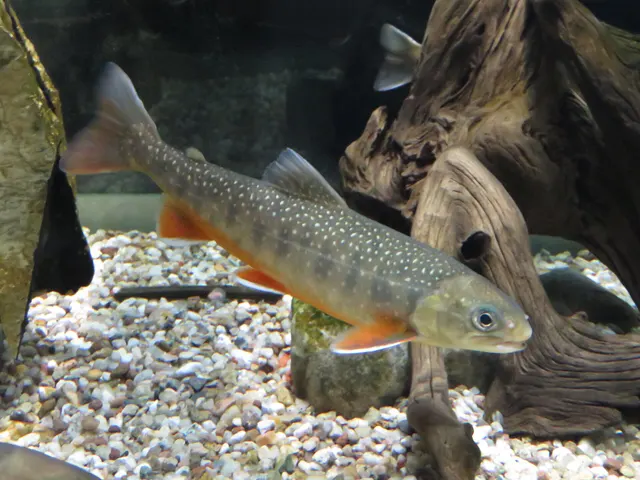 Arctic charRegular local target1 placeÞingvallavatnOver lakeAround Apr–Sept
Photo: Xepheid, via Wikimedia Commons, CC BY-SA 4.0; resized; shared under the same licence
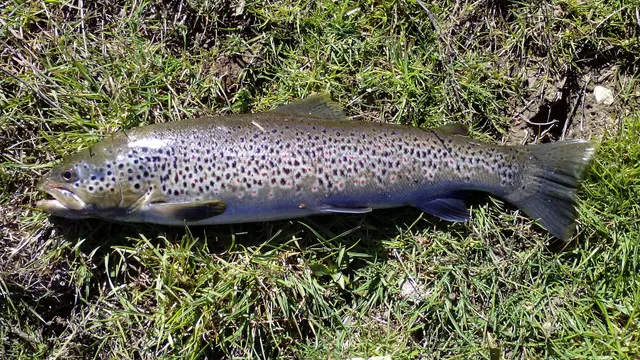 Brown troutRegular local target1 placeÞingvallavatnOver lakeAround Apr–Sept
Photo: Robermix, via Wikimedia Commons, CC0; resized and trimmed to fit


Fly fishing · 2
- Arctic charRegular local target1 placeÞingvallavatnOver lakeAround Apr–Sept
Photo: Xepheid, via Wikimedia Commons, CC BY-SA 4.0; resized; shared under the same licence
- Brown troutRegular local target1 placeÞingvallavatnOver lakeAround Apr–Sept
Photo: Robermix, via Wikimedia Commons, CC0; resized and trimmed to fit
What these strengths mean
- Regular local target
- Fishing sources describe this as a normal local target here, not merely as caught.
- How breadth is counted
- A fish documented at six marks is shown as six marks: breadth never raises the strength on its own. A fishery account describes the fishing; a recorded catch reports one specific catch. How evidence is weighed.
How people fish it
Practised here: Fly fishing, Predator fishing.
Methods the sources name for this ground. Each one is explained in full on its own page.
- Stillwater fly fishing
Fly fishing without current, where the angler supplies every movement and the problem becomes finding fish rather than presenting to them.
- Spinning
Casting an artificial lure and retrieving it so that it moves like something alive — the most direct form of lure fishing.
Baits and lures for these fish
The baits and lures each of the fish above is commonly taken on, from that fish’s own page. This is what works for the fish, not a report of what people use on this particular water — local knowledge and the conditions on the day still decide.
Baits
- Maggots — for Brown trout
Lures
How to catch them: Brown trout fishing
Rods, reels and rigs for them: Brown trout
What guides and anglers say
These are statements other people have published about fishing here, summarised and attributed. Where one is a catch, it is that angler’s own report of one day; a recommendation is not a catch, and neither is a forecast.
A safety remark
The national park warns that hidden fissures and cracks in the ground are common within the park, and asks visitors to move with care and to supervise children closely.
The body responsible for the place: Þingvellir National Park.
Getting there, as described
The national park requires a permit before fishing, allows fishing only from the shore or small islets beside it with no boat or float of any kind, closes one part of the shore in summer to protect spawning charr and keeps the Öxará river closed, and has an early part of the season that is fly only with every brown trout released. Used freshwater tackle brought into Iceland must be disinfected first. The park holds the dates and the boundaries.
The body responsible for the place: Þingvellir National Park.
Recommended as a place to fish
Þingvellir National Park says the lake holds four forms of Arctic charr and a population of brown trout, and that angling is from the shore of the northern part of the lake inside the park. It advises against eating trout over a stated length because of mercury. This is the park's description, not a record of fish caught.
The body responsible for the place: Þingvellir National Park.
The ground and the water
- The ground
- Iceland's largest natural lake, sitting in the rift where two tectonic plates are pulling apart, fed almost entirely by spring water filtered through lava rather than by surface runoff, with a bed of lava, fissures and clear cold water of exceptional visibility.
- Exposure
- Open and exposed to wind funnelling down the rift, which builds a sea quickly on water this large.
- Depth
- Deep in the fissures and shallow over the lava shelves, with vertical cracks in the bed reaching well below the general depth.
Getting there
What public sources describe, last checked 2026-10-11. Car parks fill, services change and a path existing is not a path anybody may use — none of this is a guarantee of availability and none of it is permission to be anywhere.
- Getting to it
- The national park allows angling on the northern shore of the lake only, between two named points, from the bank or from small islets close to it. The park's service centre sells permits. Other shores of the lake are let separately by their owners.
Where this access information comes from
- Þingvellir National Park: angling — Þingvellir National Park (Local authority, harbour or protected-area body)Relied on for: The national park's angling page: where on its shore angling is allowed, the facilities at its most used spot, the permit and the conduct it asks for.States this directlyPassage read and verified
What is there
Public toilets
The park says its most used angling spot, Vatnskot, has restrooms, picnic benches, outdoor sinks for cleaning fish and a wooden pier.
Through the year
Fished through the open season with the char accessible from the shore and the large brown trout following the char rather than the insects.
The months the sources attach to each species here. Where a species carries no season it is listed underneath rather than assumed to run through the year. Rows marked open season show the months this water may be fished for that species, which is a rule rather than a statement about when the fish are there.
| Species | J | F | M | A | M | J | J | A | S | O | N | D |
|---|---|---|---|---|---|---|---|---|---|---|---|---|
| Arctic char — regular local target, fishable under the published open season in April, May, June, July, August, September. | ||||||||||||
| Brown trout — regular local target, fishable under the published open season in April, May, June, July, August, September. |
Safety
Cold water shock — Can cause serious injury or death
General safety for this kind of ground, not a finding about this place.
Northern European water is cold enough for most of the year to trigger the involuntary gasp and the loss of swimming ability that decides most immersion deaths, and it does so within the first minute, long before hypothermia is relevant.
What reduces it: Wear a buoyancy aid rather than carry one, carry a means of calling for help on the person rather than in a bag, and plan on the assumption that an unplanned entry into the water is survivable only if somebody knows immediately.
Moving water and currents — Can cause serious injury or death
General safety for this kind of ground, not a finding about this place.
Glacial rivers rise with melt as well as with rain, so a bright warm day puts the level up while the weather gives no warning, and the water is opaque with rock flour so wading is done without seeing the bottom over rounded rock in fast flow.
What reduces it: Know where the level is before starting and expect it to move against the weather, wade with a staff and a belt worn tight, wade shallower than seems necessary, and treat a crossing as a decision rather than a step.
Worse when:
- On warm, sunny days in the melt season, when the river rises in clear weather.
Fishing alone — Can cause serious injury or death
General safety for this kind of ground, not a finding about this place.
Away from the ring road there are few people, patchy communications and long response times, so an injury or a vehicle failure that would be minor elsewhere becomes serious through distance alone. Unbridged river crossings by vehicle have a real incident record.
What reduces it: Leave a plan and a return time with somebody, carry a means of calling for help on the person, build margin into fuel, food, daylight and clothing, and do not attempt an unbridged crossing on unfamiliar ground.
Rules and access
Licence
No general state rod licence was described in what was read for Iceland. Each water is fished on its own permit, or on a card that covers a list of lakes.
Permission to fish
The whole question. A permit is for one water or beat and carries its own season, method and catch rules. Used freshwater tackle brought into the country must be disinfected first.
Particular to this water: A permit is needed before fishing: the park's day permit or the national fishing card. The park states a season of 20 April to 15 September, fly only and all brown trout released until 31 May, no boats or float tubes, a bay closed in July and August and a river mouth closed always. Used tackle from abroad must be disinfected. Those are the park's statements on the day they were read; check them with the park before fishing.
Beyond what is stated above, FishingHQ does not know the current access position here, and Iceland is the clearest case in Europe of why that sentence matters. There is no state angling licence and no public right to fish: every fishing right on every river and lake belongs to the landowners, who administer it through a fishing association per river, and access is bought as a permit for a named beat on named dates. Salmon rivers are frequently sold years ahead. Disinfection of imported equipment is required. Beats, quotas, seasons and the disinfection arrangements all change. Check with the river's fishing association before travelling.
Who holds the answer:
- The fishing association for the river, which is the landowners acting together and is the only body that can sell a permit for it.
- The Icelandic Food and Veterinary Authority, for the disinfection requirement on imported equipment.
- The Icelandic Marine and Freshwater Research Institute, for stock measures and for what is permitted on a given river.
- The fishing association for the river, which is the landowners acting collectively and is the only body that can sell a permit for it.
- The Icelandic Food and Veterinary Authority, for the disinfection and certification requirement on equipment brought from abroad.
- The Icelandic Marine and Freshwater Research Institute, for stock advice and for the measures set on individual rivers.
- The Icelandic Directorate of Fisheries, for measures in Icelandic marine waters.
- The landowner or harbour authority, for physical access.
Sources for this place
- Freshwater Fishes of the British Isles — HarperCollins (New Naturalist 75), 1992 (Reference work)Relied on for: Distribution, habitat requirement, ecology and life history of European freshwater fishes, including the species named for this water.States this directlyCitation checked — the work exists and is described correctly
- The European Environment Agency's assessments of Europe's waters, seas and coasts — European Environment Agency, Copenhagen (Conservation authority)Relied on for: Assessment of Europe's surface waters, including hydromorphological modification, barriers to migration and the pressures recorded on the water body.States this directlyCitation checked — the work exists and is described correctly
- Trout & Salmon — Bauer Media (Specialist angling publication)Relied on for: Long-running published description of European game angling practice by river and season, including the continental destinations British anglers fish.FishingHQ's interpretation of what it saysCitation checked — the work exists and is described correctly
- General angling website restatements of established technique — Various (Credible secondary source)Relied on for: Widely restated public descriptions of which continental waters are conventionally fished and how, recorded as practitioner consensus rather than as scholarship, and not relied on for access, permission or any current rule.Background and mechanism onlyCitation checked — the work exists and is described correctly
- RNLI water safety guidance: cold water shock and Float to Live — Royal National Lifeboat Institution (Water-safety or diver-training authority)Relied on for: Cold water shock and the immersion response, tidal cut-off, and water-safety guidance for shore anglers and small-craft users. Cited for the mechanism, which does not vary by coast.States this directlyPassage read and verified
- Þingvellir National Park: angling — Þingvellir National Park (Local authority, harbour or protected-area body)Relied on for: The national park's rules for its shore of the lake: the two fish, the season, fly only until June, the closed bay and river mouth, and the permit.States this directlyPassage read and verified
How FishingHQ labels evidence is explained in the evidence policy. Last reviewed 2026-08-18.
Something wrong or out of date?
If something on this page has changed, email us from your own account using the link that fits, with a link to where you saw the change if you can. Every report is checked by a person before anything is changed, and a report never appears on the site by itself. Please don’t send exact private marks.
Before you go
- Fish documented here
- 4 at this place itself. See them.
- Getting there
- Described from public sources, last checked 2026-10-11. Getting there.
- Rules particular to this water
- A permit is needed before fishing: the park's day permit or the national fishing card. Source not tied: no recorded source has been matched to this statement.
- The park states a season of 20 April to 15 September, fly only and all brown trout released until 31 May, no boats or float tubes, a bay closed in July and August and a river mouth closed always. Source not tied: no recorded source has been matched to this statement.
- Used tackle from abroad must be disinfected. Source not tied: no recorded source has been matched to this statement.
- Those are the park's statements on the day they were read; check them with the park before fishing. Source not tied: no recorded source has been matched to this statement.
Nothing here is watched for change. Sources and who to ask.
- Hazards particular to this place
- 1 recorded. Safety.
Check before you travel
- Whether you may fish here, and whether a licence or permit is needed — start with the fishing association for the river.
- Who holds the fishing right on the water you mean to fish.
- Anything recorded here was true when it was read; it is not watched for change.