The River Tay
Fishing regions · Last reviewed 2026-08-16
The largest river in Britain by volume, draining a seventh of Scotland through a chain of lochs to a great tidal estuary — and the river that produced the largest rod-caught salmon ever recorded in these islands.
Safety: moving water and currents — can cause serious injury or death. 2 more points apply here.
Being listed here is not permission to fish. What that meansClose
Access, fishing rights, seasons, licences, local bylaws and permitted methods vary and can change. Check current access, permission, local regulations, closures and restrictions before you travel or fish. FishingHQ describes what the ground is and names who holds the answer; it does not hold the answer itself.
Find the authority for a jurisdiction · What FishingHQ does and does not cover
The Tay is a feature-tier record because it is a single named river, but it behaves like a system: it carries more water to the sea than any other river in Britain, it drains something close to a seventh of Scotland, and it moves through loch, mountain gorge, broad lowland river and a very large estuary within its own length.
THE VOLUME IS THE FIRST FACT AND IT IS NOT A DETAIL. Mean flow here exceeds that of the Severn and the Thames combined. A river carrying that much water is physically different to fish: pools are big, the current is heavy, wading is a serious matter, and a great deal of the fishing is done from a boat because the water cannot be covered from the bank.
THE CATCHMENT IS A CHAIN OF LOCHS. Loch Tay, Loch Rannoch, Loch Ericht and others sit in the headwaters, feeding the river through the Tummel and the upper Tay. Those lochs buffer flow — a lake stores water and releases it slowly — which is why the Tay holds up in dry weather better than a purely spate river and why it has a reputation for fishing when others are low.
HYDRO-ELECTRIC REGULATION IS THE MODERN COMPLICATION. Substantial parts of this catchment were dammed and diverted for hydro power in the mid twentieth century, so flow in several tributaries and in the main river is partly a management decision rather than purely a hydrological event. That has consequences for fish passage, for the timing of runs, and for what the river does after rain.
THE SALMON RUN IS THE FISHERY THE RIVER IS KNOWN FOR, and specifically the spring run, which was historically the Tay's glory and which has declined severely across the whole of Scotland. The largest rod-caught Atlantic salmon ever recorded in British waters came from this river in the early twentieth century, and that fish is still the reference point.
AND THE ESTUARY IS SUBSTANTIAL IN ITS OWN RIGHT. The Firth of Tay is a large tidal estuary with extensive sandbanks, mudflats and one of the largest reedbeds in Britain, and it is the migratory corridor for everything entering or leaving the system.
WHAT ELSE IS THERE. Sea trout, brown trout, grayling in the lower and middle river, pike in the lochs and slower reaches, and — a genuine Tay peculiarity — a European whitefish population and a historic pearl mussel fishery, both of which say a great deal about how old and how clean parts of this system are.
What fishing here is like
The largest river in Britain by mean flow, draining a very large Highland and lowland catchment through a chain of deep lochs, a series of hydro-regulated tributaries, a mountain and gorge middle river, a broad heavy lowland river of long pools and gravel runs, and a large tidal estuary with sandbanks, mudflat and extensive reedbed. Flow is buffered by the headwater lochs and modified by hydro-electric regulation, so the river holds up in dry weather better than a spate river and responds to rain in a more complex way. The bed is gravel and cobble through most of the fishable river, and the water is generally clear and cold.
What you can target here
One entry per fish, grouped by how you would be fishing — because the answer is a different one from the rocks and from a boat. Each entry says how strongly the sources support it and how much evidence sits behind it. These are documented catches, not a forecast, and none of it is a statement that you may fish any particular ground.
From the shore · 3
From a boat · 4
Fly fishing · 3
What these strengths mean
- Characteristic of this water
- This water is strongly identified with this species by the sources that cover it.
- Regular local target
- Fishing sources describe this as a normal local target here, not merely as caught.
- Seasonal
- Well supported, and concentrated in part of the year rather than spread through it.
- Repeatedly reported
- Several independent public accounts. Enough to say it happens more than once; not enough to call it a fishery.
- Recorded here
- At least one credible public account of this species being caught here. That is all it means.
- How breadth is counted
- A fish documented at six marks is shown as six marks: breadth never raises the strength on its own. A fishery account describes the fishing; a recorded catch reports one specific catch. How evidence is weighed.
How people fish here
5 methods are recorded on the places documented here, counted from the records themselves rather than from what is practised in the country. Each opens a full guide to the technique.
Dry fly fishing
Recorded at 3 places here, over river reach.
Presenting a floating artificial to a fish feeding at the surface, so that it drifts exactly as a natural insect would.
Documented on the same ground: Atlantic salmon, Brown trout, Grayling, Northern pike.
Deadbaiting
Recorded at 1 place here, over loch.
Presenting a dead fish as bait for predators — a method that works because scavenging is normal predator behaviour, not an exception.
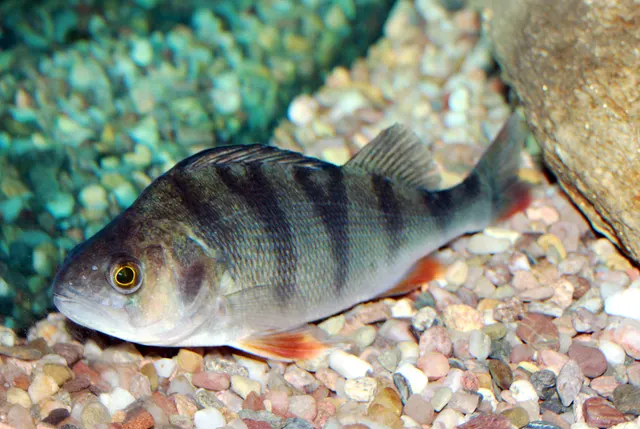
Documented on the same ground: Brown trout, Northern pike, Atlantic salmon, European perch, Arctic char.
Spinning
Recorded at 1 place here, over river reach.
Casting an artificial lure and retrieving it so that it moves like something alive — the most direct form of lure fishing.
Documented on the same ground: Atlantic salmon, Brown trout, Grayling, Northern pike.
Stillwater fly fishing
Recorded at 1 place here, over loch.
Fly fishing without current, where the angler supplies every movement and the problem becomes finding fish rather than presenting to them.
Documented on the same ground: Brown trout, Northern pike, Atlantic salmon, European perch, Arctic char.
Trolling
Recorded at 1 place here, over loch.
Towing lures or baits behind a moving boat to cover large volumes of water and locate scattered fish.
Documented on the same ground: Brown trout, Northern pike, Atlantic salmon, European perch, Arctic char.
These are the methods documented at the places FishingHQ holds here. A species listed beside a method is documented on the same ground, which is not the same as being taken that way — where a source establishes the method a fish was caught on, it is stated on that place’s own page. All fishing methods.
The fishing year here
The months the records under this area actually name, tightest season first. This is “observed in these months” rather than a season: a species whose months nobody recorded is not listed, because a gap in the evidence is not a year-round fishery.
- GraylingOctober to February
- Atlantic salmonJanuary, February, March, April, May, August, September and October
- Brown troutMarch to October
What dominates
Fly fishing for Atlantic salmon with double-handed rods, which is the river's defining discipline and its economic centre. Boat fishing from traditional craft with a ghillie on the oars, which the size of the water makes necessary rather than picturesque — harling, in which lures or flies are worked from a boat moving across and down the current, is a Tay speciality. Spinning and bait fishing where and when beat rules permit, which varies. Sea trout fishing, largely at night in summer. Grayling fishing in the colder months on the lower and middle river, which has grown substantially. Loch fishing for brown trout, char and pike in the headwater lochs. Pike fishing in the slower lower reaches and the lochs.
The water available
Deep glacial headwater lochs; hydro-regulated tributaries with managed flow; steep upland burns and gorge sections; a broad heavy lowland river of long deep pools, gravel runs and streamy glides; extensive gravel and cobble bed supporting spawning and invertebrate production; a large tidal estuary with sandbank, mudflat, saltmarsh and one of the largest reedbeds in Britain; and connected lowland lochs and still waters in the lower catchment.
How the rules are structured
Scotland's arrangements differ fundamentally from England's and visitors get this wrong constantly. There is NO ROD LICENCE in Scotland for freshwater fishing. What there is instead is private ownership: the right to fish for salmon and sea trout is a separate heritable property right, it belongs to somebody, and fishing without that person's permission is not a licensing oversight. Salmon and sea trout are administered river by river through district salmon fishery boards, with their own seasons, method rules and release requirements, and Scotland additionally operates a national river-grading system that determines whether killing a salmon is permitted on a given river in a given year. Brown trout and coarse fishing also require the owner's permission, though the arrangements are looser and clubs administer a great deal of it. Conservation designations cover parts of the system for its habitats, its salmon and its freshwater pearl mussels, which are separately and strictly protected. FishingHQ does not state what any current rule is, including any season or grading.
Who to ask
- The Tay District Salmon Fishery Board, which administers salmon and sea trout fishing across this river system.
- Marine Directorate of the Scottish Government, for national salmon conservation measures including the river grading system.
- The proprietor, estate, hotel or angling association that holds the fishing rights, since freshwater fishing rights in Scotland are private property and permission is required.
- NatureScot, where a conservation designation affects the river, its habitats or its protected species.
- The Scottish Environment Protection Agency, for water quality, abstraction and the regulation of impoundments.
Words you will meet
- Harling
- Fishing lures or flies from a boat that is worked across and down the current on the oars or under power, covering water no bank angler could reach. It is a Tay speciality, it is how a great deal of this river's salmon fishing is done, and it is a boatman's skill rather than a rod's.
- Ghillie
- The person who runs a beat: reads the water, rows the boat, decides where and how it will be fished and frequently how it will not. On a river of this size the ghillie's knowledge is the fishing, and treating the role as a service rather than as expertise is the commonest visitor mistake.
- Springer
- A salmon entering the river early in the year, typically a multi-sea-winter fish in prime condition. The Tay's spring run was the river's historic glory and its decline across Scotland is the single largest change in this fishery within living memory.
- Grading
- Scotland's national system of assessing each salmon river against its conservation limit and setting, annually, whether any salmon may be killed on it. It changes year to year and river to river, and it is the first thing to check rather than the last.
Conditions and hazards
This is a very large, cold, powerful river and the hazards scale with the volume. Wading is the principal one: depth times speed decides whether a person stays on their feet, the force rises sharply with current speed rather than gently, and the Tay's heavy pools are strong enough to take a wader off the bottom at less depth than expected over gravel and cobble that shifts. Levels rise from rain in a very large upland catchment hours away and under a clear sky over the beat, and on the regulated tributaries they can rise from a hydro release, which is a decision rather than a weather event and gives no natural warning at all. Cold water shock decides most immersions for most of the season, and the spring fishing the river is known for happens in the coldest water. Boat fishing on heavy water is a real activity with real consequences and is the reason the ghillie exists. In the estuary, extensive soft mud and sandflat fill from the channels outward, the tidal range is large, and the ground will not carry weight on the way back. The headwater lochs are deep, cold, aligned with valleys that channel and accelerate wind, and can raise a steep sea quickly.
A river too big to wade, and the fishing that grew up around that
The Tay's defining practical fact is its volume, and almost every distinctive thing about how it is fished is a response to water that cannot be covered from the bank.
THE SCALE, STATED PLAINLY. Mean flow to the sea exceeds that of the Thames and the Severn together. On the main river the pools are hundreds of metres long and wide enough that a very long double-handed cast covers a fraction of them. In ordinary height a great deal of the productive water is out of reach of anybody standing in the margin, and in high water the margin itself is not a place to stand.
SO THE BOAT IS NOT A LUXURY. Harling — working lures or flies from a boat moved across and down the current — exists because it is the only way to present anything over the middle of a big Tay pool. The boat is rowed or motored across the flow while the lines fish behind it, and the boatman controls the speed, the angle and the depth. That makes the ghillie's reading of the water the primary skill and the rod a passenger in a specific and honest sense.
AND CASTING FROM A BOAT IS ITS OWN DISCIPLINE. Being taken into position and fishing a fly through a lie that cannot be reached from either bank is how much of this river is covered, and it requires a different sense of where the fly is from bank fishing.
THE HEADWATER LOCHS BUFFER THE FLOW, which changes the river's character relative to a pure spate system. A lake stores water and releases it slowly, so the Tay holds height in dry spells that would leave a Highland spate river unfishable, and it drops more slowly after a flood. That is why the river has a reputation for fishing when others cannot, and it is a hydrological fact rather than a local boast.
HYDRO REGULATION IS LAID OVER THE TOP OF IT and complicates the picture honestly. Parts of this catchment were dammed and diverted for power in the mid twentieth century. Flow in several tributaries and in stretches of the main river is therefore managed, releases are decisions, and the relationship between rainfall and river height is no longer a simple one. For an angler the practical point is that a rise can arrive with no weather to explain it.
WHAT ELSE THE RIVER HOLDS. Grayling through the colder months on the middle and lower river, which is a genuine and growing fishery. Brown trout throughout. Pike in the slower lower reaches and the lochs, at real size. Sea trout at night in summer. And in the deep headwater lochs, Arctic charr and a European whitefish population — glacial relicts whose presence is a statement about how long this water has been cold and clean.
What experienced anglers do — why, and the sources (4)
Widely and independently recommended by experienced anglers and specialist sources. This is real angling knowledge, not proof: controlled evidence for it is limited, and FishingHQ records it as convention rather than as a demonstrated effect.
- Coarse Fishing — A. & C. Black, 1912 (Specialist angling publication)Relied on for: Established description of English coarse fishing practice on rivers, canals and still waters.FishingHQ's interpretation of what it saysCitation checked — the work exists and is described correctly
- General angling website restatements of established technique — Various (Credible secondary source)Relied on for: Widely restated descriptions of which practices are conventionally used on the waters named, recorded as practitioner consensus rather than as scholarship.Background and mechanism onlyCitation checked — the work exists and is described correctly
- Freshwater Fishes of the British Isles — HarperCollins (New Naturalist 75), 1992 (Reference work)Relied on for: Distribution, ecology, life history and conservation status of the freshwater fishes of the British Isles named here.States this directlyCitation checked — the work exists and is described correctly
- Environment Agency fisheries management, byelaws and rod licensing information — Environment Agency (Government fisheries body)Relied on for: Freshwater fisheries management, water quality, river and still-water monitoring, and the structure of the licensing framework.States this directlyCitation checked — the work exists and is described correctly
The spring run, the record fish, and an honest account of the decline
The Tay's reputation rests on two things: a spring salmon run that was once the best in Britain, and one fish caught in 1922. Both deserve stating accurately, because the gap between them and the present is the most useful thing this page contains.
THE RECORD FISH FIRST. The largest rod-caught Atlantic salmon ever recorded in British waters was taken from this river by Georgina Ballantine in October 1922, at a weight over sixty pounds. It has stood for more than a century. It is worth knowing partly as history and partly as calibration: a fish of that size was exceptional even then, and treating it as a description of what the river once routinely produced is a misreading.
THE SPRING RUN IS THE REAL STORY. Multi-sea-winter salmon entering fresh water early in the year, in prime condition, after two or more winters feeding at sea. The Tay's spring run was historically among the strongest anywhere and it supported a fishery, an economy and a body of technique built specifically around cold water and sunk lines.
AND IT HAS DECLINED SEVERELY, across Scotland and not only here. Spring fish are a smaller proportion of a smaller total run than they were, the early weeks that once defined the season are now the thinnest, and the decline is not a local management failure — it tracks changes in marine survival that operate across the whole North Atlantic and are not within any river board's control.
WHAT HAS CHANGED IN RESPONSE. Catch-and-release is now the norm on Scottish salmon rivers rather than an option, mandatory in various forms, and Scotland operates a national grading system that assesses each river annually against its conservation limit and determines whether any salmon may be killed on it at all. That grading changes year to year and river to river, which is precisely why FishingHQ does not state it: the current position is the only one worth having and it comes from the fishery board and the national authority.
THE HONEST FRAMING FOR A VISITOR. This is still one of the great salmon rivers of Europe and it is not the river the older literature describes. A season here now is likely to be measured in fish seen and water learned rather than in a bag, the autumn run is a larger share of the year than it was, and the spring fishing is a serious commitment for an uncertain return. Anybody who arrives expecting the 1920s will be disappointed by something that is nobody's fault.
AND THE OTHER MIGRATORY FISH MATTER TOO. Sea trout have declined on many west-coast systems and hold up better on some east-coast ones; the Tay's are a real fishery. The estuary is the corridor for all of it, and its condition is as much a part of the salmon question as any beat upstream.
Backed by research — why, and the sources (4)
Supported by peer-reviewed research or fisheries science. The sources are listed and can be checked.
- NASCO conservation and management of North Atlantic salmon — North Atlantic Salmon Conservation Organization (Government fisheries body)Relied on for: The status, conservation and management of North Atlantic salmon stocks, and the international framework within which national bodies manage them.States this directlyCitation checked — the work exists and is described correctly
- Freshwater Fishes of the British Isles — HarperCollins (New Naturalist 75), 1992 (Reference work)Relied on for: Life history, distribution and conservation status of Atlantic salmon and sea trout in British and Irish rivers.States this directlyCitation checked — the work exists and is described correctly
- Freshwater Fishes of the British Isles — HarperCollins (New Naturalist 75), 1992 (Reference work)Relied on for: Distribution, ecology, life history and conservation status of the freshwater fishes of the British Isles named here.States this directlyCitation checked — the work exists and is described correctly
- Environment Agency fisheries management, byelaws and rod licensing information — Environment Agency (Government fisheries body)Relied on for: Freshwater fisheries management, water quality, river and still-water monitoring, and the structure of the licensing framework.States this directlyCitation checked — the work exists and is described correctly
A rise with no rain, and water heavy enough to take you off the gravel
Everything dangerous about the Tay follows from the same fact that makes it famous: there is a very great deal of water in it.
WADING IS THE PRINCIPAL HAZARD AND THE ARITHMETIC IS UNFORGIVING. The force a current exerts on a standing person rises sharply with speed rather than gently, so water at mid-thigh in a heavy glide pushes harder than water at chest height in a slow pool. On a river carrying this volume, the point at which the feet stop holding arrives much earlier than the depth suggests, and the bed is gravel and cobble that moves. There is no moment at which this announces itself; it is a gradual change that the person in the water is the last to notice.
AND THE LEVEL RISES FROM WEATHER NOBODY ON THE BEAT CAN SEE. This is a very large upland catchment. Rain that fell in the hills hours ago arrives here under a clear sky, and the river can go from comfortable to dangerous across an afternoon with no local weather at all.
THE REGULATED TRIBUTARIES ADD A SHARPER VERSION. Where flow is managed for hydro generation, a release is a decision rather than a weather event, and it raises a river fast with no natural signal preceding it — no cloud, no rain, no rising wind.
SO THE SIGNALS TO ACT ON ARE IN THE WATER. Colouring. A level lifting against a fixed mark on the bank. Debris starting to move. Each means the same thing, none of them improves, and the decision rule is to get out at the first one rather than the second — which is hard to keep, because a rising river frequently fishes well.
THE SEASON MAKES IT WORSE IN THE OBVIOUS WAY. The spring fishing this river is known for happens in the coldest water of the year, and cold water takes breathing control within the first minute — in waders in current, that is the minute that decides it. Summer sea trout fishing is done at night, and water waded at night should be water walked in daylight.
WHAT ACTUALLY HELPS. A fastened wading belt, which stops waders filling and becoming an anchor, and a staff, which turns two points of contact into three. Wade with the current rather than against it. Do not wade above heavy water. Studded soles matched to the bed. An inflatable buoyancy aid is worth considering on water this size. And do not wade heavy water alone.
IF IT GOES WRONG: feet downstream, on your back, float and control the breathing before trying to reach anything. Fighting to stand up in moving water is how people are pinned.
THE BOAT FISHING AND THE ESTUARY ADD THEIR OWN. A boat on heavy water is a serious undertaking and is the reason experienced boatmen run it. In the estuary, extensive soft mud and sand fill from the channels outward on a large tidal range, and ground that carried weight on the way out will not on the way back. Check current river levels before travelling and again during the day; they are published and on this catchment they move.
Official guidance — why, and the sources (4)
Stated by a fisheries authority, scientific institute or recognised angling body. Authoritative, but summarising rather than demonstrating.
- RNLI water safety guidance: cold water shock and Float to Live — Royal National Lifeboat Institution (Water-safety or diver-training authority)Relied on for: Cold water shock and the immersion response, and water-safety guidance for anglers and small-craft users on inland water.States this directlyPassage read and verified
- RoSPA water safety information and UK accidental drowning statistics — Royal Society for the Prevention of Accidents (Water-safety or diver-training authority)Relied on for: UK accidental drowning statistics and inland water-safety guidance, including the proportion of drownings that begin with no intention of entering the water.States this directlyPassage read and verified
- Freshwater Fishes of the British Isles — HarperCollins (New Naturalist 75), 1992 (Reference work)Relied on for: Distribution, ecology, life history and conservation status of the freshwater fishes of the British Isles named here.States this directlyCitation checked — the work exists and is described correctly
- Environment Agency fisheries management, byelaws and rod licensing information — Environment Agency (Government fisheries body)Relied on for: Freshwater fisheries management, water quality, river and still-water monitoring, and the structure of the licensing framework.States this directlyCitation checked — the work exists and is described correctly
Some of what lives here
Fish recorded here that FishingHQ holds a reviewed photograph of. It is not a complete list of what The River Tay holds, and it is not a prediction that you will catch any of them — it is a way in to the ones we can show you.
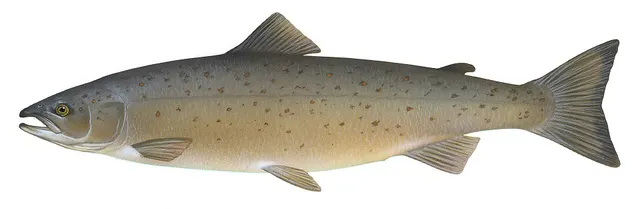 Atlantic salmonAn anadromous salmonid that migrates from its natal river to the North Atlantic and returns to spawn — and a species in serious, well-documented decline.
Knepp, Timothy, Public domain, via Wikimedia Commons
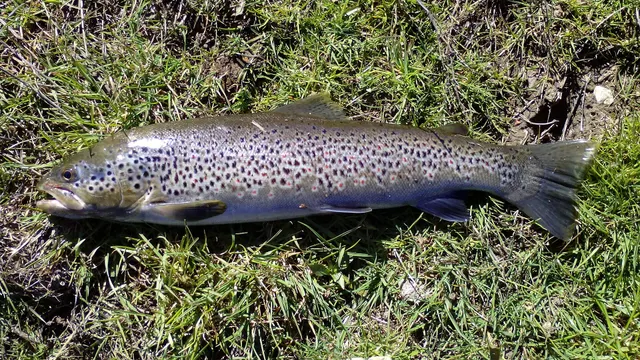 Brown troutA single, extraordinarily plastic species that appears as a tiny hill-stream fish, a deep-bodied loch trout and a silver sea-run migrant — all the same animal.
Robermix, CC0, via Wikimedia Commons
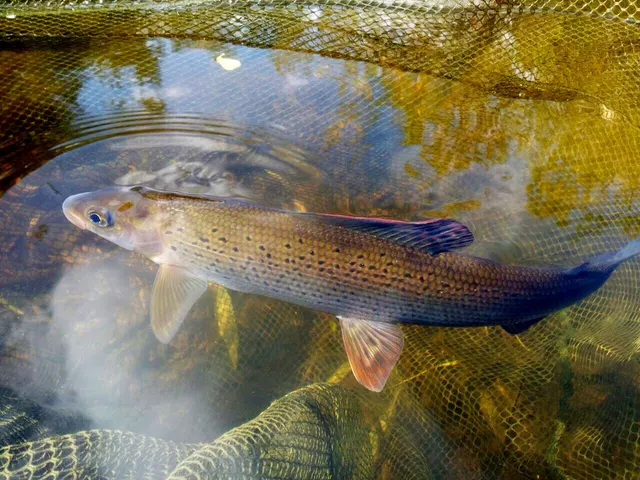 GraylingA salmonid with a sail for a dorsal fin that feeds hard through the winter — which makes it the game angler's season when the trout season has closed.
High Plains Grifter — CC BY-SA 4.0, via Wikimedia Commons
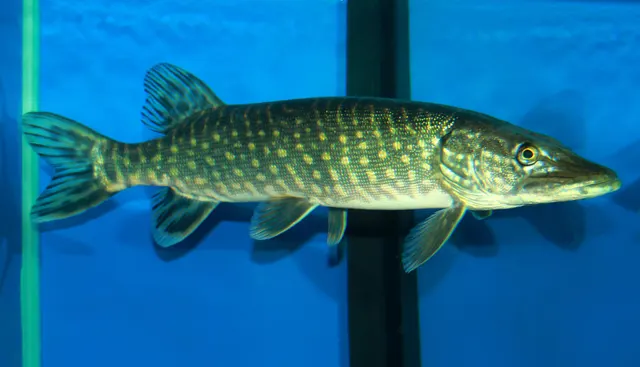 Northern pikeThe dominant freshwater ambush predator of the northern hemisphere: long, cryptic, and built for one violent acceleration rather than pursuit.
Karelj, Public domain, via Wikimedia Commons
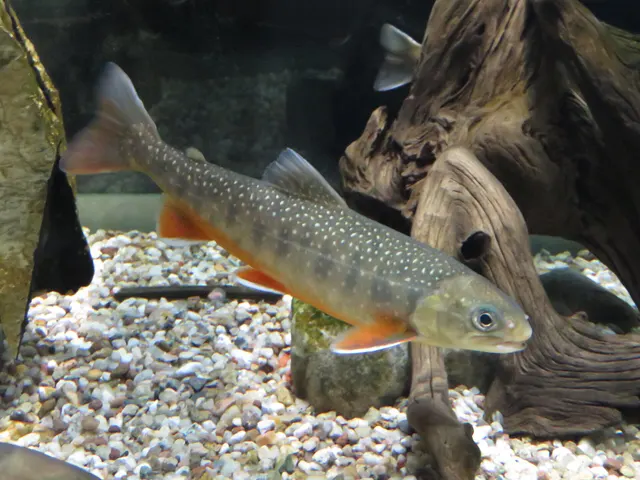 Arctic charThe most northerly freshwater fish in the world, a cold-demanding char with brilliant orange-red spawning bellies and highly distinct landlocked populations.
Xepheid — CC BY-SA 4.0, via Wikimedia Commons
Places within this area
Publicly documented fishing geography. FishingHQ describes what the ground is; it does not say whether you may fish it, and every one of these sends that question to the body that holds the answer. Browse every place in this part of the world.
Who to ask before fishing any of these
FishingHQ does not know the current access position here. Scotland has no general rod licence, and the fishing rights on almost every river and loch belong to somebody: a proprietor, an estate, an angling association or a district salmon fishery board. Permission is a separate question from access, and both change. Check with the relevant fishery board or association before going.
The Tay at Stanley
River reach · Fresh water
A wide, powerful, deep reach of the lower Tay above Perth, carrying the largest volume of water of any river in Britain over a bed of gravel, boulder and bedrock, with defined streams, deep holding water and rock ledges.
Open river valley with wooded banks in places; the river is large enough that wind affects fishing rather than safety.
Particular to this ground: moving water and currents, moving water and currents, cold water shock.
Loch Tay
Loch · Fresh water
A deep glacial ribbon loch in a steep Perthshire valley, feeding the largest river discharge in Britain, with a substantial salmon run entering through it.
Severe hazards of The River Tay apply here: moving water and currents, cold water shock.
The Tay at Dunkeld
River reach · Fresh water
A broad, deep, powerful reach below the Tummel confluence running through a wooded Perthshire gorge, with rock ledges, deep holding water and a substantial spring run.
Severe hazards of The River Tay apply here: moving water and currents, cold water shock.
The Tummel and Loch Faskally
River reach · Fresh water
A dam-controlled river and its impounded loch at Pitlochry, with a fish pass and observation chamber, and a flow set by hydroelectric release rather than by rainfall.
Severe hazards of The River Tay apply here: moving water and currents, cold water shock.
Safety
Moving water and currents — Can cause serious injury or death
The largest river in Britain by volume exerts force that rises sharply with current speed, so a wader loses their footing at less depth than expected over gravel and cobble that shifts. Levels rise from rain hours away under a clear sky, and on regulated tributaries from a hydro release with no natural warning at all.
What reduces it: Wear a fastened wading belt and use a staff, wade with the current rather than against it, do not wade above heavy water, and get out at the first sign of colouring or rising level rather than the second.
Worse when:
- After rain in the upper catchment, which arrives hours later with no local weather.
- Below or within a hydro-regulated reach, where a release raises the river without any natural signal.
Cold water shock — Can cause serious injury or death
The spring salmon fishing the river is known for happens in the coldest water of the year, and the summer sea trout fishing happens at night. Immersion takes breathing control within the first minute, which in waders in current is the minute that decides it.
What reduces it: Consider an inflatable buoyancy aid on water this size, do not wade heavy water alone, and if immersed get feet downstream and float and control the breathing before attempting to reach the bank.
Tides and being cut off — Can cause injury needing treatment
The Firth of Tay carries a large tidal range over extensive soft mud and sandflat that fills from the channels outward, and ground that carried weight on the way out will not on the way back.
What reduces it: Know the state of the tide and the exit before going onto the flats, set a leaving time from the tide rather than from the fishing, and do not go out onto soft ground alone.
Further safety reading
- Wading safely — The largest river in Britain by volume exerts force that rises sharply with current speed, and levels rise from rain hours away under a clear sky — or, on regulated tributaries, from a hydro release with no natural warning at all.
Check the rules before you fish
Fishing laws, bylaws, access rules, seasons, bait restrictions and permitted methods vary by location and can change. Check the current rules from the relevant authority and the water you intend to fish before fishing.
Check with:
- Current national or regional law for where you are fishing
- Current local bylaws
- The relevant fisheries authority
- The landowner, club or fishery whose water it is
- Any restrictions specific to the species or the method you intend to use
Where to go next
What swims here
- Arctic charIn the deep cold headwater lochs of this system as a glacial relict, isolated there since the ice retreated and dependent on water that stays cold and oxygenated at depth.
- Atlantic salmonThe river's defining fish and its economic centre. The spring run was historically among the strongest anywhere and has declined severely across Scotland; the largest rod-caught salmon ever recorded in British waters came from this river in 1922.
- Brown troutThroughout the system as a resident fish and as sea trout in the lower river and estuary. The headwater lochs hold populations of their own.
- GraylingOn the middle and lower river through the colder months, a fishery that has grown substantially and that occupies the season when salmon fishing is closed or unproductive.
- Northern pikeIn the slower lower reaches and in the headwater lochs, at real size, in water productive enough to support a substantial prey base.
How this compares
Environment and conservation
Sources and evidence
- Freshwater Fishes of the British Isles — HarperCollins (New Naturalist 75), 1992 (Reference work)Relied on for: Distribution, ecology, life history and conservation status of the freshwater fishes of the British Isles named here.States this directlyCitation checked — the work exists and is described correctly
- Environment Agency fisheries management, byelaws and rod licensing information — Environment Agency (Government fisheries body)Relied on for: Freshwater fisheries management, water quality, river and still-water monitoring, and the structure of the licensing framework.States this directlyCitation checked — the work exists and is described correctly
- JNCC species and habitat conservation advice — Joint Nature Conservation Committee (Conservation authority)Relied on for: Designation, habitat description and conservation status of the freshwater and wetland habitats named, and the species characteristically associated with them.States this directlyCitation checked — the work exists and is described correctly
- The Fishes of the British Isles and North-West Europe — Macmillan, 1969 (Reference work)Relied on for: Distribution, habitat association and biology of the freshwater and migratory fishes of the British Isles named here.States this directlyCitation checked — the work exists and is described correctly
- RNLI water safety guidance: cold water shock and Float to Live — Royal National Lifeboat Institution (Water-safety or diver-training authority)Relied on for: Cold water shock and the immersion response, and water-safety guidance for anglers and small-craft users on inland water.States this directlyPassage read and verified
- RoSPA water safety information and UK accidental drowning statistics — Royal Society for the Prevention of Accidents (Water-safety or diver-training authority)Relied on for: UK accidental drowning statistics and inland water-safety guidance, including the proportion of drownings that begin with no intention of entering the water.States this directlyPassage read and verified
Why the 10 connections on this page are here, and the sources
What swims here
Backed by research — 5 connections
Supported by peer-reviewed research or fisheries science. The sources are listed and can be checked.
Arctic char
A claim that a place contains the ground, water and seasonal conditions the species is associated with. It is a distributional statement about the world, it rests on the regional reference literature, and it deliberately asserts nothing about access, permission or catch.
- Freshwater Fishes of the British Isles — HarperCollins (New Naturalist 75), 1992 (Reference work)Relied on for: Distribution, ecology and conservation status of the freshwater fishes of the British Isles, including in artificial and modified waters.States this directlyCitation checked — the work exists and is described correctly
- Environment Agency fisheries management, byelaws and rod licensing information — Environment Agency (Government fisheries body)Relied on for: Fisheries monitoring, water quality and species distribution in English rivers, canals and still waters.States this directlyCitation checked — the work exists and is described correctly
Atlantic salmon
A claim that a place contains the ground, water and seasonal conditions the species is associated with. It is a distributional statement about the world, it rests on the regional reference literature, and it deliberately asserts nothing about access, permission or catch.
- Freshwater Fishes of the British Isles — HarperCollins (New Naturalist 75), 1992 (Reference work)Relied on for: Distribution, ecology and conservation status of the freshwater fishes of the British Isles, including in artificial and modified waters.States this directlyCitation checked — the work exists and is described correctly
- Environment Agency fisheries management, byelaws and rod licensing information — Environment Agency (Government fisheries body)Relied on for: Fisheries monitoring, water quality and species distribution in English rivers, canals and still waters.States this directlyCitation checked — the work exists and is described correctly
Brown trout
A claim that a place contains the ground, water and seasonal conditions the species is associated with. It is a distributional statement about the world, it rests on the regional reference literature, and it deliberately asserts nothing about access, permission or catch.
- Freshwater Fishes of the British Isles — HarperCollins (New Naturalist 75), 1992 (Reference work)Relied on for: Distribution, ecology and conservation status of the freshwater fishes of the British Isles, including in artificial and modified waters.States this directlyCitation checked — the work exists and is described correctly
- Environment Agency fisheries management, byelaws and rod licensing information — Environment Agency (Government fisheries body)Relied on for: Fisheries monitoring, water quality and species distribution in English rivers, canals and still waters.States this directlyCitation checked — the work exists and is described correctly
Grayling
A claim that a place contains the ground, water and seasonal conditions the species is associated with. It is a distributional statement about the world, it rests on the regional reference literature, and it deliberately asserts nothing about access, permission or catch.
- Freshwater Fishes of the British Isles — HarperCollins (New Naturalist 75), 1992 (Reference work)Relied on for: Distribution, ecology and conservation status of the freshwater fishes of the British Isles, including in artificial and modified waters.States this directlyCitation checked — the work exists and is described correctly
- Environment Agency fisheries management, byelaws and rod licensing information — Environment Agency (Government fisheries body)Relied on for: Fisheries monitoring, water quality and species distribution in English rivers, canals and still waters.States this directlyCitation checked — the work exists and is described correctly
Northern pike
A claim that a place contains the ground, water and seasonal conditions the species is associated with. It is a distributional statement about the world, it rests on the regional reference literature, and it deliberately asserts nothing about access, permission or catch.
- Freshwater Fishes of the British Isles — HarperCollins (New Naturalist 75), 1992 (Reference work)Relied on for: Distribution, ecology and conservation status of the freshwater fishes of the British Isles, including in artificial and modified waters.States this directlyCitation checked — the work exists and is described correctly
- Environment Agency fisheries management, byelaws and rod licensing information — Environment Agency (Government fisheries body)Relied on for: Fisheries monitoring, water quality and species distribution in English rivers, canals and still waters.States this directlyCitation checked — the work exists and is described correctly
How people fish here
What experienced anglers do — 2 connections
Widely and independently recommended by experienced anglers and specialist sources. This is real angling knowledge, not proof: controlled evidence for it is limited, and FishingHQ records it as convention rather than as a demonstrated effect.
Fly fishing
A claim about angling convention rather than about the world: that this place sits within this branch of fishing, which drives the information architecture as well as the page. It rests on independent practitioner description.
- General angling website restatements of established technique — Various (Credible secondary source)Relied on for: Widely restated descriptions of which practices are conventionally used on the waters named, recorded as practitioner consensus rather than as scholarship.Background and mechanism onlyCitation checked — the work exists and is described correctly
- Coarse Fishing — A. & C. Black, 1912 (Specialist angling publication)Relied on for: Established description of English coarse and game fishing practice on rivers, canals and still waters.FishingHQ's interpretation of what it saysCitation checked — the work exists and is described correctly
Predator fishing
A claim about angling convention rather than about the world: that this place sits within this branch of fishing, which drives the information architecture as well as the page. It rests on independent practitioner description.
- General angling website restatements of established technique — Various (Credible secondary source)Relied on for: Widely restated descriptions of which practices are conventionally used on the waters named, recorded as practitioner consensus rather than as scholarship.Background and mechanism onlyCitation checked — the work exists and is described correctly
- Coarse Fishing — A. & C. Black, 1912 (Specialist angling publication)Relied on for: Established description of English coarse and game fishing practice on rivers, canals and still waters.FishingHQ's interpretation of what it saysCitation checked — the work exists and is described correctly
How this compares
What experienced anglers do — 1 connection
Widely and independently recommended by experienced anglers and specialist sources. This is real angling knowledge, not proof: controlled evidence for it is limited, and FishingHQ records it as convention rather than as a demonstrated effect.
The River Tweed
A claim that two places are worth reading against one another, because a reader choosing between them or generalising from one to the other needs to know how the underlying process differs.
- General angling website restatements of established technique — Various (Credible secondary source)Relied on for: Widely restated descriptions of which practices are conventionally used in the waters named, recorded as practitioner consensus rather than as scholarship.Background and mechanism onlyCitation checked — the work exists and is described correctly
- Sea Angler — Bauer Media (Specialist angling publication)Relied on for: Long-running published description of British and Irish sea angling practice by region and by ground type.FishingHQ's interpretation of what it saysCitation checked — the work exists and is described correctly
Safety reading
Official guidance — 1 connection
Stated by a fisheries authority, scientific institute or recognised angling body. Authoritative, but summarising rather than demonstrating.
Wading safely
A claim that a place presents a particular hazard strongly enough that the reader should be sent to the page dealing with it in full, rather than left with the short warning on the place itself.
- RNLI water safety guidance: cold water shock and Float to Live — Royal National Lifeboat Institution (Water-safety or diver-training authority)Relied on for: Cold water shock and the immersion response, tidal cut-off, and water-safety guidance for shore anglers and small-craft users.States this directlyPassage read and verified
Environment and conservation
Backed by research — 1 connection
Supported by peer-reviewed research or fisheries science. The sources are listed and can be checked.
Fish stocks and sustainability
A claim that a place raises a particular environmental question, resting on the scientific and conservation literature for the system rather than on angling practice.
- JNCC species and habitat conservation advice — Joint Nature Conservation Committee (Conservation authority)Relied on for: Habitat classification and description for the intertidal, coastal, estuarine and freshwater habitats named, and the species characteristically associated with them.States this directlyCitation checked — the work exists and is described correctly
- Cefas science, advice and data on marine and freshwater environments — Centre for Environment, Fisheries and Aquaculture Science (Government fisheries body)Relied on for: Characterisation of UK inshore sediment, intertidal habitat, estuarine process and the shellfish beds associated with them.States this directlyCitation checked — the work exists and is described correctly
How FishingHQ labels evidence is explained in the evidence policy.