Spinnerbaits and bladed jigs
Lure · Last reviewed 2026-08-10
A wire-framed lure with a blade and a skirt that is nearly weedless — the answer to fishing vibration and flash through cover that would snag anything else.
Safety: hooks and barbs — can cause injury needing treatment. One more point applies here.
A spinnerbait is a strange-looking object that solves a specific problem. A safety-pin wire frame carries one or more spinning blades on the upper arm and a weighted head with a skirted hook on the lower, and the geometry means the wire arm shields the hook point from weed, timber and branches.
That is the whole point. Crankbaits and treble-hooked lures cannot be fished through heavy cover, and heavy cover is where a great many predators live. A spinnerbait can be run through submerged branches, weed beds and flooded timber and come out clean, while still producing the flash and vibration that draw fish in coloured water.
The blades determine what it does. A COLORADO blade is round and cupped, turns slowly, and produces heavy low-frequency thump — best in coloured water and cold conditions. A WILLOW blade is long and narrow, spins fast and tight, produces more flash and less vibration, and suits clear water and faster retrieves. Most spinnerbaits combine the two.
A BLADED JIG, often called a chatterbait, is a related but distinct lure: a jig head with a hinged blade at the nose that makes the whole lure shimmy violently. It is less weedless than a spinnerbait and produces a stronger vibration, and it has largely taken over some of the water spinnerbaits used to own.
At a glance
- Depth range
- Surface to around 8 m, controlled by head weight, blade type and retrieve speed. Colorado blades run shallower for a given weight; willow blades run deeper and faster.
What it does in the water
The blade or blades rotate around the wire arm, producing both flash and a pressure wave the fish detects through the lateral line. A Colorado blade turns slowly on a wide axis, generating strong low-frequency vibration and considerable lift, so the lure runs shallow and slow. A willow blade spins fast and close to the shaft, generating flash rather than thump and allowing a faster retrieve at greater depth. A bladed jig behaves differently again: the hinged blade at the nose deflects side to side and makes the entire lure shimmy hard.
How it is worked
A steady retrieve is the baseline, with the speed chosen so the blade is turning and the lure is running at the depth wanted. Slow-rolling — a very slow retrieve along the bottom or through cover — is the classic cold-water and coloured-water presentation. Deliberately banging the lure into cover and letting it deflect is a standard trigger, and one of the few techniques where hitting an obstruction is the intention rather than the accident.
Fish it catches
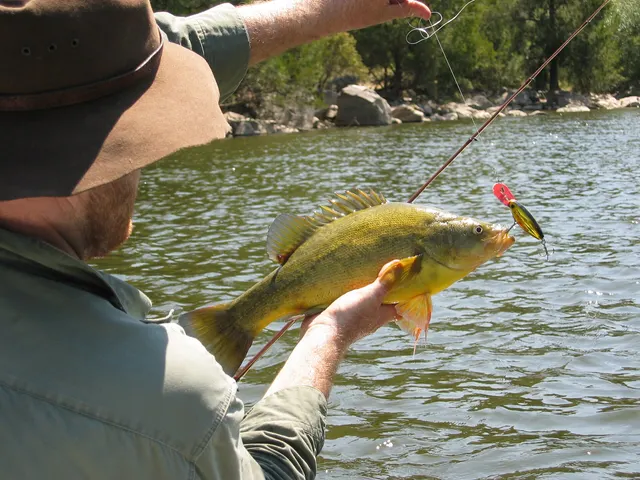 Golden perchSpinnerbaits worked around timber in turbid inland waters are a standard golden perch method, because the vibration reaches a fish hunting in water where sight is limited.
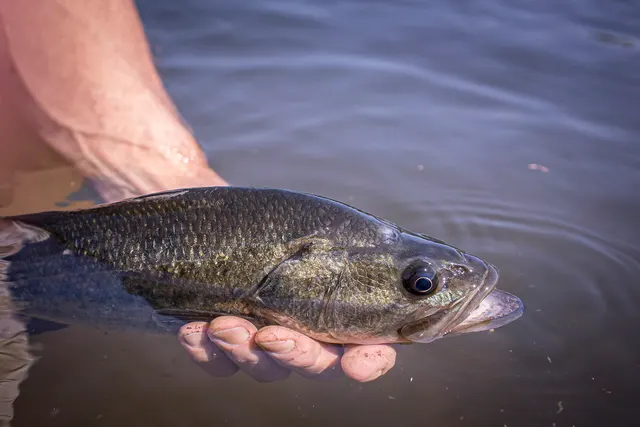 Largemouth bassA spinnerbait is a cover lure that happens to flash: the safety-pin arm deflects it off timber and weed rather than fouling, which is why it is the searching lure in exactly the water the fish prefers.
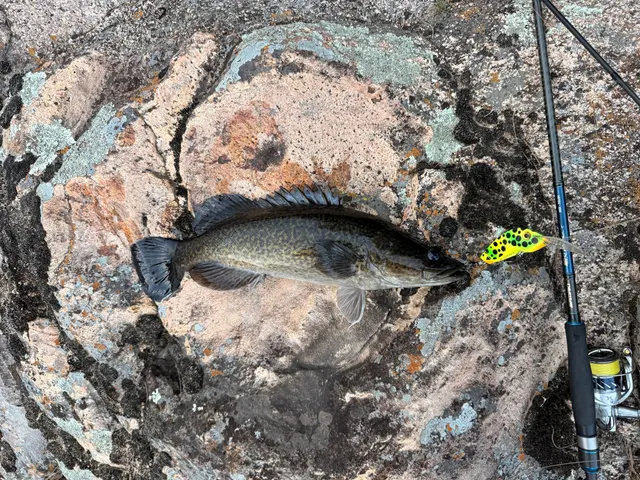 Murray codTurbid inland Australian rivers where sight is nearly useless, and a fish that hunts by vibration — which is why spinnerbaits are conventional for cod and subtle lures are not.
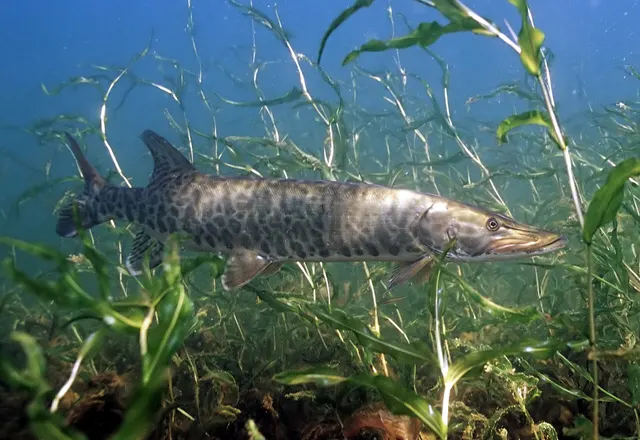 MuskellungeThe large bucktail is the searching lure of muskellunge fishing, and its function is to cover enormous amounts of water at speed — which is what a fishery for a low-density apex predator requires.
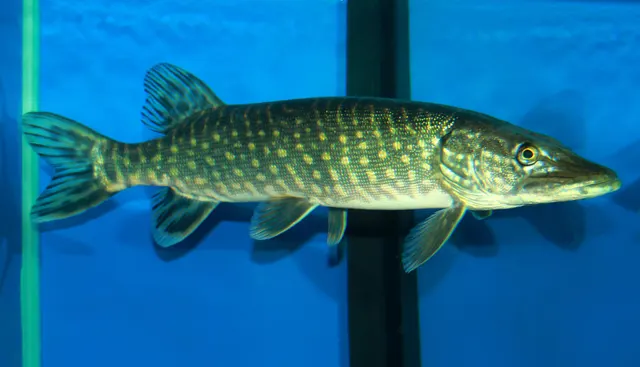 Northern pikeNearly weedless, so it can be worked through the weed and timber pike ambush from, while still producing the vibration that finds them in coloured water.
What it imitates
Not a close imitation of anything. A spinnerbait works by presenting flash, vibration and a moving profile that reads as a small fish or a group of small fish without resembling one closely. That is a genuine design philosophy rather than a compromise: in coloured water, where a fish is hunting by lateral line as much as by sight, a strong vibration signature is more useful than an accurate outline.
Where it stops working
- Not a subtle lure. In very clear water and on heavily fished ground, spinnerbaits can be conspicuously less effective than more natural presentations.
- Hook-up rate is imperfect: fish frequently strike at the blade rather than the hook, which is a known and unresolved characteristic of the design.
- The wire frame bends and must be checked and reset, and a bent frame makes the lure run on its side.
- Bladed jigs are considerably less weedless than spinnerbaits despite being used in similar water.
- Blades and swivels corrode and seize, particularly in salt water, and a blade that will not turn is a lure that does nothing.
Safety
Hooks and barbs — Can cause injury needing treatment
A single large exposed hook on a heavy lure cast repeatedly into cover, frequently from a boat in company.
What reduces it: Look behind and beside you before every cast. Use a de-hooking tool. Cut the line rather than pulling at a hook that has gone in past the barb.
Precautions that always apply here
- If a hook goes past the barb into a person, cut the line, leave the hook where it is, and get medical help. Pulling it back out does far more damage than pushing it through under proper care.
Where to go next
Understanding it
- Spinner blade shapeA spinnerbait's blade combination is tuned against the head weight to set lift and vibration, which is the blade principle applied to a two-part lure.
- What lure action meansA spinnerbait produces action from a rotating blade and a skirted head at once, which is why it behaves like neither a spinner nor a jig.
More lures
Not related to this page — just the rest of the section. There is little else joined to this subject yet, and a short page should still lead somewhere.
Sources and evidence
- Angling Times — Bauer Media (Specialist angling publication)Relied on for: Contemporary practitioner treatment of spinnerbait blade types, slow-rolling and deflection off cover as a trigger.FishingHQ's interpretation of what it saysCitation checked — the work exists and is described correctly
- General angling website restatements of established technique — Various (Credible secondary source)Relied on for: The widely restated practitioner position that Colorado blades suit coloured water and willow blades clear water, and that spinnerbaits suffer imperfect hook-up rates.FishingHQ's interpretation of what it saysCitation checked — the work exists and is described correctly
Why the 8 connections on this page are here, and the sources
Fish it catches
What experienced anglers do — 5 connections
Widely and independently recommended by experienced anglers and specialist sources. This is real angling knowledge, not proof: controlled evidence for it is limited, and FishingHQ records it as convention rather than as a demonstrated effect.
Golden perch
A practitioner claim about which lure family answers this species' feeding or holding behaviour.
- IGFA International Angling Rules and World Record Requirements — International Game Fish Association (Angling or fisheries organisation)Relied on for: Recognition of the species as an established sport fish taken on artificial lures, and the line and tackle classes used for it.States this directlyPassage read and verified
- General angling website restatements of established technique — Various (Credible secondary source)Relied on for: Widely restated lure practice for this species.Background and mechanism onlyCitation checked — the work exists and is described correctly
Largemouth bass
A practitioner claim about which lure family answers this species' feeding or holding behaviour.
- General angling website restatements of established technique — Various (Credible secondary source)Relied on for: Widely restated North American lure practice for this species.Background and mechanism onlyCitation checked — the work exists and is described correctly
- IGFA International Angling Rules and World Record Requirements — International Game Fish Association (Angling or fisheries organisation)Relied on for: Recognition of the species as an established sport fish taken on artificial lures, and the tackle conventions used for it.States this directlyPassage read and verified
Murray cod
A practitioner claim following from the species' verified reliance on the lateral line in turbid water.
- General angling website restatements of established technique — Various (Credible secondary source)Relied on for: Widely restated practitioner accounts of spinnerbait use for Murray cod in turbid water.Citation checked — the work exists and is described correctly
- Angling Times — Bauer Media (Specialist angling publication)Relied on for: Contemporary practitioner treatment of vibration-producing lures in coloured water.Citation checked — the work exists and is described correctly
Muskellunge
A practitioner claim about which lure family answers this species' feeding or holding behaviour.
- General angling website restatements of established technique — Various (Credible secondary source)Relied on for: Widely restated North American lure practice for this species.Background and mechanism onlyCitation checked — the work exists and is described correctly
- IGFA International Angling Rules and World Record Requirements — International Game Fish Association (Angling or fisheries organisation)Relied on for: Recognition of the species as an established sport fish taken on artificial lures, and the tackle conventions used for it.States this directlyPassage read and verified
Northern pike
A practitioner claim about a lure-species pairing and the design property behind it.
- Pike and the Pike Angler — Stanley Paul, 1981 (Specialist angling publication)Relied on for: Practitioner treatment of lure selection for pike in weeded and structured water.Citation checked — the work exists and is described correctly
- Pike Anglers' Club of Great Britain guidance on pike care and handling — Pike Anglers' Club of Great Britain, 1977 (Angling or fisheries organisation)Relied on for: Practitioner treatment of pike lure fishing from a source independent of the angling press.Passage read and verified
How it is worked
What experienced anglers do — 1 connection
Widely and independently recommended by experienced anglers and specialist sources. This is real angling knowledge, not proof: controlled evidence for it is limited, and FishingHQ records it as convention rather than as a demonstrated effect.
Spinning
The spinnerbait record's claim is that it is nearly weedless and can be fished through cover that would snag anything else. That is a spinning retrieve in the specific water spinning is otherwise excluded from.
- Angling Times — Bauer Media (Specialist angling publication)Relied on for: Specialist treatment of which bait or lure family this technique is fished with.States this directlyCitation checked — the work exists and is described correctly
- General angling website restatements of established technique — Various (Credible secondary source)Relied on for: The independently restated practitioner pairing of this technique with this family.Background and mechanism onlyCitation checked — the work exists and is described correctly
Understanding it
What experienced anglers do — 2 connections
Widely and independently recommended by experienced anglers and specialist sources. This is real angling knowledge, not proof: controlled evidence for it is limited, and FishingHQ records it as convention rather than as a demonstrated effect.
Spinner blade shape
Blade and head weight are selected together in spinnerbait practice.
- Angling Times — Bauer Media (Specialist angling publication)Relied on for: Contemporary lure angling practice with modern materials and lure types.States this directlyCitation checked — the work exists and is described correctly
- Sea Angler — Bauer Media (Specialist angling publication)Relied on for: Saltwater lure angling practice with the same materials and lure types.States this directlyCitation checked — the work exists and is described correctly
What lure action means
The compound action of the lure type is what practitioners describe when explaining its use.
- Angling Times — Bauer Media (Specialist angling publication)Relied on for: Contemporary lure angling practice with modern materials and lure types.States this directlyCitation checked — the work exists and is described correctly
- Sea Angler — Bauer Media (Specialist angling publication)Relied on for: Saltwater lure angling practice with the same materials and lure types.States this directlyCitation checked — the work exists and is described correctly
How FishingHQ labels evidence is explained in the evidence policy.