Murray cod
Fish · Last reviewed 2026-08-10
Australia's largest wholly freshwater fish, reaching 113 kg and 48 years, and not a cod at all — a temperate perch that has been the Murray-Darling's apex predator for a very long time.
Safety: injury while handling fish — can cause injury needing treatment. 6 more points apply here.
How this was identified, and who took it
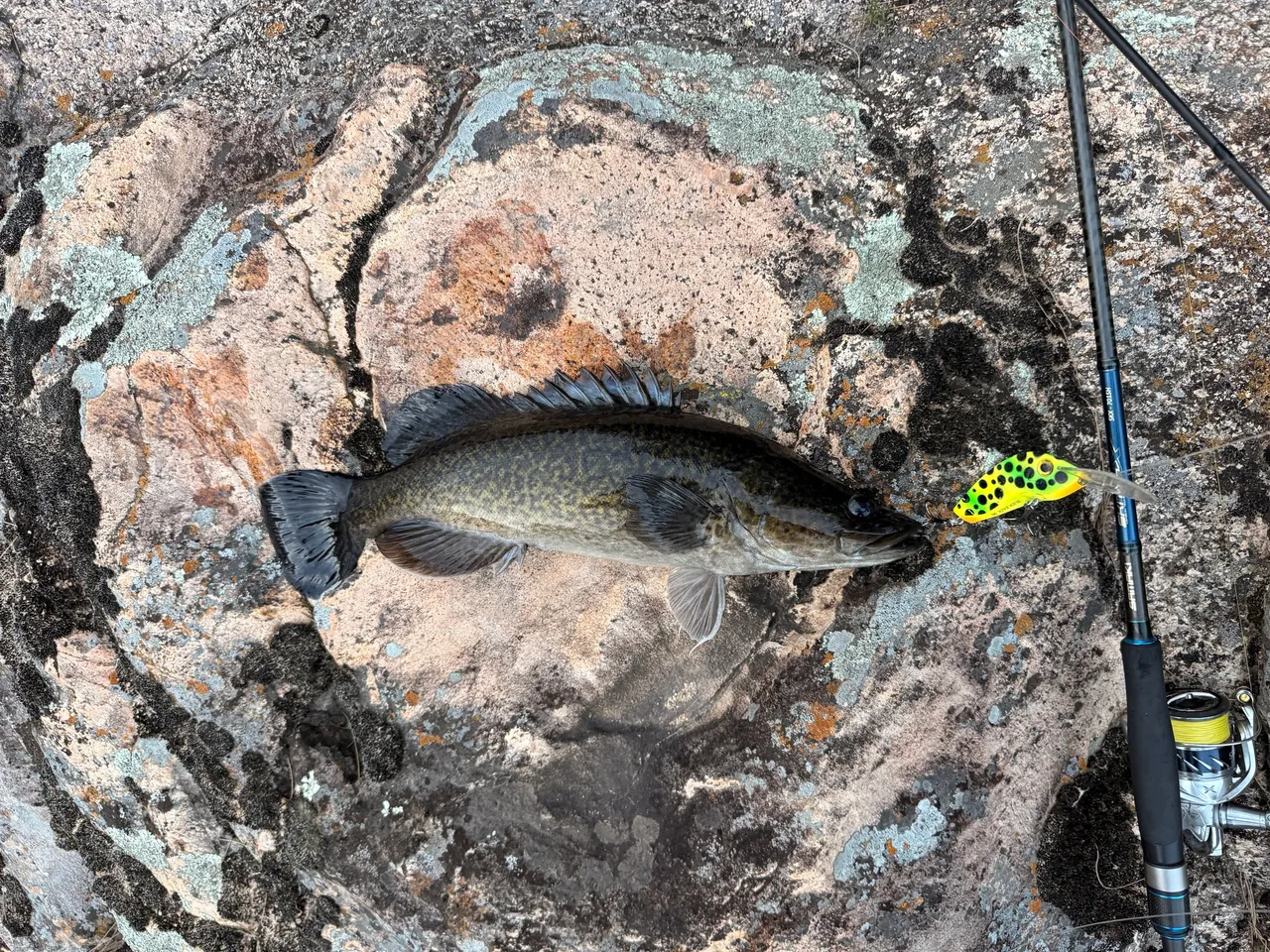
Identified by: A heavy body with a broad flattened head and a large mouth whose lower jaw protrudes slightly, and mottling forming a FINE RETICULATED net over yellow-green rather than discrete blotches, which is the distinction the record specifically draws. A white belly, a long dorsal running from spines into soft rays, and a rounded pale-edged tail.James H — CC BY, via iNaturalist — source, licenceCatching Murray cod
Everything here on fishing for it. Each entry opens the page behind it.
- Ground
The Murray cod is one of the world's great freshwater fish and another case of a common name pointing at the wrong family. It is not a cod; it is a Percichthyidae, a temperate perch, and its resemblance to a cod is entirely in the mottled green skin and the large mouth.
Everything about it is superlative for a freshwater fish. It reaches a maximum published weight of 113.5 kg and a maximum reported age of 48 years, which puts a large individual well beyond the span of most people's fishing lives. It is the apex predator of the Murray-Darling system and it eats essentially whatever it can fit in its mouth — invertebrates, fish, amphibians, and on record reptiles, birds and aquatic mammals.
It is also territorial and structure-bound in a way that shapes the entire fishery. A Murray cod lives against a snag — a fallen tree, a rock ledge, an undercut — and stays there. That makes it findable, which makes it catchable, which makes it vulnerable; and it means an individual removed from a piece of structure is an individual that took decades to grow and will not be replaced quickly.
Its IUCN assessment is Least Concern, but the species declined severely through the twentieth century and is the subject of substantial management, stocking and habitat work.
How it is caught
Gear for this fish
- Spinnerbaits and bladed jigsTurbid inland Australian rivers where sight is nearly useless, and a fish that hunts by vibration — which is why spinnerbaits are conventional for cod and subtle lures are not.
- Surface luresLarge surface lures worked slowly at dusk over snags are a defining Murray cod method, and it follows from an ambush predator that holds under timber and comes up through it.
- SwimbaitsVery large jointed swimbaits answer a fish that will take prey items a substantial fraction of its own length, and the size is a deliberate selection for larger fish.
Identification
- Scientific name
- Maccullochella peelii
- Family
- Percichthyidae
- Water
- Freshwater
- Conservation status
- Least Concern
- Regions
- Australia
- Very large, heavy-bodied fish with a broad flattened head and a large mouth, the lower jaw protruding slightly.
- Mottled green to yellow-green over a white belly, the mottling forming a fine reticulated pattern rather than distinct blotches.
- A single long dorsal fin with a spiny front portion and a much taller rounded soft rear portion; all fins rounded.
- Small eye set high and well forward on the head.
- Not a Gadidae cod. Separated from the closely related and much rarer trout cod by the mottling pattern, the mouth and the eye position rather than by size.
Size
- Typical
- 2–8 kg (4–18 lb)
- Large
- 15–25 kg (33–55 lb)
Exceptional: Over 40 kg (88 lb); maximum published weight 113.5 kg
A long-lived apex fish, a fragile jaw, and summer water that does the killing
Murray cod handling is governed by three facts about the species that between them explain every rule applied to it.
IT IS VERY LONG-LIVED AND SLOW-GROWING. A large Murray cod is decades old. The population cannot replace one quickly, the species has been depleted historically, and the fishery operates under closed seasons and size limits — including maximum sizes in places — for that reason.
THE JAW WILL NOT TAKE THE WEIGHT. Murray cod are large-headed, heavy-bodied fish, and holding one vertically by the lower jaw is the single most damaging thing done to them. The jaw structure dislocates and the internal organs are displaced. Horizontal support, one hand under the jaw and one under the belly, and only for as long as it takes.
AND THE SUMMER WATER IS THE HAZARD. These fish are caught in warm inland rivers and impoundments where water temperatures in summer are high and dissolved oxygen is low. A large cod that has fought hard in that water has almost no margin, and delayed mortality after apparently successful release is the recognised problem in this fishery. Air exposure of more than a few seconds in those conditions is materially harmful.
THE FISH ITSELF IS NOT DANGEROUS to a person — no cutting teeth, only abrasive pads, and no venomous spines. The gill covers are hard-edged and the mouth is large enough to take a hand, which it will grip firmly.
AND THE PRACTICAL SEQUENCE. Big net, fish stays in the water, hooks out with pliers while it is in the net, lift horizontally for a few seconds if at all, and hold it upright in the water facing into flow until it goes. On a hot day, consider not fishing for them.
What experienced anglers do — why, and the sources (2)
Widely and independently recommended by experienced anglers and specialist sources. This is real angling knowledge, not proof: controlled evidence for it is limited, and FishingHQ records it as convention rather than as a demonstrated effect.
- FishBase: a global information system on fishes — Froese, R. and D. Pauly, eds. — FishBase Consortium (Scientific institute)Relied on for: Dentition, fin and spine morphology, body form, air-breathing capability and distribution for the species, which are the anatomical facts the handling practice below follows from.States this directlyPassage read and verified
- General angling website restatements of established technique — Various (Credible secondary source)Relied on for: Widely restated angling practice for handling this species, recorded as practitioner consensus rather than as tested fact.Background and mechanism onlyCitation checked — the work exists and is described correctly
A southern-hemisphere year, flow events, and the biology behind a closed season
Murray cod run on the southern calendar and on the river's flow, and this is one of the clearest cases in FishingHQ where a biological pattern and a legal season sit directly on top of each other and must still be kept distinct.
THE CALENDAR IS INVERTED FROM A NORTHERN READER'S ASSUMPTIONS. Activity rises through the southern spring and summer and falls sharply in cold water. In the Murray–Darling system that means the warm active months are those a European reader associates with winter, and nothing about a northern seasonal frame transfers.
TEMPERATURE SETS ACTIVITY. Murray cod are large ambush predators with a metabolic rate that scales with water temperature, and in cold water they become slow, deep and difficult. The rise in activity as water warms is the primary seasonal signal in the fishery.
FLOW EVENTS ARE THE SECOND DRIVER AND THEY ARE NOT SEASONAL IN A REGULAR WAY. A rise in river level moves fish, floods marginal habitat, dislodges food and triggers feeding — and in a system as variable and as heavily regulated as the Murray–Darling, when that happens is a function of rainfall and of dam operations rather than of the month. Anglers on these rivers read flow data for the same reason a barbel angler reads a river gauge.
AND THE SPAWNING BIOLOGY IS WHY A CLOSED SEASON EXISTS ACROSS MUCH OF THE RANGE. Murray cod spawn in spring as water warms, laying adhesive eggs on a hard surface — submerged timber, rock, or a hollow log — and the male then guards the eggs and the newly hatched larvae, remaining on station and driving off intruders. That guarding male is aggressive, stationary, findable and easy to catch, and removing him leaves the eggs to fungus and predation.
THAT IS BIOLOGY, AND IT IS THE REASONING BEHIND THE RULE RATHER THAN THE RULE. A closed season over the spawning period applies in much of the range, the dates and the waters differ between jurisdictions, and it is current local information that this page does not state. What is durable is the mechanism: an aggregating, nest-guarding, slow-growing, very long-lived apex predator has almost no capacity to absorb pressure at the moment it reproduces.
Backed by research — why, and the sources (4)
Supported by peer-reviewed research or fisheries science. The sources are listed and can be checked.
- FishBase: a global information system on fishes — Froese, R. and D. Pauly, eds. — FishBase Consortium (Scientific institute)Relied on for: Temperature association, migration, flood-cycle response and spawning season recorded for the species.States this directlyPassage read and verified
- IGFA International Angling Rules and World Record Requirements — International Game Fish Association (Angling or fisheries organisation)Relied on for: Recognition of the species as an established sport fish and the seasonal conventions of its recognised fisheries.Background and mechanism onlyPassage read and verified
- The IUCN Red List of Threatened Species — International Union for Conservation of Nature (Conservation authority)Relied on for: Assessment, population trend and the life-history traits that determine sensitivity to seasonal exploitation.States this directlyCitation checked — the work exists and is described correctly
- FishBase: a global information system on fishes — Froese, R. and D. Pauly, eds. — FishBase Consortium (Scientific institute)Relied on for: Spawning season, migration and life-history data recorded for the species.States this directlyPassage read and verified
Snags in a lowland river, and an animal that lives beside one log for years
Murray cod habitat is unusually specific and unusually easy to destroy, and both facts come down to a single feature: large woody debris.
THE FISH LIVES ON SNAGS. Murray cod occupy lowland and mid-slope reaches of the Murray–Darling rivers and their tributaries, and within those they associate overwhelmingly with large submerged timber — fallen river red gums, root balls, stumps, log jams — in deeper, slower water. An individual fish holds a home site on a particular snag and uses it for extended periods, moving out to feed and returning. Habitat here is not a stretch of river; it is a specific piece of wood.
WHICH IS WHY DESNAGGING WAS SO DAMAGING. Rivers across the basin were cleared of timber through the twentieth century for navigation and flood conveyance, and each log removed was a home site removed. Reintroducing woody debris is now a standard restoration measure for exactly that reason, and it works, which is the strongest possible confirmation that the snag is the habitat.
THE WATER ITSELF IS WARM, TURBID AND LOWLAND. Murray cod are adapted to a naturally variable, often turbid, seasonally warm river system, and they tolerate conditions that would trouble a salmonid comfortably. What they do not tolerate is cold water released from the bottom of large dams — coldwater pollution from stratified storages suppresses spawning and recruitment for long distances downstream, and it is one of the most significant habitat impacts on the species.
FLOW VARIABILITY IS PART OF THE HABITAT. The natural regime of these rivers includes seasonal flow pulses and floodplain connection, and cod movement, spawning cues and recruitment are tied to that variability. River regulation that flattens the hydrograph removes a habitat process rather than a habitat place, which is harder to see and just as consequential.
MIGRATION AND CONNECTIVITY MATTER MORE THAN THE SEDENTARY BEHAVIOUR SUGGESTS. Murray cod are strongly site-attached for most of the year and undertake substantial upstream movements around spawning, so weirs and barriers fragment a population that otherwise looks static.
AND IMPOUNDMENTS ARE A GENUINELY DIFFERENT HABITAT. Stocked cod in large storages relate to standing timber, points and inflows rather than to river snags, and they grow well. That is a real fishery and it is not the same animal in the same place, and conclusions drawn from one do not transfer to the other.
Backed by research — why, and the sources (2)
Supported by peer-reviewed research or fisheries science. The sources are listed and can be checked.
- FishBase: a global information system on fishes — Froese, R. and D. Pauly, eds. — FishBase Consortium (Scientific institute)Relied on for: Habitat association, depth range, substrate preference, salinity tolerance and temperature range recorded for the species.States this directlyPassage read and verified
- The IUCN Red List of Threatened Species — International Union for Conservation of Nature (Conservation authority)Relied on for: Assessment and habitat account, including the habitats on which the species depends and the threats to them.Background and mechanism onlyCitation checked — the work exists and is described correctly
A guarded nest on a submerged log, and a flow regime that no longer arrives
Murray cod reproduction is tightly bound to the physical structure and the flow regime of the Murray–Darling rivers, and both have been substantially altered — which is why the species' recruitment is a managed problem rather than a natural process in much of its range.
SPAWNING IS ON A HARD SURFACE AND THE MALE GUARDS IT. As water warms in spring, a pair spawns on a cleaned hard surface — typically submerged timber, a hollow log, a root mass, or in some cases a rock or a clay bank — and the male then guards the adhesive eggs, fanning them and defending the site until they hatch, and for a period afterward.
WHICH MAKES LARGE WOODY DEBRIS A REPRODUCTIVE REQUIREMENT, not merely a habitat preference. A reach cleared of snags has lost its spawning surfaces as well as its adult home sites, and the widespread desnagging of these rivers through the twentieth century removed both simultaneously. Reintroducing timber is now a standard restoration measure and it works.
TEMPERATURE IS THE PRIMARY CUE and it is where river regulation does its damage. Cold water released from the depths of large storages depresses downstream temperatures for long distances, delaying or preventing the temperature rise that triggers spawning. Coldwater pollution can suppress recruitment along whole reaches of river, and it is invisible unless somebody measures it.
FLOW MATTERS FOR THE LARVAE RATHER THAN THE SPAWNING. Larvae drift downstream after hatching, and their survival depends on the conditions and food they encounter during the drift and on reaching suitable nursery habitat. A flattened hydrograph without the natural spring rise alters that drift, and floodplain disconnection removes the productivity that used to feed it.
SITE FIDELITY AND MOVEMENT ARE BOTH INVOLVED. Adults undertake upstream movements associated with spawning and return afterwards, so barriers fragment a reproductive process even where they do not fragment the habitat.
MATURITY IS LATE AND FISH ARE VERY LONG-LIVED, so populations persist for a long time on ageing adults while recruiting little — the same delayed-signal problem as barbel and white sturgeon.
AND CLOSED SEASONS FOR MURRAY COD EXIST IN THE RELEVANT JURISDICTIONS, along with size and slot limits. They are set by state authorities, they differ, and they are not derivable from anything above.
Backed by research — why, and the sources (2)
Supported by peer-reviewed research or fisheries science. The sources are listed and can be checked.
- FishBase: a global information system on fishes — Froese, R. and D. Pauly, eds. — FishBase Consortium (Scientific institute)Relied on for: Reproductive mode, spawning season, fecundity, size and age at maturity, and larval development recorded for the species.States this directlyPassage read and verified
- The IUCN Red List of Threatened Species — International Union for Conservation of Nature (Conservation authority)Relied on for: Assessment and life-history account, including reproductive biology and the pressures acting on recruitment.Background and mechanism onlyCitation checked — the work exists and is described correctly
Tackle sized for a submerged tree rather than for a fish
Murray cod tackle looks extreme for a freshwater fish and every element of it is answering the same question: how do you stop an ambush predator returning to the log it came from.
THE FISH LIVES ON A SNAG AND RETURNS TO IT. A Murray cod holds a home site in submerged timber, and its response to being hooked is to go back into it — a distance frequently measured in a metre or two. If it gets there the fight is over, the line is cut on timber, and the fish is left attached to a lure. There is no playing this fish out and no letting it run.
SO THE TACKLE IS BUILT FOR AN IMMEDIATE LIFT. Heavy braid, a short powerful rod, a locked or nearly locked drag, and a leader chosen for abrasion resistance against wood. That combination is not about the fish's weight, which is manageable; it is about a very short window in which the fish must be moved away from cover.
THE LURES ARE LARGE AND THAT SETS THE CASTING REQUIREMENT. Murray cod take large prey and large lures — surface lures, big swimbaits, heavy spinnerbaits — and the rod must load and unload with that mass repeatedly for hours. Casting fatigue is a real design constraint in this fishery.
HOOKS AND HARDWARE ARE UPGRADED AS A MATTER OF COURSE, because the bite pressure and the lifting loads straighten standard components. This is one of the fisheries where the terminal hardware, rather than the line, is what actually fails.
LANDING GEAR IS PART OF THE OUTFIT AND IS ROUTINELY UNDERSIZED. A large Murray cod needs a genuinely large soft-mesh net or cradle, and lifting one by the jaw is exactly the injury the record's handling section describes.
AND THE SPECIES' STATUS SITS OVER THE WHOLE THING. Murray cod are long-lived, slow to mature and heavily managed, with closed seasons and slot limits set by state authorities that differ and change. Tackle capable of ending a fight quickly is what makes a released fish likely to survive, and what any current rule is remains a matter for the competent authority.
Official guidance — why, and the sources (2)
Stated by a fisheries authority, scientific institute or recognised angling body. Authoritative, but summarising rather than demonstrating.
- Understanding the Complexity of Catch-and-Release in Recreational Fishing — Reviews in Fisheries Science 15:75–167, 2007 (Scientific literature)Relied on for: Catch-and-release outcomes and the tackle and handling variables that govern post-release survival, including hooking location and fight duration.States this directlyCitation checked — the work exists and is described correctly
- Do we need species-specific guidelines for catch-and-release recreational angling? — Biodiversity and Conservation 14:1195–1209, 2005 (Scientific literature)Relied on for: Physiological consequences of capture and the effect of gear choice on injury, exhaustion and recovery.States this directlyCitation checked — the work exists and is described correctly
Big lures at a log, and a surface take that is the point of the whole fishery
Murray cod lure fishing is the most structure-bound lure discipline on FishingHQ, and it is organised around a fish that will move a very short distance from a very specific object.
THE LURE HAS TO ARRIVE AT THE SNAG. The record's habitat section explains that a Murray cod holds a home site in submerged timber and stays there. A lure passing two metres away is not a near miss; it is a different piece of water. The fishery is therefore a matter of identifying holding timber and putting a lure hard against it, repeatedly and accurately.
THE LURES ARE LARGE BECAUSE THE FISH EATS LARGE THINGS. Murray cod take substantial prey and respond to a large profile and a strong displacement of water — big surface lures, large swimbaits, heavy spinnerbaits, deep-diving hardbaits. Scaling down catches smaller fish and misses the ones the fishery exists for.
SURFACE FISHING AT NIGHT IS THE SIGNATURE AND IT IS NOT A NOVELTY. A large surface lure worked slowly over timber in warm months, at dusk and after dark, produces takes that are the reason most people fish for this species. The take is heavy, deliberate and unmistakable, and it happens because a cod hunting upward against a night sky detects surface disturbance readily.
SLOW IS ALMOST ALWAYS RIGHT. Cod are ambush predators rather than pursuers, and a lure worked too fast passes the window. Working a bait slowly enough to feel uncomfortable is the common advice and it is mechanically correct.
CASTING ACCURACY AND SNAG TOLERANCE ARE THE TWO SKILLS. Fishing this tight to timber costs lures, and anglers who fish far enough away to avoid losses are fishing the wrong water.
AND THE HARDWARE MUST MATCH THE FISH. The record's tackle section explains why hooks and rings are upgraded as routine; a large lure with standard components is straightened by a cod that reaches its log.
CLOSED SEASONS AND SLOT LIMITS APPLY IN THE RELEVANT JURISDICTIONS, are set by state authorities, differ, and are not derivable from anything above.
What experienced anglers do — why, and the sources (2)
Widely and independently recommended by experienced anglers and specialist sources. This is real angling knowledge, not proof: controlled evidence for it is limited, and FishingHQ records it as convention rather than as a demonstrated effect.
- Angling Times — Bauer Media (Specialist angling publication)Relied on for: Contemporary lure angling practice, presentation and the reasoning behind it.States this directlyCitation checked — the work exists and is described correctly
- FishBase: a global information system on fishes — Froese, R. and D. Pauly, eds. — FishBase Consortium (Scientific institute)Relied on for: Diet, feeding mode, prey composition and sensory biology recorded for the species.Background and mechanism onlyPassage read and verified
Lifecycle and reproduction
Extremely long-lived, with a maximum reported age of 48 years. Growth is steady rather than fast and large fish are very old. Spawning follows rising water temperature in spring, with eggs laid on a hard surface — a hollow log, a rock — and guarded by the male until they hatch. That combination of great longevity, territoriality and parental care makes local populations slow to rebuild once depleted.
Spawns in spring as water temperatures rise, laying adhesive eggs on hard substrate inside hollow logs or against rock, with the male guarding them until hatching. Suitable spawning structure is a genuine limiting factor: a river cleared of large woody debris — as much of the Murray-Darling was — loses the substrate the species depends on, independently of how many adults remain.
Feeding and senses
Adults are carnivorous, taking invertebrates, fish and amphibians, and on record reptiles, birds and aquatic mammals. Juveniles feed on zooplankton. The breadth is the point: this is an ambush predator that will take anything it can engulf, which is why very large surface lures work on a fish that spends most of its life on the bottom.
Adapted to turbid, low-visibility water, using the lateral line and hearing as much as sight. Murray cod feed heavily at dawn, dusk and after dark, and respond strongly to vibration — which is why noisy surface lures and large spinnerbaits are conventional for them, and why the fishing is frequently a night fishing.
Through the year
Driven by water temperature and by the river's flow. Activity rises through the southern-hemisphere spring and summer and falls sharply in cold water; a closed season over the spawning period applies in much of the range. Flow events move fish and trigger feeding. The southern calendar applies throughout, which is the reverse of any northern reader's assumptions.
Distribution
Endemic to Australia, occurring throughout most of the Murray-Darling River system across South Australia, Victoria, New South Wales and Queensland. Occupies a wide range of habitats from clear rocky streams to slow, turbid rivers and billabongs, generally in water to about 5 m with shelter from rock, timber or undercut banks.
This is a biological range — where the species occurs, not a prediction that you will catch one. To browse the fishing geography FishingHQ holds, start at fishing places.
Why anglers care
The headline freshwater sport fish of inland Australia, fished with large surface lures, spinnerbaits, swimbaits and bait against snags and structure. Predominantly catch-and-release for large fish, with strict size and bag limits and a closed season over spawning in much of the range. Culturally significant well beyond angling, and the subject of long-running stocking and habitat restoration programmes.
Handling and returning
A very large, heavy fish that must be supported horizontally and handled in the water wherever possible — a fish of this size lifted vertically by the jaw will be damaged. Use a large knotless net or a cradle. Keep it wet, minimise air time entirely, and revive properly. Given that large individuals are decades old and territorial, returning one to the structure it came from promptly is the whole point of releasing it.
Going further
- What does murray cod eat? — feeding biology, kept separate from what anglers infer from it.
Safety
Injury while handling fish — Can cause injury needing treatment
A very large, heavy, powerful fish with a big mouth and abrasive tooth pads, frequently handled from a small boat at night.
What reduces it: Support the body horizontally with two hands or a cradle. Never lift a large fish vertically. Wet hands, work in the water, and use long pliers with a light.
Boat safety — Can cause injury needing treatment
Much of this fishing is done at night from small boats on inland rivers with submerged timber — the same snags the fish live against.
What reduces it: Wear a lifejacket. Carry good lighting and a means of calling for help. Navigate slowly where timber is present, and tell somebody where you are and when you will be back.
Precautions that always apply here
- Support the fish's weight along its body, keep it out of the water for as short a time as possible, and hold it over something soft.
- Wet your hands before touching a fish. Dry hands strip the protective mucus layer that keeps infection out.
- Wear a buoyancy aid or lifejacket. Cold water incapacitates strong swimmers within a minute, long before swimming ability matters.
- Tell somebody where you are going and when you expect to be back.
- Carry a charged phone in a waterproof case, or another means of calling for help.
Check the rules before you fish
Fishing laws, bylaws, access rules, seasons, bait restrictions and permitted methods vary by location and can change. Check the current rules from the relevant authority and the water you intend to fish before fishing.
Check with:
- Current national or regional law for where you are fishing
- Current local bylaws
- The relevant fisheries authority
- The landowner, club or fishery whose water it is
- Any restrictions specific to the species or the method you intend to use
Where to go next
Where it lives
Where you will find it
Understanding this fish
Told apart from
Environment and conservation
Sources and evidence
- FishBase: a global information system on fishes — Froese, R. and D. Pauly, eds. — FishBase Consortium (Scientific institute)Relied on for: Scientific name, family placement in the Percichthyidae, maximum length of 180 cm standard length, maximum published weight of 113.5 kg and maximum reported age of 48 years, endemism to Australia throughout most of the Murray-Darling system across South Australia, Victoria, New South Wales and Queensland.States this directlyPassage read and verified
- FishBase: a global information system on fishes — Froese, R. and D. Pauly, eds. — FishBase Consortium (Scientific institute)Relied on for: The IUCN Red List category for Maccullochella peelii — Least Concern, assessed 13 February 2019 — as republished by FishBase.States this directlyPassage read and verified
Why the 10 connections on this page are here, and the sources
How it is caught
What experienced anglers do — 2 connections
Widely and independently recommended by experienced anglers and specialist sources. This is real angling knowledge, not proof: controlled evidence for it is limited, and FishingHQ records it as convention rather than as a demonstrated effect.
Spinning
Established angling practice for this species, recorded as convention. The note states the property of the animal or its water that makes the method the answer.
- IGFA International Angling Rules and World Record Requirements — International Game Fish Association (Angling or fisheries organisation)Relied on for: Recognition of the species as an established sport fish and the angling methods and tackle classes conventionally used for it.States this directlyPassage read and verified
- General angling website restatements of established technique — Various (Credible secondary source)Relied on for: Widely restated practice connecting this species and method.Background and mechanism onlyCitation checked — the work exists and is described correctly
Trolling
Established angling practice for this species, recorded as convention. The note states the property of the animal or its water that makes the method the answer.
- IGFA International Angling Rules and World Record Requirements — International Game Fish Association (Angling or fisheries organisation)Relied on for: Recognition of the species as an established sport fish and the angling methods and tackle classes conventionally used for it.States this directlyPassage read and verified
- General angling website restatements of established technique — Various (Credible secondary source)Relied on for: Widely restated practice connecting this species and method.Background and mechanism onlyCitation checked — the work exists and is described correctly
Gear for this fish
What experienced anglers do — 3 connections
Widely and independently recommended by experienced anglers and specialist sources. This is real angling knowledge, not proof: controlled evidence for it is limited, and FishingHQ records it as convention rather than as a demonstrated effect.
Spinnerbaits and bladed jigs
A practitioner claim following from the species' verified reliance on the lateral line in turbid water.
- General angling website restatements of established technique — Various (Credible secondary source)Relied on for: Widely restated practitioner accounts of spinnerbait use for Murray cod in turbid water.Citation checked — the work exists and is described correctly
- Angling Times — Bauer Media (Specialist angling publication)Relied on for: Contemporary practitioner treatment of vibration-producing lures in coloured water.Citation checked — the work exists and is described correctly
Surface lures
A practitioner claim about which lure family answers this species' feeding or holding behaviour.
- IGFA International Angling Rules and World Record Requirements — International Game Fish Association (Angling or fisheries organisation)Relied on for: Recognition of the species as an established sport fish taken on artificial lures, and the line and tackle classes used for it.States this directlyPassage read and verified
- General angling website restatements of established technique — Various (Credible secondary source)Relied on for: Widely restated lure practice for this species.Background and mechanism onlyCitation checked — the work exists and is described correctly
Swimbaits
A practitioner claim about which lure family answers this species' feeding or holding behaviour.
- IGFA International Angling Rules and World Record Requirements — International Game Fish Association (Angling or fisheries organisation)Relied on for: Recognition of the species as an established sport fish taken on artificial lures, and the line and tackle classes used for it.States this directlyPassage read and verified
- General angling website restatements of established technique — Various (Credible secondary source)Relied on for: Widely restated lure practice for this species.Background and mechanism onlyCitation checked — the work exists and is described correctly
Where it lives
Backed by research — 1 connection
Supported by peer-reviewed research or fisheries science. The sources are listed and can be checked.
Lowland rivers
A habitat claim held to a scientific standard.
- FishBase: a global information system on fishes — Froese, R. and D. Pauly, eds. — FishBase Consortium (Scientific institute)Relied on for: That Maccullochella peelii occupies a wide range of habitats from clear rocky streams to slow flowing turbid rivers and billabongs, typically in water to 5 m with shelter from rocks, timber or banks.States this directlyPassage read and verified
Where you will find it
Backed by research — 1 connection
Supported by peer-reviewed research or fisheries science. The sources are listed and can be checked.
Australia
A distribution claim held to a scientific standard.
- FishBase: a global information system on fishes — Froese, R. and D. Pauly, eds. — FishBase Consortium (Scientific institute)Relied on for: That Maccullochella peelii occurs throughout most of the Murray-Darling River system of South Australia, Victoria, New South Wales and Queensland, reaching 180 cm standard length, 113.5 kg and a maximum reported age of 48 years.States this directlyPassage read and verified
Understanding this fish
Backed by research — 1 connection
Supported by peer-reviewed research or fisheries science. The sources are listed and can be checked.
Freshwater crayfish as prey
Recorded diet evidence identifies freshwater crayfish as a food item of this predator at group level rather than to species. The edge points at the taxon record for that reason, and encoding it as a species-level claim would assert something the source does not.
- FishBase: a global information system on fishes — Froese, R. and D. Pauly, eds. — FishBase Consortium (Scientific institute)Relied on for: Food items recorded for this predator, given as freshwater crayfish.States this directlyPassage read and verified
- FAO Species Identification Guides for Fishery Purposes and the FAO Species Catalogues — Food and Agriculture Organization of the United Nations (Scientific institute)Relied on for: Species account describing this predator's diet, recorded at the level of freshwater crayfish.Background and mechanism onlyCitation checked — the work exists and is described correctly
Told apart from
Backed by research — 1 connection
Supported by peer-reviewed research or fisheries science. The sources are listed and can be checked.
Golden perch
A comparison resting on documented differences in movement and reproduction, naming both binomials.
- FishBase: a global information system on fishes — Froese, R. and D. Pauly, eds. — FishBase Consortium (Scientific institute)Relied on for: That Maccullochella peelii is a territorial structure-associated species of the Murray-Darling while Macquaria ambigua of the same system is highly mobile.States this directlyPassage read and verified
Environment and conservation
Backed by research — 1 connection
Supported by peer-reviewed research or fisheries science. The sources are listed and can be checked.
Fish stocks and sustainability
A conservation claim resting on verified longevity and habitat requirement.
- FishBase: a global information system on fishes — Froese, R. and D. Pauly, eds. — FishBase Consortium (Scientific institute)Relied on for: That Maccullochella peelii has a maximum reported age of 48 years and requires shelter from rocks, timber or banks.States this directlyPassage read and verified
- Good Fish Guide — Marine Conservation Society (Conservation authority)Relied on for: That longevity and dependence on specific habitat are material to whether a population can sustain harvest.FishingHQ's interpretation of what it saysCitation checked — the work exists and is described correctly
How FishingHQ labels evidence is explained in the evidence policy.