What does murray cod eat?
What is established about how murray cod feeds, kept separate from what anglers infer from it.
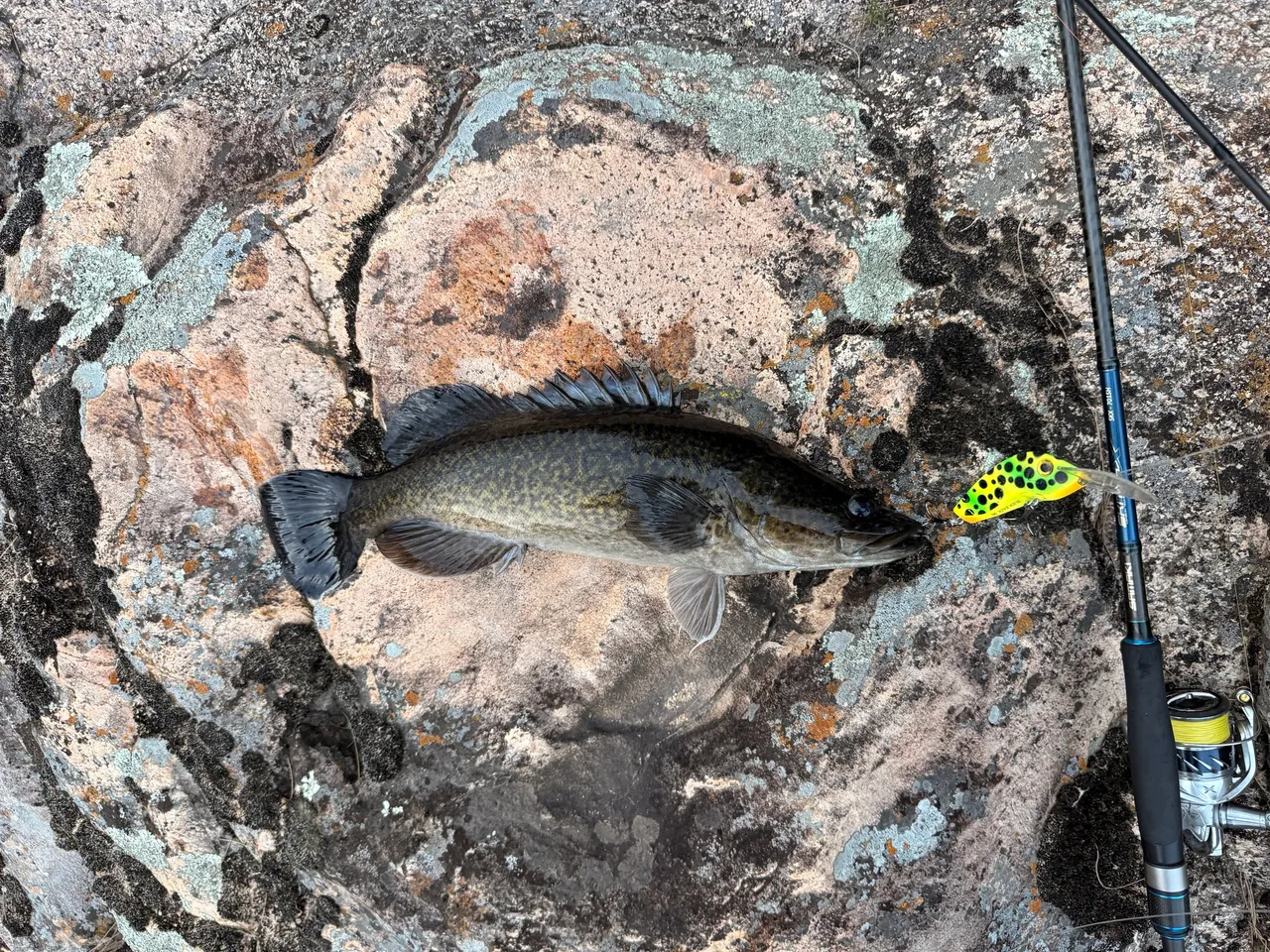
How this was identified, and who took it
Identified by: A heavy body with a broad flattened head and a large mouth whose lower jaw protrudes slightly, and mottling forming a FINE RETICULATED net over yellow-green rather than discrete blotches, which is the distinction the record specifically draws. A white belly, a long dorsal running from spines into soft rays, and a rounded pale-edged tail.James H — CC BY, via iNaturalist — source, licenceWhat is known about how it feeds
The Murray cod is Australia's largest freshwater fish and it eats essentially anything it can fit in its mouth, which at full size is a considerable range.
The adult diet is limited by gape and by very little else. Invertebrates, fish and frogs make up the bulk of it, and the recorded list extends to reptiles, waterbirds and small mammals taken from the surface. Juveniles start on zooplankton and work up as the mouth grows.
The verified relationship is freshwater crayfish, and yabbies are a principal item across the Murray-Darling system. That relationship also explains where the fish is: Murray cod are associated with snags — submerged timber — and so are yabbies, so the habitat association and the diet are the same fact.
The feeding method is ambush with suction, from and around that timber, and the fish is territorial about a particular snag over long periods.
What makes the species unusual on FishingHQ is longevity. Murray cod live for decades and grow slowly, so a large fish is very old and represents an accumulation that cannot be replaced within a human timescale. That is a diet fact in the sense that decades of eating produced it.
The species is listed as threatened, populations have declined substantially through habitat loss, river regulation and the removal of snags, and it is now supported by stocking across much of the range.
The food
Prey with a verified dietary link to this fish. Each entry carries its own evidence, and each is written at the precision the source actually used: a named species where the source named one, a group or food category where it said “polychaetes”, “crustaceans” or “detritus” and meant it. That is why this list is shorter than the animal’s real diet rather than longer.
- Freshwater crayfish as prey — a group rather than a species: the evidence names the group
Murray cod take yabbies and freshwater crayfish heavily alongside fish, and the species' association with snags is partly an association with crayfish habitat.
Food with no page of its own here yet
These are real components of the diet, listed as plain text because FishingHQ has no page for them yet. Inventing pages to make the list look fuller would be the fabrication this whole approach exists to prevent.
- bony bream and other native fish
- introduced carp
- frogs
- freshwater shrimp
- waterbirds and small mammals, recorded
- juvenile Murray cod (cannibalism)
What anglers do with this
Everything below is interpretation, not finding. It is what experienced anglers conclude from the biology above, and the reasoning is usually sound and almost never tested. It is separated from the biology deliberately.
The snag association is the location method and it follows from the diet rather than from a preference for cover as such: yabbies live in and around timber, and so does the fish that eats them.
The breadth of the diet is used to argue that offering type matters less than placement, which is practitioner reasoning from a documented opportunism.
The conservation and handling positions are not interpretation and they dominate the fishery. Murray cod are protected by closed seasons and slot limits in most jurisdictions, large fish are decades old, and the species is heavy enough that an unsupported lift causes internal damage. What applies is a question for the relevant authority.
What this does not establish
One group-level relationship for an extreme opportunist. The fish and vertebrate components are real and unrepresented, composition varies with river system and fish size, and many populations are stocked. Nothing here establishes proportions.
Where this connects
These are the baits, lures, methods and explainers FishingHQ already joins to this fish — which is why the list is sometimes short. They are not chosen for this page, and a link here means an evidenced relationship exists, not that it follows from the diet.
Lures recorded for this species
Where it lives
This page covers feeding. The Murray cod record covers identification, lifecycle, seasonal behaviour, handling and the sources behind all of it.
Reviewed 2026-08-12.