Golden perch
Fish · Last reviewed 2026-08-10
The Murray-Darling's other great native target — a flood-cued spawner that can travel a thousand kilometres and barely breeds at all in a regulated river.
Safety: venomous and spined species — can cause injury needing treatment. 5 more points apply here.
Barotrauma and pressure injury — Can cause injury needing treatment
Fish taken from deeper impoundment water suffer swim bladder expansion and cannot return to depth unaided.
What reduces it: Where release is intended, use a descending device or vent correctly, and consider fishing shallower water. Return fish promptly rather than after a period on deck.
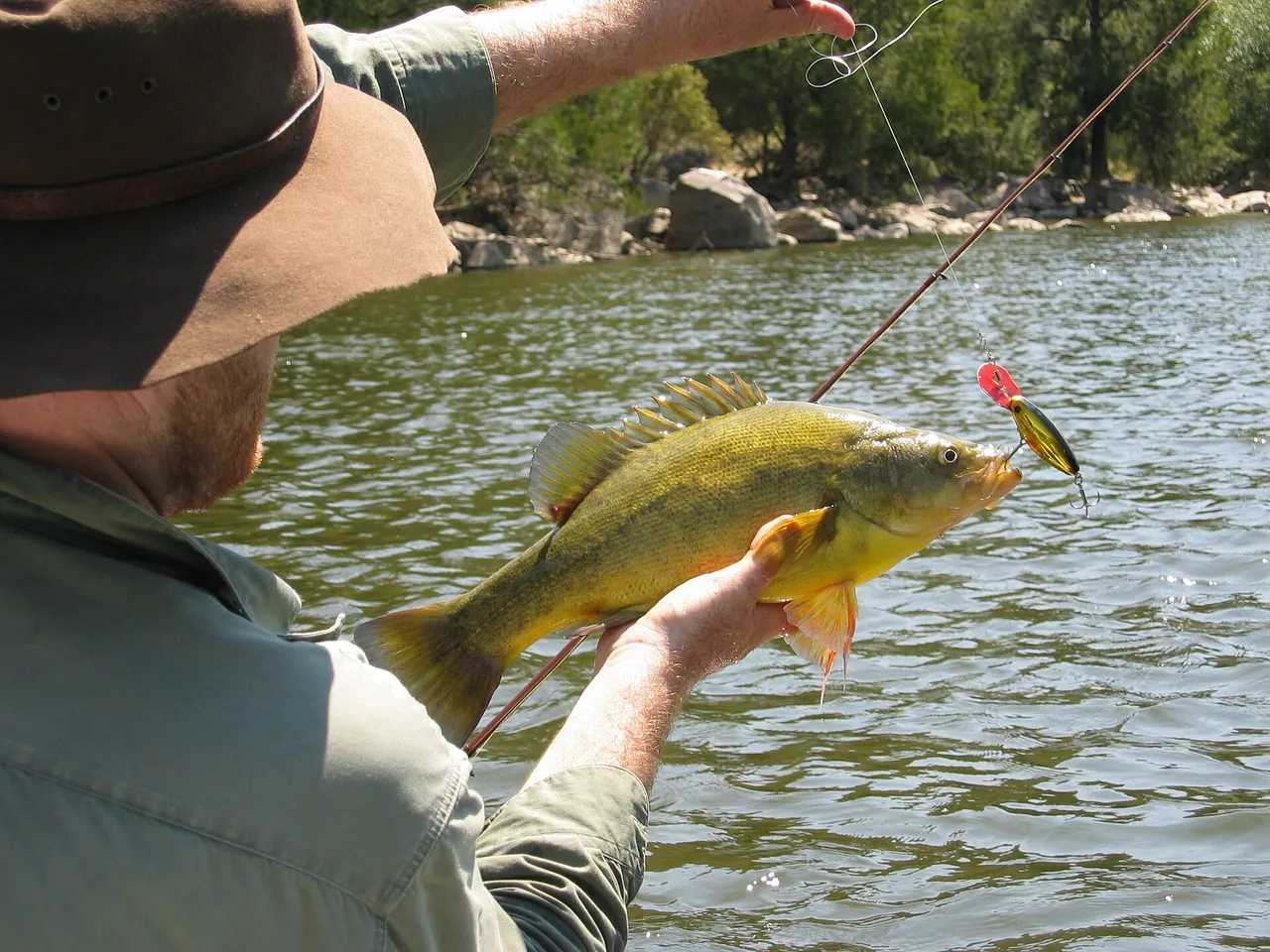
How this was identified, and who took it
Identified by: Full lateral view of a wild fish supported horizontally over water before release. The deep humped body with its concave forehead profile, the spiny dorsal, the golden-olive flank and the yellow lower fins are all clear. The caption notes Lernaea parasite spots, which are incidental to the identification.Codman at English Wikipedia — CC BY-SA 3.0, via Wikimedia Commons — source, licence
Catching Golden perch
Everything here on fishing for it. Each entry opens the page behind it.
- Ground
The golden perch is the Murray cod's companion species across inland Australia, and where the cod is a territorial ambusher that stays put, the golden perch is a traveller. Individuals have been recorded moving over a thousand kilometres within a river system, and that mobility is central to both its biology and its problems.
Its reproduction is cued by flooding. Golden perch spawn in response to rising water temperature combined with a flow event, releasing semi-buoyant eggs that drift and develop in the current, with larvae recruiting into floodplain habitat. In a naturally flowing river that works. In a river regulated for irrigation — which describes most of the Murray-Darling — the flow events either do not happen, happen at the wrong time, or are captured by weirs, and recruitment fails for years at a stretch. Many populations are consequently maintained by stocking.
As a target it is a compact, deep-bodied, hard-fighting fish that takes lures, bait and fly, and is far more willing than Murray cod. Its accessibility, its willingness and its presence in stocked impoundments make it the fish most inland Australian anglers actually catch, whatever the cod's reputation.
How it is caught
Identification
- Scientific name
- Macquaria ambigua
- Family
- Percichthyidae
- Water
- Freshwater, Brackish
- Conservation status
- Least Concern
- Regions
- Australia
- Deep, compressed, humped body with a distinctly concave forehead profile — the outline is the quickest identification.
- Golden-yellow to olive-bronze flanks, giving the common names golden perch and yellowbelly.
- A single dorsal fin notched between the spiny and soft portions; fins rounded.
- Small mouth for the body size, angled slightly upward.
- Separated from the similar and rarer Macquarie perch by the head profile, the body depth and the range.
Size
- Typical
- 0.5–1.5 kg (1–3.3 lb)
- Large
- 3–5 kg (6.6–11 lb)
Exceptional: Over 7 kg (15 lb); maximum published weight 23 kg
Turbid inland rivers, snags and warm slow water
Golden perch are fish of the turbid, warm, slow-moving inland rivers of the Murray-Darling system, and they are adapted to conditions most fish find difficult.
TURBIDITY IS NORMAL AND NOT A PROBLEM. These rivers are naturally silt-laden, and golden perch hunt by scent, sound and lateral line rather than by sight, so muddy water is habitat rather than a handicap.
SNAGS ARE THE STRUCTURE. Submerged timber — fallen river red gums in particular — is the defining habitat feature of these rivers, providing cover, flow break and feeding station. De-snagging of the rivers for navigation was one of the most damaging habitat interventions in the system's history and golden perch declined with it.
WARM WATER SUITS THEM, and they tolerate high temperatures and low oxygen better than most native species in the basin, which is part of why they persist where others have declined.
THEY USE BILLABONGS, ANABRANCHES AND FLOODPLAIN when water is high, and retreat to the channel and to deeper holes as it falls.
IMPOUNDMENTS HOLD THEM WELL AS ADULTS, and stocked reservoir populations are widespread — though as with several Australian natives, those populations rarely reproduce because the flow conditions spawning needs are absent.
AND THE SPECIES MOVES A LONG WAY. Golden perch undertake substantial migrations within the system, so habitat has to be considered at basin scale rather than reach scale.
Backed by research — why, and the sources (2)
Supported by peer-reviewed research or fisheries science. The sources are listed and can be checked.
- FishBase: a global information system on fishes — Froese, R. and D. Pauly, eds. — FishBase Consortium (Scientific institute)Relied on for: Distribution, habitat association, depth range, size, reproduction and life-history parameters recorded for the species.States this directlyPassage read and verified
- The IUCN Red List of Threatened Species — International Union for Conservation of Nature (Conservation authority)Relied on for: Assessment and range account for the species, including the habitats it depends on, its life history and the pressures acting on it.States this directlyCitation checked — the work exists and is described correctly
A flow-cued spawner in a river system that no longer floods naturally
Golden perch seasonality is dominated by a spawning requirement that river regulation has largely removed, and the resulting story is one of the clearest freshwater management cases on FishingHQ.
SPAWNING IS TRIGGERED BY RISING WATER AND WARMING, typically in spring and summer, and it requires a flow event rather than a date. Without a rise of sufficient size and duration at the right temperature, spawning may not occur at all in a given year.
EGGS ARE SEMI-BUOYANT AND DRIFT, requiring flowing water to remain suspended and to be carried downstream to nursery habitat. In a still pool they settle and die, which is why flow is not merely a cue but a physical requirement.
ADULTS MIGRATE LONG DISTANCES IN RESPONSE TO FLOW, and the movement is one of the better-documented freshwater fish migrations in Australia.
RIVER REGULATION HAS SUPPRESSED THE CUE AND THE TRANSPORT. Dams, weirs and extraction have reduced the frequency and altered the timing of the flow events golden perch depend on, and barriers block the migration. Environmental water releases designed to mimic natural rises are now used explicitly to trigger spawning, which is an unusual and instructive case of a season being managed rather than observed.
FEEDING ACTIVITY IS STRONGLY TEMPERATURE-DRIVEN, falling away sharply in cold water and rising through the warm months.
AND THE SOUTHERN HEMISPHERE TIMING PUTS THE ACTIVE SEASON ACROSS THE TURN OF THE CALENDAR YEAR.
Backed by research — why, and the sources (2)
Supported by peer-reviewed research or fisheries science. The sources are listed and can be checked.
- FishBase: a global information system on fishes — Froese, R. and D. Pauly, eds. — FishBase Consortium (Scientific institute)Relied on for: Distribution, habitat association, depth range, size, reproduction and life-history parameters recorded for the species.States this directlyPassage read and verified
- The IUCN Red List of Threatened Species — International Union for Conservation of Nature (Conservation authority)Relied on for: Assessment and range account for the species, including the habitats it depends on, its life history and the pressures acting on it.States this directlyCitation checked — the work exists and is described correctly
Spines, depth and a fish that is often caught in very warm water
Golden perch handling turns on the water they are usually caught in rather than on their equipment, though the equipment is worth knowing.
THE SPINES are a stiff spiny dorsal and sharp gill cover edges — ordinary percichthyid armament, handled with the hand sliding forward from the tail so the fin folds flat. Minor punctures, easily avoided.
THE HEAT IS THE ACTUAL PROBLEM. This is a fish of warm inland rivers and impoundments, frequently caught when the water is very warm and the air warmer. Warm water holds less oxygen, a fish that has fought hard needs more of it, and the margin between a fish that swims off and one that dies twenty minutes later is small and invisible. Air exposure in those conditions should be measured in seconds.
AND SOME ARE CAUGHT DEEP. In impoundments golden perch are taken from depths sufficient to produce swim bladder problems, and a fish that will not submerge is showing a pressure injury rather than exhaustion. Where deep fish are being released, recompression is the correct response and prolonged surface revival is not.
HOLDING. Support horizontally, wet hands, and lip-grip only with the body supported — this species has small abrasive teeth rather than cutting ones, so lipping is safe for the handler and hard on the fish if it takes the whole weight.
THE STOCKING CONTEXT MATTERS. Many golden perch fisheries are maintained by stocking, which makes it easy to treat individual fish as replaceable. The habitat and flow conditions that would let them breed naturally are the actual constraint, and neither is improved by killing fish carelessly.
What experienced anglers do — why, and the sources (2)
Widely and independently recommended by experienced anglers and specialist sources. This is real angling knowledge, not proof: controlled evidence for it is limited, and FishingHQ records it as convention rather than as a demonstrated effect.
- FishBase: a global information system on fishes — Froese, R. and D. Pauly, eds. — FishBase Consortium (Scientific institute)Relied on for: Dentition, fin and spine morphology, body form, air-breathing capability and distribution for the species, which are the anatomical facts the handling practice below follows from.States this directlyPassage read and verified
- General angling website restatements of established technique — Various (Credible secondary source)Relied on for: Widely restated angling practice for handling this species, recorded as practitioner consensus rather than as tested fact.Background and mechanism onlyCitation checked — the work exists and is described correctly
Flow-cued spawning in a river that no longer floods on schedule
Golden perch reproduction is tied to a hydrological event rather than to a date, and the alteration of that event is the central conservation problem for the species.
SPAWNING IS CUED BY A RISE IN RIVER LEVEL. Golden perch spawn in response to increased flow in the warmer months, typically associated with a spring or summer flood pulse in the Murray–Darling system. Rising water together with adequate temperature is the trigger; temperature alone is not enough, and a warm year without a rise can produce very little spawning at all.
THE EGGS ARE SEMI-BUOYANT AND MUST DRIFT, which is the second half of the requirement and the more demanding one. Eggs and larvae are carried downstream in the current for a period before the young settle, and that requires sustained flow over a considerable distance. A river that rises briefly and falls back does not complete it.
SO THE SPECIES NEEDS A FLOW REGIME RATHER THAN A PLACE, and river regulation is what removes it. Storage dams flatten the hydrograph, capture the spring rise, and deliver water on an irrigation schedule that bears no relation to the natural pattern — which suppresses both the cue and the drift. Environmental flow releases in these systems are designed partly to reinstate that trigger deliberately.
ADULTS MIGRATE SUBSTANTIALLY TO SPAWN, moving long distances upstream on rising water, which means weirs and barriers fragment the process even where flows are adequate. Fishways on these systems exist largely because of species like this one.
RECRUITMENT IS CONSEQUENTLY EPISODIC RATHER THAN ANNUAL. Golden perch populations are dominated by strong year classes produced in the years when flow, temperature and connectivity coincided, and long gaps between them are normal in a regulated river.
ADULTS ARE LONG-LIVED, which is what allows a population to persist through those gaps — and it is also why a population can look stable for many years while recruiting almost nothing.
AND CLOSED SEASONS, SIZE AND SLOT LIMITS ARE SET BY STATE AUTHORITIES, differ between jurisdictions, and are not derivable from the biology.
Backed by research — why, and the sources (2)
Supported by peer-reviewed research or fisheries science. The sources are listed and can be checked.
- Freshwater Fishes of the British Isles — HarperCollins (New Naturalist 75), 1992 (Reference work)Relied on for: Habitat association, spawning behaviour, seasonal activity and ecology of freshwater fishes, including position within a water body.States this directlyCitation checked — the work exists and is described correctly
- FishBase: a global information system on fishes — Froese, R. and D. Pauly, eds. — FishBase Consortium (Scientific institute)Relied on for: Habitat association, spawning season, temperature tolerance and water-type tolerance recorded for the species.States this directlyPassage read and verified
Lifecycle and reproduction
Long-lived, with individuals recorded over twenty-five years, and highly mobile — movements of more than a thousand kilometres within a river system have been recorded. Spawning is cued by a combination of rising water temperature and a flow event, and produces semi-buoyant eggs that must drift in current to develop. Where flow is regulated, recruitment fails, and many populations persist only through stocking.
Flood-cued broadcast spawning in late spring and summer, requiring both warm water and a rise in flow. Semi-buoyant eggs drift and hatch in the current, with larvae recruiting into floodplain and slackwater habitat. River regulation removes or mistimes the flow cues, which is why natural recruitment in the Murray-Darling is episodic and why environmental flow releases are used specifically to trigger it.
Feeding and senses
Takes shrimp, yabbies and other crustaceans, aquatic insects and small fish, feeding actively rather than by pure ambush. The crustacean component is the practically useful part: yabby and shrimp imitations, and baits based on them, are traditional and effective, and the fish is far more willing to chase a lure than Murray cod is.
Adapted to the turbid water characteristic of inland Australian rivers, relying substantially on the lateral line and on vibration rather than sight. This is why lures with strong actions, spinnerbaits and vibrating blades are conventional for the species, and why golden perch remain catchable in water where visibility is measured in centimetres.
Through the year
Activity rises with water temperature through the southern-hemisphere spring and summer and falls sharply in cold water. Flow events trigger both movement and spawning at any point in the warm season. In stocked impoundments, where no flow cue exists, the fish still feed seasonally but do not reproduce — which is why those fisheries depend entirely on continued stocking.
Distribution
Endemic to Australia, native to the Murray-Darling basin and to the Lake Eyre and Bulloo-Bancannia drainages, and widely stocked into impoundments within and beyond that range. Occupies turbid slow rivers, billabongs and impoundments.
This is a biological range — where the species occurs, not a prediction that you will catch one. To browse the fishing geography FishingHQ holds, start at fishing places.
Why anglers care
One of the two principal native freshwater sport fish of inland Australia alongside Murray cod, and the more accessible of the pair. Taken on lures, spinnerbaits, bait and fly from banks, boats and kayaks, and a mainstay of stocked impoundment fisheries. Subject to size and bag limits and, in places, closed seasons.
Handling and returning
Sharp dorsal spines and firm gill covers. Wet hands, support the body horizontally, and use a knotless net. Fish taken from deeper impoundment water can suffer barotrauma, and where release is intended a descending device or careful venting may be needed. Given that many populations do not reproduce naturally, released fish are a larger share of the fishery's future than they would be elsewhere.
Going further
- What does golden perch eat? — feeding biology, kept separate from what anglers infer from it.
Safety
Barotrauma and pressure injury is set out at the top of this page, where it cannot be missed.
Venomous and spined species — Can cause injury needing treatment
Sharp dorsal spines and firm gill covers on a deep-bodied fish that is awkward to grip.
What reduces it: Wet hands, support the body from beneath, keep fingers clear of the gill plates, and use a knotless net and pliers.
Precautions that always apply here
- Handle spined and venomous species with the spines controlled. Know which local species have them before you fish, not afterwards.
- Wet your hands before touching a fish. Dry hands strip the protective mucus layer that keeps infection out.
- Support the fish's weight along its body, keep it out of the water for as short a time as possible, and hold it over something soft.
- Wear a buoyancy aid or lifejacket. Cold water incapacitates strong swimmers within a minute, long before swimming ability matters.
Check the rules before you fish
Fishing laws, bylaws, access rules, seasons, bait restrictions and permitted methods vary by location and can change. Check the current rules from the relevant authority and the water you intend to fish before fishing.
Check with:
- Current national or regional law for where you are fishing
- Current local bylaws
- The relevant fisheries authority
- The landowner, club or fishery whose water it is
- Any restrictions specific to the species or the method you intend to use
Where to go next
Where it lives
Understanding this fish
Told apart from
More fish
Not related to this page — just the rest of the section. There is little else joined to this subject yet, and a short page should still lead somewhere.
Sources and evidence
- FishBase: a global information system on fishes — Froese, R. and D. Pauly, eds. — FishBase Consortium (Scientific institute)Relied on for: Scientific name, family placement in the Percichthyidae, a maximum length of 76.0 cm SL, a maximum published weight of 24.0 kg, a maximum reported age of 20 years.States this directlyPassage read and verified
- FishBase: a global information system on fishes — Froese, R. and D. Pauly, eds. — FishBase Consortium (Scientific institute)Relied on for: Environment, climate zone and depth range as recorded: Freshwater; demersal; potamodromous ; depth range 10 - ? m . Temperate; 10°C - 30°C ; 19°S - 38°SStates this directlyPassage read and verified
- FishBase: a global information system on fishes — Froese, R. and D. Pauly, eds. — FishBase Consortium (Scientific institute)Relied on for: The IUCN Red List category for Macquaria ambigua — Least Concern, assessed 14 February 2019 — as republished by FishBase, the Red List itself being unreachable during review.States this directlyPassage read and verified
- Understanding the Complexity of Catch-and-Release in Recreational Fishing — Reviews in Fisheries Science 15:75–167, 2007 (Scientific literature)Relied on for: That barotrauma and handling materially affect the survival of released fish.FishingHQ's interpretation of what it saysCitation checked — the work exists and is described correctly
Why the 6 connections on this page are here, and the sources
How it is caught
What experienced anglers do — 2 connections
Widely and independently recommended by experienced anglers and specialist sources. This is real angling knowledge, not proof: controlled evidence for it is limited, and FishingHQ records it as convention rather than as a demonstrated effect.
Spinning
Established angling practice for this species, recorded as convention. The note states the property of the animal or its water that makes the method the answer.
- IGFA International Angling Rules and World Record Requirements — International Game Fish Association (Angling or fisheries organisation)Relied on for: Recognition of the species as an established sport fish and the angling methods and tackle classes conventionally used for it.States this directlyPassage read and verified
- General angling website restatements of established technique — Various (Credible secondary source)Relied on for: Widely restated practice connecting this species and method.Background and mechanism onlyCitation checked — the work exists and is described correctly
Trolling
Established angling practice for this species, recorded as convention. The note states the property of the animal or its water that makes the method the answer.
- IGFA International Angling Rules and World Record Requirements — International Game Fish Association (Angling or fisheries organisation)Relied on for: Recognition of the species as an established sport fish and the angling methods and tackle classes conventionally used for it.States this directlyPassage read and verified
- General angling website restatements of established technique — Various (Credible secondary source)Relied on for: Widely restated practice connecting this species and method.Background and mechanism onlyCitation checked — the work exists and is described correctly
Gear for this fish
What experienced anglers do — 1 connection
Widely and independently recommended by experienced anglers and specialist sources. This is real angling knowledge, not proof: controlled evidence for it is limited, and FishingHQ records it as convention rather than as a demonstrated effect.
Spinnerbaits and bladed jigs
A practitioner claim about which lure family answers this species' feeding or holding behaviour.
- IGFA International Angling Rules and World Record Requirements — International Game Fish Association (Angling or fisheries organisation)Relied on for: Recognition of the species as an established sport fish taken on artificial lures, and the line and tackle classes used for it.States this directlyPassage read and verified
- General angling website restatements of established technique — Various (Credible secondary source)Relied on for: Widely restated lure practice for this species.Background and mechanism onlyCitation checked — the work exists and is described correctly
Where it lives
Backed by research — 1 connection
Supported by peer-reviewed research or fisheries science. The sources are listed and can be checked.
Lowland rivers
A habitat and reproductive claim held to a scientific standard, and the basis of the environmental-flow argument.
- FishBase: a global information system on fishes — Froese, R. and D. Pauly, eds. — FishBase Consortium (Scientific institute)Relied on for: That Macquaria ambigua is a freshwater species of the Murray-Darling, Lake Eyre and Bulloo-Bancannia drainages in turbid slow rivers and impoundments.States this directlyPassage read and verified
Understanding this fish
Backed by research — 1 connection
Supported by peer-reviewed research or fisheries science. The sources are listed and can be checked.
Freshwater crayfish as prey
Recorded diet evidence identifies freshwater crayfish as a food item of this predator at group level rather than to species. The edge points at the taxon record for that reason, and encoding it as a species-level claim would assert something the source does not.
- FishBase: a global information system on fishes — Froese, R. and D. Pauly, eds. — FishBase Consortium (Scientific institute)Relied on for: Food items recorded for this predator, given as freshwater crayfish.States this directlyPassage read and verified
- FAO Species Identification Guides for Fishery Purposes and the FAO Species Catalogues — Food and Agriculture Organization of the United Nations (Scientific institute)Relied on for: Species account describing this predator's diet, recorded at the level of freshwater crayfish.Background and mechanism onlyCitation checked — the work exists and is described correctly
Told apart from
Backed by research — 1 connection
Supported by peer-reviewed research or fisheries science. The sources are listed and can be checked.
Murray cod
A comparison resting on documented differences in movement and reproduction, naming both binomials.
- FishBase: a global information system on fishes — Froese, R. and D. Pauly, eds. — FishBase Consortium (Scientific institute)Relied on for: That Maccullochella peelii is a territorial structure-associated species of the Murray-Darling while Macquaria ambigua of the same system is highly mobile.States this directlyPassage read and verified
How FishingHQ labels evidence is explained in the evidence policy.