How to identify golden perch
Macquaria ambigua · Percichthyidae
The characters that identify golden perch, ranked by how far each one can be trusted on its own.
Safety: venomous and spined species — can cause injury needing treatment. One more point applies here.
How this was identified, and who took it
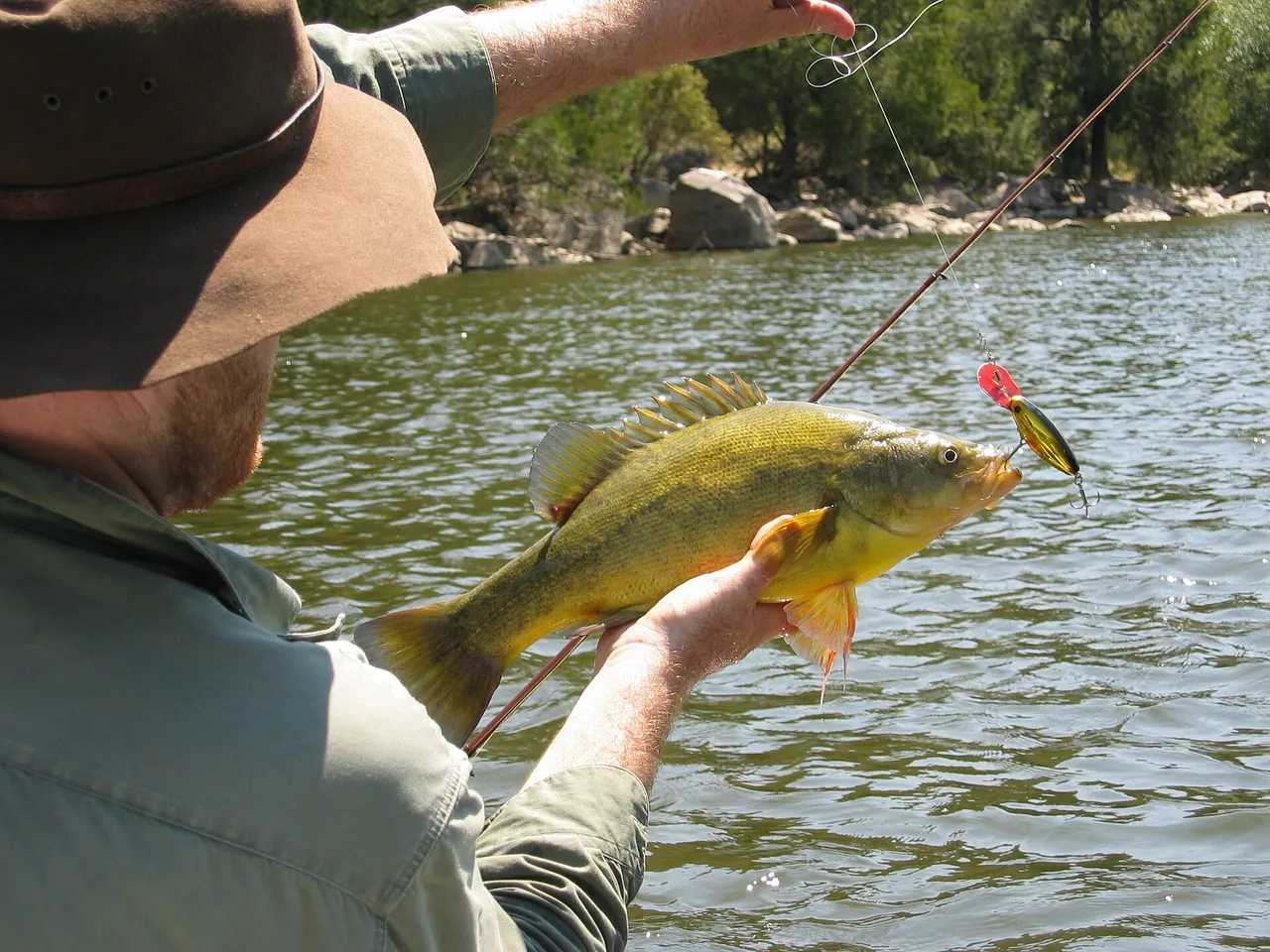
Identified by: Full lateral view of a wild fish supported horizontally over water before release. The deep humped body with its concave forehead profile, the spiny dorsal, the golden-olive flank and the yellow lower fins are all clear. The caption notes Lernaea parasite spots, which are incidental to the identification.Codman at English Wikipedia — CC BY-SA 3.0, via Wikimedia Commons — source, licenceLook at this first
The outline names it. A deep humped body with the forehead scooped inward above the eye, and a small upward-angled mouth on the front of it — a shape no other native fish in the Murray-Darling shares.
Diagnostic — settles it on its own
Each of these settles the identification on its own. If one is clear, you have your answer.
A concave forehead over a deep humped body
The profile dips above the eye then rises steeply to the dorsal origin, giving a distinctly humped silhouette. It is the fastest identification available and it holds regardless of the water the fish came from.
Supporting — use with other characters
Real characters that are not conclusive by themselves. Use two or three together.
A small mouth angled upward
Notably small for the body size and tilted up, quite unlike the large horizontal mouth of a Murray cod of comparable weight. Combined with the head profile it settles the identification.
One dorsal fin, notched, with rounded fins behind
A single dorsal divided by a shallow notch between spiny and soft portions, with rounded anal and tail fins. It separates golden perch from the introduced redfin, whose dorsals are more clearly divided.
Where the fish came from
Native to the Murray-Darling and to the Lake Eyre and Bulloo-Bancannia systems, and stocked into impoundments well beyond that. Range narrows the field considerably in a continent with a small native freshwater fauna.
Suggestive only — varies with condition
Hints only. These vary with condition, season, water and how long the fish has been out of it, and a fish that contradicts them is still the same species.
Golden-olive flanks
The colour behind both common names, and it shifts with turbidity — fish from clear impoundments are noticeably different from fish out of a muddy river. Pleasant, and not evidence.
What it gets confused with
- Macquarie perch, which is rarer, more elongate and lacks the strongly concave forehead.
- Silver perch in the same rivers, which has a much smaller head and a more pointed snout.
- Redfin perch, an introduced species with two clearly separate dorsal fins and bold vertical barring.
Where this stops working
Macquarie perch is the identification that matters, because it is threatened and protected across much of its remaining range while golden perch is not — a misidentification there has a consequence beyond the individual fish. Many golden perch populations do not reproduce naturally and are maintained by stocking, so a fish in an impoundment says little about what the system holds naturally.
The full record
This page covers identification only. The Golden perch record covers behaviour, lifecycle, distribution, handling and the sources behind all of it.
Reviewed 2026-08-14.
More about this fish
Telling it apart is one question. Here are the others.
How it is caught
Where it lives
Why the 3 connections on this page are here, and the sources
How it is caught
What experienced anglers do — 2 connections
Widely and independently recommended by experienced anglers and specialist sources. This is real angling knowledge, not proof: controlled evidence for it is limited, and FishingHQ records it as convention rather than as a demonstrated effect.
Spinning
Established angling practice for this species, recorded as convention. The note states the property of the animal or its water that makes the method the answer.
- IGFA International Angling Rules and World Record Requirements — International Game Fish Association (Angling or fisheries organisation)Relied on for: Recognition of the species as an established sport fish and the angling methods and tackle classes conventionally used for it.States this directlyPassage read and verified
- General angling website restatements of established technique — Various (Credible secondary source)Relied on for: Widely restated practice connecting this species and method.Background and mechanism onlyCitation checked — the work exists and is described correctly
Trolling
Established angling practice for this species, recorded as convention. The note states the property of the animal or its water that makes the method the answer.
- IGFA International Angling Rules and World Record Requirements — International Game Fish Association (Angling or fisheries organisation)Relied on for: Recognition of the species as an established sport fish and the angling methods and tackle classes conventionally used for it.States this directlyPassage read and verified
- General angling website restatements of established technique — Various (Credible secondary source)Relied on for: Widely restated practice connecting this species and method.Background and mechanism onlyCitation checked — the work exists and is described correctly
Where it lives
Backed by research — 1 connection
Supported by peer-reviewed research or fisheries science. The sources are listed and can be checked.
Lowland rivers
A habitat and reproductive claim held to a scientific standard, and the basis of the environmental-flow argument.
- FishBase: a global information system on fishes — Froese, R. and D. Pauly, eds. — FishBase Consortium (Scientific institute)Relied on for: That Macquaria ambigua is a freshwater species of the Murray-Darling, Lake Eyre and Bulloo-Bancannia drainages in turbid slow rivers and impoundments.States this directlyPassage read and verified
Safety
Barotrauma and pressure injury is set out at the top of this page, where it cannot be missed.
Venomous and spined species — Can cause injury needing treatment
Sharp dorsal spines and firm gill covers on a deep-bodied fish that is awkward to grip.
What reduces it: Wet hands, support the body from beneath, keep fingers clear of the gill plates, and use a knotless net and pliers.