What does golden perch eat?
What is established about how golden perch feeds, kept separate from what anglers infer from it.
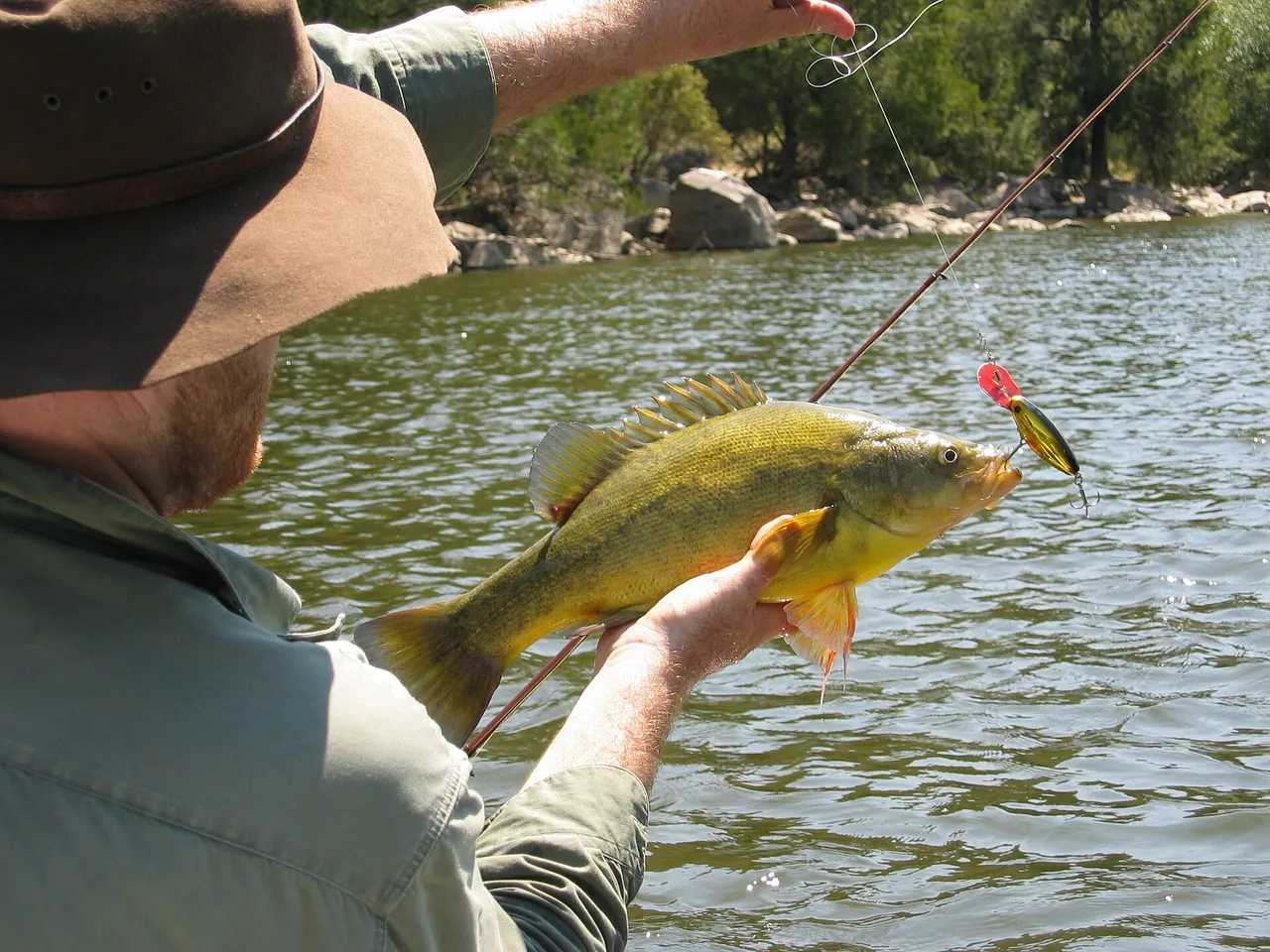
How this was identified, and who took it
Identified by: Full lateral view of a wild fish supported horizontally over water before release. The deep humped body with its concave forehead profile, the spiny dorsal, the golden-olive flank and the yellow lower fins are all clear. The caption notes Lernaea parasite spots, which are incidental to the identification.Codman at English Wikipedia — CC BY-SA 3.0, via Wikimedia Commons — source, licenceWhat is known about how it feeds
The golden perch is an active feeder rather than a pure ambusher, which separates it from the Murray cod it shares water with.
The fish moves and searches, taking shrimp, yabbies and other crustaceans, aquatic insects and small fish. The verified relationship is freshwater crayfish, which is the principal item by weight across the Murray-Darling system.
What distinguishes the species biologically is the migration. Golden perch undertake long upstream movements — hundreds of kilometres are recorded — cued by rising water and rising temperature, and spawning depends on a flow event rather than on a date. In a regulated river where those flow pulses have been removed, the fish may not spawn at all, and populations are maintained by stocking.
So this is a species whose reproduction is triggered by the same hydrological event that reorganises its food supply, and the two are connected: a flow pulse mobilises invertebrates and moves the whole system.
Feeding is strongly temperature-linked and largely diurnal, in contrast with the nocturnal habit of the cod.
The species tolerates turbid, warm and low-oxygen water better than most, which is why it persists in parts of the system where other native fish have not.
The food
Prey with a verified dietary link to this fish. Each entry carries its own evidence, and each is written at the precision the source actually used: a named species where the source named one, a group or food category where it said “polychaetes”, “crustaceans” or “detritus” and meant it. That is why this list is shorter than the animal’s real diet rather than longer.
- Freshwater crayfish as prey — a group rather than a species: the evidence names the group
Yabbies and other freshwater crayfish are a principal item in the golden perch diet across the Murray-Darling system.
Food with no page of its own here yet
These are real components of the diet, listed as plain text because FishingHQ has no page for them yet. Inventing pages to make the list look fuller would be the fabrication this whole approach exists to prevent.
- freshwater shrimp
- aquatic insect larvae
- small native fish
- molluscs
What anglers do with this
Everything below is interpretation, not finding. It is what experienced anglers conclude from the biology above, and the reasoning is usually sound and almost never tested. It is separated from the biology deliberately.
The active searching habit converts into an approach that covers water rather than working a single piece of structure, which is how anglers distinguish the fishery from Murray cod fishing on the same river.
The crustacean emphasis underlies the use of yabby and shrimp imitations, and the reasoning from diet to imitation is explicit in the practitioner literature.
The flow-triggered migration is used to explain seasonal movements and concentrations, and it rests on documented behaviour rather than on convention.
Many impoundment populations are stocked rather than self-sustaining, which is worth knowing before drawing conclusions about a water's productivity.
What this does not establish
One group-level relationship for a broader diet including insects and fish. Composition varies between riverine and impoundment populations, and many of the latter are stocked. Nothing here establishes proportions.
Where this connects
These are the baits, lures, methods and explainers FishingHQ already joins to this fish — which is why the list is sometimes short. They are not chosen for this page, and a link here means an evidenced relationship exists, not that it follows from the diet.
Lures recorded for this species
Where it lives
This page covers feeding. The Golden perch record covers identification, lifecycle, seasonal behaviour, handling and the sources behind all of it.
Reviewed 2026-08-12.