Muskellunge
Fish · Last reviewed 2026-08-10
North America's largest pike and the fish that gave rise to the phrase "the fish of ten thousand casts" — a solitary ambush predator with a well-earned reputation for refusal.
Safety: species that bite — can cause serious injury or death. 5 more points apply here.
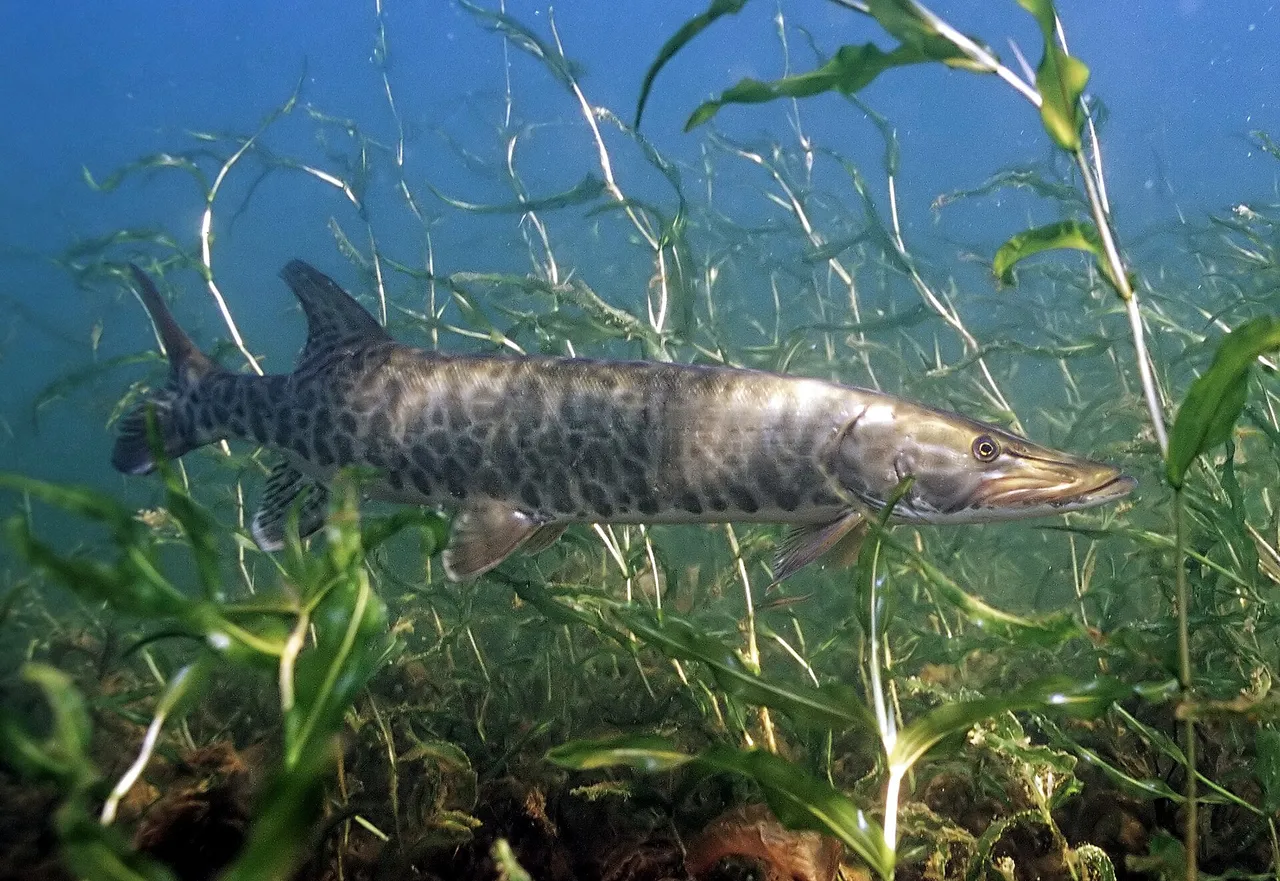
How this was identified, and who took it
Identified by: Full lateral view in weed. The pattern is the point: dark vertical bars and spots on a PALE ground, the inverse of a pike's pale spots on a dark ground, which is the character that separates the two congeners in one look.Engbretson, Eric / U.S. Fish and Wildlife Service — Public domain, via Wikimedia Commons — source, licence
Catching Muskellunge
Everything here on fishing for it. Each entry opens the page behind it.
The muskellunge is the largest member of the pike family and one of the most single-minded sport fisheries in fresh water. It reaches over 180 centimetres and thirty kilograms, it lives alone in clear vegetated lakes and large rivers, and it refuses lures with a consistency that has produced an entire subculture built around persistence.
The reputation is not folklore. Muskellunge occur at genuinely low densities compared with pike — a large lake may hold very few adults — and they are notorious for following a lure to the boat and turning away without taking, which is where the figure-of-eight retrieve at boatside comes from. A day without a fish is normal and expected, and the fishery's culture is organised around that rather than around catch rates.
It is separated from the northern pike, with which it shares water across much of its range, by the markings and by the cheek and gill-cover scaling: pike have pale marks on a dark ground, muskellunge have dark marks on a pale ground, and the muskellunge's cheek and gill cover are only partly scaled. Hybrids between the two — tiger muskellunge — occur naturally and are intermediate.
Almost the entire modern fishery is catch-and-release, and the handling of a very large, very toothy fish at boatside is a genuine skill that the fishery takes seriously.
How it is caught
- SpinningA low-density apex predator in large water is found by covering it, and casting large lures across structure at speed is the whole search strategy of the fishery.
- TrollingTrolling covers open-water and deep-structure fish that a casting angler never reaches, and it is how the largest fish are disproportionately taken.
Gear for this fish
- Spinnerbaits and bladed jigsThe large bucktail is the searching lure of muskellunge fishing, and its function is to cover enormous amounts of water at speed — which is what a fishery for a low-density apex predator requires.
- Surface luresLarge surface baits work on muskellunge in warm water and low light, and the follow-without-taking that characterises the species is most visible and most workable on the surface.
- SwimbaitsA fish that attacks prey up to a third of its own length is a fish that will take a lure the size of a small pike, which is why muskellunge swimbaits look absurd and work.
Identification
- Scientific name
- Esox masquinongy
- Family
- Esocidae
- Water
- Freshwater
- Conservation status
- Least Concern
- Regions
- North America
- DARK markings — bars, spots or none at all — on a PALE ground. Northern pike show the opposite: pale bean-shaped marks on a dark ground.
- Cheek and gill cover scaled only on the upper half; a northern pike's cheek is fully scaled and its gill cover half scaled.
- Six to nine sensory pores on the underside of each side of the lower jaw; pike have five or fewer.
- Body very elongate with dorsal and anal fins set far back near the tail, as in all Esox.
- Tail lobes more pointed than a pike's. Colour and pattern vary enormously and are not reliable alone.
Size
- Typical
- 4–8 kg (9–18 lb)
- Large
- 11–16 kg (24–35 lb)
Exceptional: Over 20 kg (44 lb); maximum published weight 31.8 kg
The largest handling problem in freshwater, and why it takes two people
A muskellunge combines everything that makes a fish difficult to handle: length, mass, a mouthful of long canines, hard bony gill rakers, and — the part that catches people out — a strong likelihood of being caught on large lures carrying two or three heavy trebles.
THE INJURY THAT DEFINES THIS FISHERY is not the bite. It is a treble hook driven into a hand while a large fish thrashes, frequently with the other treble still in the fish, so that the angler and the fish are hooked together. That is a genuine emergency on a boat and it is the reason muskie anglers carry heavy-duty split-ring pliers and hook cutters as standard rather than as a precaution.
SO THE EQUIPMENT IS THE TECHNIQUE. A large cradle or a wide, deep, knotless net that the fish stays in and in the water. Long-nosed pliers. Jaw spreaders used gently. Bolt cutters capable of going through a heavy treble shank, within reach, not in a bag. Two people: one controlling the fish, one working on the hooks.
THE FISH'S SIDE OF IT. Muskellunge are a low-density, slow-growing, heavily released fishery, and the population cannot absorb release mortality. Keep the fish in the water in the net while the hooks come out. Support the body horizontally if it is lifted at all, and lift for seconds rather than for a composition. In warm summer water the species is genuinely vulnerable to delayed mortality after a long fight, and the responsible answer on a hot day is to fish elsewhere or fish deeper cooler water.
AND THE GILL RAKERS, not the teeth, are what open a hand during the unhooking. Fingers do not go under the gill cover on this fish.
What experienced anglers do — why, and the sources (2)
Widely and independently recommended by experienced anglers and specialist sources. This is real angling knowledge, not proof: controlled evidence for it is limited, and FishingHQ records it as convention rather than as a demonstrated effect.
- FishBase: a global information system on fishes — Froese, R. and D. Pauly, eds. — FishBase Consortium (Scientific institute)Relied on for: Dentition, fin and spine morphology, body form, air-breathing capability and distribution for the species, which are the anatomical facts the handling practice below follows from.States this directlyPassage read and verified
- General angling website restatements of established technique — Various (Credible secondary source)Relied on for: Widely restated angling practice for handling this species, recorded as practitioner consensus rather than as tested fact.Background and mechanism onlyCitation checked — the work exists and is described correctly
Spawning after the pike, and the recruitment failure that follows
Muskellunge reproduction is best understood by comparison with the pike they frequently share water with, because the difference of a few weeks has consequences that run through entire populations.
THE STRATEGY IS THE SAME IN OUTLINE. Broadcast spawning over vegetation in shallow bays in spring, shortly after ice-out, with adhesive eggs scattered and abandoned and no parental care whatsoever.
THE TIMING IS THE PROBLEM. Where northern pike share the water, they spawn EARLIER — and by the mechanism described on the pike record, pike fry are piscivorous by the time muskellunge fry hatch. The result is that muskellunge fry emerge into water already containing a slightly larger, already fish-eating predator of a closely related species. Pike predation on muskellunge fry is one of the factors implicated in muskellunge recruitment failure in mixed populations, and it is a substantial part of why muskellunge waters are frequently managed to limit pike.
THIS COMPOUNDS AN ALREADY MARGINAL POSITION. Muskellunge are naturally low-density apex predators — a healthy population is a small number of large fish over a large area — with slow growth and late maturity. A species with those traits has very little recruitment to spare, and losing a large share of each year class to a competitor is not something the population absorbs easily. It is also why muskellunge fisheries have moved so comprehensively to catch-and-release: the adults cannot be replaced quickly.
HYBRIDISATION IS THE OTHER CONSEQUENCE OF SHARING WATER. Pike and muskellunge interbreed naturally where both occur, producing tiger muskellunge, which are generally sterile. A sterile hybrid represents the reproductive output of both parents converted into nothing, and where hybridisation rates are high that is a further drain on an already thin recruitment.
THE SPAWNING HABITAT REQUIREMENT — shallow, vegetated, protected bays — is the same one that shoreline development, dredging and weed removal eliminate, and it is not replaced by deeper water however much of it there is.
Backed by research — why, and the sources (4)
Supported by peer-reviewed research or fisheries science. The sources are listed and can be checked.
- FishBase: a global information system on fishes — Froese, R. and D. Pauly, eds. — FishBase Consortium (Scientific institute)Relied on for: Reproductive mode, spawning season, fecundity, parental care, sex-change pattern and larval development recorded for the species.States this directlyPassage read and verified
- The IUCN Red List of Threatened Species — International Union for Conservation of Nature (Conservation authority)Relied on for: Assessment, population trend, and the life-history traits — age at maturity, longevity, reproductive strategy — that determine sensitivity to exploitation.States this directlyCitation checked — the work exists and is described correctly
- Pike: Biology and Exploitation — Chapman & Hall (Fish and Fisheries Series 19), 1996 (Scientific literature)Relied on for: Pike reproductive biology, spawning habitat and timing, egg deposition, and the consequences of early spawning for fry survival.States this directlyCitation checked — the work exists and is described correctly
- A short review of pike ecology — Hydrobiologia 601:5–16, Springer, 2008 (Scientific literature)Relied on for: Review of pike ecology including reproduction and recruitment.States this directlyPassage read and verified
A cool-water predator with a summer problem and an autumn peak
Muskellunge seasonality is dominated by temperature acting on a very large, low-density predator, and the autumn peak everybody associates with the species has a specific physiological reason behind it.
SPRING IS SPAWNING AND IT IS EARLY. Muskellunge spawn in shallow, vegetated bays and marshy margins soon after ice-out, in cool water, scattering eggs over vegetation with no parental care. Post-spawn fish are in poor condition and feed reluctantly for a period, which is why early-season musky fishing is frequently slow despite the fish being shallow and visible.
SUMMER IS A THERMAL PROBLEM RATHER THAN A FEEDING ONE. Muskellunge are cool-water fish, and a big-bodied predator in warm water has a high absolute oxygen demand and a poor capacity to shed heat. In midsummer they relate to cooler water — deeper basins, thermocline depth, spring inflows, shaded structure — and feed in shorter windows. High summer water temperature is also when released fish are at greatest risk, and it is the reason many musky fisheries and clubs advise against fishing at all above certain water temperatures. That is a welfare consideration and it is not a legal statement.
AUTUMN IS THE PEAK AND THE MECHANISM IS PRE-WINTER FEEDING. As water cools through autumn, muskellunge feed heavily to build reserves before winter, and they do so on progressively larger prey. Cooling water also removes the thermal constraint, so the fish can operate hard for longer. That combination — high motivation, high capability, and large prey preference — is why the late season produces both the most action and the largest fish, and why the biggest baits work then.
WINTER SLOWS THEM WITHOUT STOPPING THEM. Muskellunge remain active at low temperature and are taken through the ice in some waters, holding deep and near remaining structure.
DENSITY MAKES ALL OF THIS FEEL SHARPER THAN IT IS. This is a fish of very low natural density, so seasonal changes in activity translate into large swings in encounter rate, and a poor period feels like an absence.
AND CLOSED SEASONS FOR THIS SPECIES ARE COMMON AND VARIABLE. Many jurisdictions operate closed seasons, minimum sizes and specific measures for muskellunge, and they are set for management reasons that do not necessarily track the spawning period. The competent authority is the only source for them.
Backed by research — why, and the sources (2)
Supported by peer-reviewed research or fisheries science. The sources are listed and can be checked.
- Freshwater Fishes of the British Isles — HarperCollins (New Naturalist 75), 1992 (Reference work)Relied on for: Seasonal behaviour, spawning period and temperature-driven activity of freshwater fishes.Background and mechanism onlyCitation checked — the work exists and is described correctly
- FishBase: a global information system on fishes — Froese, R. and D. Pauly, eds. — FishBase Consortium (Scientific institute)Relied on for: Spawning season, temperature preference and seasonal behaviour for the species.States this directlyPassage read and verified
Very large lures for a fish that eats large prey, and the figure-eight that ends the cast
Muskellunge lure fishing has two features that distinguish it from everything else in fresh water, and both follow from the same fact: this is a large predator that eats large prey and inspects before committing.
THE LURES ARE GENUINELY LARGE AND IT IS BIOLOGY RATHER THAN BRAVADO. Muskellunge routinely take prey items that are a substantial fraction of their own length, and a large fish shows a clear preference for large meals — the energetics favour one big prey item over several small ones. So lures that would be absurd for any other freshwater species are correctly sized here, and the tackle exists to cast them repeatedly.
THE SECOND FEATURE IS THE FOLLOW, AND THE FIGURE-EIGHT THAT ANSWERS IT. Muskellunge very frequently follow a lure to the boat without taking it, and a substantial proportion of fish are caught by continuing the retrieve into a smooth figure-eight or oval pattern at the rod tip beside the boat. The turn changes the lure's direction and speed, which is what commits a following fish. Stopping the retrieve at the boat loses those fish, and anybody fishing for muskellunge without doing this is throwing away a real share of their chances.
LURE CATEGORIES SORT BY DEPTH AND BY THE KIND OF DISTURBANCE THEY MAKE. Large bucktails and bladed lures cover water and displace a great deal of it. Big glidebaits and jerkbaits hang and dart, staying in the zone for a fish that will not chase far. Deep-diving crankbaits and large soft baits reach fish holding on deep structure. Topwater lures work in warm water when fish are up and aggressive.
SPEED SCALES WITH TEMPERATURE, and the autumn pattern that produces the biggest fish is a slow, deep, large-bait presentation matching the pre-winter feeding described in the record's season section.
AND THE WELFARE KIT IS PART OF THE LURE DECISION. Very large lures carry multiple large trebles, and unhooking a muskellunge is a two-person job with long pliers, hook cutters and a large cradle or net. Reducing hook numbers and crushing barbs shortens the process substantially, and given how completely this is a catch-and-release fishery, that trade is worth making. Where any hook restriction applies, the competent authority sets it.
What experienced anglers do — why, and the sources (2)
Widely and independently recommended by experienced anglers and specialist sources. This is real angling knowledge, not proof: controlled evidence for it is limited, and FishingHQ records it as convention rather than as a demonstrated effect.
- Angling Times — Bauer Media (Specialist angling publication)Relied on for: Contemporary lure angling practice, presentation and the reasoning behind it.States this directlyCitation checked — the work exists and is described correctly
- FishBase: a global information system on fishes — Froese, R. and D. Pauly, eds. — FishBase Consortium (Scientific institute)Relied on for: Diet, feeding mode, prey composition and sensory biology recorded for the species.Background and mechanism onlyPassage read and verified
Everything oversized, and a leader specified for teeth rather than for weight
Muskellunge tackle is the heaviest freshwater outfit on FishingHQ and almost none of its weight is about the fish's pulling power.
THE CASTING LOAD IS THE FIRST DESIGN DRIVER AND IT IS SUBSTANTIAL. Musky lures are very large and heavy, and the fishing is a matter of casting them for hours. A rod that can load and unload with that mass repeatedly, and a reel with the capacity and gearing to handle it, are specified by the lure rather than by the fish — the record's lure section explains why the baits are that size.
THE LEADER IS SPECIFIED BY THE TEETH. A muskellunge's dentition will part any main line on contact, so a wire or heavy fluorocarbon leader is mandatory in the same way and for the same reason it is for pike. A bitten-off fish carries a very large lure with multiple hooks, which is the worst outcome available in this fishery.
THE FIGURE-EIGHT SHAPES THE ROD. A substantial proportion of muskellunge are hooked beside the boat during the figure-eight described in the record's lure section, which means the rod must have the length and stiffness to drive a hook home at a rod's length of line and to sweep a large lure through a turn under control. A soft rod cannot do either.
HOOK-SETTING POWER IS A GENUINE REQUIREMENT because the mouth is hard and the hooks are large. Low-stretch line and a stiff butt section are what get a point in.
THE RELEASE KIT IS PART OF THE OUTFIT AND IS NOT NEGOTIABLE. A large cradle or net that the fish can be held in, in the water; long pliers; hook cutters capable of going through the hook rather than the fish; and jaw spreaders. Unhooking a muskellunge is a two-person job and improvising it is exactly what kills fish in a fishery that is otherwise almost entirely catch-and-release.
AND REDUCING HOOK NUMBERS IS THE UNDERUSED IMPROVEMENT. Crushed barbs and fewer, larger single hooks shorten the unhooking substantially at a modest cost in hook-ups, and on a fish this slow to replace that is a trade worth making.
Official guidance — why, and the sources (2)
Stated by a fisheries authority, scientific institute or recognised angling body. Authoritative, but summarising rather than demonstrating.
- Understanding the Complexity of Catch-and-Release in Recreational Fishing — Reviews in Fisheries Science 15:75–167, 2007 (Scientific literature)Relied on for: Catch-and-release outcomes and the tackle and handling variables that govern post-release survival, including hooking location and fight duration.States this directlyCitation checked — the work exists and is described correctly
- Do we need species-specific guidelines for catch-and-release recreational angling? — Biodiversity and Conservation 14:1195–1209, 2005 (Scientific literature)Relied on for: Physiological consequences of capture and the effect of gear choice on injury, exhaustion and recovery.States this directlyCitation checked — the work exists and is described correctly
Cool water, big weed and low density: a predator that needs a great deal of lake each
Muskellunge habitat is not unusual in its components and is unusual in the quantity required, and that is the fact that shapes everything about the fishery.
THE COMPONENTS ARE ORDINARY: cool to cold water, large lakes and big rivers, extensive weed beds, rock bars, points, drop-offs and the deeper water beside them. Muskellunge are ambush predators using cover and structure exactly as pike do, and where the two share water they overlap considerably.
WHAT IS UNUSUAL IS THE DENSITY. This is naturally a very low-density fish — a large, slow-growing, long-lived apex predator that requires a great deal of prey and a great deal of water per individual. A lake that supports a good pike population supports far fewer muskellunge, and that scarcity is a property of the species rather than of the fishing.
THERMAL PREFERENCE SORTS THEM WITHIN A LAKE IN SUMMER. Muskellunge are cool-water fish and a big-bodied predator in warm water has a high absolute oxygen demand, so in midsummer they relate to cooler water — deeper basins, the thermocline, spring inflows, shaded structure — while smaller pike remain in the warm shallows.
WEED IS THE SPRING AND AUTUMN HABITAT AND ROCK IS THE SUMMER ONE, broadly, and following that shift through a season is most of what locating them consists of.
RIVER MUSKELLUNGE ARE A DIFFERENT PROPOSITION, holding in slack water beside current — behind bars, in eddies, at the mouths of tributaries — which is closer to a barbel's use of a river than to a lake fish's use of weed.
SPAWNING PUTS THEM IN SHALLOW MARSHY BAYS in spring, which is habitat that development, water-level management and shoreline hardening remove readily.
AND THE LOW DENSITY IS WHY LOCAL DEPLETION MATTERS SO MUCH. A lake's muskellunge are a small number of old fish, and removing them is not quickly reversed — which is why the fishery is overwhelmingly catch-and-release and why closed seasons and size limits are common. What applies is a matter for the competent authority.
Backed by research — why, and the sources (2)
Supported by peer-reviewed research or fisheries science. The sources are listed and can be checked.
- Freshwater Fishes of the British Isles — HarperCollins (New Naturalist 75), 1992 (Reference work)Relied on for: Habitat association, spawning behaviour, seasonal activity and ecology of freshwater fishes, including position within a water body.States this directlyCitation checked — the work exists and is described correctly
- FishBase: a global information system on fishes — Froese, R. and D. Pauly, eds. — FishBase Consortium (Scientific institute)Relied on for: Habitat association, spawning season, temperature tolerance and water-type tolerance recorded for the species.States this directlyPassage read and verified
Lifecycle and reproduction
Grows fast, matures at three to five years and lives up to about thirty. Spawns in spring in shallow vegetated water, scattering eggs with no parental care and no nest. Occurs at low density even in good habitat, so a population is a small number of large individuals rather than many small ones — which is why removing adults has a disproportionate effect and why the fishery moved to release.
Broadcast spawning over vegetation in shallow bays in spring, shortly after ice-out, with eggs scattered and abandoned. Where northern pike share the water they spawn earlier, and the resulting size advantage of pike fry is one factor implicated in muskellunge recruitment failure in mixed populations. Natural hybridisation with pike produces tiger muskellunge, which are generally sterile.
Feeding and senses
An ambush predator taking fish of surprisingly large size relative to its own — a muskellunge will attack prey a third of its own length — along with amphibians, small mammals and waterbirds. It hunts from cover in vegetation or against structure, striking once at speed. The willingness to attack very large prey is why muskellunge lures are the size they are, and why they look absurd to anglers from other traditions.
Sight-dominant in the clear vegetated water it prefers, with a strong response to movement and to profile. The lateral line matters for detecting prey in weed. The species' habit of following without taking is a visual evaluation happening at close range, which is why the figure-of-eight at the boat works: it keeps the lure moving and turning rather than stopping, which is what triggers the refusal.
Through the year
Spawns in shallow bays shortly after ice-out, then disperses to weed edges, points and structure through summer, and feeds heavily in autumn as water cools — which is the traditional big-fish period. Activity falls in very cold water but the species remains catchable. Northern-hemisphere calendar throughout the native range.
Distribution
North America: native to the St Lawrence River and Great Lakes, the Hudson Bay drainage via the Red River, and the Mississippi River basin. Introduced elsewhere in the United States, with native populations protected in parts of Tennessee and Ohio.
This is a biological range — where the species occurs, not a prediction that you will catch one. To browse the fishing geography FishingHQ holds, start at fishing places.
Why anglers care
A specialist fishery with a strong culture of its own, taken on very large lures, jerkbaits, bucktails and surface baits, and increasingly on fly. Almost entirely catch-and-release. The fishery is defined by low catch rates and by the handling standards it has developed for releasing very large fish quickly and safely.
Handling and returning
This is a large fish with a mouth full of teeth, handled at boatside, and the fishery has developed genuine standards for it. Use a large cradle or knotless net, keep the fish in the water, use long pliers and hook cutters, support the body horizontally with two hands and never lift a big fish vertically. Have the tools ready before the fish is landed rather than looking for them with the fish in the net.
Going further
- What does muskellunge eat? — feeding biology, kept separate from what anglers infer from it.
- Muskellunge vs Northern pike — how to tell them apart.
Safety
Species that bite — Can cause serious injury or death
A large mouth densely set with sharp teeth, on a powerful fish handled at close quarters in a boat, frequently with large lures carrying multiple treble hooks still in it.
What reduces it: Never put a hand near the mouth. Use a cradle or large net, long-nosed pliers and hook cutters, and have them to hand before landing. Two people for a large fish. Keep the fish in the water throughout wherever possible.
Hooks and barbs — Can cause serious injury or death
Very large lures carrying several treble hooks, attached to a thrashing fish in a net, are the classic route to a serious hook injury requiring medical removal.
What reduces it: Cut hooks rather than working them free when a fish is difficult. Carry proper hook cutters. Control the fish before touching the lure, and keep hands out of the net.
Precautions that always apply here
- Support the fish's weight along its body, keep it out of the water for as short a time as possible, and hold it over something soft.
- Wet your hands before touching a fish. Dry hands strip the protective mucus layer that keeps infection out.
- Keep fingers out of the gills and clear of the teeth. Gill damage is usually fatal to the fish, and several species will remove skin from a finger.
- If a hook goes past the barb into a person, cut the line, leave the hook where it is, and get medical help. Pulling it back out does far more damage than pushing it through under proper care.
Check the rules before you fish
Fishing laws, bylaws, access rules, seasons, bait restrictions and permitted methods vary by location and can change. Check the current rules from the relevant authority and the water you intend to fish before fishing.
Check with:
- Current national or regional law for where you are fishing
- Current local bylaws
- The relevant fisheries authority
- The landowner, club or fishery whose water it is
- Any restrictions specific to the species or the method you intend to use
Where to go next
Similar and related fish
- CiscoCisco are a substantial prey item for large muskellunge in northern lakes, and their open-water habit is one of the reasons big muskies are found well away from cover.
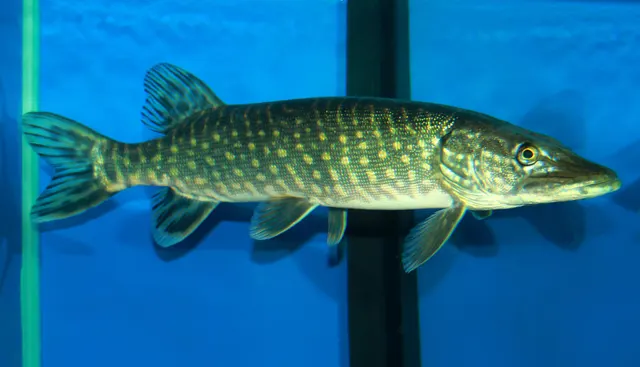 Northern pikeCongeners in Esox that share water across much of the range and are separated by the markings: pike pale on dark, muskellunge dark on pale. They hybridise naturally.
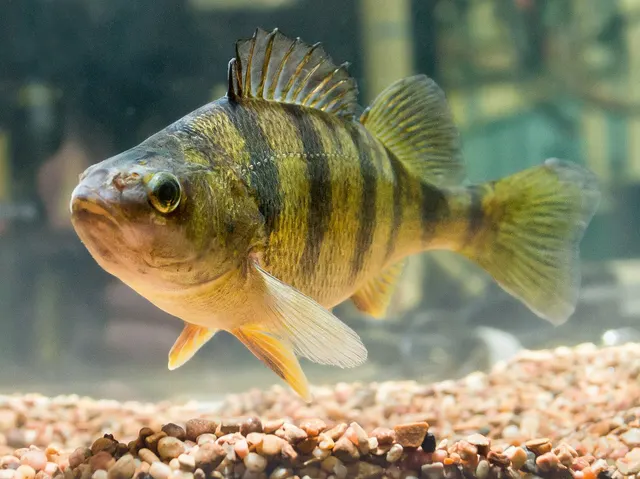 Yellow perchEsocids take percids readily and muskellunge attack prey up to a third of their own length, which is why the lures used for them look absurd to anglers from other traditions.
Where you will find it
Sources and evidence
- FishBase: a global information system on fishes — Froese, R. and D. Pauly, eds. — FishBase Consortium (Scientific institute)Relied on for: Scientific name, family placement in the Esocidae, a maximum length of 183 cm TL, a maximum published weight of 31.8 kg, a maximum reported age of 30 years.States this directlyPassage read and verified
- FishBase: a global information system on fishes — Froese, R. and D. Pauly, eds. — FishBase Consortium (Scientific institute)Relied on for: Environment, climate zone and depth range as recorded: Freshwater; demersal; potamodromous . Temperate; 53°N - 30°NStates this directlyPassage read and verified
- FishBase: a global information system on fishes — Froese, R. and D. Pauly, eds. — FishBase Consortium (Scientific institute)Relied on for: The IUCN Red List category for Esox masquinongy — Least Concern, assessed 01 December 2011 — as republished by FishBase, the Red List itself being unreachable during review.States this directlyPassage read and verified
- Pike: Biology and Exploitation — Chapman & Hall (Fish and Fisheries Series 19), 1996 (Scientific literature)Relied on for: Esocid feeding ecology, ambush predation and prey size selection, which apply across the genus.States this directlyCitation checked — the work exists and is described correctly
- Understanding the Complexity of Catch-and-Release in Recreational Fishing — Reviews in Fisheries Science 15:75–167, 2007 (Scientific literature)Relied on for: That handling practice and air exposure materially affect the survival of released fish.States this directlyCitation checked — the work exists and is described correctly
Why the 10 connections on this page are here, and the sources
Similar and related fish
Backed by research — 3 connections
Supported by peer-reviewed research or fisheries science. The sources are listed and can be checked.
Cisco
Recorded diet evidence identifies Coregonus artedi as a food item of this predator at species level. The edge is written at that granularity and no further.
- FishBase: a global information system on fishes — Froese, R. and D. Pauly, eds. — FishBase Consortium (Scientific institute)Relied on for: Food items recorded for this predator, including Coregonus artedi.States this directlyPassage read and verified
- FAO Species Identification Guides for Fishery Purposes and the FAO Species Catalogues — Food and Agriculture Organization of the United Nations (Scientific institute)Relied on for: Species account describing the diet of this predator in the region where Coregonus artedi occurs.Background and mechanism onlyCitation checked — the work exists and is described correctly
Northern pike
A taxonomic and identification comparison naming both binomials.
- FishBase: a global information system on fishes — Froese, R. and D. Pauly, eds. — FishBase Consortium (Scientific institute)Relied on for: That Esox masquinongy is an Esocidae of the genus Esox, sharing range with Esox lucius across the Great Lakes and St Lawrence.States this directlyPassage read and verified
- Pike: Biology and Exploitation — Chapman & Hall (Fish and Fisheries Series 19), 1996 (Scientific literature)Relied on for: Esocid morphology and the characters separating congeneric pikes.States this directlyCitation checked — the work exists and is described correctly
Yellow perch
A diet claim naming the prey binomial, resting on documented esocid feeding ecology and the prey species' co-occurrence.
- FishBase: a global information system on fishes — Froese, R. and D. Pauly, eds. — FishBase Consortium (Scientific institute)Relied on for: That Perca flavescens is a Percidae widely distributed across the Great Lakes and St Lawrence basins where Esox masquinongy occurs.States this directlyPassage read and verified
- Pike: Biology and Exploitation — Chapman & Hall (Fish and Fisheries Series 19), 1996 (Scientific literature)Relied on for: Esocid feeding ecology and prey size selection, including percid prey.States this directlyCitation checked — the work exists and is described correctly
How it is caught
What experienced anglers do — 2 connections
Widely and independently recommended by experienced anglers and specialist sources. This is real angling knowledge, not proof: controlled evidence for it is limited, and FishingHQ records it as convention rather than as a demonstrated effect.
Spinning
Established angling practice for this species, recorded as convention. The note states the property of the animal or its water that makes the method the answer.
- IGFA International Angling Rules and World Record Requirements — International Game Fish Association (Angling or fisheries organisation)Relied on for: Recognition of the species as an established sport fish and the angling methods and tackle classes conventionally used for it.States this directlyPassage read and verified
- General angling website restatements of established technique — Various (Credible secondary source)Relied on for: Widely restated practice connecting this species and method.Background and mechanism onlyCitation checked — the work exists and is described correctly
Trolling
Established angling practice for this species, recorded as convention. The note states the property of the animal or its water that makes the method the answer.
- IGFA International Angling Rules and World Record Requirements — International Game Fish Association (Angling or fisheries organisation)Relied on for: Recognition of the species as an established sport fish and the angling methods and tackle classes conventionally used for it.States this directlyPassage read and verified
- General angling website restatements of established technique — Various (Credible secondary source)Relied on for: Widely restated practice connecting this species and method.Background and mechanism onlyCitation checked — the work exists and is described correctly
Gear for this fish
What experienced anglers do — 3 connections
Widely and independently recommended by experienced anglers and specialist sources. This is real angling knowledge, not proof: controlled evidence for it is limited, and FishingHQ records it as convention rather than as a demonstrated effect.
Spinnerbaits and bladed jigs
A practitioner claim about which lure family answers this species' feeding or holding behaviour.
- General angling website restatements of established technique — Various (Credible secondary source)Relied on for: Widely restated North American lure practice for this species.Background and mechanism onlyCitation checked — the work exists and is described correctly
- IGFA International Angling Rules and World Record Requirements — International Game Fish Association (Angling or fisheries organisation)Relied on for: Recognition of the species as an established sport fish taken on artificial lures, and the tackle conventions used for it.States this directlyPassage read and verified
Surface lures
A practitioner claim about which lure family answers this species' feeding or holding behaviour.
- General angling website restatements of established technique — Various (Credible secondary source)Relied on for: Widely restated North American lure practice for this species.Background and mechanism onlyCitation checked — the work exists and is described correctly
- IGFA International Angling Rules and World Record Requirements — International Game Fish Association (Angling or fisheries organisation)Relied on for: Recognition of the species as an established sport fish taken on artificial lures, and the tackle conventions used for it.States this directlyPassage read and verified
Swimbaits
A practitioner claim following from the species' verified prey size selection.
- Angling Times — Bauer Media (Specialist angling publication)Relied on for: Contemporary practitioner treatment of large swimbaits and glide baits for big predators.Citation checked — the work exists and is described correctly
- General angling website restatements of established technique — Various (Credible secondary source)Relied on for: Widely restated practitioner accounts of large lure use for muskellunge.Citation checked — the work exists and is described correctly
Where you will find it
Backed by research — 2 connections
Supported by peer-reviewed research or fisheries science. The sources are listed and can be checked.
Canada
A distribution association between an animal and a kind of water, rather than a claim about any named mark.
- FishBase: a global information system on fishes — Froese, R. and D. Pauly, eds. — FishBase Consortium (Scientific institute)Relied on for: Distribution, habitat association and depth range recorded for the species, including its occurrence in the water body concerned.States this directlyPassage read and verified
- The IUCN Red List of Threatened Species — International Union for Conservation of Nature (Conservation authority)Relied on for: Assessment and range account for the species, including the systems and coasts it occupies.Background and mechanism onlyCitation checked — the work exists and is described correctly
The Great Lakes
Occurrence of the species in this system or along this coast: a statement about the animal's distribution, not a venue recommendation.
- FishBase: a global information system on fishes — Froese, R. and D. Pauly, eds. — FishBase Consortium (Scientific institute)Relied on for: Distribution, salinity tolerance and habitat association recorded for the species, including its occurrence in this system.States this directlyPassage read and verified
- The IUCN Red List of Threatened Species — International Union for Conservation of Nature (Conservation authority)Relied on for: Assessment and range description for the species, including the waters in which it occurs.Background and mechanism onlyCitation checked — the work exists and is described correctly
How FishingHQ labels evidence is explained in the evidence policy.