Yellow perch
Fish · Last reviewed 2026-08-10
North America's most-caught panfish and the walleye's principal prey — the fish that anchors both the food chain and the family fishing trip across a whole continent.
Safety: venomous and spined species — can cause injury needing treatment. 5 more points apply here.
How this was identified, and who took it
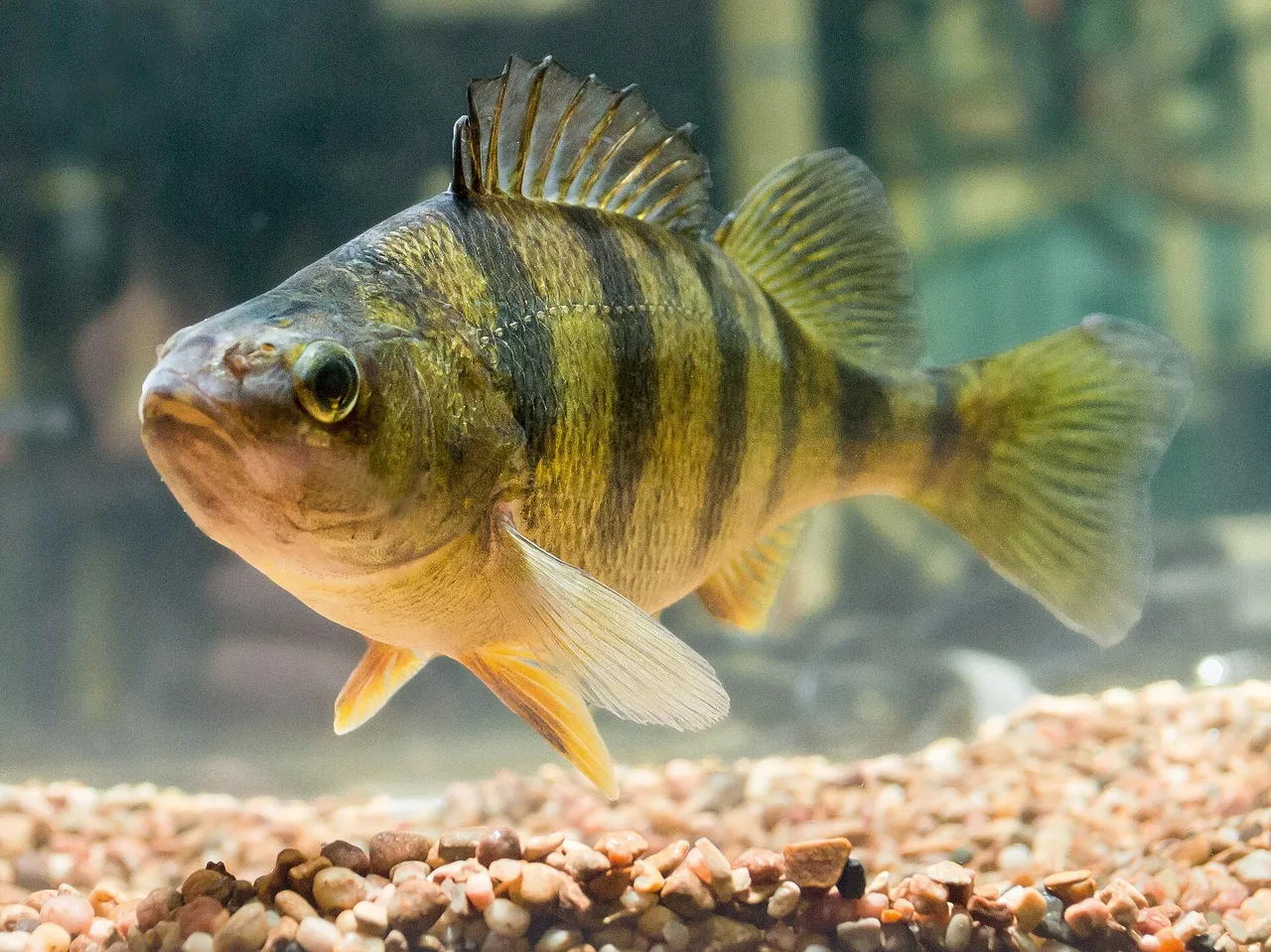
Identified by: Vertical flank barring, orange lower fins and — critically — NO dark blotch at the rear of the spiny dorsal, which is the character separating this species from European perch. Photographed in an aquarium.Robert Colletta — Public domain, via Wikimedia Commons — source, licence.jpg)
Catching Yellow perch
Everything here on fishing for it. Each entry opens the page behind it.
- Ground
The yellow perch is the European perch's North American counterpart, and the resemblance is not coincidence: they are congeners in the same genus, built to the same plan and doing the same job on opposite sides of the Atlantic.
It matters twice over. Ecologically it is the forage base of an enormous amount of North American fresh water — the walleye's recorded diet preference, and prey for pike, muskellunge, bass and almost everything else with a mouth. A lake's perch population and its predator population move together, and anglers who understand that read a water differently.
Socially it is the fish that gets people fishing. Perch shoal, they are willing, they are reachable from a bank or through a hole in the ice, and they are excellent to eat. In much of the northern United States and Canada the yellow perch is the species a child catches first and the species that fills a winter freezer, which gives it a cultural weight that its modest size does not suggest.
FishingHQ added it during an earlier pass for a precise reason: FishingHQ claimed walleye preyed on European perch, because that was the perch FishingHQ had. It was the wrong fish. Adding the right one was the fix.
Identification
- Scientific name
- Perca flavescens
- Family
- Percidae
- Water
- Freshwater, Brackish
- Conservation status
- Least Concern
- Regions
- North America, Arctic & Subarctic
- Two clearly separate dorsal fins, the first spiny — the family character shared with European perch and walleye.
- Six to eight dark vertical bars on a golden-yellow to brassy flank, tapering downward.
- Pelvic and anal fins yellow to orange, becoming bright orange-red in spawning males.
- Body deeper and more humped behind the head than a walleye, and markedly smaller at maturity.
- Separated from European perch by geography above all; the two are extremely similar, with yellow perch generally more golden and less olive, and lacking the strong dark blotch at the rear of the first dorsal that European perch usually shows.
Size
- Typical
- 100–250 g (4–9 oz)
- Large
- 400–700 g (14 oz–1.5 lb)
Exceptional: Over 1 kg (2.2 lb); maximum published weight 1.9 kg
Ribbons of eggs in the shallows, and a spring that decides the year
Yellow perch spawning is distinctive enough to be identifiable from the eggs alone, and its timing determines much of the population's fate.
THE EGG MASS IS A GELATINOUS RIBBON. Females release eggs in a long accordion-folded gelatinous strand — unlike almost any other freshwater fish — which is draped over submerged vegetation, brush, fallen timber or rock in shallow water. The structure gives the eggs surface area for oxygen and some protection from predation.
SPAWNING IS IN EARLY SPRING, soon after ice-out where there is ice, triggered by rising water temperature and lengthening days. Perch are among the earliest spawners in their waters, which puts the eggs in the water before most predators are active.
ADULTS MOVE INTO SHALLOW VEGETATED WATER TO SPAWN, frequently in large numbers, and males arrive first and remain longest.
THERE IS NO NEST AND NO PARENTAL CARE. Once the ribbon is deposited and fertilised the adults leave.
FECUNDITY IS HIGH AND RECRUITMENT IS ERRATIC. Year-class strength varies enormously with spring conditions — a cold snap, a wind event that destroys egg ribbons, or poor zooplankton timing can largely remove a cohort — and a single strong year class can dominate a fishery for years afterwards.
MATURITY COMES AT TWO TO FOUR YEARS, earlier in males.
AND STUNTING IS THE COMMON OUTCOME OF SUCCESS. Where perch recruit strongly and predation is limited, populations become dense and growth slows, producing a lake full of small fish — which is a reproductive outcome rather than a food shortage.
Backed by research — why, and the sources (2)
Supported by peer-reviewed research or fisheries science. The sources are listed and can be checked.
- Freshwater Fishes of the British Isles — HarperCollins (New Naturalist 75), 1992 (Reference work)Relied on for: Distribution, habitat association, spawning requirements and ecology of European freshwater fishes.States this directlyCitation checked — the work exists and is described correctly
- FishBase: a global information system on fishes — Froese, R. and D. Pauly, eds. — FishBase Consortium (Scientific institute)Relied on for: Distribution, habitat association, depth range, size, reproduction and life-history parameters recorded for the species.States this directlyPassage read and verified
The yellow perch lifecycle, and a shoal that changes with age
ESTABLISHED. Yellow perch spawn in spring, laying eggs in gelatinous accordion-like ribbons draped over vegetation and structure — the same distinctive strategy as their European relative. They are strongly shoaling, and shoals tend to be size-graded rather than mixed.
THE SIZE GRADING MATTERS PRACTICALLY. Catching one small perch usually means catching many, and catching a larger one often means the shoal is of larger fish. Moving to find a different shoal is frequently more effective than changing method, which is the opposite of the usual instinct.
THE ONTOGENETIC SHIFT is the same as in European perch: invertebrates when young, fish as they grow, with the larger individuals becoming more predatory and less tightly shoaled.
WINTER BEHAVIOUR is unusually important for this species because it supports a major ice fishery. The fish remain active and shoaled under ice, feeding through the coldest period, which is not true of every species in the same water.
WHAT ANGLERS RELIABLY REPORT. Strong dawn and dusk feeding, and shoals moving predictably between deeper water and shallower feeding ground through the day. Widely observed; the timing is local.
Backed by research — why, and the sources (2)
Supported by peer-reviewed research or fisheries science. The sources are listed and can be checked.
- FishBase: a global information system on fishes — Froese, R. and D. Pauly, eds. — FishBase Consortium (Scientific institute)Relied on for: Life history, spawning biology, habitat association and feeding ecology for the species.States this directlyPassage read and verified
- Freshwater Fishes of the British Isles — HarperCollins (New Naturalist 75), 1992 (Reference work)Relied on for: Life history and behaviour of European freshwater fishes, independently of the angling literature.Background and mechanism onlyCitation checked — the work exists and is described correctly
Small, spiny, and the fish most people are pricked by
Yellow perch injure more anglers than any dangerous fish does, for the simple reason that they are caught in enormous numbers, often by beginners, often by children, and handled without thought.
WHAT DOES IT. The first dorsal fin is a row of stiff sharp spines, and the perch raises it defensively the moment it is gripped. The gill covers carry a spine at the rear corner. Neither is venomous in the medical sense and both produce a puncture that stings disproportionately and can become infected if ignored.
THE GRIP THAT WORKS is from behind and above with the dorsal folded down under the palm: slide the hand forward from the tail so the fin lies flat against the body rather than approaching from the front, which is when the spines meet the fingers. It takes one demonstration to learn and it is worth teaching anybody fishing with children.
THE FISH IS OTHERWISE ROBUST. Perch handle well, survive release readily in cool water, and are not delicate. The commonest welfare failure is not handling at all but leaving a bucket of them in the sun.
AND THE BIOSECURITY LINE MATTERS FOR THIS SPECIES. Yellow perch are widely introduced outside their native range and are a listed problem in some jurisdictions. Never move live fish, and never empty a bait bucket into a water.
What experienced anglers do — why, and the sources (2)
Widely and independently recommended by experienced anglers and specialist sources. This is real angling knowledge, not proof: controlled evidence for it is limited, and FishingHQ records it as convention rather than as a demonstrated effect.
- FishBase: a global information system on fishes — Froese, R. and D. Pauly, eds. — FishBase Consortium (Scientific institute)Relied on for: Dentition, fin and spine morphology, body form, air-breathing capability and distribution for the species, which are the anatomical facts the handling practice below follows from.States this directlyPassage read and verified
- General angling website restatements of established technique — Various (Credible secondary source)Relied on for: Widely restated angling practice for handling this species, recorded as practitioner consensus rather than as tested fact.Background and mechanism onlyCitation checked — the work exists and is described correctly
Weed edge, shoals and a fish that hands the deep water to something else
Yellow perch habitat is best understood as a compromise between food and danger, because a yellow perch is prey for everything in the lake and its position reflects that continuously.
THE CORE HABITAT IS SHALLOW TO MID-DEPTH VEGETATED AND STRUCTURED WATER. Yellow perch occupy lakes, ponds, reservoirs, slow rivers and large lake systems, holding around weed beds, weed edges, drop-offs, docks, timber and gravel or sand flats. They are strongly shoaling and size-sorted, and the shoal is the primary anti-predator device — position within it matters more to an individual perch than the exact structure does.
THE WEED EDGE IS THE CLASSIC POSITION AND IT IS A COMPROMISE. Inside dense weed is safe and food-poor for a fish of any size; open water is food-rich and lethal. The edge is where a shoal can feed on invertebrates and small fish along the margin and retreat into cover, and the depth of that edge changes through the season as light and weed growth change.
DEPTH USE IS SEASONAL AND TEMPERATURE-DRIVEN. Perch move shallow in spring to spawn and feed, use mid-depth weed and structure through summer, move deeper in late autumn, and are famously accessible under ice in winter — the ice fishery is a habitat statement, because it depends on perch concentrating in predictable depths and remaining active in very cold water.
THEY SHARE WATER WITH WALLEYE AND THE PARTITION IS BY LIGHT. Where the two occur together, walleye take the low-light and deeper niche and yellow perch occupy the brighter, shallower, more structured one. Perch are visual daylight feeders and become largely inactive at night, which is the mirror image of the walleye pattern and is why the two are caught at opposite ends of the day in the same water.
SPAWNING IS ON VEGETATION AND STRUCTURE IN THE SHALLOWS, with the distinctive gelatinous egg ribbon draped over weed, branches and debris in shallow water in early spring. Loss of shallow vegetated margins removes spawning habitat directly, which is why heavily developed and hardened lake shorelines support far fewer perch.
AND STUNTING IS A HABITAT OUTCOME RATHER THAN A DEFECT. Where predators are scarce and weed is dense, perch numbers rise, food per fish falls, and the population stalls at a small size. A lake full of tiny perch is a lake with too few pike or walleye in it, and the perch are behaving exactly as expected.
Backed by research — why, and the sources (2)
Supported by peer-reviewed research or fisheries science. The sources are listed and can be checked.
- Freshwater Fishes of the British Isles — HarperCollins (New Naturalist 75), 1992 (Reference work)Relied on for: Habitat association, distribution and ecology of European freshwater fishes, including position within a water body.States this directlyCitation checked — the work exists and is described correctly
- FishBase: a global information system on fishes — Froese, R. and D. Pauly, eds. — FishBase Consortium (Scientific institute)Relied on for: Habitat association, depth range and water-type tolerance recorded for the species.States this directlyPassage read and verified
A spring shallow move, a summer of structure and a winter fishery on the ice
Yellow perch seasonality is a clear four-part cycle, and the useful thing about it is that the fish remain catchable throughout — the question is only where.
SPRING IS THE SHALLOW SPAWNING MOVE AND IT IS THE MOST CONCENTRATED PERIOD. As water warms after ice-out, perch move into shallow vegetated margins to spawn, draping the distinctive gelatinous egg ribbons over weed and debris. Large numbers of fish in shallow water make this the most accessible period of the year, and it is also when the population is most exposed.
SUMMER DISPERSES THEM ONTO STRUCTURE AND WEED EDGES at moderate depth, shoaled by size, feeding through the day. This is the least concentrated period and it is when perch fishing becomes a matter of locating a shoal rather than of finding a bank.
AUTUMN COOLING PULLS THEM TOGETHER AND DEEPER, and feeding intensity rises as fish build reserves. Autumn frequently produces the best mixture of numbers and size, for the same pre-winter reason that governs most temperate predators.
WINTER IS A MAJOR FISHERY RATHER THAN AN ABSENCE. Yellow perch remain active at low temperature and are one of the principal ice-fishing targets across the northern range, holding at predictable depths and feeding steadily. That contradicts the assumption that a small percid shuts down in the cold, and it is a defining feature of the species.
LIGHT GOVERNS THE DAILY PATTERN THROUGHOUT AND IT IS THE OPPOSITE OF WALLEYE. Perch are visual daylight feeders and become largely inactive at night, so in a water holding both, the two species are caught at opposite ends of the day — which the record's habitat section explains as a partition by light rather than by place.
AND THE LEGAL POSITION IS SEPARATE. Some jurisdictions manage the spawning period or apply seasonal or size measures to perch; many do not. Whether any applies is a matter for the competent authority and is not inferable from the cycle above.
Backed by research — why, and the sources (2)
Supported by peer-reviewed research or fisheries science. The sources are listed and can be checked.
- Freshwater Fishes of the British Isles — HarperCollins (New Naturalist 75), 1992 (Reference work)Relied on for: Habitat association, spawning behaviour, seasonal activity and ecology of freshwater fishes, including position within a water body.States this directlyCitation checked — the work exists and is described correctly
- FishBase: a global information system on fishes — Froese, R. and D. Pauly, eds. — FishBase Consortium (Scientific institute)Relied on for: Habitat association, spawning season, temperature tolerance and water-type tolerance recorded for the species.States this directlyPassage read and verified
Lifecycle and reproduction
Spawns in spring in shallow water, draping long gelatinous ribbons of eggs over vegetation and submerged branches — a distinctive strategy shared with European perch and with almost nothing else. No parental care follows. Growth is slow and populations very commonly stunt where perch are abundant and predators are few, producing large numbers of small fish. That stunting is the central management fact about the species: a lake full of small perch usually needs more predators rather than fewer perch.
Egg ribbons are laid over structure in shallow water as temperatures rise in spring, then abandoned. Fecundity is high and recruitment is usually reliable, which is precisely why stunting is so common — a perch population with nothing eating it will expand until growth stops rather than until numbers do.
Feeding and senses
Feeds during daylight on immature aquatic insects, larger invertebrates, fishes and fish eggs. The daytime feeding is worth noting because it is the opposite of the walleye that eats it: perch feed by sight in daylight and retreat as light falls, which is exactly when the walleye starts hunting. The two behaviours interlock.
Sight-dominant and a daylight feeder, preferring clear water near aquatic plants. That preference is what puts perch in the shallow, weedy, well-lit water where they are catchable from a bank, and what makes them unavailable at night when their principal predator is most active.
Through the year
Congregates near shorelines in spring around spawning, disperses to weed edges and structure through the warmer months, and shoals tightly in deeper water in winter — where it becomes a principal ice-fishing target across the northern part of the range. Described here by water temperature and light rather than by month, because the range spans a very wide band of latitude.
Distribution
North America: the Atlantic, Arctic, Great Lakes and Mississippi River basins from Nova Scotia to the Mackenzie River drainage in the Northwest Territories, south to Ohio, Illinois and Nebraska, and south in Atlantic drainages to the Savannah River in Georgia. Occurs in fresh and brackish water from the surface to about 56 m.
This is a biological range — where the species occurs, not a prediction that you will catch one. To browse the fishing geography FishingHQ holds, start at fishing places.
Why anglers care
One of the most-caught freshwater fish in North America and a mainstay of both open-water and ice fishing. Taken on worms, minnows, small jigs and soft plastics, from banks, docks, small boats and through the ice. Excellent eating, and the fish that introduces an enormous number of people to angling — which is a form of significance the size figures do not convey.
Handling and returning
The dorsal spines are genuinely sharp and the gill covers are spined; this is a small fish that regularly draws blood from people who grip it carelessly. Stroke the hand from head to tail rather than tail to head, which folds the spines down. Wet hands, and use a disgorger for deeply taken baits — perch take small baits properly and hook removal is where they are damaged.
Going further
- What does yellow perch eat? — feeding biology, kept separate from what anglers infer from it.
- Yellow perch vs European perch — how to tell them apart.
Safety
Venomous and spined species — Can cause injury needing treatment
Sharp dorsal spines and spined gill covers on a small fish that is handled in large numbers, frequently by beginners and children. Punctures are common and readily become infected.
What reduces it: Hold the fish from head to tail so the spines fold flat. Wet hands. Use a disgorger rather than fingers. Clean any puncture properly — marine and freshwater wound infections are slow and serious.
Biosecurity and disease transfer — Can cause injury needing treatment
Yellow perch are widely used as live bait and are moved between waters, which spreads both the species and the pathogens that travel with it.
What reduces it: Never move live fish or water between waters. Clean, drain, dry and check equipment between waters.
Precautions that always apply here
- Handle spined and venomous species with the spines controlled. Know which local species have them before you fish, not afterwards.
- Wet your hands before touching a fish. Dry hands strip the protective mucus layer that keeps infection out.
- Check, clean and dry your kit between different waters — the published guidance is 48 hours’ drying, in sunlight where possible, because a number of invasive species survive over two weeks in damp conditions. Nets, boots and wet mats move invasive species and disease more effectively than anything else anglers do.
- Never move live fish, live bait or water from one water to another.
Check the rules before you fish
Fishing laws, bylaws, access rules, seasons, bait restrictions and permitted methods vary by location and can change. Check the current rules from the relevant authority and the water you intend to fish before fishing.
Check with:
- Current national or regional law for where you are fishing
- Current local bylaws
- The relevant fisheries authority
- The landowner, club or fishery whose water it is
- Any restrictions specific to the species or the method you intend to use
Where to go next
Similar and related fish
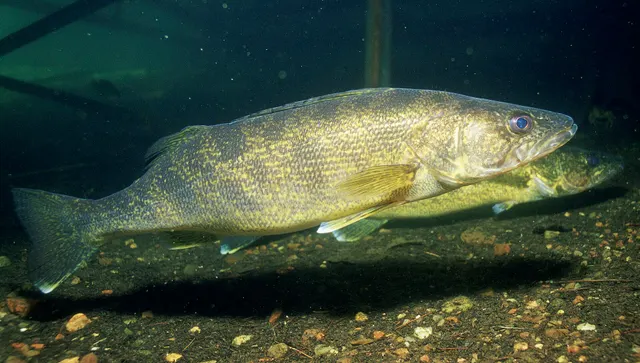 WalleyeYellow perch are the recorded diet preference, and the relationship runs both ways in practice — the two species share most of their range and a walleye population's condition frequently tracks its perch population.
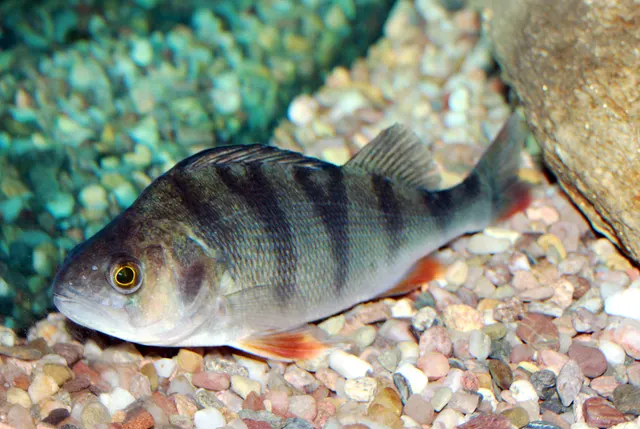 European perchCongeners in the same genus doing the same job on opposite sides of the Atlantic — both shoal in clear weedy water, both drape egg ribbons over structure, and both stunt when nothing eats them.
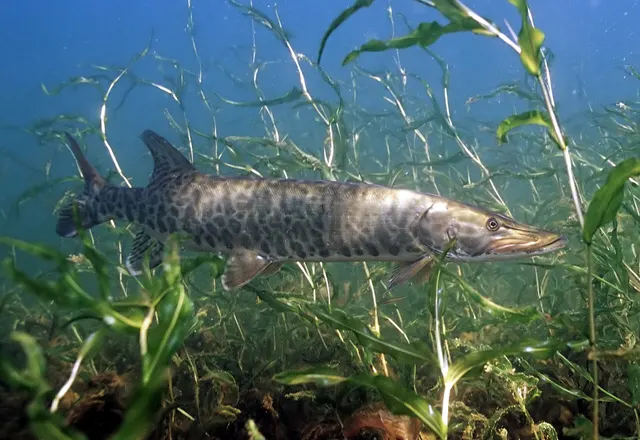 MuskellungeEsocids take percids readily and muskellunge attack prey up to a third of their own length, which is why the lures used for them look absurd to anglers from other traditions.
Where it lives
Where you will find it
Understanding this fish
Sources and evidence
- FishBase: a global information system on fishes — Froese, R. and D. Pauly, eds. — FishBase Consortium (Scientific institute)Relied on for: Scientific name, family placement in the Percidae, maximum length of 50 cm and maximum published weight of 1.9 kg, North American distribution across the Atlantic, Arctic, Great Lakes and Mississippi basins from Nova Scotia to the Mackenzie drainage and south to Ohio, Illinois, Nebraska and the Savannah River.States this directlyPassage read and verified
- FishBase: a global information system on fishes — Froese, R. and D. Pauly, eds. — FishBase Consortium (Scientific institute)Relied on for: The IUCN Red List category for Perca flavescens — Least Concern, assessed 1 March 2012 — as republished by FishBase.States this directlyPassage read and verified
- Freshwater Fishes of the British Isles — HarperCollins (New Naturalist 75), 1992 (Reference work)Relied on for: The comparable ecology and stunting behaviour of Perca fluviatilis in European waters, which is the basis for the comparison drawn on this page.FishingHQ's interpretation of what it saysCitation checked — the work exists and is described correctly
Why the 8 connections on this page are here, and the sources
Similar and related fish
Backed by research — 3 connections
Supported by peer-reviewed research or fisheries science. The sources are listed and can be checked.
Walleye
The inverse of the walleye diet edge, recorded separately because a reader on the perch page is asking what eats it rather than what it eats.
- FishBase: a global information system on fishes — Froese, R. and D. Pauly, eds. — FishBase Consortium (Scientific institute)Relied on for: That Sander vitreus feeds at night mainly on insects and fishes with a preference for yellow perch, Perca flavescens, and freshwater drum.States this directlyPassage read and verified
A diet claim naming the exact species FishBase records. This once pointed at European perch because yellow perch was not yet described here; the species was added rather than leaving a claim that named the wrong fish.
- FishBase: a global information system on fishes — Froese, R. and D. Pauly, eds. — FishBase Consortium (Scientific institute)Relied on for: That Sander vitreus feeds at night mainly on insects and fishes with a preference for yellow perch, Perca flavescens, and freshwater drum, taking any fish available.States this directlyPassage read and verified
European perch
A taxonomic and ecological comparison, naming both scientific names so there is no ambiguity about which animals are being compared.
- FishBase: a global information system on fishes — Froese, R. and D. Pauly, eds. — FishBase Consortium (Scientific institute)Relied on for: That Perca flavescens is a Percidae of the genus Perca occupying fresh and brackish water with a preference for clear water near aquatic plants, feeding by day on immature aquatic insects, larger invertebrates, fishes and fish eggs.States this directlyPassage read and verified
- Freshwater Fishes of the British Isles — HarperCollins (New Naturalist 75), 1992 (Reference work)Relied on for: The comparable ecology, egg-ribbon spawning and stunting behaviour of Perca fluviatilis in European fresh waters.States this directlyCitation checked — the work exists and is described correctly
Muskellunge
A diet claim naming the prey binomial, resting on documented esocid feeding ecology and the prey species' co-occurrence.
- FishBase: a global information system on fishes — Froese, R. and D. Pauly, eds. — FishBase Consortium (Scientific institute)Relied on for: That Perca flavescens is a Percidae widely distributed across the Great Lakes and St Lawrence basins where Esox masquinongy occurs.States this directlyPassage read and verified
- Pike: Biology and Exploitation — Chapman & Hall (Fish and Fisheries Series 19), 1996 (Scientific literature)Relied on for: Esocid feeding ecology and prey size selection, including percid prey.States this directlyCitation checked — the work exists and is described correctly
How it is caught
What experienced anglers do — 1 connection
Widely and independently recommended by experienced anglers and specialist sources. This is real angling knowledge, not proof: controlled evidence for it is limited, and FishingHQ records it as convention rather than as a demonstrated effect.
Ice fishing
A practitioner claim about a species-method pairing.
- General angling website restatements of established technique — Various (Credible secondary source)Relied on for: Widely restated practitioner accounts of yellow perch as a principal ice-fishing target.Citation checked — the work exists and is described correctly
- Angling Times — Bauer Media (Specialist angling publication)Relied on for: Contemporary treatment of ice fishing technique in the angling press.Citation checked — the work exists and is described correctly
Gear for this fish
What experienced anglers do — 1 connection
Widely and independently recommended by experienced anglers and specialist sources. This is real angling knowledge, not proof: controlled evidence for it is limited, and FishingHQ records it as convention rather than as a demonstrated effect.
Jigs and jig heads
A practitioner claim about which lure family answers this species' feeding or holding behaviour.
- General angling website restatements of established technique — Various (Credible secondary source)Relied on for: Widely restated North American lure practice for this species.Background and mechanism onlyCitation checked — the work exists and is described correctly
- IGFA International Angling Rules and World Record Requirements — International Game Fish Association (Angling or fisheries organisation)Relied on for: Recognition of the species as an established sport fish taken on artificial lures, and the tackle conventions used for it.States this directlyPassage read and verified
Where it lives
Backed by research — 1 connection
Supported by peer-reviewed research or fisheries science. The sources are listed and can be checked.
Lowland stillwaters
A habitat claim held to a scientific standard.
- FishBase: a global information system on fishes — Froese, R. and D. Pauly, eds. — FishBase Consortium (Scientific institute)Relied on for: That Perca flavescens inhabits fresh and brackish water, prefers clear water near aquatic plants, congregates near shorelines in spring, and occupies depths from 0 to 56 m.States this directlyPassage read and verified
Where you will find it
Backed by research — 1 connection
Supported by peer-reviewed research or fisheries science. The sources are listed and can be checked.
The Great Lakes
Occurrence of the species in this system or along this coast: a statement about the animal's distribution, not a venue recommendation.
- FishBase: a global information system on fishes — Froese, R. and D. Pauly, eds. — FishBase Consortium (Scientific institute)Relied on for: Distribution, salinity tolerance and habitat association recorded for the species, including its occurrence in this system.States this directlyPassage read and verified
- The IUCN Red List of Threatened Species — International Union for Conservation of Nature (Conservation authority)Relied on for: Assessment and range description for the species, including the waters in which it occurs.Background and mechanism onlyCitation checked — the work exists and is described correctly
Understanding this fish
Backed by research — 1 connection
Supported by peer-reviewed research or fisheries science. The sources are listed and can be checked.
Aquatic insect larvae as prey
Recorded diet evidence identifies aquatic insect larvae as a food item of this predator at group level rather than to species. The edge points at the taxon record for that reason, and encoding it as a species-level claim would assert something the source does not.
- FishBase: a global information system on fishes — Froese, R. and D. Pauly, eds. — FishBase Consortium (Scientific institute)Relied on for: Food items recorded for this predator, given as aquatic insect larvae.States this directlyPassage read and verified
- FAO Species Identification Guides for Fishery Purposes and the FAO Species Catalogues — Food and Agriculture Organization of the United Nations (Scientific institute)Relied on for: Species account describing this predator's diet, recorded at the level of aquatic insect larvae.Background and mechanism onlyCitation checked — the work exists and is described correctly
How FishingHQ labels evidence is explained in the evidence policy.