Walleye
Fish · Last reviewed 2026-08-10
A low-light predator of large North American lakes and rivers whose reflective eye lets it hunt in conditions where its prey cannot see it coming.
Safety: injury while handling fish — can cause injury needing treatment. 5 more points apply here.
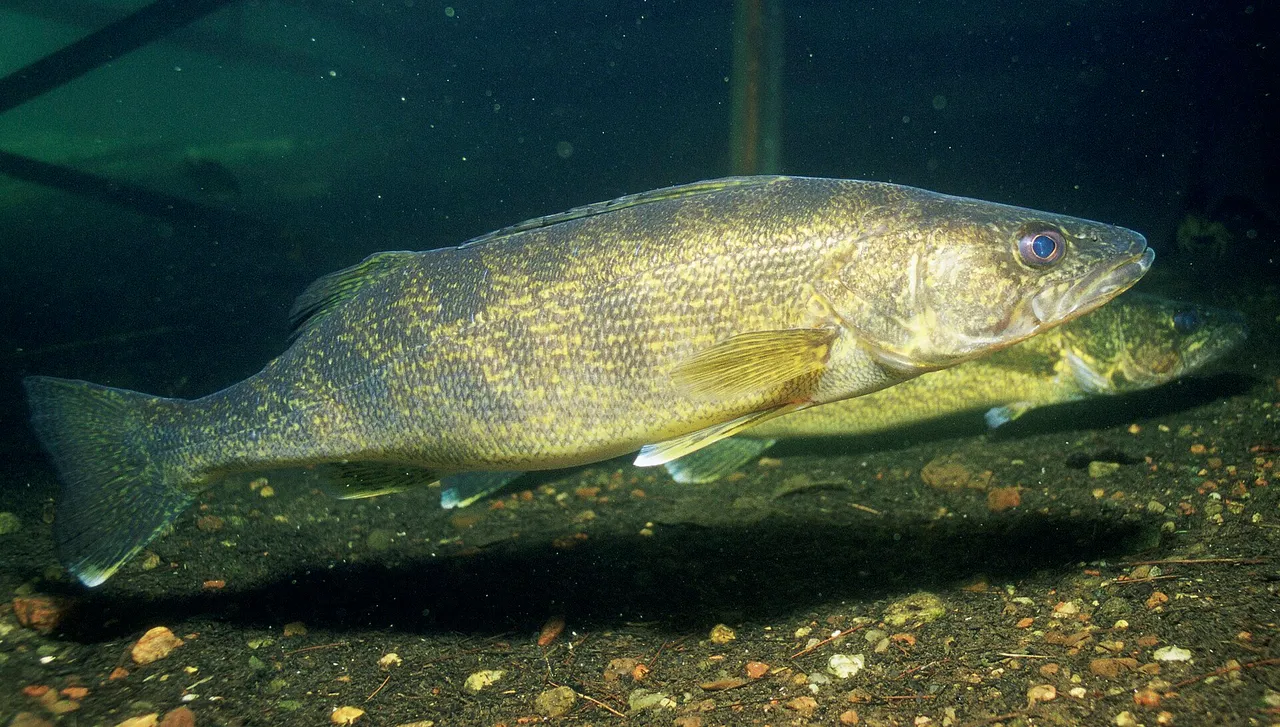
How this was identified, and who took it
Identified by: Large glassy reflective eye, two separate dorsal fins, visible canine teeth, and a white tip on the lower lobe of the tail — the last being the standard separation from sauger.Engbretson, Eric / U.S. Fish and Wildlife Service, Public domain, via Wikimedia Commons — source, licence
Catching Walleye
Everything here on fishing for it. Each entry opens the page behind it.
The walleye is North America's answer to the zander, and the resemblance is not coincidence — they are close relatives in the same genus, doing the same job on different continents.
What defines it is the eye. The scientific name vitreus means glassy, and the eye's reflective layer gathers light so effectively that the fish can hunt at intensities where the small fish it eats are effectively blind. That single adaptation explains almost everything about walleye fishing: why the best periods are dawn, dusk and after dark; why the fish moves shallow in low light and deep in bright sun; and why coloured, wind-stirred water frequently fishes better than clear calm.
It is also, by a wide margin, one of the most sought-after food fish in North American fresh water — white, mild and firm — which gives the fishery a take-for-the-table culture rather than the release culture around bass. Both exist, and the tension between them is a live management question across much of the range.
Gear for this fish
- CrankbaitsTrolled and cast crankbaits cover the flats and breaklines walleye patrol at night and in coloured water, where a jig cannot search fast enough to find a moving school.
- Jigs and jig headsThe jig-and-minnow is the defining walleye presentation, and it works because a walleye feeds close to the bottom in low light and takes a slow-moving item at its own level rather than chasing through the column.
- Soft plasticsSoft plastic on a jighead has largely replaced live minnow in much of this fishery, retaining the fall and the bottom contact without the bait-handling.
Identification
- Scientific name
- Sander vitreus
- Family
- Percidae
- Water
- Freshwater
- Conservation status
- Least Concern
- Regions
- North America, Arctic & Subarctic
- Two clearly separate dorsal fins — the first spiny, the second soft — which distinguishes it from pike and from bass at a glance.
- Large, glassy, opaque-looking eye that reflects light strongly, the character the species is named for.
- A distinct white tip on the lower lobe of the tail, the single most reliable field mark separating it from the closely related sauger.
- Olive to brassy gold flanks with darker mottling; the belly white.
- Prominent canine teeth in the jaws, which sauger and perch lack at that size.
Size
- Typical
- 0.5–1.5 kg (1–3 lb)
- Large
- 3–5 kg (6.5–11 lb)
Exceptional: Over 7 kg (15 lb); maximum published weight 11.3 kg
Three separate hazards on one head, and the grip that meets all of them
Walleye injure more people than their reputation suggests, and the reason is that the head carries three distinct hazards in three different places, and the natural way to pick a fish up meets all of them at once.
THE TEETH ARE REAL. Walleye are visual ambush predators on other fish, and the mouth carries long, sharp, backward-curving canines. Backward-curving is the operative word: a hand that went into the mouth without resistance does not come out the same way, because every tooth is angled to prevent exactly that. This is the same mechanism that makes pike dangerous and it is less expected here.
THE GILL COVER IS A BLADE. The rear margin of the operculum is thin and hard with a genuine edge, and it is positioned where a hand slides when somebody grips a fish behind the head.
THE PREOPERCULUM IS SPINED, and those spines are forward of the gill cover, angled outward and downward — so a hand that has avoided the teeth and cleared the operculum can still find them.
THE GRIP THAT WORKS AVOIDS THE WHOLE HEAD. A hand across the back behind the pectorals, with the body supported and the fish held horizontally, contacts none of the three. A knotless net removes the need to grip a green fish at all, and long pliers put the unhooking at arm's length rather than at finger length. The one hold to avoid is the intuitive one — a hand around the head from above, thumb under the gill cover, which is how a bass is held and is how walleye anglers cut themselves.
AND THE RELEASE PROBLEM IS DEPTH AND SEASON. Walleye taken from deep water in summer arrive with swim-bladder expansion and warm water to recover in, which is the worst combination there is. Where fish are going back, taking them from shallower water in the first place beats every technique applied afterwards.
What experienced anglers do — why, and the sources (4)
Widely and independently recommended by experienced anglers and specialist sources. This is real angling knowledge, not proof: controlled evidence for it is limited, and FishingHQ records it as convention rather than as a demonstrated effect.
- FishBase: a global information system on fishes — Froese, R. and D. Pauly, eds. — FishBase Consortium (Scientific institute)Relied on for: Morphology, dentition, spination, thermal tolerance, reproductive strategy and depth range recorded for the species.States this directlyPassage read and verified
- The IUCN Red List of Threatened Species — International Union for Conservation of Nature (Conservation authority)Relied on for: Assessment, population trend and the life-history traits — longevity, growth rate, sex structure — that determine a population's sensitivity to the removal of large individuals.Background and mechanism onlyCitation checked — the work exists and is described correctly
- Understanding the Complexity of Catch-and-Release in Recreational Fishing — Reviews in Fisheries Science 15:75–167, 2007 (Scientific literature)Relied on for: The determinants of catch-and-release outcome in recreational fisheries, and the gap between angler belief and measured survival.States this directlyCitation checked — the work exists and is described correctly
- Do we need species-specific guidelines for catch-and-release recreational angling? — Biodiversity and Conservation 14:1195–1209, 2005 (Scientific literature)Relied on for: That air exposure, handling duration and water temperature are the dominant modifiable determinants of post-release survival.States this directlyCitation checked — the work exists and is described correctly
A light-limited predator in a cold climate, and why the day matters more than the month
Walleye have a seasonal pattern that is real and a daily pattern that is stronger, and the two are driven by the same organ.
THE EYE IS THE DEFINING FEATURE, and it is in the name. Walleye carry a tapetum lucidum behind the retina — the reflective layer that returns light through the photoreceptors a second time and gives the eye its characteristic shine. It confers a large advantage in dim light and makes bright light aversive, so a walleye is at its most effective when its prey can see least: dusk, dawn, night, turbid water, wind-roughened surface, and under cloud.
WHICH MEANS THE LIGHT LEVEL ON A GIVEN DAY OUTWEIGHS THE MONTH. A grey, windy, coloured-water afternoon in midsummer can fish better than a bright calm morning in the supposed peak, because the fish's advantage is present in the first and absent in the second. This is the single most useful thing to understand about the species and it is a mechanism rather than a rule of thumb.
THE SEASONAL FRAME SITS ON TOP OF THAT. Walleye move shallow to spawn as water warms past the high single figures in spring, over gravel, rubble and rocky shoals or in river current, broadcasting eggs with no parental care afterwards. They then disperse to summer structure — reefs, points, weed edges, current seams — and feed heavily again as water cools in autumn. In cold water they remain active, which is why they are a major ice-fishing target across the northern part of the range, and the low light under ice suits them.
THE SPAWNING AGGREGATION IS THE VULNERABLE MOMENT. Fish concentrate in shallow, predictable, accessible places over a short period, in numbers, and are readily caught there. That is a biological fact about the species, and it is the reasoning behind the seasonal restrictions that exist in many jurisdictions — restrictions whose dates, waters and terms are current, local, and not something this page states.
AND DEPTH INTERACTS WITH RELEASE. Summer walleye taken from deep water arrive with swim-bladder expansion into warm surface water, which is the worst combination for survival; where fish are being returned, taking them from shallower water in the first place beats any technique applied afterwards.
Backed by research — why, and the sources (2)
Supported by peer-reviewed research or fisheries science. The sources are listed and can be checked.
- FishBase: a global information system on fishes — Froese, R. and D. Pauly, eds. — FishBase Consortium (Scientific institute)Relied on for: Temperature association, migration, flood-cycle response and spawning season recorded for the species.States this directlyPassage read and verified
- IGFA International Angling Rules and World Record Requirements — International Game Fish Association (Angling or fisheries organisation)Relied on for: Recognition of the species as an established sport fish and the seasonal conventions of its recognised fisheries.Background and mechanism onlyPassage read and verified
The same light-limited niche as a zander, in a different hemisphere
Walleye habitat is a near-perfect parallel to zander habitat, and the parallel is the most efficient way to explain it: the two are closely related percids that solved the same problem the same way.
THE EYE DECIDES EVERYTHING. A walleye's tapetum lucidum makes it an effective predator in light too low for its prey and its competitors, so the species occupies water that is deep, turbid, stained, wind-roiled or dark. Bright clear shallow water in daylight is not walleye habitat; the same water at dusk, at night, or after a wind has stirred it, is.
WHICH PRODUCES THE FAMILIAR PATTERNS. Walleye go deep in clear lakes and stay shallower in stained ones, feed hardest at dawn, dusk and night, and move shallow when wind puts a chop on and breaks up the light — the 'walleye chop' is a genuine habitat effect rather than folklore. In a clear lake, the fish are on deep structure by day; in a tannin-stained one, they may be in a few feet of water all afternoon.
THE STRUCTURE THEY USE IS HARD AND SUBTLE. Gravel and rock bars, points, humps, reefs, weed edges, sharp breaks and river channel edges. Walleye relate to the transition rather than to cover — they are not a snag or weed fish in the way a pike or a largemouth is.
RIVERS AND LARGE LAKES BOTH WORK, and the Great Lakes are the outstanding example of the second: enormous, deep, cool, structurally varied water supporting one of the most significant walleye fisheries anywhere, with strong seasonal movement between deep summer water and shallow spring spawning ground.
SPAWNING NEEDS CLEAN COARSE SUBSTRATE IN MOVING OR WAVE-WASHED WATER. Walleye broadcast eggs over gravel, rubble and rock in rivers, on wind-swept shoals, or below dams, and the eggs need oxygenated water moving through the substrate. Siltation of spawning shoals and barriers on spawning rivers are the two habitat failures that most commonly limit a walleye population, and many fisheries are maintained by stocking because of them.
TEMPERATURE PUTS THEM IN THE MIDDLE. Walleye are cool-water fish, sitting between the coldwater salmonids and the warmwater centrarchids, and in a stratified lake in summer they are frequently found in a narrow band where temperature and oxygen both suit — which concentrates them and makes the depth as important as the structure.
Backed by research — why, and the sources (2)
Supported by peer-reviewed research or fisheries science. The sources are listed and can be checked.
- Freshwater Fishes of the British Isles — HarperCollins (New Naturalist 75), 1992 (Reference work)Relied on for: Habitat association, distribution and ecology of European freshwater fishes, including position within a water body.States this directlyCitation checked — the work exists and is described correctly
- FishBase: a global information system on fishes — Froese, R. and D. Pauly, eds. — FishBase Consortium (Scientific institute)Relied on for: Habitat association, depth range and water-type tolerance recorded for the species.States this directlyPassage read and verified
Broadcast over rock in the dark, and a species that is very often stocked because it cannot recruit
Walleye reproduction is simple, unguarded and physically demanding of the habitat, and the mismatch between what it needs and what most managed waters provide is why so many walleye fisheries are maintained artificially.
SPAWNING IS A BROADCAST EVENT OVER COARSE SUBSTRATE. Soon after ice-out, walleye move to rocky and rubble ground — river reaches, wave-washed shoals, the tailwaters below dams — and release eggs and sperm into the water at night, usually in shallow water with current or wave action. The eggs fall into the spaces between the rocks. There is no nest, no guarding and no care of any kind.
THE EGGS DEPEND ENTIRELY ON WATER MOVING THROUGH THE SUBSTRATE, exactly as trout and barbel eggs do, and they are equally destroyed by fine sediment. A shoal that silts up stops producing walleye while remaining a shoal.
WHICH IS WHY SPAWNING HABITAT IS THE COMMONEST LIMITING FACTOR. Many lakes and reservoirs have abundant adult walleye habitat and no suitable clean coarse substrate at the right depth with the right water movement. Those fisheries are sustained by stocking, and the fish in them are the product of a hatchery rather than of the lake — a fact worth knowing when judging what a water is actually doing.
RIVER SPAWNING RUNS ARE THE OTHER PATTERN, with fish moving upstream from lakes into tributaries, and they are blocked by exactly the same structures that block every other spawning migration.
TIMING IS SHARPLY TEMPERATURE-CUED AND EARLY, immediately after ice-out in the northern range, which places the whole event in cold, high, often turbid spring water. That is also when the fish are most concentrated and most accessible, which is why closed seasons over the spawn are common in walleye jurisdictions. Whether one applies anywhere is a matter for the competent authority and they differ considerably.
FEMALES ARE LARGER AND FAR MORE FECUND, and the large females are old — so the same big-old-fecund-female argument applies here as elsewhere, and slot limits in several fisheries reflect it.
AND RECRUITMENT IS ERRATIC EVEN WHERE HABITAT IS GOOD, driven by spring weather, water level and the timing of the food supply for the fry. Strong year classes dominate walleye populations for years, which is a defining feature of the fishery.
Backed by research — why, and the sources (2)
Supported by peer-reviewed research or fisheries science. The sources are listed and can be checked.
- Freshwater Fishes of the British Isles — HarperCollins (New Naturalist 75), 1992 (Reference work)Relied on for: Spawning behaviour, substrate requirements, timing and recruitment of European freshwater fishes.States this directlyCitation checked — the work exists and is described correctly
- FishBase: a global information system on fishes — Froese, R. and D. Pauly, eds. — FishBase Consortium (Scientific institute)Relied on for: Reproductive mode, spawning season, fecundity and maturity for the species.States this directlyPassage read and verified
Tackle built to feel a bite that barely happens
Walleye tackle is specified by bite detection more than by anything else, and once that is understood the whole outfit is coherent.
THE TAKE IS FREQUENTLY ALMOST NOTHING. A walleye commonly inhales a bait or jig and holds still, or moves toward the angler, producing a change in pressure rather than a pull. A great many walleye bites are never detected at all, and the difference between anglers on the same water is very often the difference between feeling them and not.
SO SENSITIVITY IS THE DESIGN GOAL. Low-stretch braided line, a rod with a fast responsive tip, and the lightest jig that will hold bottom in the conditions — because a heavier jig masks the bite and a lighter one telegraphs it. That chain is the reason walleye anglers argue about a few grams of jig weight.
THE LEADER IS THEN DOING TWO JOBS. Fluorocarbon provides some concealment in the clear water walleye occupy in daylight, and it restores a small amount of the shock absorption braid removed — which matters on a fish with a bony mouth and a modest hook hold.
DEPTH CONTROL IS THE OTHER HALF, and it is why this fishery is so attentive to line diameter and lure weight. Walleye relate to specific depths on structure, and being three feet off is being in the wrong place. Trolling with leadcore, planer boards and precisely controlled speed is the same problem solved by different means.
LIGHT IS THE VARIABLE THAT MOVES EVERYTHING. The record's habitat section explains why walleye occupy low-light and turbid water, and the practical consequence is that the productive fishing happens at dawn, dusk, at night or in a wind-driven chop — which is exactly when detecting a subtle take is hardest. Sensitivity earns its place because of when the fishing happens.
AND HOOK CHOICE IS A RELEASE VARIABLE. Walleye are frequently kept, but where slot limits apply, deep hooking on live bait held for too long is the main cause of unreleasable fish. Circle hooks reduce it. What any slot or limit is remains a matter for the competent authority.
What experienced anglers do — why, and the sources (2)
Widely and independently recommended by experienced anglers and specialist sources. This is real angling knowledge, not proof: controlled evidence for it is limited, and FishingHQ records it as convention rather than as a demonstrated effect.
- Coarse Fishing — A. & C. Black, 1912 (Specialist angling publication)Relied on for: Established coarse angling practice, including tackle, presentation and the reasoning behind them.States this directlyCitation checked — the work exists and is described correctly
- Freshwater Fishing — Macdonald & Jane's, 1975 (Specialist angling publication)Relied on for: Freshwater angling technique, tackle and the principles behind method selection.States this directlyCitation checked — the work exists and is described correctly
A jig held at a depth, and a lure choice made by how much light there is
Walleye lure fishing is decided by two variables — depth and light — and the lure is largely a way of holding a presentation in the right combination of both.
THE JIG IS THE CENTRAL TOOL AND THE REASON IS CONTROL. A jig can be held at a precise depth, worked slowly along a specific contour, and fished with a subtle action that a walleye will commit to. Because the take is frequently almost nothing — the record's tackle section explains this — the presentation that keeps the lure in the strike zone longest wins, and that is a jig worked slowly on the bottom or just above it.
LIGHT DECIDES WHEN AND WHERE. The record's habitat section explains that a walleye's eye gives it an advantage in low light, so the productive periods are dawn, dusk, night, and any time wind or colour reduces clarity. In a clear lake in daylight, that means deep; in a stained lake or a chop, it can mean shallow all afternoon. Choosing the lure without establishing the light condition is choosing at random.
TROLLING SOLVES THE SEARCH PROBLEM at scale, and it is why crankbaits, spinner rigs and controlled-depth trolling are so central on large waters. When fish are scattered along a contour, covering ground at a controlled depth finds them far faster than casting.
LIVE-BAIT RIGS AND SLOW PRESENTATIONS DOMINATE IN COLD WATER, because a cold walleye will not chase and will hold a bait for a long time before committing. Speed is the commonest error in early and late season.
COLOUR MATTERS MORE HERE THAN FOR MOST SPECIES, and the explanation is optical rather than aesthetic: in stained water at low light, high-contrast and fluorescent finishes are simply more findable, and that is a visibility argument rather than a preference claim.
AND HOOKING IS THE WEAK POINT. A walleye's mouth is bony and hook holds are modest, so sharp hooks, a firm connection and steady pressure matter more than drag settings. Where slot limits apply, deep hooking on live bait held too long is the main cause of unreleasable fish.
What experienced anglers do — why, and the sources (2)
Widely and independently recommended by experienced anglers and specialist sources. This is real angling knowledge, not proof: controlled evidence for it is limited, and FishingHQ records it as convention rather than as a demonstrated effect.
- Angling Times — Bauer Media (Specialist angling publication)Relied on for: Contemporary lure angling practice, presentation and the reasoning behind it.States this directlyCitation checked — the work exists and is described correctly
- FishBase: a global information system on fishes — Froese, R. and D. Pauly, eds. — FishBase Consortium (Scientific institute)Relied on for: Diet, feeding mode, prey composition and sensory biology recorded for the species.Background and mechanism onlyPassage read and verified
Lifecycle and reproduction
Spawns in early spring, shortly after ice-out where there is ice, over gravel and rubble in rivers and on wind-swept lake shoals. No nest is built and no care is given. Growth is moderate and the species is long-lived, with large fish representing many years — which matters for a fishery where large fish are also the ones most often taken home.
Broadcast spawning over hard bottom in cold water, with no parental care. Because spawning depends on suitable gravel with current or wave action over it, walleye populations are unusually sensitive to habitat modification — a dammed or silted spawning shoal removes recruitment regardless of how many adults remain. Extensive hatchery stocking across the range is a direct response to that.
Feeding and senses
Feeds at night, principally on fish, with yellow perch and freshwater drum recorded as preferences though any available fish is taken. Insects feature substantially, and crayfish, snails, frogs, mudpuppies and even small mammals appear when fish and insects are scarce. The night feeding is the defining behaviour and it is a consequence of the eye rather than a preference.
Vision in low light, to a degree that is the species' entire ecological strategy. The eye's reflective structure lets it locate prey at light levels where prey fish cannot see a predator approaching, which is why walleye hunt at dawn, dusk, after dark and in wind-stirred coloured water, and why bright still conditions push them deep or off the feed entirely. The lateral line supports this in turbid water.
Through the year
Moves shallow to spawn as water warms above about 6 to 8 degrees in spring, then disperses to summer structure — reefs, points, weed edges and river current seams. Feeds heavily in autumn as water cools. Remains active under ice and is a major ice-fishing target across the northern part of the range. Within any season, the light level on the day matters more than the calendar.
Distribution
North America: the St Lawrence and Great Lakes, Arctic and Mississippi River basins, from Quebec west to the Northwest Territories in Canada and south to Alabama and Arkansas in the United States. Widely stocked beyond that native range within the continent.
This is a biological range — where the species occurs, not a prediction that you will catch one. To browse the fishing geography FishingHQ holds, start at fishing places.
Why anglers care
One of the most heavily fished freshwater species in North America, taken by trolling, jigging, live-bait rigs and increasingly on soft plastics, and a major ice-fishing target. Unlike the bass fishery, it is substantially a take-for-the-table fishery, and reconciling that with the fish's slow replacement of large individuals is a recurring management question.
Handling and returning
Teeth are genuinely sharp and the gill covers and preoperculum are spined — this is a fish that cuts people who grip it carelessly. Support the body horizontally, keep fingers clear of the gills and the jaw, and use a knotless net. Fish brought up from deep water in summer can suffer barotrauma; where that is a possibility, a fish that will be released is better taken from shallower water in the first place.
Going further
- What does walleye eat? — feeding biology, kept separate from what anglers infer from it.
Safety
Injury while handling fish — Can cause injury needing treatment
Sharp canine teeth and spined gill covers cause cuts to hands and forearms, usually when somebody grips the fish behind the head.
What reduces it: Support the fish horizontally with wet hands and keep fingers away from the jaw and the gill plates. Use a knotless net and long-nosed pliers for unhooking.
Biosecurity and disease transfer — Can cause injury needing treatment
Walleye are stocked widely within North America, and the movement of live fish and water between waters spreads pathogens and non-native organisms regardless of the species being moved.
What reduces it: Clean, drain, dry and check equipment between waters. Never move live fish or water between systems.
Precautions that always apply here
- Wet your hands before touching a fish. Dry hands strip the protective mucus layer that keeps infection out.
- Keep fingers out of the gills and clear of the teeth. Gill damage is usually fatal to the fish, and several species will remove skin from a finger.
- Support the fish's weight along its body, keep it out of the water for as short a time as possible, and hold it over something soft.
- Check, clean and dry your kit between different waters — the published guidance is 48 hours’ drying, in sunlight where possible, because a number of invasive species survive over two weeks in damp conditions. Nets, boots and wet mats move invasive species and disease more effectively than anything else anglers do.
Check the rules before you fish
Fishing laws, bylaws, access rules, seasons, bait restrictions and permitted methods vary by location and can change. Check the current rules from the relevant authority and the water you intend to fish before fishing.
Check with:
- Current national or regional law for where you are fishing
- Current local bylaws
- The relevant fisheries authority
- The landowner, club or fishery whose water it is
- Any restrictions specific to the species or the method you intend to use
Where to go next
Similar and related fish
- Yellow perchYellow perch are the recorded diet preference, and the relationship runs both ways in practice — the two species share most of their range and a walleye population's condition frequently tracks its perch population.
- CiscoCisco are taken where the two overlap, and walleye moving deep in summer are frequently following them.
- Rainbow smeltSmelt are a principal walleye prey in northern lakes where they occur, taken in low light in the same conditions that suit the walleye's own vision.
Where you will find it
- CanadaThe most widely targeted freshwater fish across the shield, the prairie rivers and the Great Lakes basin.
- North American freshwater fishingThe characteristic species of the glaciated coolwater belt, and the fish most associated with the spring opener across the northern tier.
- The Great LakesSupports one of the largest freshwater recreational fisheries in North America, particularly in the shallow, warm, highly productive western basin of Lake Erie.
Understanding this fish
Told apart from
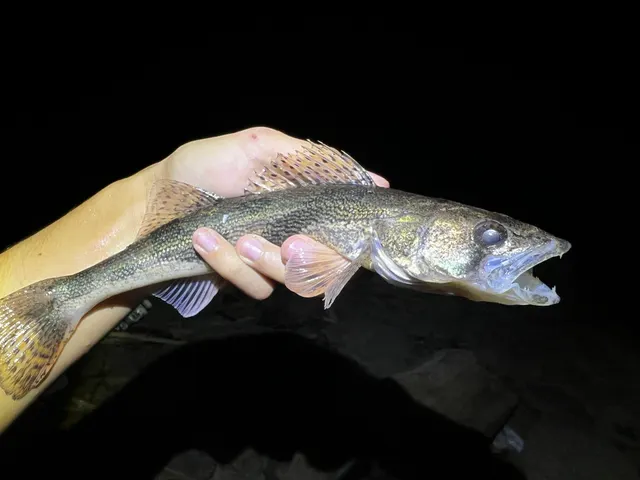 SaugerSpotted membranes on the spiny dorsal and NO white tip on the lower tail lobe make a sauger; a plain dorsal and a white tail tip make a walleye. Saugeye, the hybrid, is intermediate in both and cannot be named by eye.
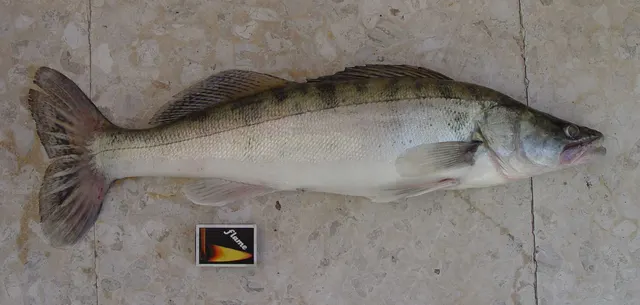 ZanderClose relatives in the same genus doing the same job on different continents — both low-light shoal hunters of large turbid water, and both routinely mistaken for pike by people who have not seen the two dorsals.
Sources and evidence
- FishBase: a global information system on fishes — Froese, R. and D. Pauly, eds. — FishBase Consortium (Scientific institute)Relied on for: Scientific name, family placement in the Percidae, maximum length of 107 cm fork length and maximum published weight of 11.3 kg, native distribution across the St Lawrence, Great Lakes, Arctic and Mississippi basins, habitat in lakes, pools, backwaters and runs of medium to large rivers with a preference for large shallow turbid lakes.States this directlyPassage read and verified
- FishBase: a global information system on fishes — Froese, R. and D. Pauly, eds. — FishBase Consortium (Scientific institute)Relied on for: The IUCN Red List category — Least Concern, assessed 1 March 2012 — is taken from FishBase's republication.States this directlyPassage read and verified
Why the 13 connections on this page are here, and the sources
Similar and related fish
Backed by research — 3 connections
Supported by peer-reviewed research or fisheries science. The sources are listed and can be checked.
Yellow perch
A diet claim naming the exact species FishBase records. This once pointed at European perch because yellow perch was not yet described here; the species was added rather than leaving a claim that named the wrong fish.
- FishBase: a global information system on fishes — Froese, R. and D. Pauly, eds. — FishBase Consortium (Scientific institute)Relied on for: That Sander vitreus feeds at night mainly on insects and fishes with a preference for yellow perch, Perca flavescens, and freshwater drum, taking any fish available.States this directlyPassage read and verified
The inverse of the walleye diet edge, recorded separately because a reader on the perch page is asking what eats it rather than what it eats.
- FishBase: a global information system on fishes — Froese, R. and D. Pauly, eds. — FishBase Consortium (Scientific institute)Relied on for: That Sander vitreus feeds at night mainly on insects and fishes with a preference for yellow perch, Perca flavescens, and freshwater drum.States this directlyPassage read and verified
Cisco
Recorded diet evidence identifies Coregonus artedi as a food item of this predator at species level. The edge is written at that granularity and no further.
- FishBase: a global information system on fishes — Froese, R. and D. Pauly, eds. — FishBase Consortium (Scientific institute)Relied on for: Food items recorded for this predator, including Coregonus artedi.States this directlyPassage read and verified
- FAO Species Identification Guides for Fishery Purposes and the FAO Species Catalogues — Food and Agriculture Organization of the United Nations (Scientific institute)Relied on for: Species account describing the diet of this predator in the region where Coregonus artedi occurs.Background and mechanism onlyCitation checked — the work exists and is described correctly
Rainbow smelt
Recorded diet evidence identifies Osmerus mordax as a food item of this predator at species level. The edge is written at that granularity and no further.
- FishBase: a global information system on fishes — Froese, R. and D. Pauly, eds. — FishBase Consortium (Scientific institute)Relied on for: Food items recorded for this predator, including Osmerus mordax.States this directlyPassage read and verified
- FAO Species Identification Guides for Fishery Purposes and the FAO Species Catalogues — Food and Agriculture Organization of the United Nations (Scientific institute)Relied on for: Species account describing the diet of this predator in the region where Osmerus mordax occurs.Background and mechanism onlyCitation checked — the work exists and is described correctly
How it is caught
What experienced anglers do — 1 connection
Widely and independently recommended by experienced anglers and specialist sources. This is real angling knowledge, not proof: controlled evidence for it is limited, and FishingHQ records it as convention rather than as a demonstrated effect.
Ice fishing
A practitioner claim about a species-method pairing.
- General angling website restatements of established technique — Various (Credible secondary source)Relied on for: Widely restated practitioner accounts of walleye as a principal ice-fishing target.Citation checked — the work exists and is described correctly
- Angling Times — Bauer Media (Specialist angling publication)Relied on for: Contemporary treatment of ice fishing technique in the angling press.Citation checked — the work exists and is described correctly
Gear for this fish
What experienced anglers do — 3 connections
Widely and independently recommended by experienced anglers and specialist sources. This is real angling knowledge, not proof: controlled evidence for it is limited, and FishingHQ records it as convention rather than as a demonstrated effect.
Crankbaits
A practitioner claim about which lure family answers this species' feeding or holding behaviour.
- General angling website restatements of established technique — Various (Credible secondary source)Relied on for: Widely restated North American lure practice for this species.Background and mechanism onlyCitation checked — the work exists and is described correctly
- IGFA International Angling Rules and World Record Requirements — International Game Fish Association (Angling or fisheries organisation)Relied on for: Recognition of the species as an established sport fish taken on artificial lures, and the tackle conventions used for it.States this directlyPassage read and verified
Jigs and jig heads
A practitioner claim about which lure family answers this species' feeding or holding behaviour.
- General angling website restatements of established technique — Various (Credible secondary source)Relied on for: Widely restated North American lure practice for this species.Background and mechanism onlyCitation checked — the work exists and is described correctly
- IGFA International Angling Rules and World Record Requirements — International Game Fish Association (Angling or fisheries organisation)Relied on for: Recognition of the species as an established sport fish taken on artificial lures, and the tackle conventions used for it.States this directlyPassage read and verified
Soft plastics
A practitioner claim about which lure family answers this species' feeding or holding behaviour.
- General angling website restatements of established technique — Various (Credible secondary source)Relied on for: Widely restated North American lure practice for this species.Background and mechanism onlyCitation checked — the work exists and is described correctly
- IGFA International Angling Rules and World Record Requirements — International Game Fish Association (Angling or fisheries organisation)Relied on for: Recognition of the species as an established sport fish taken on artificial lures, and the tackle conventions used for it.States this directlyPassage read and verified
Where you will find it
Backed by research — 3 connections
Supported by peer-reviewed research or fisheries science. The sources are listed and can be checked.
Canada
A distribution association between an animal and a kind of water, rather than a claim about any named mark.
- FishBase: a global information system on fishes — Froese, R. and D. Pauly, eds. — FishBase Consortium (Scientific institute)Relied on for: Distribution, habitat association and depth range recorded for the species, including its occurrence in the water body concerned.States this directlyPassage read and verified
- The IUCN Red List of Threatened Species — International Union for Conservation of Nature (Conservation authority)Relied on for: Assessment and range account for the species, including the systems and coasts it occupies.Background and mechanism onlyCitation checked — the work exists and is described correctly
North American freshwater fishing
A distributional claim taken from reference sources on the species rather than from angling report. It states presence and asserts nothing about a fishery.
- FishBase: a global information system on fishes — Froese, R. and D. Pauly, eds. — FishBase Consortium (Scientific institute)Relied on for: Distribution, habitat association, depth range and life history recorded for the species concerned.States this directlyPassage read and verified
- The IUCN Red List of Threatened Species — International Union for Conservation of Nature (Conservation authority)Relied on for: Global distribution, population trend and extinction-risk assessment for the species concerned.States this directlyCitation checked — the work exists and is described correctly
The Great Lakes
Occurrence of the species in this system or along this coast: a statement about the animal's distribution, not a venue recommendation.
- FishBase: a global information system on fishes — Froese, R. and D. Pauly, eds. — FishBase Consortium (Scientific institute)Relied on for: Distribution, salinity tolerance and habitat association recorded for the species, including its occurrence in this system.States this directlyPassage read and verified
- The IUCN Red List of Threatened Species — International Union for Conservation of Nature (Conservation authority)Relied on for: Assessment and range description for the species, including the waters in which it occurs.Background and mechanism onlyCitation checked — the work exists and is described correctly
Understanding this fish
Backed by research — 1 connection
Supported by peer-reviewed research or fisheries science. The sources are listed and can be checked.
How fish detect prey
A sensory-biology claim that determines when and where the species feeds, and therefore belongs on the mechanism concept rather than only in the species prose.
- FishBase: a global information system on fishes — Froese, R. and D. Pauly, eds. — FishBase Consortium (Scientific institute)Relied on for: That Sander vitreus feeds at night, that vitreus means glassy alluding to the nature of the large silvery eyes, and that it favours large shallow lakes with high turbidity.States this directlyPassage read and verified
Told apart from
Backed by research — 2 connections
Supported by peer-reviewed research or fisheries science. The sources are listed and can be checked.
Sauger
A claim that two species are genuinely confused and are separated by stated characters. It rests on the identification literature rather than on the observation that both exist.
- Freshwater Fishes of the British Isles — HarperCollins (New Naturalist 75), 1992 (Reference work)Relied on for: Distribution, habitat association, identification and life history of the freshwater fishes of the British Isles.States this directlyCitation checked — the work exists and is described correctly
- FishBase: a global information system on fishes — Froese, R. and D. Pauly, eds. — FishBase Consortium (Scientific institute)Relied on for: Distribution, habitat association, depth range, diet and reproductive parameters recorded for the species.States this directlyPassage read and verified
Zander
A comparison resting on shared genus and documented ecology rather than on resemblance, which is what makes it more than a curiosity.
- FishBase: a global information system on fishes — Froese, R. and D. Pauly, eds. — FishBase Consortium (Scientific institute)Relied on for: That Sander vitreus is a Percidae of the genus Sander occupying lakes, pools, backwaters and runs of medium to large rivers, feeding at night mainly on insects and fishes.States this directlyPassage read and verified
- Freshwater Fishes of the British Isles — HarperCollins (New Naturalist 75), 1992 (Reference work)Relied on for: The ecology and low-light feeding of Sander lucioperca in European fresh waters.States this directlyCitation checked — the work exists and is described correctly
How FishingHQ labels evidence is explained in the evidence policy.