Sauger
Fish · Last reviewed 2026-08-15
The walleye's smaller river-dwelling relative, separated by spotted dorsal membranes and the absence of a white tail tip — a fish of big turbid rivers where walleye are fish of lakes.
Safety: injury while handling fish — can cause injury needing treatment. One more point applies here.
How this was identified, and who took it
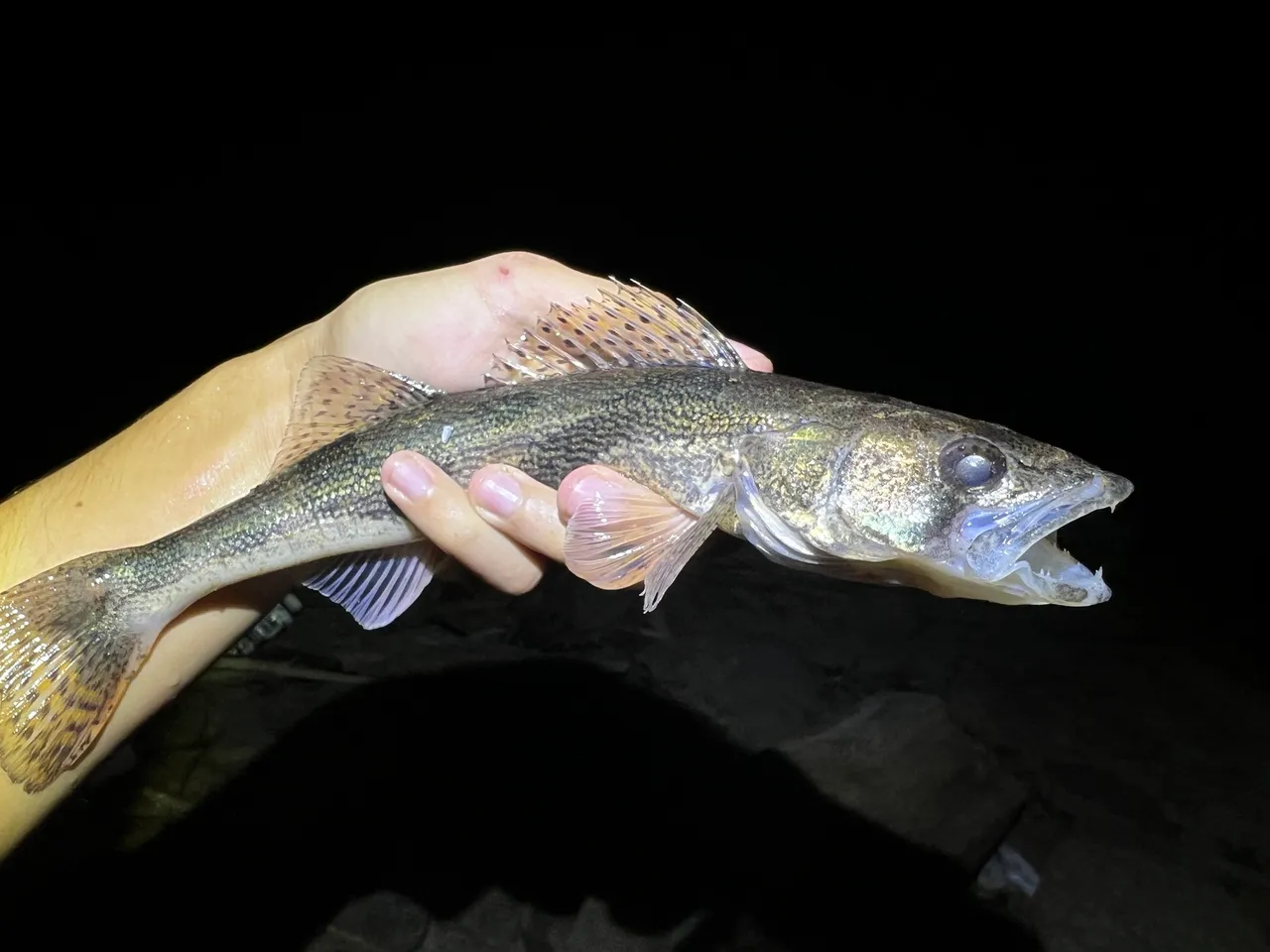
Identified by: Rows of distinct dark spots on the membranes of the erect spiny dorsal fin, dark saddle-like blotches on a brassy ground, and no white tip on the lower lobe of the caudal fin — the three characters that separate Sander canadensis from the walleye. Canines and a reflective tapetum visible. Four agreeing identifications on the source, none disagreeing.Nick Tobler (Cowturtle) — CC BY, via iNaturalist — source, licenceCatching Sauger
Everything here on fishing for it. Each entry opens the page behind it.
- Ground
Sauger is the fish American anglers catch while walleye fishing and frequently record as a small walleye, and the difference is worth getting right because the two live differently and are managed differently.
THREE CHARACTERS SEPARATE THEM AND TWO OF THEM ARE RELIABLE. First, THE SPINY DORSAL FIN: a sauger's is marked with distinct rows of dark spots on the membranes between the spines, while a walleye's is plain or carries a single dark blotch at the rear base. Second, THE TAIL: a walleye has a white or cream tip on the lower lobe of the tail, and a sauger does not. Third, and less reliably, sauger usually show dark saddle-like blotches across the back where a walleye is more uniformly mottled.
BOTH ARE PERCIDS WITH THE SAME MACHINERY. Canine teeth, a reflective tapetum lucidum behind the retina that gives both fish the glassy eye they are named for, and a strong preference for feeding in low light. That shared eye is the single most useful thing to know about either: they hunt when the light is poor, which means dawn, dusk, night, and — for sauger especially — turbid water at any hour.
THE HABITAT SPLIT IS THE INTERESTING PART. Walleye is the lake and reservoir fish; sauger is the fish of large turbid rivers, and it tolerates current, sediment and flow variation that walleye avoid. Where a river has been impounded, sauger populations have often suffered while walleye have gained, because the impoundment converts sauger habitat into walleye habitat. Sauger also undertake long upstream spawning migrations in big river systems, which makes them another species that dams affect directly.
AND THEY HYBRIDISE. The saugeye — a walleye/sauger cross — occurs naturally where the two meet and is stocked deliberately in some fisheries, and it is intermediate in exactly the characters used to tell the parents apart. That is worth knowing before betting on an identification in a river holding both.
How it is caught
Identification
- Scientific name
- Sander canadensis
- Family
- Percidae
- Water
- Freshwater
- Conservation status
- Least Concern
- Regions
- North America
- THE SPINY DORSAL FIN CARRIES DISTINCT ROWS OF DARK SPOTS on the membranes between the spines. A walleye's spiny dorsal is plain or carries a single dark blotch at the rear base.
- NO WHITE TIP ON THE LOWER LOBE OF THE TAIL. A walleye has a clear white or cream tip there, and it is visible in the water.
- Dark saddle-shaped blotches across the back and flanks; walleye are more uniformly mottled. Supporting rather than diagnostic.
- Smaller and more slender than a walleye of the same age, with a proportionally longer, more pointed head.
- Both species have canine teeth and the reflective eye that gives the group its name, so neither character distinguishes them.
- Saugeye — the natural and stocked walleye hybrid — is intermediate in all of the above, and cannot be named confidently by eye.
Size
- Typical
- 300 g–1 kg and 30–40 cm.
- Large
- Over 1.5 kg and 45 cm is a good sauger.
Exceptional: Reported maxima around 76 cm and 4 kg. Fish approaching that should be checked against walleye and saugeye before being claimed.
Where sauger live: the turbid river walleye avoid
The sauger's habitat is the clearest way to understand the fish, because it is defined against its better-known relative at every point.
SAUGER ARE FISH OF LARGE, TURBID, FLOWING RIVERS. Walleye are fish of clear lakes and reservoirs. Where the two overlap, sauger occupy the moving, coloured, sediment-laden water and walleye the clearer and stiller parts of the same system.
THE EYE EXPLAINS IT. Both species carry a tapetum lucidum — a reflective layer behind the retina — that makes the eye highly efficient in dim light. Sauger's tolerance of turbidity goes further than walleye's, which means a sauger can hunt in water where its prey is effectively blind and where a walleye would be at less of an advantage.
SO THEY ARE FOUND IN MAIN RIVER CHANNELS, in deep holes, over sand and rubble bottom, and above all in TAILWATERS — the turbulent, oxygenated, food-rich water immediately below a dam. Tailwater fisheries are the classic sauger location and are where most of the recreational catch comes from.
THEY MIGRATE LONG DISTANCES TO SPAWN, ascending rivers in early spring to reach gravel and rubble shoals. In a large unobstructed system those migrations can cover a very long way.
WHICH MAKES IMPOUNDMENT A DOUBLE PROBLEM. A dam blocks the migration, and it also converts the river above it into a lake — which is to say, it converts sauger habitat into walleye habitat. Sauger populations have contracted in impounded stretches across their range while walleye have gained, and the two facts are the same fact.
THE PRACTICAL CONSEQUENCE FOR AN ANGLER is that sauger are found by looking for the water walleye anglers ignore: coloured, moving, below a dam, and often in the cold months.
Backed by research — why, and the sources (2)
Supported by peer-reviewed research or fisheries science. The sources are listed and can be checked.
- FishBase: a global information system on fishes — Froese, R. and D. Pauly, eds. — FishBase Consortium (Scientific institute)Relied on for: Distribution, habitat association, depth range, growth, maximum size and reproductive parameters recorded for the species.States this directlyPassage read and verified
- The IUCN Red List of Threatened Species — International Union for Conservation of Nature (Conservation authority)Relied on for: Global conservation assessment, range and recorded threats for the species.States this directlyCitation checked — the work exists and is described correctly
How big a sauger gets
Sauger size is the character that most often causes a misidentification, because the fish is smaller than a walleye at every age and a large sauger looks like an ordinary walleye.
A TYPICAL SAUGER IS 30 TO 40 CENTIMETRES AND 300 GRAMS TO A KILOGRAM. Over 1.5 kilograms and 45 centimetres is a good fish in most waters.
REPORTED MAXIMA ARE AROUND 76 CENTIMETRES AND FOUR KILOGRAMS, and fish approaching that should be checked carefully against walleye and against saugeye before being claimed — the hybrid is intermediate in exactly the characters used to separate the parents, and it is stocked deliberately in some fisheries as well as occurring naturally.
GROWTH IS SLOWER AND ULTIMATE SIZE SMALLER THAN WALLEYE in the same system. That asymmetry is why the misidentification runs one way: a large sauger gets recorded as a modest walleye far more often than the reverse.
THEY ARE MODERATELY LONG-LIVED, maturing at two to four years and reaching well beyond ten in northern populations. Large sauger are therefore old sauger, and in heavily fished tailwaters the large fish are the ones a fishery has left rather than the ones it produces quickly.
WHICH BEARS ON MANAGEMENT AND ON RETENTION. Sauger and walleye are frequently managed under different size and bag rules in the same water, precisely because they grow differently — and an angler who cannot separate the two cannot comply with rules that treat them separately. That is the practical reason the identification matters, quite apart from the satisfaction of knowing what you caught.
Backed by research — why, and the sources (2)
Supported by peer-reviewed research or fisheries science. The sources are listed and can be checked.
- FishBase: a global information system on fishes — Froese, R. and D. Pauly, eds. — FishBase Consortium (Scientific institute)Relied on for: Distribution, habitat association, depth range, growth, maximum size and reproductive parameters recorded for the species.States this directlyPassage read and verified
- The IUCN Red List of Threatened Species — International Union for Conservation of Nature (Conservation authority)Relied on for: Global conservation assessment, range and recorded threats for the species.States this directlyCitation checked — the work exists and is described correctly
The sauger year, and why it is a cold-weather fishery
Sauger run to a calendar that puts the best fishing at the times most anglers have stopped, which is a large part of why the species is undervalued.
SPAWNING IS IN EARLY SPRING, on an upstream migration to gravel and rubble shoals in current. Eggs are broadcast rather than guarded. In big river systems the migration is long, and fish concentrate below any structure that interrupts it — which is both an opportunity and, where the structure is a dam, a population-level problem.
THROUGH SUMMER THEY DISPERSE into deeper river channels and tailwater flats, and are harder to locate because they are spread rather than stacked.
AUTUMN AND WINTER ARE THE CLASSIC SAUGER SEASON. Fish concentrate in tailwaters and in deep wintering holes, and they feed actively in cold water. A tailwater in November or February with a jig worked slowly along the bottom is the archetypal sauger fishery, and it is happening while most river anglers have put their gear away.
LOW LIGHT IS THE OTHER HALF OF THE TIMING. Sauger feed hardest at dawn, dusk and after dark, and in coloured water at any hour. A bright still day on clear water is the worst combination available; a grey day on a coloured river is the best.
SO THE PRACTICAL RULE IS THAT SAUGER FISHING HAPPENS WHERE AND WHEN WALLEYE FISHING DOES NOT — coloured rather than clear, moving rather than still, cold rather than warm, and dark rather than bright. An angler who understands that difference has roughly twice as much fishable year as one who does not.
What experienced anglers do — why, and the sources (2)
Widely and independently recommended by experienced anglers and specialist sources. This is real angling knowledge, not proof: controlled evidence for it is limited, and FishingHQ records it as convention rather than as a demonstrated effect.
- General angling website restatements of established technique — Various (Credible secondary source)Relied on for: Widely restated descriptions of species behaviour and regional angling practice, recorded as consensus rather than as scholarship.Background and mechanism onlyCitation checked — the work exists and is described correctly
- IGFA International Angling Rules and World Record Requirements — International Game Fish Association (Angling or fisheries organisation)Relied on for: International recreational angling practice and the record framework documenting which species are pursued and at what sizes.Background and mechanism onlyPassage read and verified
Handling a sauger
Sauger handling is a percid problem with a tailwater complication, and the second part is the one that gets overlooked.
THE TEETH AND SPINES ARE THE OBVIOUS PART. Prominent canines, a spiny first dorsal fin and sharp opercular edges mean a fish that is gripped carelessly will draw blood. A lip grip or a wet towel laid over the back controls the fish; long-nosed pliers keep fingers out of the mouth. Most injuries happen while removing a treble-hooked crankbait from a fish that is still moving, so controlling the fish before touching the hooks is the whole answer.
BAROTRAUMA IS THE COMPLICATION. Sauger are caught in deep tailwaters and deep river holes, and a fish brought up quickly from depth suffers swim-bladder expansion that it cannot correct. A fish that will not stay down when released, or whose stomach is visibly everted, has been injured by the ascent rather than by handling, and no amount of careful unhooking undoes it.
THE PRACTICAL RESPONSES ARE LIMITED AND WORTH KNOWING. Bringing fish up more slowly helps. Deciding in advance to keep fish from deep water — where the rules permit it — is more honest than releasing fish that will not survive. Descending devices, which return a fish to depth so it can recompress, are used in some fisheries and are worth having where deep-water release is routine.
AND THE SKIN AND SLIME MATTER AS THEY DO FOR ANY FISH. Wet hands, minimal air time, and support under the body rather than a vertical hold by the jaw for a heavy fish.
WHERE A FISH IS BEING KEPT, the catch-to-table records apply and the ordinary sequence — dispatch, then chill — is the one that decides whether it was worth keeping.
What experienced anglers do — why, and the sources (2)
Widely and independently recommended by experienced anglers and specialist sources. This is real angling knowledge, not proof: controlled evidence for it is limited, and FishingHQ records it as convention rather than as a demonstrated effect.
- General angling website restatements of established technique — Various (Credible secondary source)Relied on for: Widely restated descriptions of species behaviour and regional angling practice, recorded as consensus rather than as scholarship.Background and mechanism onlyCitation checked — the work exists and is described correctly
- IGFA International Angling Rules and World Record Requirements — International Game Fish Association (Angling or fisheries organisation)Relied on for: International recreational angling practice and the record framework documenting which species are pursued and at what sizes.Background and mechanism onlyPassage read and verified
Lifecycle and reproduction
Moderately long-lived, maturing at two to four years and reaching well over ten years in northern populations. Growth is slower and ultimate size smaller than walleye in the same system, which is part of why large sauger are misidentified as ordinary walleye rather than the reverse.
Spawns in early spring, ascending rivers to broadcast eggs over gravel, rubble and rocky shoals in current. Spawning migrations in large river systems can cover a very long distance, which makes the species sensitive to any structure that interrupts a river's length.
Feeding and senses
A fish predator taking shad, minnows and other small fish, with invertebrates important to younger fish. Feeds most heavily in low light and in turbid conditions, where its light-gathering eye gives it an advantage its prey does not have.
The tapetum lucidum — a reflective layer behind the retina — makes the eye highly efficient in dim light, and sauger are more tolerant of turbidity than walleye. That single adaptation explains the habitat, the timing and the methods: this is a fish that hunts when its prey cannot see.
Through the year
Moves upstream to spawn in early spring, disperses through the summer into deeper river channels and tailwaters, and concentrates below dams and in wintering holes in cold water. Tailwater fisheries in autumn and winter are the classic sauger opportunity.
Distribution
Central and eastern North America, in the Mississippi, Missouri, Ohio and Tennessee systems, the Great Lakes drainage and northward into the Canadian prairie provinces. It is a fish of large turbid rivers and river-run reservoirs rather than of clear lakes, and its range has contracted in impounded stretches.
This is a biological range — where the species occurs, not a prediction that you will catch one. To browse the fishing geography FishingHQ holds, start at fishing places.
Why anglers care
A widely fished river and tailwater species, taken on jigs tipped with soft plastic or minnow, on trolled crankbaits and on live bait fished near the bottom in current. Its practical significance is that it is caught where and when walleye are not — in coloured, moving water, below dams, and in cold weather — so an angler who understands the difference fishes twice as much of the year.
Handling and returning
Sharp canine teeth, sharp gill covers and a spiny first dorsal make this a fish to grip carefully; a lip grip or a wet towel over the back is the usual answer. Barotrauma is a real consideration in deep tailwater and reservoir fishing, and a fish brought up quickly from depth may not survive release however carefully it is handled.
Safety
Injury while handling fish — Can cause injury needing treatment
Sauger carry prominent canine teeth, a spiny first dorsal fin and sharp opercular edges. The commonest injuries occur while removing a jig or a treble-hooked crankbait from a fish that is still moving.
What reduces it: Control the fish before unhooking — a wet towel over the back or a lip grip. Use long-nosed pliers rather than fingers. Keep hands clear of the gill covers.
Worse when:
- Removing multi-hook lures from a fish that is not fully controlled
- Night fishing, which is when most sauger are caught
- Cold hands with reduced sensation and grip
Precautions that always apply here
- Keep fingers out of the gills and clear of the teeth. Gill damage is usually fatal to the fish, and several species will remove skin from a finger.
Check the rules before you fish
Fishing laws, bylaws, access rules, seasons, bait restrictions and permitted methods vary by location and can change. Check the current rules from the relevant authority and the water you intend to fish before fishing.
Check with:
- Current national or regional law for where you are fishing
- Current local bylaws
- The relevant fisheries authority
- The landowner, club or fishery whose water it is
- Any restrictions specific to the species or the method you intend to use
Where to go next
Where it lives
- Lowland riversThe habitat that separates it from walleye: large, turbid, flowing rivers, and the tailwaters below dams. Sauger tolerate current and sediment that walleye avoid, and impoundment converts sauger habitat into walleye habitat.
- ReservoirsPresent in river-run reservoirs and their tailwaters, which is where most of the recreational fishery happens, though it is a river fish occupying an impounded river rather than a lake fish.
Told apart from
More fish
Not related to this page — just the rest of the section. There is little else joined to this subject yet, and a short page should still lead somewhere.
Sources and evidence
- FishBase: a global information system on fishes — Froese, R. and D. Pauly, eds. — FishBase Consortium (Scientific institute)Relied on for: Distribution, habitat association, depth range, diet, growth and reproductive parameters recorded for the species.States this directlyPassage read and verified
- The IUCN Red List of Threatened Species — International Union for Conservation of Nature (Conservation authority)Relied on for: Global conservation assessment and the threats recorded for the species.States this directlyCitation checked — the work exists and is described correctly
- General angling website restatements of established technique — Various (Credible secondary source)Relied on for: Widely restated descriptions of species behaviour and regional angling practice, recorded as consensus rather than as scholarship.Background and mechanism onlyCitation checked — the work exists and is described correctly
Why the 5 connections on this page are here, and the sources
How it is caught
What experienced anglers do — 2 connections
Widely and independently recommended by experienced anglers and specialist sources. This is real angling knowledge, not proof: controlled evidence for it is limited, and FishingHQ records it as convention rather than as a demonstrated effect.
Jigging
A statement about how a species is fished outside Europe, resting on restated international practice rather than on the British angling literature.
- General angling website restatements of established technique — Various (Credible secondary source)Relied on for: Widely restated descriptions of regional angling practice, recorded as consensus rather than as scholarship.States this directlyCitation checked — the work exists and is described correctly
- IGFA International Angling Rules and World Record Requirements — International Game Fish Association (Angling or fisheries organisation)Relied on for: International recreational angling practice and the record framework that documents which species are pursued and how.Background and mechanism onlyPassage read and verified
Trolling
A statement about how a species is fished outside Europe, resting on restated international practice rather than on the British angling literature.
- General angling website restatements of established technique — Various (Credible secondary source)Relied on for: Widely restated descriptions of regional angling practice, recorded as consensus rather than as scholarship.States this directlyCitation checked — the work exists and is described correctly
- IGFA International Angling Rules and World Record Requirements — International Game Fish Association (Angling or fisheries organisation)Relied on for: International recreational angling practice and the record framework that documents which species are pursued and how.Background and mechanism onlyPassage read and verified
Where it lives
Backed by research — 2 connections
Supported by peer-reviewed research or fisheries science. The sources are listed and can be checked.
Lowland rivers
A distributional claim about a species outside the range of the British reference works, resting on the global databases instead.
- FishBase: a global information system on fishes — Froese, R. and D. Pauly, eds. — FishBase Consortium (Scientific institute)Relied on for: Distribution, habitat association, depth range, diet and reproductive parameters recorded for the species.States this directlyPassage read and verified
- The IUCN Red List of Threatened Species — International Union for Conservation of Nature (Conservation authority)Relied on for: Global conservation assessment, range and recorded threats for the species.States this directlyCitation checked — the work exists and is described correctly
Reservoirs
A distributional claim about a species outside the range of the British reference works, resting on the global databases instead.
- FishBase: a global information system on fishes — Froese, R. and D. Pauly, eds. — FishBase Consortium (Scientific institute)Relied on for: Distribution, habitat association, depth range, diet and reproductive parameters recorded for the species.States this directlyPassage read and verified
- The IUCN Red List of Threatened Species — International Union for Conservation of Nature (Conservation authority)Relied on for: Global conservation assessment, range and recorded threats for the species.States this directlyCitation checked — the work exists and is described correctly
Told apart from
Backed by research — 1 connection
Supported by peer-reviewed research or fisheries science. The sources are listed and can be checked.
Walleye
A claim that two species are genuinely confused and are separated by stated characters. It rests on the identification literature rather than on the observation that both exist.
- Freshwater Fishes of the British Isles — HarperCollins (New Naturalist 75), 1992 (Reference work)Relied on for: Distribution, habitat association, identification and life history of the freshwater fishes of the British Isles.States this directlyCitation checked — the work exists and is described correctly
- FishBase: a global information system on fishes — Froese, R. and D. Pauly, eds. — FishBase Consortium (Scientific institute)Relied on for: Distribution, habitat association, depth range, diet and reproductive parameters recorded for the species.States this directlyPassage read and verified
How FishingHQ labels evidence is explained in the evidence policy.