How to identify sauger
Sander canadensis · Percidae
The characters that identify sauger, ranked by how far each one can be trusted on its own.
Safety: injury while handling fish — can cause injury needing treatment.
How this was identified, and who took it
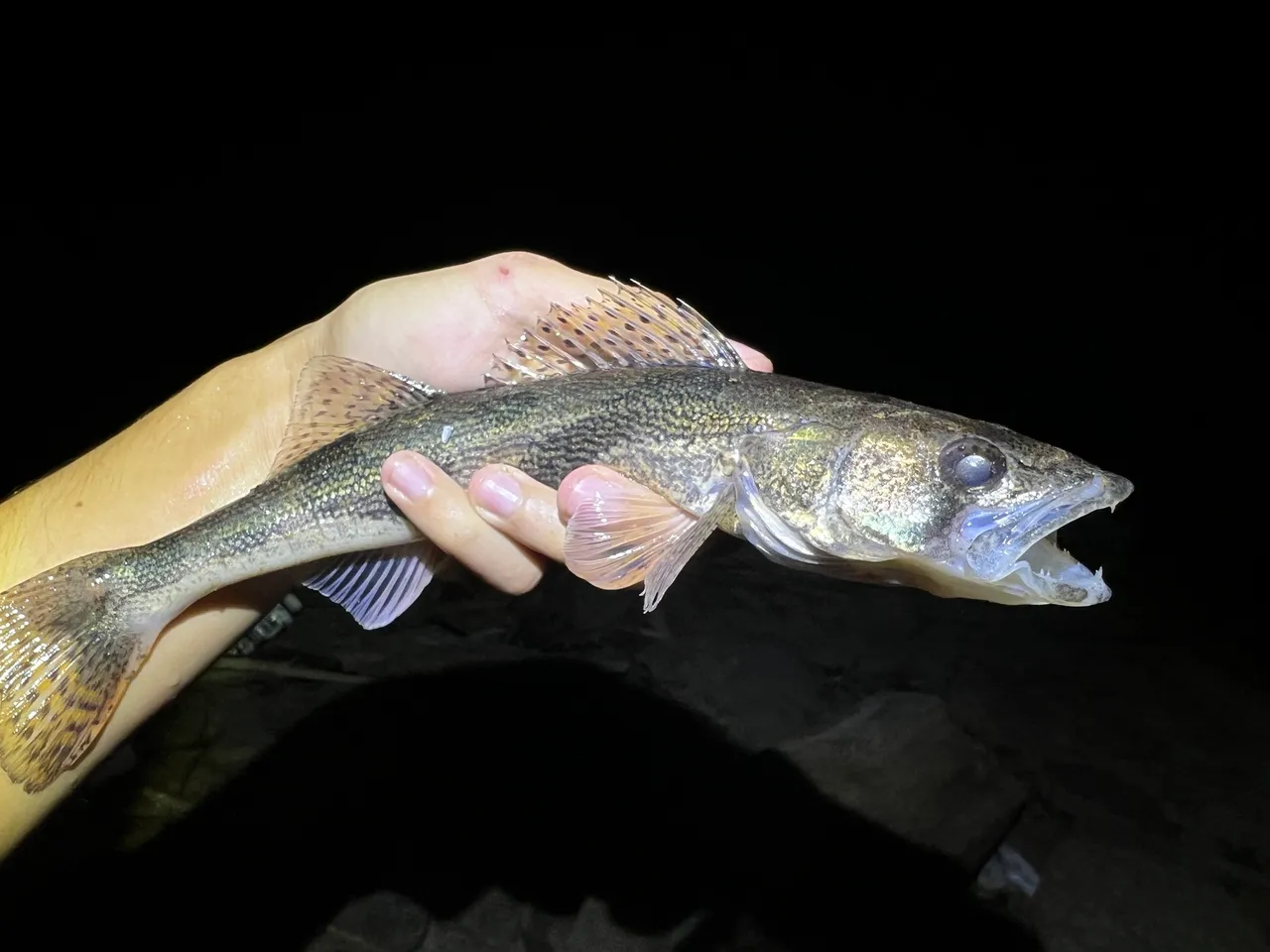
Identified by: Rows of distinct dark spots on the membranes of the erect spiny dorsal fin, dark saddle-like blotches on a brassy ground, and no white tip on the lower lobe of the caudal fin — the three characters that separate Sander canadensis from the walleye. Canines and a reflective tapetum visible. Four agreeing identifications on the source, none disagreeing.Nick Tobler (Cowturtle) — CC BY, via iNaturalist — source, licenceLook at this first
Raise the spiny dorsal fin before deciding anything else, because the character that settles this fish only exists when the fin is up. Spread between the spines there are rows of distinct dark spots on the membrane. A walleye's spiny dorsal is plain or carries one dark blotch low at the back of the fin, and it never carries rows.
Diagnostic — settles it on its own
Each of these settles the identification on its own. If one is clear, you have your answer.
Rows of dark spots across the spiny dorsal membrane
With the first dorsal fin raised, look at the skin stretched between the spines rather than at the spines themselves. On this fish it carries several rows of well-defined dark spots running the length of the fin. The nearest relative carries either a clean membrane or a single smudged blotch low at the rear of the fin, never ordered rows. This is the character that decides the species, and everything else on this page is subordinate to it.
No pale tip on the bottom lobe of the tail
Look at the lower corner of the caudal fin. A walleye carries a clear white or cream margin there, distinct enough to be visible on a fish still in the water beside a boat. This species does not. It is the second character to check and it is valuable precisely because it works at a distance and through the surface, before the fish is in hand and before the dorsal fin can be raised at all.
Supporting — use with other characters
Real characters that are not conclusive by themselves. Use two or three together.
Dark saddles across the back rather than an even mottle
The back and upper flank carry several distinct dark blotches shaped like saddles laid across the fish, with paler ground between them. The close relative is more evenly mottled and less obviously banded. This is a genuine difference and it is a matter of degree rather than of presence, so it will support a conclusion the dorsal fin has already reached and should not be asked to reach one on its own.
Size, and the point at which to be suspicious
Ordinary fish run 300 g to a kilo at 30 to 40 cm, and a good one exceeds 1.5 kg and 45 cm. Reported maxima are around 76 cm and 4 kg. A fish approaching those figures deserves particular care rather than particular confidence: at that size the alternative species and the hybrid are both far more likely than a record-class individual of this one, and the dorsal fin should be checked before the fish is claimed.
Suggestive only — varies with condition
Hints only. These vary with condition, season, water and how long the fish has been out of it, and a fish that contradicts them is still the same species.
A slimmer body and a longer, more pointed head
At the same age this fish is smaller and noticeably less deep through the body than its relative, and the head is proportionally longer and more sharply pointed. It is a real difference and it is nearly useless to anyone who has not handled both recently, because it is a proportion judged without a reference fish alongside. Rank it last among the body characters and use it to raise a suspicion rather than to confirm one.
Large turbid rivers rather than clear lakes
The range covers central and eastern North America — the Mississippi, Missouri, Ohio and Tennessee systems, the Great Lakes drainage and north into the Canadian prairie provinces. Within it this is a fish of big coloured rivers and river-run reservoirs, and its range has contracted where rivers have been impounded. Habitat shifts the odds and settles nothing, because the species it is confused with occupies the same water.
Where and when they concentrate
The fish moves upstream to spawn in early spring, spreads into deeper river channels and tailwaters through summer, and gathers below dams and in wintering holes as the water cools. Autumn and winter tailwater concentrations are the classic encounter. This is context rather than identification: it tells a reader why they are looking at this fish in this place, and it does not distinguish it from anything sharing the tailwater.
What it gets confused with
- Walleye, the species this fish is most often taken for, separated by the spotted dorsal membrane and by the pale tip on the lower tail lobe.
- Saugeye, the walleye hybrid, which is stocked widely and is intermediate in every character on this page.
- Yellow perch, which shares the banded look at small sizes but has no canine teeth and a very different body shape.
Where this stops working
This page cannot separate a sauger from a saugeye, and neither can anybody else working from a photograph. The hybrid occurs naturally where the parents overlap and is stocked deliberately across much of this species' range; it is intermediate in the dorsal spotting, in the tail tip and in body proportion, which means it can present as a convincing example of either parent. A fish showing spotted dorsal membranes AND a faint pale tail tip is a hybrid until proven otherwise. Beyond that, the leading character requires an erect fin: a photograph of a fish with the dorsal folded flat has not recorded the evidence, however good the picture is otherwise. Both species carry canine teeth and the reflective eye layer the group is known for, so neither of those is worth checking at all.
The full record
This page covers identification only. The Sauger record covers behaviour, lifecycle, distribution, handling and the sources behind all of it.
Reviewed 2026-08-17.
More about this fish
Telling it apart is one question. Here are the others.
How it is caught
Where it lives
- Lowland riversThe habitat that separates it from walleye: large, turbid, flowing rivers, and the tailwaters below dams. Sauger tolerate current and sediment that walleye avoid, and impoundment converts sauger habitat into walleye habitat.
- ReservoirsPresent in river-run reservoirs and their tailwaters, which is where most of the recreational fishery happens, though it is a river fish occupying an impounded river rather than a lake fish.
Why the 4 connections on this page are here, and the sources
How it is caught
What experienced anglers do — 2 connections
Widely and independently recommended by experienced anglers and specialist sources. This is real angling knowledge, not proof: controlled evidence for it is limited, and FishingHQ records it as convention rather than as a demonstrated effect.
Jigging
A statement about how a species is fished outside Europe, resting on restated international practice rather than on the British angling literature.
- General angling website restatements of established technique — Various (Credible secondary source)Relied on for: Widely restated descriptions of regional angling practice, recorded as consensus rather than as scholarship.States this directlyCitation checked — the work exists and is described correctly
- IGFA International Angling Rules and World Record Requirements — International Game Fish Association (Angling or fisheries organisation)Relied on for: International recreational angling practice and the record framework that documents which species are pursued and how.Background and mechanism onlyPassage read and verified
Trolling
A statement about how a species is fished outside Europe, resting on restated international practice rather than on the British angling literature.
- General angling website restatements of established technique — Various (Credible secondary source)Relied on for: Widely restated descriptions of regional angling practice, recorded as consensus rather than as scholarship.States this directlyCitation checked — the work exists and is described correctly
- IGFA International Angling Rules and World Record Requirements — International Game Fish Association (Angling or fisheries organisation)Relied on for: International recreational angling practice and the record framework that documents which species are pursued and how.Background and mechanism onlyPassage read and verified
Where it lives
Backed by research — 2 connections
Supported by peer-reviewed research or fisheries science. The sources are listed and can be checked.
Lowland rivers
A distributional claim about a species outside the range of the British reference works, resting on the global databases instead.
- FishBase: a global information system on fishes — Froese, R. and D. Pauly, eds. — FishBase Consortium (Scientific institute)Relied on for: Distribution, habitat association, depth range, diet and reproductive parameters recorded for the species.States this directlyPassage read and verified
- The IUCN Red List of Threatened Species — International Union for Conservation of Nature (Conservation authority)Relied on for: Global conservation assessment, range and recorded threats for the species.States this directlyCitation checked — the work exists and is described correctly
Reservoirs
A distributional claim about a species outside the range of the British reference works, resting on the global databases instead.
- FishBase: a global information system on fishes — Froese, R. and D. Pauly, eds. — FishBase Consortium (Scientific institute)Relied on for: Distribution, habitat association, depth range, diet and reproductive parameters recorded for the species.States this directlyPassage read and verified
- The IUCN Red List of Threatened Species — International Union for Conservation of Nature (Conservation authority)Relied on for: Global conservation assessment, range and recorded threats for the species.States this directlyCitation checked — the work exists and is described correctly
Safety
Injury while handling fish — Can cause injury needing treatment
Sauger carry prominent canine teeth, a spiny first dorsal fin and sharp opercular edges. The commonest injuries occur while removing a jig or a treble-hooked crankbait from a fish that is still moving.
What reduces it: Control the fish before unhooking — a wet towel over the back or a lip grip. Use long-nosed pliers rather than fingers. Keep hands clear of the gill covers.
Worse when:
- Removing multi-hook lures from a fish that is not fully controlled
- Night fishing, which is when most sauger are caught
- Cold hands with reduced sensation and grip