North American freshwater fishing
Fishing regions · Last reviewed 2026-08-14
A continent of glacial lakes, enormous river systems and a bass fishery that became an industry — organised around boats, electronics and public access in a way that has no European equivalent.
Safety: cold water shock — can cause serious injury or death. One more point applies here.
Being listed here is not permission to fish. What that meansClose
Access, fishing rights, seasons, licences, local bylaws and permitted methods vary and can change. Check current access, permission, local regulations, closures and restrictions before you travel or fish. FishingHQ describes what the ground is and names who holds the answer; it does not hold the answer itself.
Find the authority for a jurisdiction · What FishingHQ does and does not cover
North American freshwater fishing is the largest recreational freshwater fishery in the world, and the things that make it distinctive are structural rather than biological.
THE WATER IS PUBLIC IN A WAY EUROPEAN WATER IS NOT. Across most of the United States and Canada, fishing rights on navigable waters are held publicly and access is by state or provincial licence rather than by permission from a landowner or a club. A European angler's first surprise is that one licence covers thousands of waters. The second is what that does to the culture: no syndicates, no bailiffs, no waiting lists, and a fishery whose limiting factor is a boat ramp rather than a subscription.
THE GEOGRAPHY IS GLACIAL AND VAST. The last glaciation left tens of thousands of lakes across the northern half of the continent — the Great Lakes at one extreme, and a scatter of small clear lakes across Ontario, Quebec, Minnesota, Wisconsin and Michigan at the other. South and west of the ice limit, the continent is organised by enormous river systems: the Mississippi and its tributaries draining most of the interior, the Colorado and the Columbia in the west, the Mackenzie and the Yukon in the north.
AND MUCH OF THE FISHERY IS ENGINEERED. Reservoirs built for flood control, power and water supply — particularly across the south and the interior — are among the most heavily fished waters on the continent, and several of the most famous fisheries did not exist a century ago.
THE CATCH DIVIDES ROUGHLY BY LATITUDE AND TEMPERATURE. Coldwater: trout, char, salmon in the north and in the mountains. Coolwater: walleye, northern pike, muskellunge, smallmouth bass across the glaciated middle. Warmwater: largemouth bass, crappie, sunfish, catfish across the south and the reservoirs. The bass, in particular, is the organising fish of American angling in the way carp is of British.
WHAT A VISITOR SHOULD KNOW BEFORE ANYTHING ELSE: the licence is per state or province and does not travel, non-resident licences are a separate class, and the rules on baitfish and their movement are strict everywhere and vary sharply between jurisdictions.
What fishing here is like
A publicly accessible, licence-based freshwater fishery of enormous extent, organised around boats and around a species mix that shifts with latitude. The bass fishery of the south and the interior is a professional sport with its own industry; the coolwater fishery of the glaciated north is a cabin-and-boat tradition; and the coldwater fishery of the mountains and the far north is closer to what a European game angler would recognise.
The culture is boat-centred to a degree that surprises visitors. Bank fishing exists and is normal, but a very large share of the continent's freshwater angling is done from a boat with a sounder, and the equipment expectations follow from that.
What dominates
Lure fishing for black bass, which is the continent's dominant recreational discipline and the one with the largest industry behind it. Trolling and jigging for walleye, pike and muskellunge across the coolwater belt. Fly fishing for trout in the mountain west, the north-east and the spring creeks of the interior. Ice fishing across the northern tier through the winter, which is a substantial season rather than a curiosity. Catfishing in the southern rivers and reservoirs, including a distinct big-catfish specialism. Panfish fishing for crappie and sunfish, which is the family and food fishery of much of the continent.
The water available
Glacial lakes in tens of thousands across the north, from the Great Lakes down to small clear cold lakes. Enormous engineered reservoirs across the south and interior, many with standing timber and drowned structure. Continental river systems — the Mississippi and its tributaries, the Columbia, the Colorado, the Mackenzie. Spring creeks and tailwaters with stable temperature and flow. Prairie potholes and shallow warmwater lakes. Subarctic rivers and lakes in the far north with very short seasons.
How the rules are structured
Freshwater fishing is regulated at the STATE or PROVINCIAL level rather than nationally, which is the single most important structural fact for a visitor: rules, licences, seasons, limits and permitted methods differ between neighbouring jurisdictions and a licence does not travel across a state line. Non-resident licences are a distinct category and are usually more expensive and sometimes shorter. Baitfish rules are strict and vary sharply — several jurisdictions prohibit the movement or use of live baitfish entirely, in response to invasive species and disease. Tribal and treaty fishing rights exist across much of the continent and are administered separately, with their own waters, seasons and authorities. Federal law applies to migratory species, endangered species and interstate transport. FishingHQ does not state what any current rule is: establish the position with the state or provincial fish and wildlife agency for the specific jurisdiction before fishing.
Who to ask
- The state or provincial fish and wildlife agency for the jurisdiction concerned — the primary authority for licences, seasons, limits and methods, and different in every state and province
- The relevant tribal or First Nations fisheries authority, where fishing on or adjacent to tribal waters or under treaty rights
- The federal fisheries or wildlife agency, for migratory and endangered species and for interstate movement of fish and bait
- The managing body of any reservoir, park or public land, which frequently adds its own access, launch and boating rules
- The local conservation officer or warden service, which is the enforcement arm and often the fastest source of a current answer
Words you will meet
- Panfish
- Crappie, bluegill, perch and other small edible species taken in numbers — a category with no British equivalent and one that carries no dismissive sense.
- Tailwater
- The river below a dam, where releases from depth keep the temperature and flow far more stable than a natural river. Several of the continent's best trout fisheries are tailwaters and are entirely artificial in character.
- Slot limit
- A retention rule specifying a size RANGE rather than a minimum — protecting both juveniles and the large breeding fish. Very widely used across North America and much rarer in Europe.
- Skunked
- To blank; to catch nothing. Universal across the continent.
- Structure and cover
- Two distinct ideas that European anglers usually merge. Structure is the shape of the bottom — points, humps, drop-offs, creek channels. Cover is what sits on it — timber, weed, rock. Bass fishing vocabulary keeps them apart because they are found and fished differently.
Conditions and hazards
Distance and isolation are the characteristic hazards rather than tide or swell. Large lakes generate genuinely dangerous water very quickly — the Great Lakes in particular behave like inland seas — and small craft are caught out by fetch rather than by current.
Cold is the second: much of the continent's fishing happens in water and air temperatures where immersion is rapidly disabling, and the ice-fishing season adds the specific and serious problem of judging ice, which is local knowledge that does not transfer between waters.
Wildlife encounters are a real consideration across much of the north and west, including bears at salmon rivers, and are managed by food and waste discipline rather than by chance.
Heat, sun exposure and dehydration are the corresponding southern problem, on open reservoirs with no shade.
Mobile coverage is absent across large areas, and the practical requirement is that somebody knows the plan and the return time.
The environments, and why the ice line explains most of them
The last glaciation is the single most useful organising fact for this continent's fresh water.
NORTH OF THE ICE LIMIT the landscape was scoured and left with tens of thousands of lakes — deep, cold, clear, often rocky, and connected by short rivers. This is the coolwater and coldwater belt, and it runs from the Canadian north through the Great Lakes and into the northern tier of the United States.
SOUTH AND WEST OF IT the continent is organised by rivers rather than lakes, and by the reservoirs built on them. Warm, often turbid, frequently with drowned timber and complex bottom structure, these are the waters that produced the modern bass fishery.
THE MOUNTAIN WEST is a third case: cold, fast, clear rivers and high lakes, with trout and char, and a fly-fishing culture closer to European game angling than anything else on the continent.
AND THE SPRING CREEKS AND TAILWATERS are a fourth. Groundwater-fed or dam-released, they hold temperature and flow far more stable than any natural river at their latitude, which produces year-round trout fisheries in places that could not otherwise support one.
What experienced anglers do — why, and the sources (2)
Widely and independently recommended by experienced anglers and specialist sources. This is real angling knowledge, not proof: controlled evidence for it is limited, and FishingHQ records it as convention rather than as a demonstrated effect.
- FishBase: a global information system on fishes — Froese, R. and D. Pauly, eds. — FishBase Consortium (Scientific institute)Relied on for: Distribution, habitat association, life history and diet recorded for the species concerned.States this directlyPassage read and verified
- General angling website restatements of established technique — Various (Credible secondary source)Relied on for: Widely restated descriptions of regional angling practice, recorded as consensus rather than as scholarship.Background and mechanism onlyCitation checked — the work exists and is described correctly
What is caught, and how the year is shaped
The species mix tracks water temperature, and the year tracks it too.
WARMWATER — largemouth bass, crappie, bluegill, catfish — across the south and the reservoirs, feeding hard from spring through autumn and slowing but not stopping in winter.
COOLWATER — walleye, northern pike, muskellunge, smallmouth bass — across the glaciated middle, with a spring opener that is a genuine cultural event in several states and provinces, and a hard-water season in winter.
COLDWATER — trout, char, grayling, and landlocked and sea-run salmon — in the mountains and the north, with short intense seasons at high latitude.
THE SPRING OPENER AND THE CLOSED SEASON structure the year in most jurisdictions, and are set around spawning. Ice-out in the north produces a compressed and productive few weeks. Summer stratification pushes fish deep in the reservoirs. Autumn cooling produces the year's best predator fishing before the freeze.
What experienced anglers do — why, and the sources (2)
Widely and independently recommended by experienced anglers and specialist sources. This is real angling knowledge, not proof: controlled evidence for it is limited, and FishingHQ records it as convention rather than as a demonstrated effect.
- FishBase: a global information system on fishes — Froese, R. and D. Pauly, eds. — FishBase Consortium (Scientific institute)Relied on for: Distribution, habitat association, life history and diet recorded for the species concerned.States this directlyPassage read and verified
- The IUCN Red List of Threatened Species — International Union for Conservation of Nature (Conservation authority)Relied on for: Global extinction-risk assessment, population trend and identified threats for the species concerned.States this directlyCitation checked — the work exists and is described correctly
How it is fished, and why the boat is central
A very large share of North American freshwater angling is done afloat, and the equipment culture follows.
BASS FISHING FROM A BOAT, with a sounder, an electric bow motor and a large lure inventory, is the dominant discipline and has a professional tournament circuit behind it that has shaped the tackle available worldwide.
TROLLING AND JIGGING for walleye, pike and muskellunge across the big coolwater lakes, where covering water is the problem and electronics are the answer.
FLY FISHING in the mountain west and north-east, on rivers, spring creeks and tailwaters.
ICE FISHING across the northern tier, from a bucket to a heated shelter, with its own tackle, its own social culture and its own serious safety problem.
BANK AND PIER FISHING for catfish and panfish, which is the continent's most accessible fishery and the one most visitors overlook.
AND KAYAK FISHING, which has grown substantially and suits the shallow, timber-filled reservoirs particularly well.
What experienced anglers do — why, and the sources (2)
Widely and independently recommended by experienced anglers and specialist sources. This is real angling knowledge, not proof: controlled evidence for it is limited, and FishingHQ records it as convention rather than as a demonstrated effect.
- General angling website restatements of established technique — Various (Credible secondary source)Relied on for: Widely restated descriptions of regional angling practice, recorded as consensus rather than as scholarship.Background and mechanism onlyCitation checked — the work exists and is described correctly
- FAO fishing gear types and fishing technology information — Food and Agriculture Organization of the United Nations (Scientific institute)Relied on for: Classification and description of world fishing gears and the regions in which each is used.States this directlyCitation checked — the work exists and is described correctly
A public fishery, and the history that made it one
The defining cultural fact is that the water is publicly accessible under a licence, and that is a deliberate historical settlement rather than an accident.
North American fish and wildlife management developed through the twentieth century around the principle that wildlife is held in trust for the public rather than attached to land ownership, funded substantially by licence fees and by excise taxes on tackle. Whatever one thinks of the details, the practical result is a continent where an ordinary person can buy a licence and fish thousands of waters, which is not the European position and is the thing European anglers most consistently envy.
The bass fishery is the other great cultural fact. Competitive bass angling grew from the 1960s into a professional sport with televised events, sponsored anglers and a tackle industry that drives global product development. A very large proportion of the lure technology sold worldwide was designed for American bass fishing first.
AND TRIBAL AND TREATY FISHING RIGHTS are a live and significant part of the picture across much of the continent — rights that predate the state, are recognised in law, are administered by tribal authorities, and have been the subject of substantial litigation. A visitor should understand that these are separate legal systems governing the same water, not an exception to the general one.
What experienced anglers do — why, and the sources (2)
Widely and independently recommended by experienced anglers and specialist sources. This is real angling knowledge, not proof: controlled evidence for it is limited, and FishingHQ records it as convention rather than as a demonstrated effect.
- Code of Conduct for Responsible Fisheries — Food and Agriculture Organization of the United Nations, Rome, 1995 (Standards body)Relied on for: International principles for responsible fisheries, including small-scale and artisanal fisheries and the role of national authorities.States this directlyCitation checked — the work exists and is described correctly
- General angling website restatements of established technique — Various (Credible secondary source)Relied on for: Widely restated descriptions of regional angling practice, recorded as consensus rather than as scholarship.Background and mechanism onlyCitation checked — the work exists and is described correctly
The vocabulary, and where it will trip a visitor
The vocabulary differs enough to cause real confusion.
PANFISH has no British equivalent and no dismissive sense: it means small edible species taken in numbers and is a respected fishery.
STRUCTURE AND COVER are kept apart. Structure is the shape of the bottom; cover is what sits on it. British usage merges them and American bass vocabulary does not, because they are located and fished differently.
TAILWATER means the river below a dam, and is a specific and important fishery type.
SLOT LIMIT means a retention size RANGE rather than a minimum, and is far more common here than in Europe.
CRANKBAIT, JERKBAIT, SPINNERBAIT and the rest of the lure vocabulary originate here and have been exported wholesale.
AND THE WORD 'BASS' is the classic trap: American black bass are sunfishes and are unrelated to the European sea bass, to the striped bass, or to Australian bass. Four different fish, one word.
What experienced anglers do — why, and the sources (2)
Widely and independently recommended by experienced anglers and specialist sources. This is real angling knowledge, not proof: controlled evidence for it is limited, and FishingHQ records it as convention rather than as a demonstrated effect.
- FishBase: a global information system on fishes — Froese, R. and D. Pauly, eds. — FishBase Consortium (Scientific institute)Relied on for: Distribution, habitat association, life history and diet recorded for the species concerned.States this directlyPassage read and verified
- General angling website restatements of established technique — Various (Credible secondary source)Relied on for: Widely restated descriptions of regional angling practice, recorded as consensus rather than as scholarship.Background and mechanism onlyCitation checked — the work exists and is described correctly
Who governs it, and why a state line matters more than a national border
The structural fact a visitor must absorb is that freshwater fishing is administered by the STATE or PROVINCE, not by the country.
Each state and each province has its own fish and wildlife agency setting its own licences, seasons, size and bag limits, permitted methods and baitfish rules. Those differ across a state line as much as across an international border, and a licence does not travel. Non-resident licences are a separate and usually more expensive class, sometimes issued for short periods.
BAITFISH RULES deserve specific attention because they are strict, they vary sharply, and breaking them is both an offence and an ecological harm. Several jurisdictions prohibit the use or movement of live baitfish outright in response to invasive species and fish disease.
TRIBAL AND TREATY FISHERIES are administered by tribal authorities under separate legal arrangements, with their own rules and their own waters.
FEDERAL LAW covers migratory species, endangered species and interstate transport.
AND RESERVOIRS, PARKS AND PUBLIC LANDS frequently add their own access, launch and boating requirements on top of everything above. FishingHQ states none of these; the state or provincial agency is the place to start and the conservation officer is often the fastest route to a current answer.
Official guidance — why, and the sources (2)
Stated by a fisheries authority, scientific institute or recognised angling body. Authoritative, but summarising rather than demonstrating.
- Code of Conduct for Responsible Fisheries — Food and Agriculture Organization of the United Nations, Rome, 1995 (Standards body)Relied on for: International principles for responsible fisheries, including small-scale and artisanal fisheries and the role of national authorities.States this directlyCitation checked — the work exists and is described correctly
- Good Fish Guide — Marine Conservation Society (Conservation authority)Relied on for: Synthesis of stock and gear information relating fishing methods to their effects on stocks and habitats.Background and mechanism onlyCitation checked — the work exists and is described correctly
Some of what lives here
Fish recorded here that FishingHQ holds a reviewed photograph of. It is not a complete list of what North American freshwater fishing holds, and it is not a prediction that you will catch any of them — it is a way in to the ones we can show you.
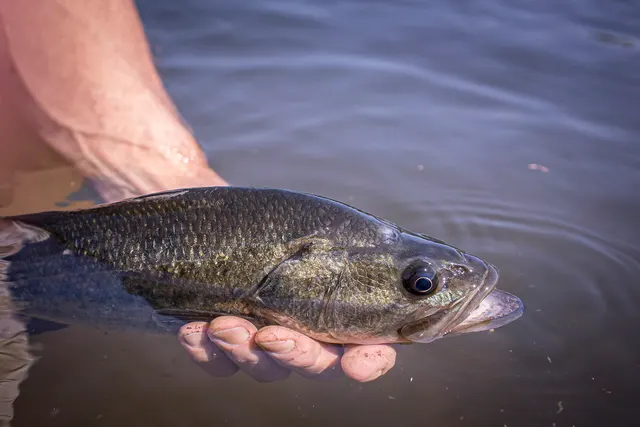 Largemouth bassThe most heavily fished freshwater sport species in the world: an ambush predator of warm, weedy, structured water.
USFWS Mountain Prairie, Public domain, via Wikimedia Commons
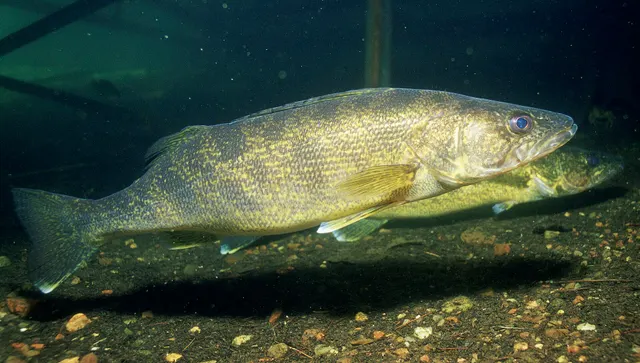 WalleyeA low-light predator of large North American lakes and rivers whose reflective eye lets it hunt in conditions where its prey cannot see it coming.
Engbretson, Eric / U.S. Fish and Wildlife Service, Public domain, via Wikimedia Commons
Safety
Cold water shock — Can cause serious injury or death
Much of the continent's freshwater fishing takes place in water cold enough to disable a person within a minute of immersion, and the large lakes generate steep dangerous water with very little warning because the fetch is enormous. Small craft are lost to wind rather than to current.
What reduces it: Wear a buoyancy aid afloat, watch the forecast for wind rather than for rain, treat the big lakes as inland seas rather than as lakes, and file a plan with somebody who will notice if you do not return.
Worse when:
- The Great Lakes and other large open waters, where fetch builds a sea quickly
- Ice-out and late autumn, when water temperature is at its most dangerous
- Remote water with no mobile coverage and no other boats
Biosecurity and disease transfer — Can cause serious injury or death
Moving live baitfish, water or unclean equipment between waters spreads invasive species and fish disease across a connected continental system. Several jurisdictions have prohibited live baitfish entirely in response, and enforcement is active.
What reduces it: Never move live bait, fish or water between waters; drain every compartment before leaving a launch; and check the specific baitfish rules for the jurisdiction, which differ across a state line.
Check the rules before you fish
Fishing laws, bylaws, access rules, seasons, bait restrictions and permitted methods vary by location and can change. Check the current rules from the relevant authority and the water you intend to fish before fishing.
Check with:
- Current national or regional law for where you are fishing
- Current local bylaws
- The relevant fisheries authority
- The landowner, club or fishery whose water it is
- Any restrictions specific to the species or the method you intend to use
Where to go next
What swims here
How people fish here
Local knowledge
How this compares
- The Great LakesThe Great Lakes are the largest single piece of the continent's fresh water and are not representative of it: the overview exists to say how they relate to the reservoirs, the prairie lakes and the mountain rivers.
- United StatesThe freshwater story — public access under a state licence, a bass fishery that became an industry — is continental rather than national, and this is where the national record connects to it.
Sources and evidence
- FishBase: a global information system on fishes — Froese, R. and D. Pauly, eds. — FishBase Consortium (Scientific institute)Relied on for: Distribution, habitat association, life history and diet recorded for the species concerned.States this directlyPassage read and verified
- Code of Conduct for Responsible Fisheries — Food and Agriculture Organization of the United Nations, Rome, 1995 (Standards body)Relied on for: International principles for responsible fisheries, including small-scale and artisanal fisheries and the role of national authorities.States this directlyCitation checked — the work exists and is described correctly
- General angling website restatements of established technique — Various (Credible secondary source)Relied on for: Widely restated descriptions of regional angling practice, recorded as consensus rather than as scholarship.Background and mechanism onlyCitation checked — the work exists and is described correctly
Why the 6 connections on this page are here, and the sources
What swims here
Backed by research — 2 connections
Supported by peer-reviewed research or fisheries science. The sources are listed and can be checked.
Largemouth bass
A distributional claim taken from reference sources on the species rather than from angling report. It states presence and asserts nothing about a fishery.
- FishBase: a global information system on fishes — Froese, R. and D. Pauly, eds. — FishBase Consortium (Scientific institute)Relied on for: Distribution, habitat association, depth range and life history recorded for the species concerned.States this directlyPassage read and verified
- The IUCN Red List of Threatened Species — International Union for Conservation of Nature (Conservation authority)Relied on for: Global distribution, population trend and extinction-risk assessment for the species concerned.States this directlyCitation checked — the work exists and is described correctly
Walleye
A distributional claim taken from reference sources on the species rather than from angling report. It states presence and asserts nothing about a fishery.
- FishBase: a global information system on fishes — Froese, R. and D. Pauly, eds. — FishBase Consortium (Scientific institute)Relied on for: Distribution, habitat association, depth range and life history recorded for the species concerned.States this directlyPassage read and verified
- The IUCN Red List of Threatened Species — International Union for Conservation of Nature (Conservation authority)Relied on for: Global distribution, population trend and extinction-risk assessment for the species concerned.States this directlyCitation checked — the work exists and is described correctly
How people fish here
What experienced anglers do — 1 connection
Widely and independently recommended by experienced anglers and specialist sources. This is real angling knowledge, not proof: controlled evidence for it is limited, and FishingHQ records it as convention rather than as a demonstrated effect.
Lure fishing
Which branch of fishing dominates a region is a statement about practice rather than about the place, and is recorded as convention.
- FAO fishing gear types and fishing technology information — Food and Agriculture Organization of the United Nations (Scientific institute)Relied on for: Classification and description of world fishing gears and the regions in which each is used.States this directlyCitation checked — the work exists and is described correctly
- General angling website restatements of established technique — Various (Credible secondary source)Relied on for: Widely restated descriptions of regional angling practice, recorded as consensus rather than as scholarship.Background and mechanism onlyCitation checked — the work exists and is described correctly
Local knowledge
What experienced anglers do — 1 connection
Widely and independently recommended by experienced anglers and specialist sources. This is real angling knowledge, not proof: controlled evidence for it is limited, and FishingHQ records it as convention rather than as a demonstrated effect.
The fishing year: what each season changes
A region joined to the mechanism that explains what is distinctive about fishing there, which is what makes the description transferable rather than local colour.
- FAO fishing gear types and fishing technology information — Food and Agriculture Organization of the United Nations (Scientific institute)Relied on for: Classification and description of world fishing gears and the regions in which each is used.States this directlyCitation checked — the work exists and is described correctly
- General angling website restatements of established technique — Various (Credible secondary source)Relied on for: Widely restated descriptions of regional angling practice, recorded as consensus rather than as scholarship.Background and mechanism onlyCitation checked — the work exists and is described correctly
How this compares
What experienced anglers do — 2 connections
Widely and independently recommended by experienced anglers and specialist sources. This is real angling knowledge, not proof: controlled evidence for it is limited, and FishingHQ records it as convention rather than as a demonstrated effect.
The Great Lakes
A continental overview joined to a record it sits above, so that the synthesis and the detail are reachable from one another rather than duplicating each other.
- FAO fishing gear types and fishing technology information — Food and Agriculture Organization of the United Nations (Scientific institute)Relied on for: Classification and description of world fishing gears and the regions in which each is used.States this directlyCitation checked — the work exists and is described correctly
- General angling website restatements of established technique — Various (Credible secondary source)Relied on for: Widely restated descriptions of regional angling practice, recorded as consensus rather than as scholarship.Background and mechanism onlyCitation checked — the work exists and is described correctly
United States
Two places or records a reader will hold together, joined where the comparison teaches something neither states alone.
- Coarse Fishing — A. & C. Black, 1912 (Specialist angling publication)Relied on for: Classical British coarse angling practice: river and stillwater reading, baits and seasonal observation.States this directlyCitation checked — the work exists and is described correctly
- Angling Times — Bauer Media (Specialist angling publication)Relied on for: Contemporary UK coarse angling practice as reported by practitioners, including venue character and method convention.States this directlyCitation checked — the work exists and is described correctly
How FishingHQ labels evidence is explained in the evidence policy.