How to identify walleye
Sander vitreus · Percidae
The characters that identify walleye, ranked by how far each one can be trusted on its own.
Safety: injury while handling fish — can cause injury needing treatment. One more point applies here.
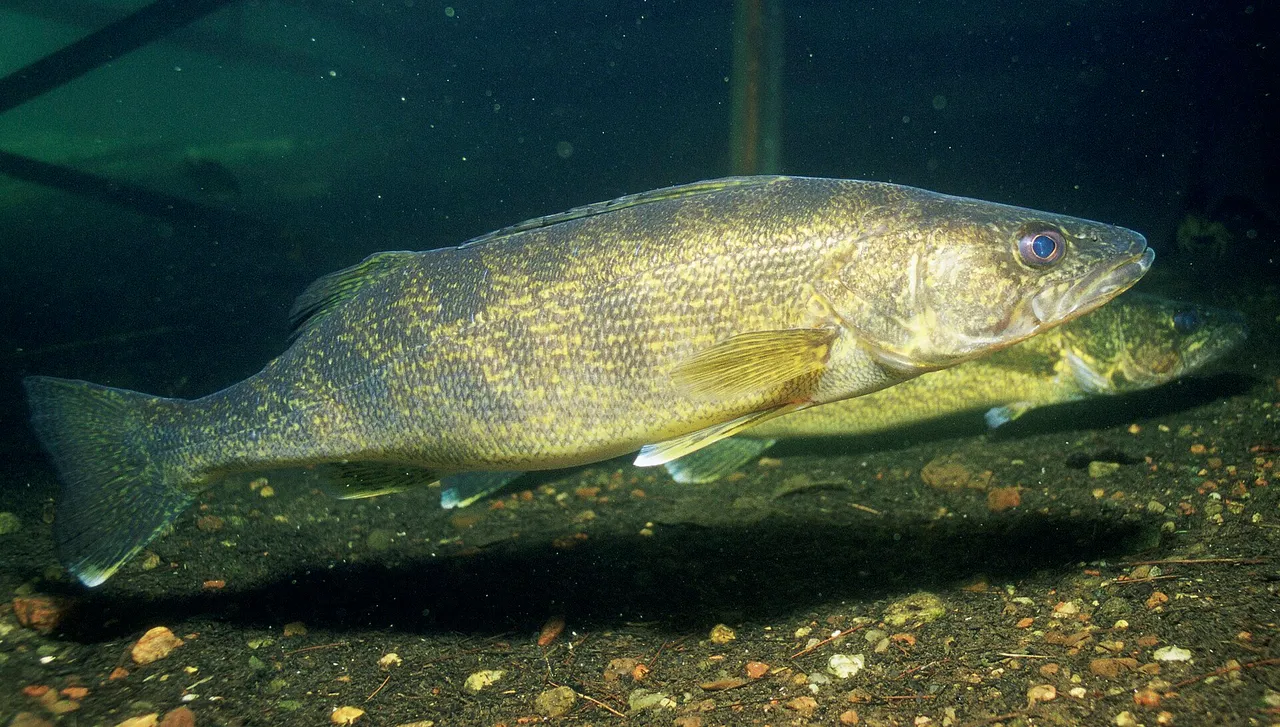
How this was identified, and who took it
Identified by: Large glassy reflective eye, two separate dorsal fins, visible canine teeth, and a white tip on the lower lobe of the tail — the last being the standard separation from sauger.Engbretson, Eric / U.S. Fish and Wildlife Service, Public domain, via Wikimedia Commons — source, licenceLook at this first
Look at the bottom lobe of the tail. A walleye has a clean white tip there and a sauger does not. That is the separation that matters in most of the range, and it survives on a fish in a net or on ice.
Diagnostic — settles it on its own
Each of these settles the identification on its own. If one is clear, you have your answer.
A white tip on the lower lobe of the tail
A distinct pale patch at the bottom corner of the caudal fin. Sauger lacks it, and sauger is the fish walleye is genuinely confused with. Clear at any size and unaffected by condition.
Two separate dorsal fins with a clear spiny first
The percid arrangement, which separates walleye from pike and from the black basses at a glance. Sauger shares it, so this narrows rather than settles.
Supporting — use with other characters
Real characters that are not conclusive by themselves. Use two or three together.
A large glassy eye that reflects strongly
The character the fish is named for. The reflective layer behind the retina gives the eye a milky, opaque look and makes it shine under a light. Shared with sauger and zander.
Prominent canine teeth
Long fangs at the front of the jaws, absent in a yellow perch of comparable size. They confirm the pikeperch group and are a handling consideration in their own right.
Suggestive only — varies with condition
Hints only. These vary with condition, season, water and how long the fish has been out of it, and a fish that contradicts them is still the same species.
Olive to brassy gold flanks with dark mottling
Variable, and overlapping with sauger, which typically shows more distinct dark blotches. Use it to prompt the tail check rather than to conclude.
What it gets confused with
- Sauger, which is the real confusion. The white tail tip is the answer; sauger also carries spotted dorsal membranes that walleye lacks.
- Saugeye, the walleye × sauger hybrid, which is intermediate and common where both occur or where it is stocked.
- Yellow perch, which is deeper-bodied, boldly barred and toothless by comparison.
Where this stops working
Saugeye hybrids are stocked deliberately in some fisheries and occur naturally in others, and they can show a faint white tail tip together with sauger's spotted dorsal — that fish cannot be named reliably by eye. Walleye and zander are separated by geography rather than by structure. Size and bag limits frequently differ between walleye and sauger, so where both are present the tail check is worth making before the fish goes in a box; the rules are local and change.
The full record
This page covers identification only. The Walleye record covers behaviour, lifecycle, distribution, handling and the sources behind all of it.
Reviewed 2026-08-13.
More about this fish
Telling it apart is one question. Here are the others.
Similar and related fish
- Yellow perchYellow perch are the recorded diet preference, and the relationship runs both ways in practice — the two species share most of their range and a walleye population's condition frequently tracks its perch population.
- CiscoCisco are taken where the two overlap, and walleye moving deep in summer are frequently following them.
- Rainbow smeltSmelt are a principal walleye prey in northern lakes where they occur, taken in low light in the same conditions that suit the walleye's own vision.
How it is caught
Where you will find it
- CanadaThe most widely targeted freshwater fish across the shield, the prairie rivers and the Great Lakes basin.
- North American freshwater fishingThe characteristic species of the glaciated coolwater belt, and the fish most associated with the spring opener across the northern tier.
- The Great LakesSupports one of the largest freshwater recreational fisheries in North America, particularly in the shallow, warm, highly productive western basin of Lake Erie.
Why the 7 connections on this page are here, and the sources
Similar and related fish
Backed by research — 3 connections
Supported by peer-reviewed research or fisheries science. The sources are listed and can be checked.
Yellow perch
A diet claim naming the exact species FishBase records. This once pointed at European perch because yellow perch was not yet described here; the species was added rather than leaving a claim that named the wrong fish.
- FishBase: a global information system on fishes — Froese, R. and D. Pauly, eds. — FishBase Consortium (Scientific institute)Relied on for: That Sander vitreus feeds at night mainly on insects and fishes with a preference for yellow perch, Perca flavescens, and freshwater drum, taking any fish available.States this directlyPassage read and verified
The inverse of the walleye diet edge, recorded separately because a reader on the perch page is asking what eats it rather than what it eats.
- FishBase: a global information system on fishes — Froese, R. and D. Pauly, eds. — FishBase Consortium (Scientific institute)Relied on for: That Sander vitreus feeds at night mainly on insects and fishes with a preference for yellow perch, Perca flavescens, and freshwater drum.States this directlyPassage read and verified
Cisco
Recorded diet evidence identifies Coregonus artedi as a food item of this predator at species level. The edge is written at that granularity and no further.
- FishBase: a global information system on fishes — Froese, R. and D. Pauly, eds. — FishBase Consortium (Scientific institute)Relied on for: Food items recorded for this predator, including Coregonus artedi.States this directlyPassage read and verified
- FAO Species Identification Guides for Fishery Purposes and the FAO Species Catalogues — Food and Agriculture Organization of the United Nations (Scientific institute)Relied on for: Species account describing the diet of this predator in the region where Coregonus artedi occurs.Background and mechanism onlyCitation checked — the work exists and is described correctly
Rainbow smelt
Recorded diet evidence identifies Osmerus mordax as a food item of this predator at species level. The edge is written at that granularity and no further.
- FishBase: a global information system on fishes — Froese, R. and D. Pauly, eds. — FishBase Consortium (Scientific institute)Relied on for: Food items recorded for this predator, including Osmerus mordax.States this directlyPassage read and verified
- FAO Species Identification Guides for Fishery Purposes and the FAO Species Catalogues — Food and Agriculture Organization of the United Nations (Scientific institute)Relied on for: Species account describing the diet of this predator in the region where Osmerus mordax occurs.Background and mechanism onlyCitation checked — the work exists and is described correctly
How it is caught
What experienced anglers do — 1 connection
Widely and independently recommended by experienced anglers and specialist sources. This is real angling knowledge, not proof: controlled evidence for it is limited, and FishingHQ records it as convention rather than as a demonstrated effect.
Ice fishing
A practitioner claim about a species-method pairing.
- General angling website restatements of established technique — Various (Credible secondary source)Relied on for: Widely restated practitioner accounts of walleye as a principal ice-fishing target.Citation checked — the work exists and is described correctly
- Angling Times — Bauer Media (Specialist angling publication)Relied on for: Contemporary treatment of ice fishing technique in the angling press.Citation checked — the work exists and is described correctly
Where you will find it
Backed by research — 3 connections
Supported by peer-reviewed research or fisheries science. The sources are listed and can be checked.
Canada
A distribution association between an animal and a kind of water, rather than a claim about any named mark.
- FishBase: a global information system on fishes — Froese, R. and D. Pauly, eds. — FishBase Consortium (Scientific institute)Relied on for: Distribution, habitat association and depth range recorded for the species, including its occurrence in the water body concerned.States this directlyPassage read and verified
- The IUCN Red List of Threatened Species — International Union for Conservation of Nature (Conservation authority)Relied on for: Assessment and range account for the species, including the systems and coasts it occupies.Background and mechanism onlyCitation checked — the work exists and is described correctly
North American freshwater fishing
A distributional claim taken from reference sources on the species rather than from angling report. It states presence and asserts nothing about a fishery.
- FishBase: a global information system on fishes — Froese, R. and D. Pauly, eds. — FishBase Consortium (Scientific institute)Relied on for: Distribution, habitat association, depth range and life history recorded for the species concerned.States this directlyPassage read and verified
- The IUCN Red List of Threatened Species — International Union for Conservation of Nature (Conservation authority)Relied on for: Global distribution, population trend and extinction-risk assessment for the species concerned.States this directlyCitation checked — the work exists and is described correctly
The Great Lakes
Occurrence of the species in this system or along this coast: a statement about the animal's distribution, not a venue recommendation.
- FishBase: a global information system on fishes — Froese, R. and D. Pauly, eds. — FishBase Consortium (Scientific institute)Relied on for: Distribution, salinity tolerance and habitat association recorded for the species, including its occurrence in this system.States this directlyPassage read and verified
- The IUCN Red List of Threatened Species — International Union for Conservation of Nature (Conservation authority)Relied on for: Assessment and range description for the species, including the waters in which it occurs.Background and mechanism onlyCitation checked — the work exists and is described correctly
Safety
Injury while handling fish — Can cause injury needing treatment
Sharp canine teeth and spined gill covers cause cuts to hands and forearms, usually when somebody grips the fish behind the head.
What reduces it: Support the fish horizontally with wet hands and keep fingers away from the jaw and the gill plates. Use a knotless net and long-nosed pliers for unhooking.
Biosecurity and disease transfer — Can cause injury needing treatment
Walleye are stocked widely within North America, and the movement of live fish and water between waters spreads pathogens and non-native organisms regardless of the species being moved.
What reduces it: Clean, drain, dry and check equipment between waters. Never move live fish or water between systems.