What does walleye eat?
What is established about how walleye feeds, kept separate from what anglers infer from it.
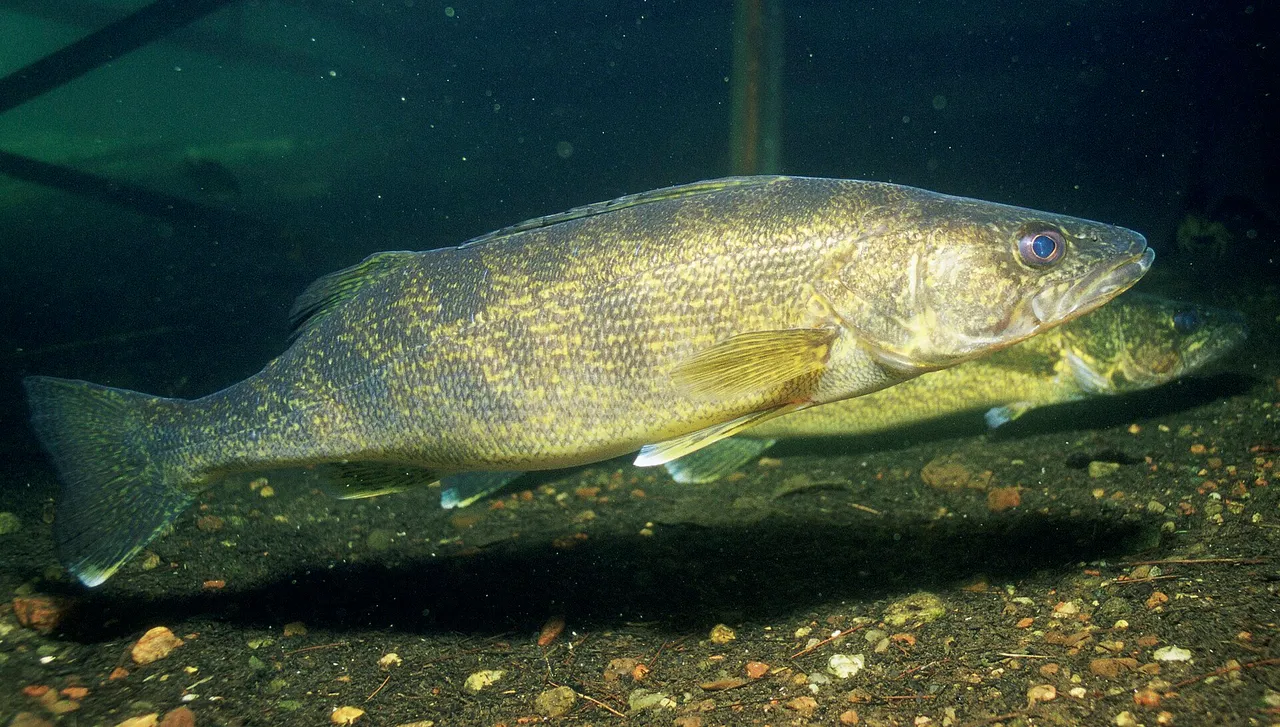
How this was identified, and who took it
Identified by: Large glassy reflective eye, two separate dorsal fins, visible canine teeth, and a white tip on the lower lobe of the tail — the last being the standard separation from sauger.Engbretson, Eric / U.S. Fish and Wildlife Service, Public domain, via Wikimedia Commons — source, licenceWhat is known about how it feeds
Walleye are the North American counterpart of zander in more than name — they are congeners, and they share the reflective tapetum lucidum that gives both fish their common names and their hunting advantage. The species feeds primarily at low light, moving from deeper water towards shallower feeding ground as light falls, and returning as it rises. FishingHQ carries verified predation on yellow perch, on cisco and on rainbow smelt. The last two matter for where the fish is rather than what it prefers: both are cold-water open-lake forage species, and walleye feeding on them are working depths and distances from shore that the classic shallow-shoreline picture of the species does not cover. The yellow perch relationship runs both ways in practice: yellow perch are a staple prey item across much of the walleye's range, and the two species share water throughout it. Walleye take prey head-first with strong canine teeth, and prey size scales with predator size in the usual way. Diet shifts through life — young walleye take invertebrates and move to fish as gape allows — and shifts through the season with prey availability, water temperature and the state of the year's prey-fish recruitment. Wind matters biologically as well as tactically: wind-driven turbidity along a shoreline reduces light penetration and shifts the balance of advantage towards the fish with the better low-light eye, which is a real mechanism rather than an angler's story.
The food
Prey with a verified dietary link to this fish. Each entry carries its own evidence, and each is written at the precision the source actually used: a named species where the source named one, a group or food category where it said “polychaetes”, “crustaceans” or “detritus” and meant it. That is why this list is shorter than the animal’s real diet rather than longer.
- Yellow perch — Perca flavescens
Yellow perch are the recorded diet preference, and the relationship runs both ways in practice — the two species share most of their range and a walleye population's condition frequently tracks its perch population.
- Rainbow smelt — Osmerus mordax
Smelt are a principal walleye prey in northern lakes where they occur, taken in low light in the same conditions that suit the walleye's own vision.
- Cisco — Coregonus artedi
Cisco are taken where the two overlap, and walleye moving deep in summer are frequently following them.
Food with no page of its own here yet
These are real components of the diet, listed as plain text because FishingHQ has no page for them yet. Inventing pages to make the list look fuller would be the fabrication this whole approach exists to prevent.
- other coldwater forage fish
- shad, where present
- young-of-year fish of many species
- aquatic invertebrates, in juveniles
What anglers do with this
Everything below is interpretation, not finding. It is what experienced anglers conclude from the biology above, and the reasoning is usually sound and almost never tested. It is separated from the biology deliberately.
The low-light biology is why walleye angling concentrates on dawn, dusk and coloured water, and the reasoning is sound but conventional rather than demonstrated. The 'walleye chop' — the preference for a wind-rippled shoreline — is practitioner consensus with a plausible mechanism behind it. What is not interpretation: walleye are frequently caught from deep water, and a fish brought up quickly from depth may suffer barotrauma that is not visible from the surface. That is a physical consequence of where the fish feeds and it constrains what a responsible release looks like.
What this does not establish
Three verified prey edges are not a diet. Walleye diets differ sharply between lakes, rivers and reservoirs and between years within one water, and forage-base collapses can change them completely. Nothing here says what walleye in any specific water are eating.
Where this connects
These are the baits, lures, methods and explainers FishingHQ already joins to this fish — which is why the list is sometimes short. They are not chosen for this page, and a link here means an evidenced relationship exists, not that it follows from the diet.
Lures recorded for this species
Methods used for it
The science behind the feeding
This page covers feeding. The Walleye record covers identification, lifecycle, seasonal behaviour, handling and the sources behind all of it.
Reviewed 2026-08-10.