What does yellow perch eat?
What is established about how yellow perch feeds, kept separate from what anglers infer from it.
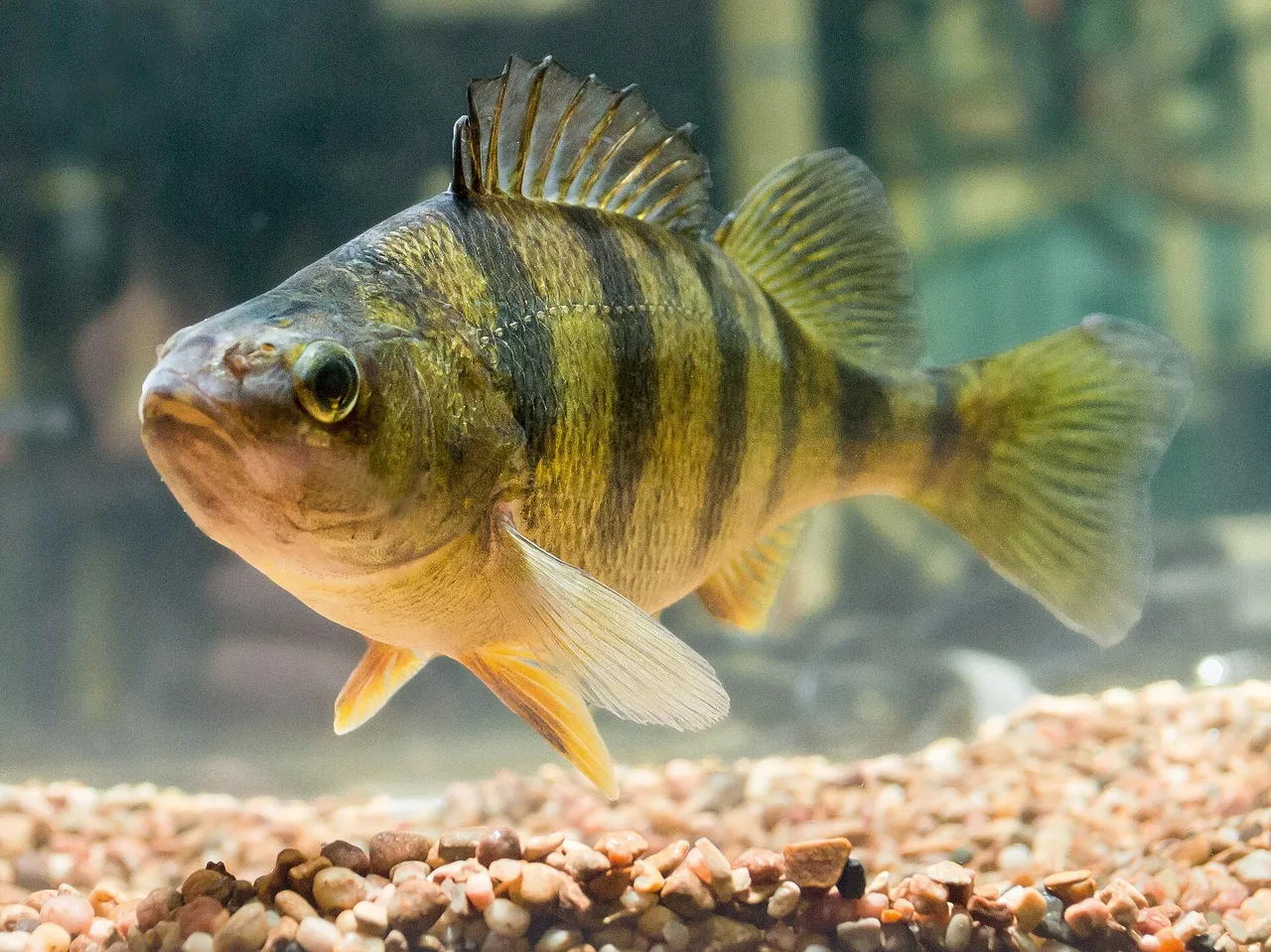
How this was identified, and who took it
Identified by: Vertical flank barring, orange lower fins and — critically — NO dark blotch at the rear of the spiny dorsal, which is the character separating this species from European perch. Photographed in an aquarium.Robert Colletta — Public domain, via Wikimedia Commons — source, licenceWhat is known about how it feeds
Yellow perch feed by sight in daylight and stop when the light goes, and the significance of that is best seen from the perspective of the fish that eats them.
Walleye — a verified predator of yellow perch on FishingHQ — begin hunting exactly when perch stop. The perch retreat as light falls; the walleye's reflective tapetum gives it the advantage in precisely those conditions. Two species in the same water, operating on opposite schedules, connected by predation.
The verified relationship for the perch's own diet is aquatic insect larvae, at group level, and it is the mainstay. Larger invertebrates, small fish and fish eggs supplement it, and the fish component increases with size without ever becoming dominant in the way it does for a European perch.
The species shoals strongly and by size, which has the same practical consequence it does for roach: the fish an angler is among determines the size of what is caught.
Yellow perch are also among the most important forage species in their range, feeding walleye, northern pike, muskellunge and lake trout. Few fish on FishingHQ sit so squarely in the middle of a food web, and the species appears on other diet pages more often than most.
Feeding continues through winter, which supports a substantial ice fishery.
The food
Prey with a verified dietary link to this fish. Each entry carries its own evidence, and each is written at the precision the source actually used: a named species where the source named one, a group or food category where it said “polychaetes”, “crustaceans” or “detritus” and meant it. That is why this list is shorter than the animal’s real diet rather than longer.
- Aquatic insect larvae as prey — a group rather than a species: the evidence names the group
Yellow perch feed heavily on insect larvae and small crustaceans throughout life, adding fish prey as they grow without ever becoming exclusively piscivorous.
Food with no page of its own here yet
These are real components of the diet, listed as plain text because FishingHQ has no page for them yet. Inventing pages to make the list look fuller would be the fabrication this whole approach exists to prevent.
- small minnows and shiners
- fish eggs
- crayfish
- zooplankton, in smaller fish
- leeches
What anglers do with this
Everything below is interpretation, not finding. It is what experienced anglers conclude from the biology above, and the reasoning is usually sound and almost never tested. It is separated from the biology deliberately.
The daylight feeding is the timing, and it is the reverse of what applies to the walleye in the same water — a distinction anglers use deliberately when fishing a lake that holds both.
The size-shoaling converts into the same movement argument that applies to roach: consistently small fish means being among small fish.
The winter activity supports a genuine cold-season fishery, which is a biological fact rather than a tradition.
The species' position as forage is worth reading alongside its position as a catch: a water producing large yellow perch usually has a predator population that is not removing them at size.
What this does not establish
One group-level relationship for a diet that includes fish and larger invertebrates not represented here. Composition varies with fish size and water body, and nothing establishes proportions.
Where this connects
These are the baits, lures, methods and explainers FishingHQ already joins to this fish — which is why the list is sometimes short. They are not chosen for this page, and a link here means an evidenced relationship exists, not that it follows from the diet.
Lures recorded for this species
Methods used for it
Where it lives
This page covers feeding. The Yellow perch record covers identification, lifecycle, seasonal behaviour, handling and the sources behind all of it.
Reviewed 2026-08-12.