How to identify yellow perch
Perca flavescens · Percidae
The characters that identify yellow perch, ranked by how far each one can be trusted on its own.
Safety: venomous and spined species — can cause injury needing treatment. One more point applies here.
How this was identified, and who took it
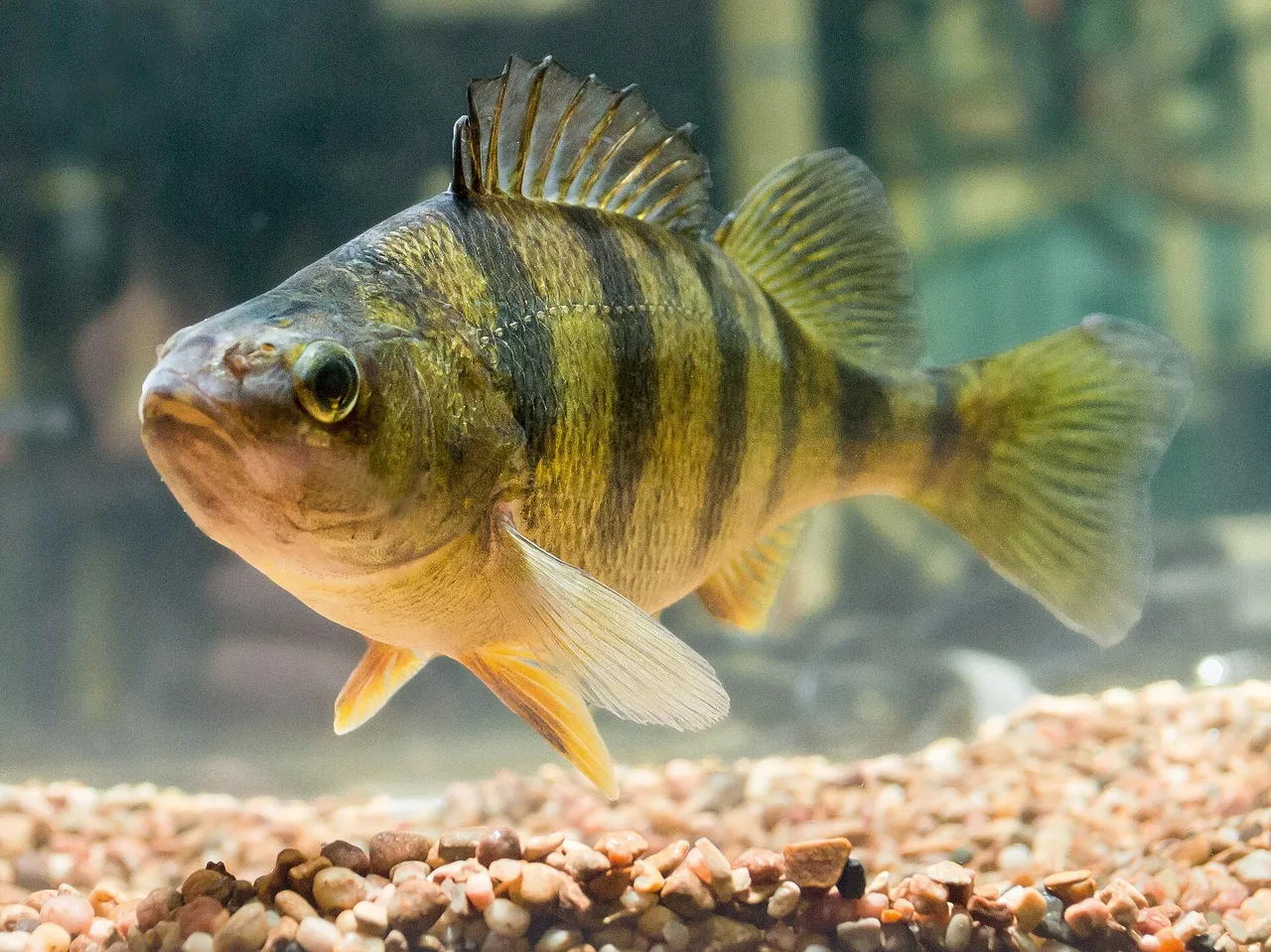
Identified by: Vertical flank barring, orange lower fins and — critically — NO dark blotch at the rear of the spiny dorsal, which is the character separating this species from European perch. Photographed in an aquarium.Robert Colletta — Public domain, via Wikimedia Commons — source, licenceLook at this first
Two separate dorsal fins over a golden flank crossed by six to eight dark bars that taper as they run down. In North America that combination is conclusive — the fish it might be confused with, walleye and sauger, are longer, plainer and armed with canines.
Diagnostic — settles it on its own
Each of these settles the identification on its own. If one is clear, you have your answer.
Two separate dorsal fins, the first spiny
The percid family arrangement. It separates yellow perch from the sunfishes and black basses, which have a single connected dorsal, and places it with walleye and sauger.
Six to eight tapering dark bars on a golden flank
Broad at the back, narrowing towards the belly, over a yellow to brassy ground. Walleye and sauger show mottling rather than clean bars, so the pattern separates yellow perch from both.
Supporting — use with other characters
Real characters that are not conclusive by themselves. Use two or three together.
No enlarged canine teeth
Run a thumb inside the jaw: a yellow perch has small teeth throughout where a walleye of the same length carries obvious fangs. A quick and reliable confirmation.
A deep body with a humped nape
Noticeably deeper and more compressed than a walleye, with a rise behind the head that becomes pronounced in older fish.
Suggestive only — varies with condition
Hints only. These vary with condition, season, water and how long the fish has been out of it, and a fish that contradicts them is still the same species.
Orange lower fins, brightest in spawning males
Yellow to orange pelvic and anal fins that turn vivid in spring males and are muted the rest of the year. Seasonal, so suggestive only.
What it gets confused with
- Walleye and sauger, which are longer, plainer and fanged.
- European perch, which is effectively the same fish in Europe and is separated by geography rather than by structure.
- White perch, which is not a percid at all and lacks the bars.
Side by side: Yellow perch vs European perch.
Where this stops working
European and yellow perch cannot be separated reliably by eye, and the distinction here rests on where the fish was caught. Bar count varies and overlaps between individuals. Small yellow perch and small walleye are more alike than adults, and the tooth check is the fastest way through that.
The full record
This page covers identification only. The Yellow perch record covers behaviour, lifecycle, distribution, handling and the sources behind all of it.
Reviewed 2026-08-13.
More about this fish
Telling it apart is one question. Here are the others.
Similar and related fish
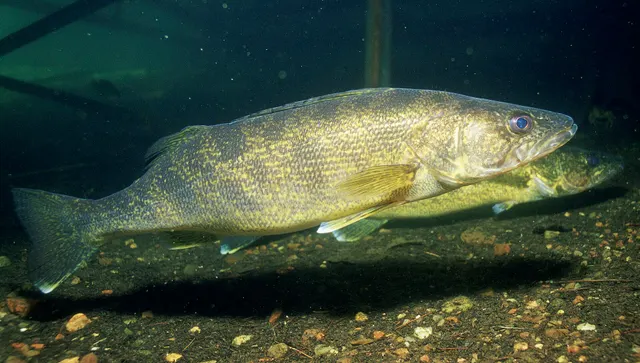 WalleyeYellow perch are the recorded diet preference, and the relationship runs both ways in practice — the two species share most of their range and a walleye population's condition frequently tracks its perch population.
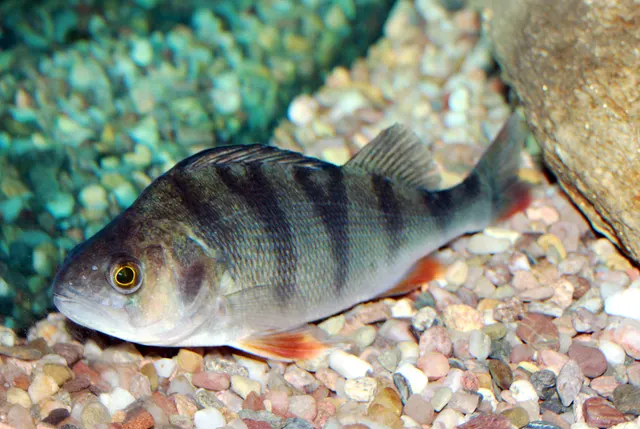 European perchCongeners in the same genus doing the same job on opposite sides of the Atlantic — both shoal in clear weedy water, both drape egg ribbons over structure, and both stunt when nothing eats them.
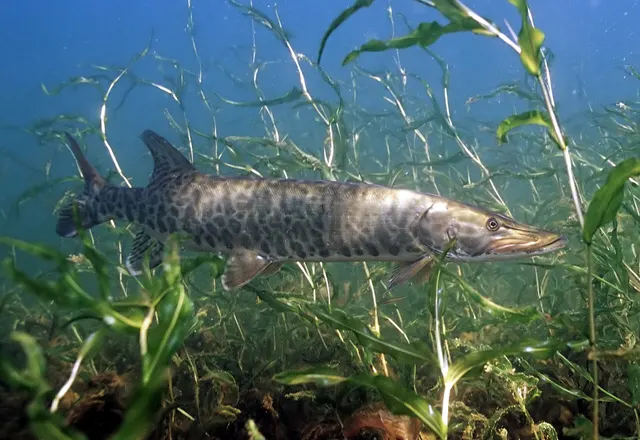 MuskellungeEsocids take percids readily and muskellunge attack prey up to a third of their own length, which is why the lures used for them look absurd to anglers from other traditions.
How it is caught
Where it lives
Where you will find it
Why the 6 connections on this page are here, and the sources
Similar and related fish
Backed by research — 3 connections
Supported by peer-reviewed research or fisheries science. The sources are listed and can be checked.
Walleye
The inverse of the walleye diet edge, recorded separately because a reader on the perch page is asking what eats it rather than what it eats.
- FishBase: a global information system on fishes — Froese, R. and D. Pauly, eds. — FishBase Consortium (Scientific institute)Relied on for: That Sander vitreus feeds at night mainly on insects and fishes with a preference for yellow perch, Perca flavescens, and freshwater drum.States this directlyPassage read and verified
A diet claim naming the exact species FishBase records. This once pointed at European perch because yellow perch was not yet described here; the species was added rather than leaving a claim that named the wrong fish.
- FishBase: a global information system on fishes — Froese, R. and D. Pauly, eds. — FishBase Consortium (Scientific institute)Relied on for: That Sander vitreus feeds at night mainly on insects and fishes with a preference for yellow perch, Perca flavescens, and freshwater drum, taking any fish available.States this directlyPassage read and verified
European perch
A taxonomic and ecological comparison, naming both scientific names so there is no ambiguity about which animals are being compared.
- FishBase: a global information system on fishes — Froese, R. and D. Pauly, eds. — FishBase Consortium (Scientific institute)Relied on for: That Perca flavescens is a Percidae of the genus Perca occupying fresh and brackish water with a preference for clear water near aquatic plants, feeding by day on immature aquatic insects, larger invertebrates, fishes and fish eggs.States this directlyPassage read and verified
- Freshwater Fishes of the British Isles — HarperCollins (New Naturalist 75), 1992 (Reference work)Relied on for: The comparable ecology, egg-ribbon spawning and stunting behaviour of Perca fluviatilis in European fresh waters.States this directlyCitation checked — the work exists and is described correctly
Muskellunge
A diet claim naming the prey binomial, resting on documented esocid feeding ecology and the prey species' co-occurrence.
- FishBase: a global information system on fishes — Froese, R. and D. Pauly, eds. — FishBase Consortium (Scientific institute)Relied on for: That Perca flavescens is a Percidae widely distributed across the Great Lakes and St Lawrence basins where Esox masquinongy occurs.States this directlyPassage read and verified
- Pike: Biology and Exploitation — Chapman & Hall (Fish and Fisheries Series 19), 1996 (Scientific literature)Relied on for: Esocid feeding ecology and prey size selection, including percid prey.States this directlyCitation checked — the work exists and is described correctly
How it is caught
What experienced anglers do — 1 connection
Widely and independently recommended by experienced anglers and specialist sources. This is real angling knowledge, not proof: controlled evidence for it is limited, and FishingHQ records it as convention rather than as a demonstrated effect.
Ice fishing
A practitioner claim about a species-method pairing.
- General angling website restatements of established technique — Various (Credible secondary source)Relied on for: Widely restated practitioner accounts of yellow perch as a principal ice-fishing target.Citation checked — the work exists and is described correctly
- Angling Times — Bauer Media (Specialist angling publication)Relied on for: Contemporary treatment of ice fishing technique in the angling press.Citation checked — the work exists and is described correctly
Where it lives
Backed by research — 1 connection
Supported by peer-reviewed research or fisheries science. The sources are listed and can be checked.
Lowland stillwaters
A habitat claim held to a scientific standard.
- FishBase: a global information system on fishes — Froese, R. and D. Pauly, eds. — FishBase Consortium (Scientific institute)Relied on for: That Perca flavescens inhabits fresh and brackish water, prefers clear water near aquatic plants, congregates near shorelines in spring, and occupies depths from 0 to 56 m.States this directlyPassage read and verified
Where you will find it
Backed by research — 1 connection
Supported by peer-reviewed research or fisheries science. The sources are listed and can be checked.
The Great Lakes
Occurrence of the species in this system or along this coast: a statement about the animal's distribution, not a venue recommendation.
- FishBase: a global information system on fishes — Froese, R. and D. Pauly, eds. — FishBase Consortium (Scientific institute)Relied on for: Distribution, salinity tolerance and habitat association recorded for the species, including its occurrence in this system.States this directlyPassage read and verified
- The IUCN Red List of Threatened Species — International Union for Conservation of Nature (Conservation authority)Relied on for: Assessment and range description for the species, including the waters in which it occurs.Background and mechanism onlyCitation checked — the work exists and is described correctly
Safety
Venomous and spined species — Can cause injury needing treatment
Sharp dorsal spines and spined gill covers on a small fish that is handled in large numbers, frequently by beginners and children. Punctures are common and readily become infected.
What reduces it: Hold the fish from head to tail so the spines fold flat. Wet hands. Use a disgorger rather than fingers. Clean any puncture properly — marine and freshwater wound infections are slow and serious.
Biosecurity and disease transfer — Can cause injury needing treatment
Yellow perch are widely used as live bait and are moved between waters, which spreads both the species and the pathogens that travel with it.
What reduces it: Never move live fish or water between waters. Clean, drain, dry and check equipment between waters.