Northern pike
Fish · Last reviewed 2026-08-10
The dominant freshwater ambush predator of the northern hemisphere: long, cryptic, and built for one violent acceleration rather than pursuit.
Safety: injury while handling fish — can cause injury needing treatment. 5 more points apply here.

Catching Northern pike
Everything here on fishing for it. Each entry opens the page behind it.
- When
- Somewhere documents it in almost every month, so there is no season for the species as a whole — the season is a property of the ground, and each place states its own.
- Where
- 66 places FishingHQ documents — strongest claim anywhere: characteristic of this water · From the shore, From a boat, Fly fishing
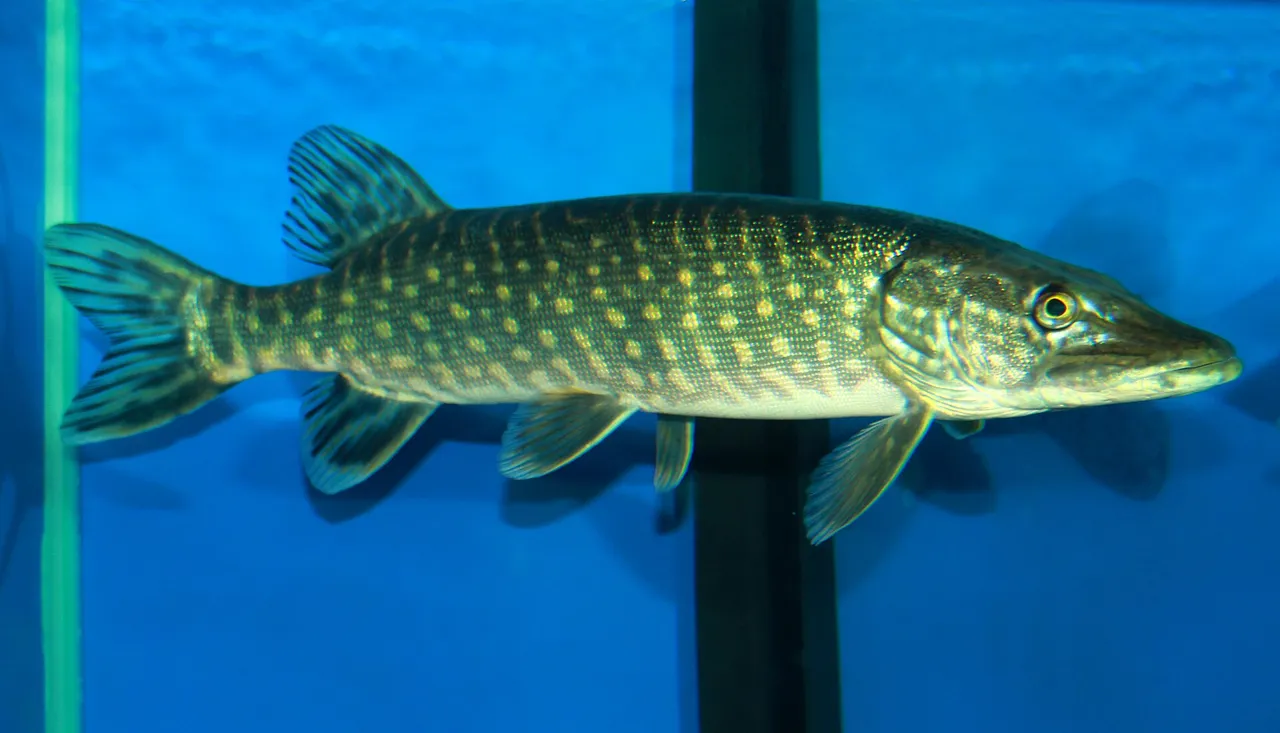
Almost everything about a pike follows from a single design decision. Its dorsal and anal fins are set far back, close to the tail, which turns the whole rear third of the fish into one large paddle. That is a body optimised for a standing start — a short, explosive lunge from ambush — and not for chasing anything down over distance. The camouflage follows the same logic: the mottled olive flank that looks conspicuous in a photograph is close to invisible against weed, and pike position themselves in weed, in reed margins, beside drop-offs and against any feature that breaks up their outline. That dependence is quantified in the review literature — juvenile and adult pike are reported to require macrophyte cover in the range of roughly 35 to 70 per cent of a water — which is why the loss of weed from a fishery is a loss of pike from it.
Understanding that changes how the fish is fished for rather than merely describing it. A pike is not searching; it is waiting, and waiting somewhere specific. It also explains the mouth: several hundred backward-raked teeth on the jaws and palate, which grip rather than cut, and which are the reason a wire or heavy fluorocarbon trace is a requirement rather than a preference.
Pike are also the species where angling folklore is thickest, and this page is written accordingly. Where a practice is long-established but untested — colour preference is the clearest example — FishingHQ says so on the page rather than presenting convention as biology.
Straight answers
For somebody who is already standing on the mark. Everything below this expands on it.
- Where is the fish?
- Beside cover, facing open water: a weed bed edge, a reed line, a drop-off, a bridge, a moored boat, the mouth of a bay. Pike hold still and accelerate, so they want an edge to hold on and something to accelerate into.
- What is the one thing that matters?
- Finding a pike that is feeding. Most of them are not — they eat heavily and then digest for days — so covering water and moving on is usually better than waiting somewhere that looked right.
- When is the best of it?
- Autumn and winter, when pike are feeding to weight rather than recovering from spawning, and when almost nothing else in fresh water is worth fishing for.
- What must I carry?
- Forceps of at least ten inches, side cutters, a large knotless net, an unhooking mat, and a wire trace on every rig. This is a minimum rather than a kit list, and a pike caught without it is likely to be a pike you injure.
- When should I not fish for them?
- At or above 18 degrees water temperature, on the specialist club's own advice — warm water carries less oxygen and pike are unusually poor at recovering from capture in it. The navigation authority for Britain's canals suggests going further and treating summer as a voluntary closed season.
- Can I use livebait?
- In England, only bait fish taken from the water you are fishing, and never moved between waters. Many fisheries prohibit it entirely, so it is the fishery's rule you have to check as well as the law.
Where you are fishing from
The same fish, and genuinely different fishing. Open the one you are standing on.
Canal
Still, shallow, linear, and usually five minutes from a bus stop
Canals — the most accessible predator fishing in Britain
- At the surface
- Upper water
- Mid water
Methods: Spinning, Deadbaiting, Float fishing, Drop shotting
How this mark actually fishes
Why fish are here
A canal is shallow, still, linear and full of small fish, and it has features every few hundred metres: bridges, locks, moored boats, marina entrances, reed margins, winding holes and turnover points. Pike hold against every one of them. It is also usually free or cheap to fish, reachable by bus, and walkable — which makes it the venue that gets more people into predator fishing than anything else.
How to fish it
Walk and cast. Work along the towpath covering each feature with a handful of casts and then move on, rather than settling into one spot: on a canal you are looking for the feeding fish rather than waiting for one. A few metres of water either side of a moored boat, the shade under a bridge and the slack of a winding hole are the classic holds.
What to look at on arrival
- Moored boats and bridge holes, which are shade and structure in water that has little of either.
- Where a canal widens or narrows — winding holes, lock approaches, marina mouths — because the change is the feature.
- Small fish topping in the margins, which is the prey the pike is holding for.
What goes wrong here
- Fishing one swim all day on water that rewards walking.
- Fishing it in high summer. This is the venue where warm shallow water and low oxygen bite hardest, and the navigation authority itself suggests treating summer as closed.
- Casting to the far bank when the fish is under the near-side moored boat.
Towpath edges are often undercut and the water beside them is deeper than it looks. Locks and their approaches move water without warning when a boat comes through.
Official guidance — why, and the sources (1)
Stated by a fisheries authority, scientific institute or recognised angling body. Authoritative, but summarising rather than demonstrating.
How canal marks fish for this species, from the evidence named here.
- Summer pike fishing — the navigation authority's guidance on its own waters — The Canal & River Trust, fisheries and angling team, 2026 (Local authority, harbour or protected-area body)Relied on for: Canal pike fishing on the trust's own waters, the tackle it asks for, and its position on summer fishing.States this directlyPassage read and verified
Lake and loch
Natural stillwater, and fish that move rather than hold
Lakes, lochs and gravel pits — where the big fish are
- Upper water
- Mid water
- Deep water
- On or near the bottom
Methods: Deadbaiting, Spinning, Float fishing, Trolling
How this mark actually fishes
Why fish are here
Standing water with depth variation, weed and a prey population is the classic pike environment, and it grows the largest fish. A mature gravel pit or a rich lowland lake gives a pike everything it needs: bars and drop-offs to hold against, weed beds to be invisible in, and shoals of roach, bream or skimmers to accelerate into.
How to fish it
Find the features before you fish. Drop-offs, bars, the edges of weed beds, the margins of islands and the deeper water off a shallow bay are the addresses. Bait rods spread across two or three features cover more ground than three rods in one swim; lure fishing lets you search a whole margin in an afternoon. Autumn and early winter, as the weed dies back and the fish feed to weight, is the best of it.
What to look at on arrival
- The line where weed stops and open water starts, which is the single most reliable pike feature on a stillwater.
- Bars and drop-offs — a marker float or a lead cast around will find them in ten minutes and save a day.
- Prey shoals showing on a sounder or topping at the surface, because pike will not be far from them.
What goes wrong here
- Fishing the middle of a big water because it looks deep. Pike are usually on a feature, and the feature is usually nearer than the middle.
- Committing to one swim for a whole session on a water you do not know.
- Fishing in wind-blown coloured water with a lure the fish can see but cannot feel.
Winter is the pike season and winter is when going into cold water is most serious. Fish with somebody, or tell somebody where you are, and stay off ice entirely — a frozen margin is not a platform.
Official guidance — why, and the sources (2)
Stated by a fisheries authority, scientific institute or recognised angling body. Authoritative, but summarising rather than demonstrating.
How lake and loch marks fish for this species, from the evidence named here.
- Freshwater Fishes of the British Isles — HarperCollins (New Naturalist 75), 1992 (Reference work)Relied on for: Pike growth depending on productivity, transparency, prey and competition.States this directlyCitation checked — the work exists and is described correctly
- Freshwater Fishing — Macdonald & Jane's, 1975 (Specialist angling publication)Relied on for: Feature location on stillwaters for pike.States this directlyCitation checked — the work exists and is described correctly
River
Moving water, and the seams fish hold on
Rivers — slack water beside fast water, and a close season to check
- Mid water
- Deep water
- On or near the bottom
Methods: Deadbaiting, Spinning, Float fishing, Trotting
How this mark actually fishes
Why fish are here
A pike in a river holds out of the main flow and beside it, for the same reason it holds beside a weed bed: minimum effort, maximum reach. Slacks, eddies, the inside of bends, deep holes, the downstream side of bridge piers and the mouths of side channels and marinas all hold fish. River pike are frequently in better condition than stillwater fish and fight considerably harder in the current.
How to fish it
Read the flow and fish the slack beside it. A deadbait fished on the edge of an eddy, a lure worked across the seam, or a float trotted down a crease all present into the same water. After a flood, pike push into the slacks and the margins and can be caught very close in.
What to look at on arrival
- The seam between fast and slack water, which on a river is the equivalent of the weed edge on a lake.
- Deep holes and the downstream side of any obstruction.
- The level. A river dropping and clearing after a flood concentrates fish in findable places.
What goes wrong here
- Fishing the main flow. A pike does not hold in fast water and will not chase far across it.
- Forgetting the close season. In England the coarse close season on rivers, streams and drains runs 15 March to 15 June, and it is national.
Winter river banks are the most dangerous ground in this profile: undercut, unlit, often steep, and beside water that is both cold and moving.
Official guidance — why, and the sources (1)
Stated by a fisheries authority, scientific institute or recognised angling body. Authoritative, but summarising rather than demonstrating.
How river marks fish for this species, from the evidence named here.
- National rod fishing byelaws for England: freshwater fishing with a rod and line — Environment Agency, published on GOV.UK, 2026 (Government fisheries body)Relied on for: The English coarse close season of 15 March to 15 June inclusive on all rivers, streams and drains.States this directlyPassage read and verified
Reservoir
A made lake with a drawdown line and a dam
Reservoirs — big water, big fish, and rules that vary by the mile
- Upper water
- Mid water
- Deep water
Methods: Deadbaiting, Spinning, Trolling, Stillwater fly fishing
How this mark actually fishes
Why fish are here
Large reservoirs hold both big prey shoals and the space for pike to grow very large on them, and some of the best-known pike in Britain come from trout reservoirs where the pike eat the stock. What they do not reliably hold is permission: several of these waters permit pike fishing only on named dates, under a separate ticket, by a specified method, or not at all.
How to fish it
Where it is permitted, features and prey shoals decide it as on any big stillwater — the dam wall, the old river channel, points, and wherever the bait fish are. Boat fishing dominates on the largest waters. Read the operator's own pike rules before anything else, because on several of these waters they are unusually specific about traces, hooks, line and how the fish is handled.
What to look at on arrival
- Whether pike fishing is permitted at all here, and on what dates. One operator permits it on one of its two lakes and threatens a ban for carrying the tackle on the other.
- The old river channel and the dam wall, which are the two features every reservoir has.
- Prey shoals — on a reservoir these move a long way and the pike move with them.
What goes wrong here
- Assuming a water holding pike is a water you may fish for pike.
- Turning up without the specific terminal tackle the fishery mandates. Several publish minimum trace and line strengths and rules on how many barbs a treble may carry.
Boat fishing on a large reservoir in winter is the most exposed thing described here, and fisheries that run boats require a lifejacket.
Official guidance — why, and the sources (1)
Stated by a fisheries authority, scientific institute or recognised angling body. Authoritative, but summarising rather than demonstrating.
How reservoir marks fish for this species, from the evidence named here.
- Managed-fishery operator information, read on 29 August 2026 — The named fisheries themselves — eight managed waters and access schemes across Britain, each read on its own website and on its published rules page where one exists, 2026 (Credible secondary source)Relied on for: Reservoir operators permitting pike fishing on one water and prohibiting it on another, running deadbait and lure pike fishing only on published dates, and mandating a 40 lb wire trace, one barb on a deadbait treble with all other hooks barbless, and minimum line strengths.States this directlyPassage read and verified
Estuary
Where the river meets the tide
Brackish water — where pike turn up and most anglers do not expect them
- Mid water
- Deep water
Methods: Deadbaiting, Spinning, Float fishing
How this mark actually fishes
Why fish are here
Pike tolerate brackish water and are found in low-salinity systems — the Baltic is the best-known example — as well as in the tidal upper reaches of rivers, drains and land-drainage systems where fresh and salt meet. They behave as they do anywhere else: holding beside cover, ambushing prey, moving with the fish they eat.
How to fish it
As on a river, with the tide as an additional variable: fish the slacks, the drain mouths and the structure, and expect the productive state of tide to be the one that concentrates prey rather than the one with the most water.
What to look at on arrival
- Drain and sluice outfalls, which concentrate both prey and predator.
- The state of tide, which in brackish water moves the fish as flow does on a river.
What goes wrong here
- Assuming a tidal reach is salt water and therefore has no pike in it.
- Assuming freshwater rules stop applying because the water is brackish. Licence and close-season rules follow the water body rather than the salinity.
Official guidance — why, and the sources (1)
Stated by a fisheries authority, scientific institute or recognised angling body. Authoritative, but summarising rather than demonstrating.
How estuary marks fish for this species, from the evidence named here.
- Freshwater Fishes of the British Isles — HarperCollins (New Naturalist 75), 1992 (Reference work)Relied on for: Pike tolerating brackish water and occurring in the low-salinity Baltic; water types recorded as freshwater and brackish.States this directlyCitation checked — the work exists and is described correctly
Where pike wait, and why most of them are not hungry
Each of these is a piece of biology or hydrography, what it looks like from where you are standing, and what you can try as a result.
It holds still and accelerates, so it needs an edge to hold on
- What you may see
- Edges. The outer margin of a weed bed or reed line, a drop-off from shallow into deep, the shade line under a bridge or a moored boat, the confluence of a side channel, the boundary between coloured and clear water.
- What to try
- Fish the edge along its length rather than casting into or across it, and work the cast so the lure or bait passes along the line a fish would be lying on. Cover an edge, then move: a pike either sees it or is not there.
- Where this breaks down
- Very large pike in big open waters behave less like this, following prey shoals into open water and holding in mid-water off features rather than against them. The edge rule is strongest in small and medium waters.
Why this happens
A pike does not patrol and does not chase over distance. It holds position, usually against or inside cover, and accelerates at prey that comes within range — taking the fish sideways in the jaws, holding it, turning it and swallowing it head-first. That means the fish needs two things in the same place: something to be invisible against, and open water to accelerate into. The productive water is therefore almost always the EDGE between the two rather than either alone. A solid weed bed holds pike badly; the outside line of it holds them well. The middle of a bay holds nothing; the point at the mouth of it holds fish.
Official guidance — why, and the sources (1)
Stated by a fisheries authority, scientific institute or recognised angling body. Authoritative, but summarising rather than demonstrating.
The mechanism above, and what it rests on.
- Freshwater Fishes of the British Isles — HarperCollins (New Naturalist 75), 1992 (Reference work)Relied on for: Pike as ambush predators holding position and accelerating, taking prey sideways, turning it and swallowing head-first.States this directlyCitation checked — the work exists and is described correctly
Most pike are not hungry, and that is the whole difficulty
- What you may see
- Nothing, directly — this is the mechanism you cannot see, which is why it is worth knowing. Indirectly: a run that comes within minutes of a bait settling, or a lure taken on the first cast into a spot, both suggest an actively feeding fish rather than a converted one.
- What to try
- Cover water. Fish a spot properly and then move rather than sitting it out, and treat a series of blank spots as information rather than as bad luck. On bait, several rods spread across different features beats several rods in one swim.
- Where this breaks down
- Cold water slows digestion and lengthens the gaps, but it does not stop feeding — pike feed through the coldest months and that is precisely why they are a winter species.
Why this happens
Pike feeding is strongly episodic. A pike takes a substantial meal, then digests it slowly — the rate depending heavily on water temperature — and does not feed again for a period that can run into days. At any moment, most of the pike in a water are not interested in anything you can offer. This is the single largest difference between pike fishing and almost every other kind of fishing: the problem is not what to present to a feeding fish, it is finding one of the minority that is feeding. It is also why pike fishing rewards covering water and punishes patience applied in the wrong place, and why the same swim can produce a fish on one visit and nothing on ten.
Official guidance — why, and the sources (1)
Stated by a fisheries authority, scientific institute or recognised angling body. Authoritative, but summarising rather than demonstrating.
The mechanism above, and what it rests on.
- Freshwater Fishes of the British Isles — HarperCollins (New Naturalist 75), 1992 (Reference work)Relied on for: Feeding strongly episodic, with slow temperature-dependent digestion, and a pike feeding heavily and then not at all for days.States this directlyCitation checked — the work exists and is described correctly
A big pike wants a big meal, and the water tells you which you have
- What you may see
- What the water actually holds. A water full of small pike behaves differently from one with fewer, larger fish, and local knowledge or a few sessions will tell you which you are on.
- What to try
- Size the offering to the pike you are trying to catch rather than to the ones you expect to see. On a big-fish water that means larger baits and larger lures, and accepting fewer runs for a better average.
Why this happens
Prey size scales with predator size, and it scales further than most people expect: large pike will attack fish approaching half their own length. The consequence is that the same bait or lure means completely different things in different waters. A four-inch lure in a drain full of jacks is a reasonable meal; the same lure in front of a twenty-pound fish is barely worth the acceleration, and the arithmetic that governs an ambush predator says so. It also explains why deadbaits work at all — a whole herring is a large, high-value item that costs nothing to catch, and pike scavenge dead fish as a matter of course rather than exceptionally.
Official guidance — why, and the sources (1)
Stated by a fisheries authority, scientific institute or recognised angling body. Authoritative, but summarising rather than demonstrating.
The mechanism above, and what it rests on.
- Freshwater Fishes of the British Isles — HarperCollins (New Naturalist 75), 1992 (Reference work)Relied on for: Prey size scaling with predator size, large pike attacking fish approaching half their own length, and scavenging on dead fish being normal rather than exceptional.States this directlyCitation checked — the work exists and is described correctly
In clear water it looks; in coloured water it feels
- What you may see
- How far down you can see a light-coloured object in the margin. That is your visibility, and it is the variable that decides whether you are fishing to a fish's eyes or to its lateral line.
- What to try
- In clear water, fish lures that look convincing and can be fished slowly enough to be examined. In colour, fish something that thumps — a wider wobble, a bigger blade, a bigger tail — and slow it down further so the fish has time to locate it.
- Where this breaks down
- COLOUR CHOICE IS WHERE ANGLING BELIEF RUNS AHEAD OF EVIDENCE. Pike have colour vision and experienced anglers recommend particular colours in particular conditions, and controlled demonstration that colour alone changes catch rates is limited. This site records that as convention rather than as fact.
Why this happens
A pike's eyes are set high and forward and give good binocular vision over the snout — the arrangement you would design for judging distance to something directly ahead — and in clear water it hunts principally by sight. In coloured water that fails, and the lateral line takes over, detecting the pressure wave of a moving fish. This is why a lure that DISPLACES WATER catches fish in conditions where a lure that merely looks right does not, and why a big-bladed spinnerbait, a jointed plug or a paddle-tailed shad earns its place when visibility drops rather than when it is good.
Official guidance — why, and the sources (1)
Stated by a fisheries authority, scientific institute or recognised angling body. Authoritative, but summarising rather than demonstrating.
The mechanism above, and what it rests on.
- Freshwater Fishes of the British Isles — HarperCollins (New Naturalist 75), 1992 (Reference work)Relied on for: Binocular vision over the snout and principally visual hunting in clear water, with the lateral line taking over in coloured water; and the limited controlled evidence for colour.States this directlyCitation checked — the work exists and is described correctly
It feeds through the winter, which is why it is a winter fish
- What you may see
- The calendar and the thermometer together. Cold, settled, clear-ish water in late autumn and winter is the classic combination, and a mild spell in midwinter frequently produces a spate of fish.
- What to try
- Plan the pike fishing for the months when the trout and the carp are finished, rather than treating it as a summer alternative. Fish shorter days properly rather than long days casually.
- Where this breaks down
- Early spring fish are spawning or recovering from it, and a heavily gravid female is the one fish on the water most worth leaving alone. Where a close season applies it exists for this reason.
Why this happens
Pike are cold-tolerant and go on feeding at temperatures where most temperate freshwater fish have largely stopped. They also spawn early — in late winter and spring, before almost everything else — which means they are thin and recovering in spring and are feeding to put weight ON through autumn and early winter. Both facts point the same way: the heaviest pike of the year are autumn and winter fish, and pike are one of very few British freshwater species genuinely worth targeting in January.
Official guidance — why, and the sources (1)
Stated by a fisheries authority, scientific institute or recognised angling body. Authoritative, but summarising rather than demonstrating.
The mechanism above, and what it rests on.
- Freshwater Fishes of the British Isles — HarperCollins (New Naturalist 75), 1992 (Reference work)Relied on for: Cold tolerance and winter feeding, early spawning in late winter and spring, post-spawning fish being thin, and autumn and winter producing the heaviest fish.States this directlyCitation checked — the work exists and is described correctly
Warm water is where pike fishing goes wrong, and there is a number
- What you may see
- A thermometer. There is no reliable proxy: a shaded canal in September can be warmer than an exposed gravel pit in the same week.
- What to try
- Take a reading before you set up. At or above 18 degrees, the specialist club's position is that you should not fish for pike; the practical version of the trust's is to treat summer as closed and go in October.
- Where this breaks down
- THE TWO BODIES PUT IT DIFFERENTLY AND THIS PROFILE DOES NOT AVERAGE THEM. One gives a temperature and says stop; the other declines to ban and recommends restraint. The number is also carried as the club's advice rather than as a measured threshold, because the leaflet names research without citing it.
Why this happens
Two things happen at once as water warms. The pike's metabolism speeds up so it needs more oxygen, and the water holds less of it — so a fish that has fought hard is being asked to repay an oxygen debt from a supply that has shrunk. Pike are unusually poor at this: the specialist literature describes them as among the first fish to suffer when water quality falls. The Pike Anglers' Club puts a number on it and says do not fish for pike at all at or above 18 degrees, attributing the figure to research and stating that fishing above it could cause fatalities. The Canal & River Trust, which manages most of Britain's canal pike fishing, does not ban anything but says pike suffer when oxygen is low, that deep hooking is especially dangerous in high temperatures, and suggests a committed pike angler ought to consider a self-imposed closed season and fish for them only in autumn and winter.
Official guidance — why, and the sources (2)
Stated by a fisheries authority, scientific institute or recognised angling body. Authoritative, but summarising rather than demonstrating.
The mechanism above, and what it rests on.
- Basic pike fishing — the club's own leaflet on tackle, welfare and unhooking — The Pike Anglers' Club of Great Britain, 2024 (Angling or fisheries organisation)Relied on for: Do not fish for pike when water temperature is at or above 18 degrees; the club attributes this to scientific research and states that fishing above it could cause fatalities.States this directlyPassage read and verified
- Summer pike fishing — the navigation authority's guidance on its own waters — The Canal & River Trust, fisheries and angling team, 2026 (Local authority, harbour or protected-area body)Relied on for: Pike suffering when oxygen levels are low, metabolism speeding up in warm water, deep hooking being especially dangerous at high temperatures, and the suggestion of a self-imposed closed season.States this directlyPassage read and verified
The strike is a welfare decision, and delaying it is the failure
- What you may see
- The bite indicator or float MOVING, which is the moment. Not the run developing, not the line pulling steadily — the first indication.
- What to try
- Strike as soon as you see or feel it. Use proper bite indication so you see it: a drop-off indicator, a bobbin, a bite alarm or a float watched closely. NEVER free-line, because a run you did not see is a fish that has swallowed the hooks.
- Where this breaks down
- Deep hooking is a risk of BAIT fishing specifically. Lure fishing, where the hooks are outside a moving object the fish attacks, produces front-of-mouth hookholds almost every time, which is one of its real advantages and is rarely stated as one.
Why this happens
A pike takes prey sideways, holds it, turns it and swallows head-first. On a bait that sequence means an interval between the take and the swallow, and everything about how a pike is hooked depends on where in that sequence the angler strikes. Strike early and the hooks are in the front of the mouth, where forceps reach them. Wait — as a great deal of older writing advised, to 'let it turn the bait' — and the hooks are in the throat or the stomach, where they cannot be reached without doing serious damage, and where the fish frequently dies whatever happens next. The Pike Anglers' Club's instruction is unambiguous: strike immediately, accept that you will miss the occasional run, and note that the pike will still be there next time.
Official guidance — why, and the sources (2)
Stated by a fisheries authority, scientific institute or recognised angling body. Authoritative, but summarising rather than demonstrating.
The mechanism above, and what it rests on.
- Basic pike fishing — the club's own leaflet on tackle, welfare and unhooking — The Pike Anglers' Club of Great Britain, 2024 (Angling or fisheries organisation)Relied on for: Strike immediately rather than delaying; a delayed strike risks gut-hooking and a dead pike; free-lining prohibited and proper bite indication required.States this directlyPassage read and verified
- Freshwater Fishes of the British Isles — HarperCollins (New Naturalist 75), 1992 (Reference work)Relied on for: Prey taken sideways, held, turned and swallowed head-first, which is the sequence the strike timing turns on.States this directlyCitation checked — the work exists and is described correctly
Finding them
What to look for, what it means, and how much it is worth. None of these guarantees a fish — the third column says how far each one is worth trusting.
7 things to look for
Small fish scattering or showering at the surface
Usually worth acting onSomething has just accelerated into them. It is the most direct evidence of a feeding predator there is.
What to do: Cast to the edge of the disturbance rather than into the middle of it, and expect the fish to be at the point the prey came from rather than where they ended up.
What experienced anglers do — why, and the sources
Widely and independently recommended by experienced anglers and specialist sources. This is real angling knowledge, not proof: controlled evidence for it is limited, and FishingHQ records it as convention rather than as a demonstrated effect.
What this sign rests on.
A clear weed edge, reed line or drop-off
Usually worth acting onThe boundary an ambush predator needs: cover on one side, open water to accelerate into on the other. This is where pike are, whether or not anything is showing.
What to do: Fish along the edge rather than across it, so the offering travels the line a fish would be lying on.
Official guidance — why, and the sources (1)
Stated by a fisheries authority, scientific institute or recognised angling body. Authoritative, but summarising rather than demonstrating.
What this sign rests on.
- Freshwater Fishes of the British Isles — HarperCollins (New Naturalist 75), 1992 (Reference work)Relied on for: Pike as ambush predators holding position and accelerating at prey.States this directlyCitation checked — the work exists and is described correctly
A take within a minute or two of the bait settling
Often worth acting onAn actively feeding fish rather than one you persuaded. Since most pike are not feeding, a fast run is worth more information than a slow one.
What to do: Treat the spot as live: fish it again, and look for the same kind of feature nearby rather than moving somewhere different.
What experienced anglers do — why, and the sources
Widely and independently recommended by experienced anglers and specialist sources. This is real angling knowledge, not proof: controlled evidence for it is limited, and FishingHQ records it as convention rather than as a demonstrated effect.
What this sign rests on.
Water you cannot see six inches into
Often worth acting onThe pike is hunting on its lateral line rather than its eyes, and a lure that only looks right will not be found.
What to do: Switch to something that displaces water — a wider wobble, a bigger blade, a bigger paddle tail — and slow it down so the fish has time to locate it.
Official guidance — why, and the sources (1)
Stated by a fisheries authority, scientific institute or recognised angling body. Authoritative, but summarising rather than demonstrating.
What this sign rests on.
- Freshwater Fishes of the British Isles — HarperCollins (New Naturalist 75), 1992 (Reference work)Relied on for: The lateral line taking over in coloured water to detect the pressure wave of a moving fish.States this directlyCitation checked — the work exists and is described correctly
A thermometer reading of 18 degrees or above
Usually worth acting onConditions in which the specialist club advises not fishing for pike at all: warm water carries less oxygen at the point the fish needs more, and pike recover from capture badly in it.
What to do: Stop, or better, do not start. Go in October.
Official guidance — why, and the sources (1)
Stated by a fisheries authority, scientific institute or recognised angling body. Authoritative, but summarising rather than demonstrating.
What this sign rests on.
- Basic pike fishing — the club's own leaflet on tackle, welfare and unhooking — The Pike Anglers' Club of Great Britain, 2024 (Angling or fisheries organisation)Relied on for: Do not fish for pike at or above 18 degrees water temperature; fishing above it could cause fatalities.States this directlyPassage read and verified
A pike following a lure to the bank and turning away
Often worth acting onA fish that is interested and not committed. It is common, it is not failure, and the fish is usually still there.
What to do: Change something rather than repeating the cast — speed, depth, or the size of the offering. A figure-of-eight at the rod tip at the end of a retrieve converts a proportion of follows.
What experienced anglers do — why, and the sources
Widely and independently recommended by experienced anglers and specialist sources. This is real angling knowledge, not proof: controlled evidence for it is limited, and FishingHQ records it as convention rather than as a demonstrated effect.
What this sign rests on.
Grebes, cormorants or herons working a stretch
Sometimes means fishPrey fish are concentrated there. It says nothing directly about pike and quite a lot about where the pike's food is.
What to do: Fish the stretch, but fish the structure within it rather than the open water the birds are using.
What experienced anglers do — why, and the sources
Widely and independently recommended by experienced anglers and specialist sources. This is real angling knowledge, not proof: controlled evidence for it is limited, and FishingHQ records it as convention rather than as a demonstrated effect.
What this sign rests on.
How to fish for them
Lure fishing
When: Whenever you want to cover water — which, given that most pike are not feeding, is most of the time.
- Canal
- Lake and loch
- River
- Reservoir
- Estuary
- At the surface
- Upper water
- Mid water
- Deep water
Why it works, how to do it, and what it will not do
Why it works
A lure searches. It lets one angler cover a canal, a margin or a whole bay in an afternoon and find the minority of fish that are feeding, rather than waiting in one place for one to become hungry. It also produces front-of-mouth hookholds almost every time, because the fish attacks an object with the hooks on the outside of it — which is a real welfare advantage and is rarely stated as one.
How to fish it
Work along features rather than casting randomly: the weed edge, the boat, the bridge, the drop-off. Vary retrieve speed and depth deliberately rather than settling into a rhythm, and finish every retrieve with a figure-of-eight at the rod tip, because a following fish frequently takes at the last moment.
Tackle
A rod matched to the weight of lure being cast, braid for direct contact and hook-setting, and a wire trace on every single cast without exception. Long-nose pliers rather than forceps for lure hooks, which are thicker, and side cutters for the ones that will not come out.
What it will not do
- It searches rather than tempts, so it is poor at a fish you know is present and have failed to interest.
- Trebles on a thrashing pike are the commonest way anglers hurt themselves and the fish. Semi-barbless or crushed barbs make a considerable difference.
- It is hard work in very cold water where a slow bait presentation will often out-fish it.
Official guidance — why, and the sources (1)
Stated by a fisheries authority, scientific institute or recognised angling body. Authoritative, but summarising rather than demonstrating.
What this account of the method rests on.
- Basic pike fishing — the club's own leaflet on tackle, welfare and unhooking — The Pike Anglers' Club of Great Britain, 2024 (Angling or fisheries organisation)Relied on for: Always use a wire trace when lure fishing; pliers rather than forceps for lure hooks; carry side cutters.States this directlyPassage read and verified
Deadbaiting
When: In cold water, at night and in winter, and on waters where covering ground is impractical or where big fish are the object.
- Lake and loch
- River
- Canal
- Reservoir
- Estuary
- Mid water
- Deep water
- On or near the bottom
Why it works, how to do it, and what it will not do
Why it works
Pike scavenge dead fish as a matter of course rather than exceptionally, so a deadbait is not a trick — it is a large, high-value meal that costs nothing to catch, which is exactly what an ambush predator's arithmetic favours. It also works when the fish is too torpid to chase, which in a cold winter is a great deal of the time. Sea baits are used because they are oily, they are available frozen everywhere, and they hold together on a cast.
How to fish it
Present it on the bottom on a straight leger with the lead on a weak link, or under a float set just over depth, on a trace of at least 30 lb and 18 inches with an uptrace above it. Use proper bite indication and watch it: a drop-off indicator, a bobbin, an alarm or a float watched closely. STRIKE IMMEDIATELY at the first indication.
Tackle
A rod capable of casting a whole herring or mackerel, at least 18 lb monofilament or 65 lb braid, a wire trace of 30 lb minimum, semi-barbless or crushed-barb trebles in sizes 4 to 6, and the full unhooking kit before anything else goes in the bag.
What it will not do
- IT IS THE METHOD THAT DEEP-HOOKS FISH. Everything about how it is rigged, indicated and struck exists to prevent that, and a delayed strike undoes all of it.
- It is static, so it finds feeding fish slowly and depends much more on choosing the right water.
- Free-lining is prohibited by the specialist club outright, and fixed leads and bolt rigs are described as unnecessary and as producing dead pike when a rig is lost.
Official guidance — why, and the sources (2)
Stated by a fisheries authority, scientific institute or recognised angling body. Authoritative, but summarising rather than demonstrating.
What this account of the method rests on.
- Basic pike fishing — the club's own leaflet on tackle, welfare and unhooking — The Pike Anglers' Club of Great Britain, 2024 (Angling or fisheries organisation)Relied on for: Minimum 18 lb mono or 65 lb braid; wire traces of at least 30 lb and 18 inches with an uptrace; leads on a weak link; semi-barbless or crushed barbs in sizes 4–6; bite indication required and free-lining prohibited; strike immediately.States this directlyPassage read and verified
- Freshwater Fishes of the British Isles — HarperCollins (New Naturalist 75), 1992 (Reference work)Relied on for: Scavenging on dead fish being normal rather than exceptional, which is the basis of deadbaiting.States this directlyCitation checked — the work exists and is described correctly
Float-fished bait
When: In shallow or weedy water where a bottom bait would be lost, and wherever a visible indication is wanted.
- Canal
- River
- Lake and loch
- Estuary
- Upper water
- Mid water
Why it works, how to do it, and what it will not do
Why it works
A float is the oldest and one of the best bite indicators there is, it holds a bait off the bottom above weed, and it lets a bait be moved and searched with — trotted down a river crease or drifted across a bay — which a leger cannot do.
How to fish it
A pike float set just over depth with a few swan shot or a weight, a wire trace beneath it, and the float watched constantly. On a river, trot it down the seam. On a lake, let the wind drift it across the feature you want to cover.
Tackle
A large float — a purpose-made pike float or a sea float — on the same trace and line as any other bait method, with the same unhooking kit alongside it.
What it will not do
- A float on a windy day drifts where the wind wants rather than where you want.
- Watching it closely is not optional: on a float rig a front alarm alone will not register a drop-back if the fish comes towards you.
- It presents the bait higher in the water than a leger, which is right in weed and wrong when the fish are hard on the bottom.
Official guidance — why, and the sources (1)
Stated by a fisheries authority, scientific institute or recognised angling body. Authoritative, but summarising rather than demonstrating.
What this account of the method rests on.
- Basic pike fishing — the club's own leaflet on tackle, welfare and unhooking — The Pike Anglers' Club of Great Britain, 2024 (Angling or fisheries organisation)Relied on for: The float as bite indication for pike, set just over depth, and the warning that a front alarm alone will not register a drop-back on a float rig.States this directlyPassage read and verified
Drop shot and light lure work
When: On canals, drains and hard-fished urban water, and where fish need something small and slow presented at a controlled depth.
- Canal
- River
- Lake and loch
- Mid water
- Deep water
- On or near the bottom
Why it works, how to do it, and what it will not do
Why it works
It holds a small soft bait at a set height off the bottom and lets it be worked almost on the spot, which is exactly what a torpid or a suspicious fish will take when a fast-moving lure is ignored. On a canal it also allows a whole feature to be picked apart from one standing position.
How to fish it
Weight on the end, hook on a tag above it, and the bait worked with small movements of the rod tip while the lead stays put. Vary the height above the lead and the amount of movement rather than the retrieve speed.
Tackle
A light lure rod and braid — and, still, a wire trace. Pike take small baits intended for perch constantly, and a bitten-off drop-shot rig leaves a hook in a fish.
What it will not do
- It is slow, so it searches badly and is a poor way to cover a big water.
- The light tackle it is usually fished on is not enough for a good pike, and the temptation to leave the trace off is exactly how fish get injured.
What experienced anglers do — why, and the sources
Widely and independently recommended by experienced anglers and specialist sources. This is real angling knowledge, not proof: controlled evidence for it is limited, and FishingHQ records it as convention rather than as a demonstrated effect.
What this account of the method rests on.
Lures
Chosen by weight, sink rate, depth and retrieve, because those are what decide whether a lure is in front of a fish. There is no best one, and no best colour.
Paddle-tail soft plastic on a jig head
A soft fish-shaped body with a broad tail that thumps on the retrieve, on a weighted head.
- Weight
- 10–40 g heads, in bodies from 10 cm up to 23 cm and beyond for big-fish waters
- Depth it fishes
- Anywhere from just under the surface to hard on the bottom, by count and retrieve speed
- Sink rate
- Set by the head, so the countdown chooses the depth
- Retrieve
- Steady enough to keep the tail working, with pauses — the take frequently comes as the lure drops. Lift-and-drop over a drop-off searches a whole depth range in one cast.
When it works, and when it does not
Almost everywhere, and particularly in coloured water where the tail's displacement gives a pike something to find on its lateral line rather than only something to look at. Size it to the pike you are trying to catch rather than the ones you expect.
Limitation: Soft plastics are destroyed by pike teeth and a torn tail stops working. On a single large hook the hookhold can be poor on a fish that takes it sideways.
- Canal
- Lake and loch
- River
- Reservoir
Official guidance — why, and the sources (1)
Stated by a fisheries authority, scientific institute or recognised angling body. Authoritative, but summarising rather than demonstrating.
What this lure guidance rests on.
- Freshwater Fishes of the British Isles — HarperCollins (New Naturalist 75), 1992 (Reference work)Relied on for: Lateral-line detection of the pressure wave of a moving fish in coloured water.States this directlyCitation checked — the work exists and is described correctly
Jointed and wobbling plug
A hard body, often jointed, with a diving lip that sets a working depth and produces a wide side-to-side action.
- Weight
- 15–60 g, in bodies of 10–20 cm
- Depth it fishes
- Set by the lip and the retrieve speed, from just subsurface to several metres
- Retrieve
- Steady with irregular pauses and changes of speed. A jointed body keeps moving on the pause, which is when a following fish commits.
When it works, and when it does not
Where a defined depth is wanted and held — along a weed edge, over a bar, down a canal margin — and in colour, because a jointed plug displaces a great deal of water for its size.
Limitation: Trebles on a hard body are the worst combination to remove from a thrashing pike, which is why crushed barbs and side cutters matter more here than anywhere.
- Canal
- Lake and loch
- River
- Reservoir
What experienced anglers do — why, and the sources
Widely and independently recommended by experienced anglers and specialist sources. This is real angling knowledge, not proof: controlled evidence for it is limited, and FishingHQ records it as convention rather than as a demonstrated effect.
What this lure guidance rests on.
Spinnerbait and bladed lure
One or two rotating blades on a wire arm above a skirted single hook.
- Weight
- 15–40 g
- Depth it fishes
- Shallow to mid-water, held up by the blade on a steady retrieve
- Retrieve
- Steady, slow enough to feel the blade turning through the rod. Kill it briefly over a feature and let it flutter.
When it works, and when it does not
In weed and snags, because the wire arm rides above the single hook and comes through cover a treble-armed lure could not, and in coloured water where the blade's vibration does the work.
Limitation: It is a poor imitation of anything and depends entirely on triggering an ambush rather than convincing a fish. In gin-clear water it is often refused.
- Canal
- Lake and loch
- River
What experienced anglers do — why, and the sources
Widely and independently recommended by experienced anglers and specialist sources. This is real angling knowledge, not proof: controlled evidence for it is limited, and FishingHQ records it as convention rather than as a demonstrated effect.
What this lure guidance rests on.
Surface lure
A floating body worked on the top — a popper, a walked stickbait or a prop bait.
- Weight
- 15–40 g
- Depth it fishes
- The surface only
- Retrieve
- Worked in a rhythm with pauses, so the lure moves, stops, and moves again.
When it works, and when it does not
In shallow weedy water in warm conditions and low light, where a pike lying under weed will come up through it. The take is the most dramatic in British freshwater fishing.
Limitation: It is a warm-water technique, which puts it squarely in the conditions where pike fishing is least defensible. A surface take is also missed more often than any other kind.
- Canal
- Lake and loch
Official guidance — why, and the sources (1)
Stated by a fisheries authority, scientific institute or recognised angling body. Authoritative, but summarising rather than demonstrating.
What this lure guidance rests on.
- Basic pike fishing — the club's own leaflet on tackle, welfare and unhooking — The Pike Anglers' Club of Great Britain, 2024 (Angling or fisheries organisation)Relied on for: Surface lures as a recognised pike lure category.States this directlyPassage read and verified
Baits
Sea deadbaits — mackerel, herring, sardine and sprat
Why it works, and how to present it
Oily sea fish leak scent into fresh water in a way no freshwater bait does, they are available frozen from any tackle shop and most fishmongers, and they represent a large meal for no effort — which is exactly what an ambush predator's arithmetic favours. Pike scavenging dead fish is normal behaviour rather than an exception exploited by anglers.
Presentation: Whole or in halves on a two-treble trace of at least 30 lb, fished hard on the bottom on a leger with the lead on a weak link, or set just over depth under a float. A half bait leaks more scent and casts further; a whole bait selects for larger fish.
Limitation: This is the presentation that deep-hooks pike, and everything about the rig, the indication and the strike exists to prevent it. It is also unusable without the full unhooking kit.
- Lake and loch
- River
- Canal
- Reservoir
Official guidance — why, and the sources (2)
Stated by a fisheries authority, scientific institute or recognised angling body. Authoritative, but summarising rather than demonstrating.
What this bait guidance rests on.
- Basic pike fishing — the club's own leaflet on tackle, welfare and unhooking — The Pike Anglers' Club of Great Britain, 2024 (Angling or fisheries organisation)Relied on for: Mackerel, herring, sardine and sprat as deadbaits, bought frozen from tackle shops or fishmongers.States this directlyPassage read and verified
- Freshwater Fishes of the British Isles — HarperCollins (New Naturalist 75), 1992 (Reference work)Relied on for: Scavenging on dead fish being normal rather than exceptional.States this directlyCitation checked — the work exists and is described correctly
Freshwater deadbaits
Why it works, and how to present it
A dead roach, bream or trout is what the pike in that water actually eat, and on hard-fished waters where every pike has seen a herring, something local is sometimes the difference.
Presentation: As for sea baits, on the same trace and the same rigs.
Limitation: MOVING FISH BETWEEN WATERS SPREADS DISEASE AND IS RESTRICTED. In England live bait fish may be used only in the water they came from, and a dead bait sourced from another water raises the same biosecurity question. Several fisheries prohibit the practice entirely.
- Lake and loch
- River
Official guidance — why, and the sources (1)
Stated by a fisheries authority, scientific institute or recognised angling body. Authoritative, but summarising rather than demonstrating.
What this bait guidance rests on.
- National rod fishing byelaws for England: freshwater fishing with a rod and line — Environment Agency, published on GOV.UK, 2026 (Government fisheries body)Relied on for: Live bait permitted only in the water the bait fish were taken from, under the English national byelaws.States this directlyPassage read and verified
Conditions
What each of these changes, why that matters to the fish, and what it is worth trying. None of it is a rule — fishing does not have any.
6 conditions, and what each one changes
Water temperature
The water temperature, which decides both how often a pike feeds and — above a threshold — whether it survives being caught.
Why it matters, and what to try
Cold water slows a pike's digestion and lengthens the gaps between meals, but pike go on feeding through it, which is why they are a winter fish. Warm water does the opposite in the worst way: the metabolism speeds up and needs more oxygen while the water holds less, and pike are poor at recovering from that. The specialist club sets 18 degrees as the point at which it advises not fishing for pike at all.
What to try: Carry a thermometer and read it before setting up. At or above 18 degrees, the club's position is do not fish; the navigation authority's practical version is to treat summer as a voluntary closed season.
Official guidance — why, and the sources (2)
Stated by a fisheries authority, scientific institute or recognised angling body. Authoritative, but summarising rather than demonstrating.
What this rests on.
- Basic pike fishing — the club's own leaflet on tackle, welfare and unhooking — The Pike Anglers' Club of Great Britain, 2024 (Angling or fisheries organisation)Relied on for: Do not fish for pike at or above 18 degrees water temperature.States this directlyPassage read and verified
- Summer pike fishing — the navigation authority's guidance on its own waters — The Canal & River Trust, fisheries and angling team, 2026 (Local authority, harbour or protected-area body)Relied on for: Low summer oxygen, faster metabolism and a suggested self-imposed closed season.States this directlyPassage read and verified
Water clarity
How far a pike can see, and therefore which of its two hunting senses is doing the work.
Why it matters, and what to try
In clear water a pike hunts by sight and can examine a lure. In coloured water the lateral line takes over and the fish locates prey by the pressure wave it makes, so an offering that displaces water is found and one that only looks right is not.
What to try: Judge visibility by how deep you can see a pale object in the margin. Clear water: something that looks convincing, fished slowly. Coloured water: something with a bigger blade, tail or wobble, fished slower still.
Official guidance — why, and the sources (1)
Stated by a fisheries authority, scientific institute or recognised angling body. Authoritative, but summarising rather than demonstrating.
What this rests on.
- Freshwater Fishes of the British Isles — HarperCollins (New Naturalist 75), 1992 (Reference work)Relied on for: Visual hunting in clear water and lateral-line detection in coloured water.States this directlyCitation checked — the work exists and is described correctly
What the fish are feeding on
Where the prey shoals are, which is where the pike are.
Why it matters, and what to try
An ambush predator has to be within acceleration range of something to eat. On a big water the prey shoals move a long way through the season, and the pike move with them — which is why a swim that produced in October can be empty in December without anything having gone wrong.
What to try: Find the bait fish first: birds working, fish topping, a sounder, or the shoals visible in a clear canal margin. Then fish the structure nearest to them rather than the open water they are in.
Official guidance — why, and the sources (1)
Stated by a fisheries authority, scientific institute or recognised angling body. Authoritative, but summarising rather than demonstrating.
What this rests on.
- Freshwater Fishes of the British Isles — HarperCollins (New Naturalist 75), 1992 (Reference work)Relied on for: Pike growth and distribution depending on the type and abundance of prey.States this directlyCitation checked — the work exists and is described correctly
Light
How much light is on the water, which shifts when pike hunt and how confidently.
Why it matters, and what to try
Pike are broadly crepuscular and opportunistic, and low light gives an ambush predator its best advantage over prey that hunts by sight. In winter that window arrives at a civilised hour; the last hour of a short December afternoon is frequently the best of the day.
What to try: Fish the first and last light of a winter day rather than the middle of it, and be set up before it rather than arriving into it.
Official guidance — why, and the sources (1)
Stated by a fisheries authority, scientific institute or recognised angling body. Authoritative, but summarising rather than demonstrating.
What this rests on.
- Freshwater Fishes of the British Isles — HarperCollins (New Naturalist 75), 1992 (Reference work)Relied on for: Crepuscular and opportunistic activity pattern.States this directlyCitation checked — the work exists and is described correctly
Season
Whether pike are recovering, feeding to weight, or spawning — and, separately, whether the law and the fishery permit fishing for them.
Why it matters, and what to try
Pike spawn early, in late winter and spring, so spring fish are thin and recovering while autumn and winter fish are feeding to put weight on. The regulatory calendar is a separate thing: in England the coarse close season runs 15 March to 15 June on rivers, streams and drains, which covers the spawning period on running water and does not automatically apply to stillwaters.
What to try: Plan the season around autumn and winter for both reasons at once. Check the close season for the water type you are fishing, and check the fishery's own rules on top — several waters here restrict pike fishing to winter regardless of the law.
Official guidance — why, and the sources (3)
Stated by a fisheries authority, scientific institute or recognised angling body. Authoritative, but summarising rather than demonstrating.
What this rests on.
- National rod fishing byelaws for England: freshwater fishing with a rod and line — Environment Agency, published on GOV.UK, 2026 (Government fisheries body)Relied on for: The national coarse close season of 15 March to 15 June on rivers, streams and drains.States this directlyPassage read and verified
- Freshwater Fishes of the British Isles — HarperCollins (New Naturalist 75), 1992 (Reference work)Relied on for: Early spawning in late winter and spring, post-spawning fish being thin, and autumn and winter producing the heaviest fish.States this directlyCitation checked — the work exists and is described correctly
- Managed-fishery operator information, read on 29 August 2026 — The named fisheries themselves — eight managed waters and access schemes across Britain, each read on its own website and on its published rules page where one exists, 2026 (Credible secondary source)Relied on for: A specimen fishery permitting pike fishing in two of its waters in winter only.States this directlyPassage read and verified
Wind
Where surface food, prey fish and coloured water end up on a stillwater.
Why it matters, and what to try
Wind pushes the upper layer of a lake downwind, taking food and small fish with it and colouring the water at that end. Pike follow, and the downwind bank in a decent blow is frequently the productive one — which is also the least pleasant to cast from.
What to try: Fish the downwind end when the wind has been in one direction for a day or more, and expect the coloured water there to favour something the fish can feel rather than see.
What experienced anglers do — why, and the sources
Widely and independently recommended by experienced anglers and specialist sources. This is real angling knowledge, not proof: controlled evidence for it is limited, and FishingHQ records it as convention rather than as a demonstrated effect.
What this rests on.
Tackle
Each of these says why it is the size it is. Where a heavier outfit is suggested it is almost always about casting range or holding bottom, not about the strength needed to land the fish.
3 outfits, and why each is the size it is
The unhooking kit — before anything else
- Canal
- Lake and loch
- River
- Reservoir
- Estuary
- Rod
- Not applicable. This is the equipment that decides whether the fish lives
- Reel
- Not applicable
- Line
- Not applicable
- Leader
- A wire trace of at least 30 lb and 18 inches for bait fishing, with an uptrace above it
- Terminal
- Long forceps or long-nose pliers of at least ten inches; long-reach wire or side cutters; a large knotless landing net of 42 inches or an equivalent oval; a large unhooking mat or cradle; a large weigh sling; and a thermometer
This is listed first because it is the thing to buy first. A pike hooked without it is a pike you cannot unhook properly, and the club that has done this for fifty years states the list as a requirement rather than as advice. The side cutters are the item people leave out and the item that occasionally saves the fish, because sometimes the only way a treble comes out is in pieces.
Official guidance — why, and the sources (1)
Stated by a fisheries authority, scientific institute or recognised angling body. Authoritative, but summarising rather than demonstrating.
What this tackle guidance rests on.
- Basic pike fishing — the club's own leaflet on tackle, welfare and unhooking — The Pike Anglers' Club of Great Britain, 2024 (Angling or fisheries organisation)Relied on for: The required tackle list: 42-inch knotless net, large unhooking mat or cradle, large weigh sling, forceps or long-nose pliers of at least ten inches, long-reach side cutters, and wire traces of at least 30 lb and 18 inches with an uptrace.States this directlyPassage read and verified
Deadbait outfit
- Lake and loch
- River
- Reservoir
- Canal
- Rod
- A rod capable of casting a whole sea deadbait — typically 2.75 lb to 3 lb test curve, twelve foot
- Reel
- A reel with a free-spool or bait-runner facility, so a taking fish meets no resistance before the strike
- Line
- A minimum of 18 lb monofilament or 65 lb braid, heavier for large baits and for straightening hooks out of snags
- Leader
- A wire trace of at least 30 lb and 18 inches, with an uptrace above it as good practice
- Terminal
- Two semi-barbless or crushed-barb trebles in sizes 4 to 6, with the lead on a weak link so it breaks away rather than leaving a baited rig in the water
Heavier than it looks necessary, and every element of it is a welfare decision rather than a landing one. Line strong enough to straighten a hook means a snagged rig comes back instead of staying in a fish's mouth; a weak link on the lead means the same; and semi-barbless hooks come out of a pike far more easily while still holding it.
Official guidance — why, and the sources (1)
Stated by a fisheries authority, scientific institute or recognised angling body. Authoritative, but summarising rather than demonstrating.
What this tackle guidance rests on.
- Basic pike fishing — the club's own leaflet on tackle, welfare and unhooking — The Pike Anglers' Club of Great Britain, 2024 (Angling or fisheries organisation)Relied on for: Minimum 18 lb mono or 65 lb braid; wire trace of at least 30 lb and 18 inches with an uptrace; semi-barbless or crushed-barb hooks in sizes 4–6; leads on a weak link.States this directlyPassage read and verified
Lure outfit
- Canal
- Lake and loch
- River
- Reservoir
- Rod
- A lure rod rated for the weight actually being cast — a rod that is over-gunned for a 15 g lure casts it badly and feels nothing
- Reel
- A fixed spool or baitcaster matched to the rod, with a smooth drag
- Line
- Braid, for direct contact and hook-setting at distance
- Leader
- A wire or heavy fluorocarbon trace on every cast without exception, including on light drop-shot rigs
- Terminal
- Semi-barbless or crushed-barb trebles, or single hooks. Long-nose pliers rather than forceps, because lure hooks are thicker
Sized to the lure rather than to the fish, which is the opposite of how most people buy a first pike rod. Casting a 20 g lure a hundred times an afternoon on a 3 lb test-curve deadbait rod is unpleasant and inaccurate, and accuracy is most of lure fishing.
Official guidance — why, and the sources (1)
Stated by a fisheries authority, scientific institute or recognised angling body. Authoritative, but summarising rather than demonstrating.
What this tackle guidance rests on.
- Basic pike fishing — the club's own leaflet on tackle, welfare and unhooking — The Pike Anglers' Club of Great Britain, 2024 (Angling or fisheries organisation)Relied on for: Wire trace always when lure fishing; pliers rather than forceps for the thicker hooks lures carry.States this directlyPassage read and verified
Things that actually help
10 things that actually help
Buy the unhooking kit before the rod
A pike caught on borrowed tackle with no forceps is a pike that gets hurt, and the situation arrives the first time somebody succeeds. The specialist club lists the gear as a requirement rather than as advice for exactly this reason, and the list is short and cheap relative to a rod.
Official guidance — why, and the sources (1)
Stated by a fisheries authority, scientific institute or recognised angling body. Authoritative, but summarising rather than demonstrating.
What this rests on.
- Basic pike fishing — the club's own leaflet on tackle, welfare and unhooking — The Pike Anglers' Club of Great Britain, 2024 (Angling or fisheries organisation)Relied on for: The tackle list stated as required gear for pike fishing.States this directlyPassage read and verified
Strike at the first indication, every time
A pike takes prey sideways and swallows it head-first, so the interval between the take and the swallow is the whole of your opportunity to hook it in the front of the mouth. The club's instruction is to strike immediately and accept missing the occasional run — the pike will still be there next time, which a gut-hooked one will not.
Official guidance — why, and the sources (1)
Stated by a fisheries authority, scientific institute or recognised angling body. Authoritative, but summarising rather than demonstrating.
What this rests on.
- Basic pike fishing — the club's own leaflet on tackle, welfare and unhooking — The Pike Anglers' Club of Great Britain, 2024 (Angling or fisheries organisation)Relied on for: Strike immediately; delaying risks gut-hooking and a dead pike; the fish will still be there next time.States this directlyPassage read and verified
Never use a gag, Boga Grips, or a balance hook under the chin
All three are still sold and all three are named by the club as things never to do. A gag holds the jaws apart at a spread the fish did not choose; a lip grip and a chin hook both hang the fish's whole weight from one point of its jaw.
Official guidance — why, and the sources (1)
Stated by a fisheries authority, scientific institute or recognised angling body. Authoritative, but summarising rather than demonstrating.
What this rests on.
- Basic pike fishing — the club's own leaflet on tackle, welfare and unhooking — The Pike Anglers' Club of Great Britain, 2024 (Angling or fisheries organisation)Relied on for: Never use a pike gag; never use Boga Grips to hold or unhook pike; weigh in a sling and never with a balance hook under the chin.States this directlyPassage read and verified
Hold the lower jaw from inside the gill cover, not by the gills
The chin-hold — fingers slid under the gill cover from outside and gripping the bony lower jaw, well clear of the gill rakers — is what lets you open a pike's mouth with one hand and work with the other. The rakers themselves will cut a hand badly and are the part of the fish most easily damaged.
Official guidance — why, and the sources (1)
Stated by a fisheries authority, scientific institute or recognised angling body. Authoritative, but summarising rather than demonstrating.
What this rests on.
- Basic pike fishing — the club's own leaflet on tackle, welfare and unhooking — The Pike Anglers' Club of Great Britain, 2024 (Angling or fisheries organisation)Relied on for: Lay the pike on its back and firmly hold its lower jaw through the gill cover, avoiding the gill rakes, while removing hooks with the other hand.States this directlyPassage read and verified
Carry a thermometer and treat 18 degrees as a stop sign
It converts a vague instruction about warm water into a decision. Warm water carries less oxygen at exactly the point a played pike needs more of it, and the fish that swims off strongly in August is the one nobody sees die.
Official guidance — why, and the sources (2)
Stated by a fisheries authority, scientific institute or recognised angling body. Authoritative, but summarising rather than demonstrating.
What this rests on.
- Basic pike fishing — the club's own leaflet on tackle, welfare and unhooking — The Pike Anglers' Club of Great Britain, 2024 (Angling or fisheries organisation)Relied on for: Do not fish for pike at or above 18 degrees; the club attributes this to research and states it could cause fatalities.States this directlyPassage read and verified
- Summer pike fishing — the navigation authority's guidance on its own waters — The Canal & River Trust, fisheries and angling team, 2026 (Local authority, harbour or protected-area body)Relied on for: Pike suffering when oxygen levels are low, and deep hooking being especially dangerous at high temperatures.States this directlyPassage read and verified
Wire trace on every cast, including the light ones
A pike will take a two-inch perch lure on a canal, and a fish that bites through a fluorocarbon leader swims away with the hooks in it. The temptation to leave the trace off is strongest on the light tackle where the consequence is worst.
Official guidance — why, and the sources (1)
Stated by a fisheries authority, scientific institute or recognised angling body. Authoritative, but summarising rather than demonstrating.
What this rests on.
- Basic pike fishing — the club's own leaflet on tackle, welfare and unhooking — The Pike Anglers' Club of Great Britain, 2024 (Angling or fisheries organisation)Relied on for: Wire traces required for bait fishing and for lure fishing; the club does not endorse mono or fluorocarbon traces.States this directlyPassage read and verified
Cover water rather than waiting
Most pike in a water are digesting rather than feeding, so the fish you want is a minority you have to go and find. Fishing one swim for six hours tests one place; walking a canal for six hours tests thirty.
Official guidance — why, and the sources (1)
Stated by a fisheries authority, scientific institute or recognised angling body. Authoritative, but summarising rather than demonstrating.
What this rests on.
- Freshwater Fishes of the British Isles — HarperCollins (New Naturalist 75), 1992 (Reference work)Relied on for: Feeding strongly episodic, with slow temperature-dependent digestion.States this directlyCitation checked — the work exists and is described correctly
Do not move live or dead bait fish between waters
In England live bait fish may only be used in the water they were taken from, and the same biosecurity logic applies to freshwater deadbaits. Moving fish between waters is how disease and unwanted species get where they were not.
Official guidance — why, and the sources (1)
Stated by a fisheries authority, scientific institute or recognised angling body. Authoritative, but summarising rather than demonstrating.
What this rests on.
- National rod fishing byelaws for England: freshwater fishing with a rod and line — Environment Agency, published on GOV.UK, 2026 (Government fisheries body)Relied on for: Live bait permitted only in the water the bait fish were taken from.States this directlyPassage read and verified
Never assume a water with pike in it is a water you may fish for pike
Fisheries restrict predator fishing constantly and for their own reasons. One operator permits pike fly fishing on one of its two lakes and threatens an immediate ban for carrying the tackle on the other, and a specimen carp water permits pike fishing in two of six waters and only in winter.
Official guidance — why, and the sources (1)
Stated by a fisheries authority, scientific institute or recognised angling body. Authoritative, but summarising rather than demonstrating.
What this rests on.
- Managed-fishery operator information, read on 29 August 2026 — The named fisheries themselves — eight managed waters and access schemes across Britain, each read on its own website and on its published rules page where one exists, 2026 (Credible secondary source)Relied on for: Fisheries restricting pike fishing to named waters, named dates and winter only, and banning it outright on one water while permitting it on another under the same operator.States this directlyPassage read and verified
Finish every lure retrieve with a figure-of-eight at the rod tip
Pike follow lures to the bank constantly and commit at the last moment or not at all. Lifting the lure out at the end of the retrieve ends the encounter; keeping it moving in a slow figure-of-eight gives the fish the moment it was waiting for.
What experienced anglers do — why, and the sources
Widely and independently recommended by experienced anglers and specialist sources. This is real angling knowledge, not proof: controlled evidence for it is limited, and FishingHQ records it as convention rather than as a demonstrated effect.
What this rests on.
What they are feeding on
What the evidence says they eat, and — separately — what that does or does not imply for what you tie on. Some of the most important prey has no angling consequence at all.
6 prey items, and what each implies
Roach, rudd and other small cyprinids
The staple prey of pike in most British stillwater and slow river systems, shoaling and abundant, and the reason pike are where the roach shoals are.
What that means for fishing: Find the roach shoals and you have narrowed the water considerably. It is also why a silver, roach-sized soft plastic is the default lure on so many waters.
Official guidance — why, and the sources (1)
Stated by a fisheries authority, scientific institute or recognised angling body. Authoritative, but summarising rather than demonstrating.
What this rests on.
- Freshwater Fishes of the British Isles — HarperCollins (New Naturalist 75), 1992 (Reference work)Relied on for: Pike growth depending on the type and abundance of prey.States this directlyCitation checked — the work exists and is described correctly
Bream and skimmers
Deep-bodied shoal fish of richer stillwaters and slow rivers, and a substantial meal for a large pike.
What that means for fishing: On waters where bream dominate, larger and deeper-bodied offerings match what the pike are eating, and the pike will often be on the deeper water the bream shoals use.
What experienced anglers do — why, and the sources
Widely and independently recommended by experienced anglers and specialist sources. This is real angling knowledge, not proof: controlled evidence for it is limited, and FishingHQ records it as convention rather than as a demonstrated effect.
What this rests on.
Perch
Taken readily despite the spined dorsal fin, and abundant in exactly the structured water pike hold in.
What that means for fishing: Explains why perch-patterned lures work, and why a hooked perch on light tackle regularly attracts a pike — which is a good argument for a trace on a perch rod.
What experienced anglers do — why, and the sources
Widely and independently recommended by experienced anglers and specialist sources. This is real angling knowledge, not proof: controlled evidence for it is limited, and FishingHQ records it as convention rather than as a demonstrated effect.
What this rests on.
Other pike
Cannibalism is normal rather than exceptional. Pike fry switch to eating fish — including their siblings — within days of absorbing the yolk sac, which is why pike populations thin themselves so effectively in the first months.
What that means for fishing: Explains why a water can hold a small number of large pike rather than many medium ones, and why a jack hooked on a lure is sometimes followed to the bank by something much larger.
Official guidance — why, and the sources (1)
Stated by a fisheries authority, scientific institute or recognised angling body. Authoritative, but summarising rather than demonstrating.
What this rests on.
- Freshwater Fishes of the British Isles — HarperCollins (New Naturalist 75), 1992 (Reference work)Relied on for: Pike fry switching to fish including their own siblings remarkably early, thinning populations in the first months.States this directlyCitation checked — the work exists and is described correctly
Dead fish on the bottom
Scavenging is normal behaviour for pike rather than an exception, which is a straightforwardly useful fact rather than a curiosity.
What that means for fishing: It is the entire basis of deadbaiting, and it is why a static sea fish on the bottom of a lake with no sea in it catches pike at all.
Official guidance — why, and the sources (1)
Stated by a fisheries authority, scientific institute or recognised angling body. Authoritative, but summarising rather than demonstrating.
What this rests on.
- Freshwater Fishes of the British Isles — HarperCollins (New Naturalist 75), 1992 (Reference work)Relied on for: Scavenging on dead fish being normal rather than exceptional.States this directlyCitation checked — the work exists and is described correctly
Trout, in stocked waters
On trout reservoirs and stocked stillwaters the pike eat the stock, which is why some of the largest pike in Britain come from waters managed for something else entirely.
What that means for fishing: Explains the size of reservoir pike and explains why those fisheries have such specific rules about when and how pike may be fished for.
Official guidance — why, and the sources (1)
Stated by a fisheries authority, scientific institute or recognised angling body. Authoritative, but summarising rather than demonstrating.
What this rests on.
- Managed-fishery operator information, read on 29 August 2026 — The named fisheries themselves — eight managed waters and access schemes across Britain, each read on its own website and on its published rules page where one exists, 2026 (Credible secondary source)Relied on for: Trout reservoirs holding pike and running separate, tightly dated pike fisheries.States this directlyPassage read and verified
When, and where
Not one season. These are different coasts with genuinely different windows, and the boundaries move between years — they follow water temperature rather than the calendar.
| Where | JJan | FFeb | MMar | AApr | MMay | JJun | JJul | AAug | SSep | OOct | NNov | DDec |
|---|---|---|---|---|---|---|---|---|---|---|---|---|
| England and Wales — rivers, streams and drains | Jan: present inshore | Feb: present inshore | Mar: present inshore | Apr: not expected | May: not expected | Jun: present inshore | Jul: present inshore | Aug: present inshore | Sep: present inshore | Oct: present inshore | Nov: present inshore | Dec: present inshore |
| England and Wales — stillwaters | Jan: present inshore | Feb: present inshore | Mar: present inshore | Apr: not expected | May: not expected | Jun: not expected | Jul: not expected | Aug: not expected | Sep: not expected | Oct: present inshore | Nov: present inshore | Dec: present inshore |
| Scotland | Jan: present inshore | Feb: present inshore | Mar: present inshore | Apr: present inshore | May: present inshore | Jun: present inshore | Jul: present inshore | Aug: present inshore | Sep: present inshore | Oct: present inshore | Nov: present inshore | Dec: present inshore |
| Northern and continental Europe | Jan: present inshore | Feb: present inshore | Mar: present inshore | Apr: present inshore | May: not expected | Jun: not expected | Jul: not expected | Aug: not expected | Sep: present inshore | Oct: present inshore | Nov: present inshore | Dec: present inshore |
What each of these 4 regions actually looks like
England and Wales — rivers, streams and drains
The national coarse close season runs 15 March to 15 June inclusive on all rivers, streams and drains, so running water is shut for the spring. It covers the pike spawning period, which is late winter and spring. It does not automatically apply to stillwaters, and the fishery's own rules apply on top wherever it does not.
Peak: October to February is when pike are feeding to weight and the heaviest fish of the year are caught.
Official guidance — why, and the sources (1)
Stated by a fisheries authority, scientific institute or recognised angling body. Authoritative, but summarising rather than demonstrating.
What this seasonal window rests on.
- National rod fishing byelaws for England: freshwater fishing with a rod and line — Environment Agency, published on GOV.UK, 2026 (Government fisheries body)Relied on for: The annual coarse close season of 15 March to 15 June inclusive on all rivers, streams and drains.States this directlyPassage read and verified
England and Wales — stillwaters
Many enclosed stillwaters are open all year, and the constraint on pike fishing is therefore temperature and the fishery's own rules rather than the law. Several fisheries permit pike fishing in winter only, on named waters, regardless of what the water body is otherwise open for.
Peak: The months given are the ones responsible pike fishing actually happens in, not a statutory season.
Official guidance — why, and the sources (2)
Stated by a fisheries authority, scientific institute or recognised angling body. Authoritative, but summarising rather than demonstrating.
What this seasonal window rests on.
- Managed-fishery operator information, read on 29 August 2026 — The named fisheries themselves — eight managed waters and access schemes across Britain, each read on its own website and on its published rules page where one exists, 2026 (Credible secondary source)Relied on for: A specimen fishery permitting pike fishing in two of its waters in winter only, and reservoir operators running pike fishing on published autumn and February dates.States this directlyPassage read and verified
- Summer pike fishing — the navigation authority's guidance on its own waters — The Canal & River Trust, fisheries and angling team, 2026 (Local authority, harbour or protected-area body)Relied on for: The suggestion that pike anglers consider a self-imposed closed season and fish for them only in autumn and winter.States this directlyPassage read and verified
Scotland
There is no rod licence in Scotland and no statutory close season for pike, so the constraints are the permission of whoever holds the fishing rights, the fishery's own rules, and the angler's own judgement about temperature. Note that pike are not universally welcome in Scottish waters and some fisheries manage them accordingly.
Peak: Autumn and winter, as everywhere, for the same biological reasons.
Official guidance — why, and the sources (1)
Stated by a fisheries authority, scientific institute or recognised angling body. Authoritative, but summarising rather than demonstrating.
What this seasonal window rests on.
- Recreational fishing — salmon and recreational fisheries policy — The Scottish Government, 2026 (Government fisheries body)Relied on for: No recreational fishing licences in Scotland, and the requirement for permission from the owner of the fishing rights.States this directlyPassage read and verified
Northern and continental Europe
Pike are circumpolar and are a major catch across northern and central Europe, including the low-salinity Baltic. Seasons, close periods and minimum sizes are set nationally and vary enormously, and nothing in this profile establishes them for any country outside Britain.
Peak: The autumn and late-winter windows either side of ice, where the water freezes at all.
Official guidance — why, and the sources (1)
Stated by a fisheries authority, scientific institute or recognised angling body. Authoritative, but summarising rather than demonstrating.
What this seasonal window rests on.
- Freshwater Fishes of the British Isles — HarperCollins (New Naturalist 75), 1992 (Reference work)Relied on for: Circumpolar distribution across northern and central Europe, and tolerance of brackish water including the Baltic.States this directlyCitation checked — the work exists and is described correctly
Why people blank
8 common mistakes, and what to do instead
Going pike fishing without the unhooking kit
It is the single commonest way pike get injured, and it is entirely avoidable. Somebody who catches their first pike with no forceps, no mat and no cutters has a fish they cannot deal with and no good options.
Instead: Assemble the kit before the first trip: forceps of at least ten inches, side cutters, a large knotless net, an unhooking mat, and a wire trace on every rig.
Official guidance — why, and the sources (1)
Stated by a fisheries authority, scientific institute or recognised angling body. Authoritative, but summarising rather than demonstrating.
What this rests on.
- Basic pike fishing — the club's own leaflet on tackle, welfare and unhooking — The Pike Anglers' Club of Great Britain, 2024 (Angling or fisheries organisation)Relied on for: The required gear list for pike fishing, stated as a requirement.States this directlyPassage read and verified
Waiting for the fish to 'turn the bait' before striking
This is genuine, widespread, older advice and it kills pike. A pike takes prey sideways and swallows head-first, so the delay that lets it turn the bait is the delay that puts the hooks in its throat.
Instead: Strike at the first indication. Missing the occasional run is the correct trade — the club's own words are that the pike will still be there next time.
Official guidance — why, and the sources (1)
Stated by a fisheries authority, scientific institute or recognised angling body. Authoritative, but summarising rather than demonstrating.
What this rests on.
- Basic pike fishing — the club's own leaflet on tackle, welfare and unhooking — The Pike Anglers' Club of Great Britain, 2024 (Angling or fisheries organisation)Relied on for: Strike immediately; by delaying you risk gut-hooking and the pike could die.States this directlyPassage read and verified
Fishing for pike in summer because they are still catchable
They are catchable and they recover from it badly. Warm water carries less oxygen at exactly the point a played fish needs more, and the mortality happens after the angler has gone home, which is why it is systematically underestimated.
Instead: Take a temperature. At or above 18 degrees the specialist club's advice is not to fish for them at all; the navigation authority for Britain's canals suggests treating the whole summer as closed.
Official guidance — why, and the sources (2)
Stated by a fisheries authority, scientific institute or recognised angling body. Authoritative, but summarising rather than demonstrating.
What this rests on.
- Basic pike fishing — the club's own leaflet on tackle, welfare and unhooking — The Pike Anglers' Club of Great Britain, 2024 (Angling or fisheries organisation)Relied on for: Do not fish for pike at or above 18 degrees water temperature.States this directlyPassage read and verified
- Summer pike fishing — the navigation authority's guidance on its own waters — The Canal & River Trust, fisheries and angling team, 2026 (Local authority, harbour or protected-area body)Relied on for: Low summer oxygen, faster metabolism, and the suggested self-imposed closed season.States this directlyPassage read and verified
Leaving the wire trace off light lure tackle
Pike take small perch lures constantly, and a fluorocarbon leader is bitten through in one shake. The fish then swims off with a hook and a length of line attached, which is the outcome the whole trace convention exists to prevent.
Instead: Fit a trace to every predator rig, including drop-shot and small-lure setups. The club does not endorse mono or fluorocarbon traces at all.
Official guidance — why, and the sources (1)
Stated by a fisheries authority, scientific institute or recognised angling body. Authoritative, but summarising rather than demonstrating.
What this rests on.
- Basic pike fishing — the club's own leaflet on tackle, welfare and unhooking — The Pike Anglers' Club of Great Britain, 2024 (Angling or fisheries organisation)Relied on for: Wire traces required; the club does not endorse mono or fluorocarbon traces.States this directlyPassage read and verified
Free-lining a deadbait, or using a fixed lead
Free-lining removes bite indication, and an unseen run is a swallowed bait. A fixed lead means a snagged rig is lost with the trace attached, which the club describes bluntly as likely to equal a dead pike.
Instead: Use proper indication — a drop-off, a bobbin, an alarm or a float watched closely — and put the lead on a weak link so it breaks away and the rig comes back.
Official guidance — why, and the sources (1)
Stated by a fisheries authority, scientific institute or recognised angling body. Authoritative, but summarising rather than demonstrating.
What this rests on.
- Basic pike fishing — the club's own leaflet on tackle, welfare and unhooking — The Pike Anglers' Club of Great Britain, 2024 (Angling or fisheries organisation)Relied on for: Never free-line; proper bite indication required; fixed leads and bolt rigs unnecessary, and a lost baited rig likely to equal a dead pike.States this directlyPassage read and verified
Sitting in one swim all day on water that rewards walking
Most pike in a water are digesting rather than feeding at any moment, so a session is a search for the minority that are hungry. One swim tests one hypothesis; a walked canal tests thirty.
Instead: Fish a spot properly and then move. Treat blank features as information rather than as the day going badly.
Official guidance — why, and the sources (1)
Stated by a fisheries authority, scientific institute or recognised angling body. Authoritative, but summarising rather than demonstrating.
What this rests on.
- Freshwater Fishes of the British Isles — HarperCollins (New Naturalist 75), 1992 (Reference work)Relied on for: Feeding strongly episodic, with slow, temperature-dependent digestion.States this directlyCitation checked — the work exists and is described correctly
Holding a pike vertically by the jaw for a photograph
It puts the whole weight of a heavy-bodied fish onto one point of its jaw and its spine. It is the pose most reproduced in older angling photography and it is the one the specialist body specifically tells anglers not to recreate with a grip device.
Instead: Support the fish along its length with a second hand under the body, keep it low over the mat, and have the camera ready before the fish leaves the water.
Official guidance — why, and the sources (1)
Stated by a fisheries authority, scientific institute or recognised angling body. Authoritative, but summarising rather than demonstrating.
What this rests on.
- Basic pike fishing — the club's own leaflet on tackle, welfare and unhooking — The Pike Anglers' Club of Great Britain, 2024 (Angling or fisheries organisation)Relied on for: Never use Boga Grips to hold or unhook pike; weigh in a sling rather than with a balance hook under the chin.States this directlyPassage read and verified
Assuming a coarse fishery with pike in it permits pike fishing
Fisheries restrict predator fishing for stock, welfare and practical reasons, and the restrictions are not guessable from the type of water. Two lakes under one operator take opposite positions on it.
Instead: Read the fishery's own rules before travelling, and expect restrictions by water, by season and by method rather than a simple yes or no.
Official guidance — why, and the sources (1)
Stated by a fisheries authority, scientific institute or recognised angling body. Authoritative, but summarising rather than demonstrating.
What this rests on.
- Managed-fishery operator information, read on 29 August 2026 — The named fisheries themselves — eight managed waters and access schemes across Britain, each read on its own website and on its published rules page where one exists, 2026 (Credible secondary source)Relied on for: Fisheries permitting pike fishing on named waters in winter only, and one operator permitting it on one lake and banning it on another.States this directlyPassage read and verified
How it is caught
- Darkhouse spearingDarkhouse spearing is a winter tradition of the upper American Midwest and the Nordic countries: a hole cut in ice, a darkened shelter over it so the angler can see down, a decoy worked below, and a spear. It works on pike specifically because a pike will approach and hold beside a slowly worked decoy rather than fleeing, which is the same ambush behaviour that makes it takeable on a deadbait.
- DeadbaitingThe standard cold-water approach, and it works because scavenging is normal pike behaviour rather than an aberration.
- Float-tube fishingA float tube gives access to shallow weedy bays on waters with no launch, though a pike alongside a float tube puts the angler's legs in the water beside a fish with the dentition to matter, which is a real and specific reason for care.
- Kayak fishingA kayak gives access to stillwater and river pike swims unreachable from a bank, and the quiet approach suits an ambush predator in shallow water.
- SpinningThe traditional way to cover water for pike, and still the fastest way to locate them in unfamiliar water.
- TrollingThe method of choice on large waters where pike are scattered and the problem is finding them rather than tempting them.
Gear for this fish
- JerkbaitsThe traditional big-pike lure, and the one that demands the most from the angler because it does nothing on its own.
- Sea deadbaitsOily sea fish release scent strongly in cold water and cannot carry freshwater pathogens, which is why they displaced coarse fish deadbaits.
- Soft plasticsLarge soft baits on a single hook have displaced much of the treble-hung tackle in pike fishing, and the reason is handling rather than catching: one hook in a pike is unhooked in seconds and three sets of trebles in a pike and a landing net is the commonest cause of damage in the fishery.
- Spinnerbaits and bladed jigsNearly weedless, so it can be worked through the weed and timber pike ambush from, while still producing the vibration that finds them in coloured water.
- SpoonsThe spoon is the original pike lure and the reason the category exists in European tackle. Its wobble throws flash and a low-frequency pulse in the band a pike's lateral line reads best, which is why it still works in coloured water where a visual lure does not.
- Wire trace deadbait rigThe trace is not a preference here. A pike's teeth will part any monofilament or fluorocarbon leader, and a fish that breaks off carrying hooks is the outcome the wire exists to prevent.
- Wire tracesThis is a requirement rather than a preference: a pike will part monofilament or braid, and a fish that bites through swims away with the hooks still in it.
- CrankbaitsA body with a diving lip that pulls it down and gives it a wobbling action — the lure family that fishes a specific, repeatable depth.
Where Northern pike is documented
Places where public sources describe this species as fished, with how it is fished and how strongly the evidence supports it. This is not a range map and it is not a recommendation — it is what has been written down about a fishery rather than a record of any individual catch, and being listed is never permission to fish.
The Lake District lakes
6 documented places
Lake
Characteristic of this water
From a boat · From the shore
Around Oct, Nov, Dec, Jan, Feb, Mar
Lake
Regular local target
From a boat · From the shore
Around Oct, Nov, Dec, Jan, Feb, Mar
Lake
Regular local target
From a boat · From the shore
Around Oct, Nov, Dec, Jan, Feb, Mar
Lake
Regular local target
From a boat · From the shore
Around Oct, Nov, Dec, Jan, Feb, Mar
Lake
Regular local target
From a boat · From the shore
Around Oct, Nov, Dec, Jan, Feb, Mar
Lake
Characteristic of this water
From a boat · From the shore
Around Oct, Nov, Dec, Jan, Feb, Mar
Scotland
5 documented places
Loch
Characteristic of this water
From the shore · From a boat
Loch
Regular local target
From a boat · From the shore
Loch
Seasonal
From the shore
Around Nov, Dec, Jan, Feb
Loch
Characteristic of this water
From the shore · From a boat
Loch
Regular local target
From a boat
The Shannon system
2 documented places
Lough
Characteristic of this water
From a boat
River reach
Characteristic of this water
From a boat · From the shore
The Fens and their drains
9 documented places
The Old Bedford River and the Delph
Drain
Regular local target
From the shore
Around Oct, Nov, Dec, Jan, Feb
River reach
Regular local target
From the shore
Around Oct, Nov, Dec, Jan, Feb
River reach
Regular local target
From the shore
Around Oct, Nov, Dec, Jan, Feb
River reach
Regular local target
From the shore
Around Oct, Nov, Dec, Jan, Feb
Drain
Regular local target
From the shore
Around Oct, Nov, Dec, Jan, Feb
Drain
Regular local target
From the shore
Around Oct, Nov, Dec, Jan, Feb
Drain
Regular local target
From the shore
Around Oct, Nov, Dec, Jan, Feb
Drain
Regular local target
From the shore
Around Oct, Nov, Dec, Jan, Feb
Drain
Regular local target
From the shore
Around Oct, Nov, Dec, Jan, Feb
The English canal network
9 documented places
Canal section
Repeatedly reported
From the shore
Canal section
Regular local target
From the shore
Around Oct, Nov, Dec, Jan, Feb
Canal section
Recorded here
From the shore
Canal section
Recorded here
From the shore
Canal section
Regular local target
From the shore
Around Oct, Nov, Dec, Jan, Feb
The Gloucester and Sharpness Canal
Canal section
Regular local target
From the shore
Around Oct, Nov, Dec, Jan, Feb
Canal section
Recorded here
From the shore
Canal section
Recorded here
From the shore
Canal section
Recorded here
From the shore
The English trout reservoirs
7 documented places
Reservoir
Seasonal
From a boat
Around Oct, Nov, Dec, Jan
Reservoir
Regular local target
From a boat
Reservoir
Seasonal
From a boat · Fly fishing
Around Mar, Apr, May, Jun, Jul, Aug, Sept, Oct
Reservoir
Recorded here
From a boat
Reservoir
Seasonal
From the shore · From a boat · Fly fishing
Around Oct, Nov, Dec, Jan, Feb
Reservoir
Regular local target
From a boat
Reservoir
Regular local target
From a boat
England and Wales
6 documented places
River reach
Recorded here
From the shore
Lake
Regular local target
From the shore · From a boat
River reach
Recorded here
From the shore
River reach
Regular local target
From the shore
Around Oct, Nov, Dec, Jan, Feb
River reach
Regular local target
From the shore
Around Oct, Nov, Dec, Jan, Feb
Reservoir
Recorded here
From a boat
Northern Ireland
4 documented places
River reach
Regular local target
From the shore · From a boat
River reach
Regular local target
From the shore
River reach
Regular local target
From the shore
Lough
Regular local target
From the shore · From a boat
Also documented on 12 more coasts
Fewer places each, or less strongly supported. Each one names its own marks.
The River Tay (2) · Lough Erne (2) · Lough Corrib (1) · The Moy and Lough Conn (1) · The Republic of Ireland (1) · Loch Lomond (1) · The Norfolk Broads (3) · The River Trent (2) · The River Thames (2) · The Severn Estuary (1) · The River Wye (1) · The Azores (1)
What these strengths mean
- Seasonal
- Well supported, and concentrated in part of the year rather than spread through it.
- Recorded here
- At least one credible public account of this species being caught here. That is all it means.
- Regular local target
- Fishing sources describe this as a normal local target here, not merely as caught.
- Characteristic of this water
- This water is strongly identified with this species by the sources that cover it.
- Repeatedly reported
- Several independent public accounts. Enough to say it happens more than once; not enough to call it a fishery.
Managed fisheries for northern pike
These are private businesses rather than public water: you pay for a day, and the fishery sets its own rules on top of whatever the law requires. That is the opposite of the section above, where the places are public geography and being listed is never permission to fish. Nothing here is a recommendation, the order is alphabetical, and no price or opening hour is carried because both change faster than this page does.
Bluebell Lakes
Carp and specimen water · Tansor, Oundle, Northamptonshire
Managed for larger carp and specimen fish
Five specimen carp lakes and a stretch of the River Nene near Oundle, sold as a ticket bought at reception rather than booked, with two waters restricted to experienced anglers.
Named by the fishery as a species you can fish for. Also named here: Common carp.
How you get a day: Day tickets on arrival.
The fishery’s own conditions: Bait fishing permitted, Coarse tactics permitted, Barbless hooks only, No livebait, Night fishing permitted, Catch and release only.
Season: Open all year, with longer hours from April to September and a dusk close through the winter.
The rules this fishery sets, in its own terms
- No bookings are taken — tickets are bought at reception on arrival.
- Manufactured barbless hooks only. Crushing the barb of a barbed hook is explicitly not accepted.
- No braided mainline, no keepsacks, and every angler must carry their own forty-two-inch landing net and unhooking mat or cradle.
- No maggots for carp anglers on any lake, and no nuts.
- Pike fishing is permitted in Bluebell Lake and the river only, and in winter only. No livebaiting anywhere.
- Kingfisher and Swan are for experienced anglers over sixteen, with a heavy weigh sling, a large padded mat and a minimum of twelve-pound line.
- Fourteen-day maximum stay on one lake, and fishing only from the pegs provided.
Checked against the operator's own information. Last checked 2026-08-29.
Chew Valley Lake
Stocked trout stillwater · Chew Stoke, Somerset
A stillwater stocked with trout, fished on a ticket
A large Somerset supply reservoir run as a fly-only trout fishery, and the one water in its operator's system where fishing for pike is permitted.
Named by the fishery as a species you can fish for. Also named here: Brown trout, Rainbow trout.
How you get a day: Book in advance, Day tickets on arrival.
The fishery’s own conditions: Fly fishing permitted, Lure fishing permitted, Bait fishing permitted, No night fishing, Limited take, on the fishery's own terms.
Season: Trout through the fly season; deadbait and lure pike fishing on published dates in February and from October to early December only.
The rules this fishery sets, in its own terms
- Only fly fishing, using traditional fly tackle, with one rod in use at a time. Bait, spinning, trolling and trailing are prohibited.
- No brown trout may be taken, and all coarse fish must be returned.
- Pike fly fishing is permitted here and at no other water the operator runs, on a ten-inch wire trace of forty-pound breaking strain.
- Deadbait and lure pike fishing runs only on published dates, booked as a boat for two anglers or a pair of bank permits.
- For pike: only one prong of a deadbait treble may carry a barb, all other hooks barbless, minimum twenty-pound mono or forty-pound braid, and a means of unhooking carried.
- Anglers must not wade deeper than the tops of thigh waders, and several stretches including the dam and the nature reserve are closed to fishing.
Checked against the operator's own information. Last checked 2026-08-29.
Lake of Menteith Fisheries
Stocked trout stillwater · Port of Menteith, Stirlingshire
A stillwater stocked with trout, fished on a ticket
Seven hundred acres of natural lake below the Trossachs, fished entirely from boats with the fly, stocked with trout reared on the fishery's own farm.
Named by the fishery as a species you can fish for. Also named here: Brown trout, Rainbow trout.
How you get a day: Book in advance.
The fishery’s own conditions: Fly only, Barbless hooks only, No night fishing, Limited take, on the fishery's own terms.
Season: Open through the fishing season seven days a week, with boats booked in advance for a session.
The rules this fishery sets, in its own terms
- Fly fishing only. No trolling, hand lining or bait.
- Barbless or debarbed hooks must be used when fishing catch and release.
- All fish under eleven inches to be returned.
- Above twenty degrees water temperature, the fishery asks anglers to limit catch and release to protect trout welfare.
- Pike fishing requires debarbed single hooks to a maximum size 6, and all pike are returned unharmed.
- Boat fishing only — a maximum of three people per boat, fifty metres between boats, no anchoring or mooring, and lifejackets or buoyancy aids worn.
Checked against the operator's own information. Last checked 2026-08-29.
Linear Fisheries
Carp and specimen water · Enslow, Kidlington, Oxfordshire
Managed for larger carp and specimen fish
A complex of carp and mixed coarse lakes in the Oxfordshire gravel-pit country, run on both day tickets and syndicates, with its own bait and tackle shop on site.
Named by the fishery as a species you can fish for. Also named here: Common bream, Common carp, European perch, Roach, Tench, Wels catfish.
How you get a day: Book in advance, Membership or syndicate.
The fishery’s own conditions: Bait fishing permitted, Coarse tactics permitted, Night fishing permitted, Catch and release only.
Season: Open through the year, with individual waters occasionally closed and stated as such on the fishery's own booking platform.
The rules this fishery sets, in its own terms
- Rules are published per water and the fishery states that they are enforced, with sections on fish care, swim reservation and retention slings.
- Individual lakes are booked through the fishery's own platform rather than by turning up at every water.
- Under-sixteens fish free with a paying adult at weekends and during school holidays.
Checked against the operator's own information. Last checked 2026-08-29.
A fishery’s own conditions — barbless hooks, no keepnets, no night fishing — are conditions of that water and not law. The licences and close seasons a jurisdiction requires are a separate matter and are set out by the fisheries authority, never here. Telephone before travelling, and see every fishing business FishingHQ lists.
When to fish for northern pike
Where the places here state a season for northern pike, it clusters in Oct–Feb. This is a count of how many documented places name each month — evidence about when people fish for it, not a prediction of what any particular day will produce.
| Jan | Feb | Mar | Apr | May | Jun | Jul | Aug | Sep | Oct | Nov | Dec |
|---|---|---|---|---|---|---|---|---|---|---|---|
| January: 30 places name this month — most places. | February: 29 places name this month — most places. | March: 9 places name this month — few places. | April: 2 places name this month — few places. | May: 2 places name this month — few places. | June: 2 places name this month — few places. | July: 1 place names this month — few places. | August: 1 place names this month — few places. | September: 2 places name this month — few places. | October: 29 places name this month — most places. | November: 28 places name this month — most places. | December: 30 places name this month — most places. |
33 of the 66 places that record catches of northern pike state which months. The other 33 name no season, so they are counted in neither direction: the shape above is what the dated records say, not the whole picture. The dated records span 11 separate areas.
Identification
- Scientific name
- Esox lucius
- Family
- Esocidae
- Water
- Freshwater, Brackish
- Conservation status
- Least Concern
- Regions
- Britain & Ireland, Northern Europe, Western Europe, Central & Eastern Europe, North America, Arctic & Subarctic
- Long, cylindrical body with the dorsal and anal fins set unusually far back, close to the tail.
- Broad, flattened, duck-billed snout — quite unlike any other British freshwater fish.
- Olive to grey-green flanks broken by rows of pale, bean-shaped spots and bars.
- Fully-scaled cheek but only the upper half of the gill cover scaled, which separates it from the closely related muskellunge.
- Large sensory pores along the underside of the lower jaw, usually five on each side.
Size
- Typical
- 45–75 cm and 1.5–5 kg for the great majority of fish caught.
- Large
- Over 90 cm and 8 kg; a fish anyone would remember.
Exceptional: Fish over 20 kg are recorded from large, productive waters and are almost always old females. Historic claims well beyond that circulate widely; specialist literature treats most of them sceptically, and FishingHQ does the same.
Colour choice in pike lures: what is actually known
Read this in full
This is the clearest example in FishingHQ of a practice worth publishing that scientific evidence does not establish. A large number of experienced, independent pike anglers recommend particular lure colours for particular conditions — bright colours and red in coloured water, natural silver and olive patterns in clear water — and the recommendation appears across sources with no obvious shared origin. That is genuine practitioner knowledge and it is worth knowing.
What it is not is a demonstrated effect. Controlled work isolating colour from contrast, silhouette, vibration, retrieve speed and angler confidence is thin, and any of those confounds could produce the same observed pattern. There is also an entirely mundane alternative explanation available: a colour an angler can see in the water is a colour they fish more attentively.
FishingHQ's position is therefore to state the convention plainly, state that it is convention, and neither dress it up nor throw it away. If you are starting out, choosing a lure you can track in the water you are fishing is defensible on its own terms — whatever the fish thinks of it.
What experienced anglers do — why, and the sources (2)
Widely and independently recommended by experienced anglers and specialist sources. This is real angling knowledge, not proof: controlled evidence for it is limited, and FishingHQ records it as convention rather than as a demonstrated effect.
- Pike and the Pike Angler — Stanley Paul, 1981 (Specialist angling publication)Relied on for: That colour selection is treated as a working variable by specialist pike anglers, and is presented as experience rather than as demonstrated fact.FishingHQ's interpretation of what it saysCitation checked — the work exists and is described correctly
- Sea Angler — Bauer Media (Specialist angling publication)Relied on for: That colour-selection conventions of the same shape appear in a separate angling tradition with a different authorial lineage.Background and mechanism onlyCitation checked — the work exists and is described correctly
Handling a pike without hurting it or yourself
Read this in full
Pike are handled badly more often than any other freshwater predator, and the reason is that the correct technique looks alarming and the incorrect one looks careful.
The teeth are the visible hazard and the gill rakers are the one that cuts. A pike's teeth are needle-sharp and backward-facing, so a hand withdrawn from the mouth catches on hundreds of points that offered no resistance going in. The rakers inside the gill covers are harder still and are what open a thumb to the bone.
The chin grip — sliding a hand under the gill cover from outside and gripping the bony arch of the lower jaw, fingers clear of the rakers — is what the guidance describes, and it works because it immobilises the head without anything entering the mouth. Supporting the body with the other hand matters as much: a pike held vertically by the jaw carries its whole weight on a joint that was not built to take it, and the damage is internal and invisible.
The tools are not optional. Long forceps, a proper unhooking mat and a jaw spreader used gently make the difference between a ten-second unhooking and a fish held for two minutes while somebody works out what to do. A pike that has been out of the water for two minutes in summer is a pike that may not survive being returned, whatever the hook damage.
Official guidance — why, and the sources (1)
Stated by a fisheries authority, scientific institute or recognised angling body. Authoritative, but summarising rather than demonstrating.
- Pike Anglers' Club of Great Britain guidance on pike care and handling — Pike Anglers' Club of Great Britain, 1977 (Angling or fisheries organisation)Relied on for: Pike unhooking and handling guidance, including the chin grip, body support and unhooking equipment.States this directlyPassage read and verified
What size a pike actually is, and what the record figures mean
Read this in full
The number that circulates is the maximum and it is the least useful one. Most pike caught anywhere are between two and five kilos — a fish of a metre or so, four or five years old, and entirely unremarkable to the population it came from.
A GOOD FISH in most waters is eight to twelve kilos. That is a large predator, usually female, and old: pike growth slows markedly once they are mature, so the difference between a five-kilo fish and a twelve-kilo one is far more years than the weights suggest.
THE EXCEPTIONAL FIGURES need reading carefully. Reports above twenty-five kilos exist and FishingHQ grades them rather than repeating them, because historical pike records are among the least reliable in angling — the species has attracted exaggeration for four centuries, several famous specimens were never weighed on anything checkable, and at least one celebrated record was later shown to be a fabrication.
THE SEX DIFFERENCE IS THE PART THAT EXPLAINS THE REST. Female pike grow considerably larger than males and live longer. Effectively every large pike is female, which is why losing big fish matters to a population in a way losing average ones does not, and why the biggest fish in a water is usually a single individual that anglers come to know.
Growth also varies enormously with water. A pike in a rich lowland lake with abundant prey reaches a size in six years that a pike in a cold oligotrophic loch may never reach at all, so a figure from one fishery says little about another.
Backed by research — why, and the sources (2)
Supported by peer-reviewed research or fisheries science. The sources are listed and can be checked.
- Pike: Biology and Exploitation — Chapman & Hall (Fish and Fisheries Series 19), 1996 (Scientific literature)Relied on for: Growth rates, sexual size dimorphism and longevity in Esox lucius, and variation between water types.States this directlyCitation checked — the work exists and is described correctly
- A short review of pike ecology — Hydrobiologia 601:5–16, Springer, 2008 (Scientific literature)Relied on for: Review of pike ecology including growth and population structure.States this directlyPassage read and verified
The pike year, described by temperature rather than by month
Read this in full
Pike behaviour through the year is driven by water temperature and by the spawning cycle, and describing it in months only works for one hemisphere and one latitude. Described by what triggers it, it transfers anywhere.
SPAWNING happens in shallow, weedy, warming water shortly after ice-off or the equivalent seasonal warming — generally in the range of roughly 6 to 12°C. Pike move into the shallowest, most vegetated water available, which is often water they occupy at no other time of year. They do not build nests; eggs are scattered over vegetation.
IMMEDIATELY AFTER SPAWNING adult pike are in poor condition and feed heavily to recover. This is a genuine biological event rather than an angling belief, and it is the reason many jurisdictions protect the period with a closed season.
THROUGH WARM WATER pike remain active but shift with oxygen and prey. In shallow productive waters they move deeper or to cooler, better-oxygenated areas; large pike in particular are less tolerant of warm water than small ones, which is why big fish become harder to locate rather than harder to tempt.
AS WATER COOLS pike feed heavily, and this is when most large fish are caught in temperate waters. Prey shoals contract and become predictable, and pike metabolism is still high enough to demand regular feeding.
IN COLD WATER feeding slows but does not stop. Pike remain catchable at temperatures where many predators are effectively dormant, which is a real property of the species rather than an angling claim.
Backed by research — why, and the sources (2)
Supported by peer-reviewed research or fisheries science. The sources are listed and can be checked.
- Pike: Biology and Exploitation — Chapman & Hall (Fish and Fisheries Series 19), 1996 (Scientific literature)Relied on for: Seasonal biology of Esox lucius including spawning temperature range, habitat use and post-spawning condition.States this directlyCitation checked — the work exists and is described correctly
- A short review of pike ecology — Hydrobiologia 601:5–16, Springer, 2008 (Scientific literature)Relied on for: Pike ecology including seasonal movement and temperature relationships.States this directlyPassage read and verified
How pike are fished, and why
Read this in full
An ambush predator that hunts by sight and by lateral line from cover, and the three main methods correspond to three different states the fish can be in.
DEADBAITING works because pike are opportunistic scavengers as well as hunters, and a dead fish on the bottom reaches a pike that is holding and not actively hunting — which is most of the time in cold water.
SPINNING and lure fishing reach the hunting fish, and work because the lure triggers an ambush response from a fish that is watching. Lure choice matters less than getting the lure past a fish's position.
TROLLING covers large waters where the problem is locating fish in open water rather than persuading them.
THE TEMPERATURE RULE TIES THEM TOGETHER. Cold water slows the fish and favours static baits; warmer water makes it hunt actively and favours lures. That is the single most useful piece of method intelligence for the species, and it is why the same water fishes completely differently in January and September.
What experienced anglers do — why, and the sources (2)
Widely and independently recommended by experienced anglers and specialist sources. This is real angling knowledge, not proof: controlled evidence for it is limited, and FishingHQ records it as convention rather than as a demonstrated effect.
- FishBase: a global information system on fishes — Froese, R. and D. Pauly, eds. — FishBase Consortium (Scientific institute)Relied on for: Habitat association, depth range, feeding ecology and prey of the species, from which the method association follows.Background and mechanism onlyPassage read and verified
- IGFA International Angling Rules and World Record Requirements — International Game Fish Association (Angling or fisheries organisation)Relied on for: Recognised angling methods and the tackle classes used for them internationally.Background and mechanism onlyPassage read and verified
Pike behaviour through the year: hunting, senses and spawning
Read this in full
ESTABLISHED. Pike are visual ambush predators with a lateral line sensitive to displaced water, binocular forward vision and an extremely rapid strike from a stationary position. They spawn early, in shallow vegetated water, at low temperatures — often before other species have begun — and the young are cannibalistic from an early stage.
TEMPERATURE ORGANISES THE YEAR. Pike are cold-adapted and remain active at temperatures that slow most coarse species, which is why winter pike fishing works. Warm water is the harder condition, not cold: at high summer temperatures pike become less active and more stressed by capture, which is a physiological fact with a direct handling consequence.
AMBUSH RATHER THAN PURSUIT. The strike is short-range and explosive, and the fish holds in cover or against a feature waiting for prey to pass. That is why lure position relative to structure matters more than lure choice, and why a fish that follows without taking has usually been shown the lure too far from its holding position rather than the wrong lure.
WHAT ANGLERS RELIABLY REPORT. Following without committing, particularly in clear water; and periods of activity that seem to affect a whole water at once. Both are consistently observed. Neither has a settled explanation.
SPAWNING BEHAVIOUR is the basis of close seasons in many places, and where they apply and when is a local and changing question.
Backed by research — why, and the sources (2)
Supported by peer-reviewed research or fisheries science. The sources are listed and can be checked.
- FishBase: a global information system on fishes — Froese, R. and D. Pauly, eds. — FishBase Consortium (Scientific institute)Relied on for: Life history, spawning biology, habitat association and feeding ecology for the species.States this directlyPassage read and verified
- Freshwater Fishes of the British Isles — HarperCollins (New Naturalist 75), 1992 (Reference work)Relied on for: Life history and behaviour of European freshwater fishes, independently of the angling literature.Background and mechanism onlyCitation checked — the work exists and is described correctly
The pike life cycle, and why the big ones are all female
Read this in full
ESTABLISHED. Pike hatch from eggs laid in flooded shallow vegetation, attach to weed by an adhesive gland while the yolk sac is absorbed, and begin feeding on invertebrates within days. The switch to fish prey comes early and is size-driven rather than age-driven: a pike that reaches piscivory sooner grows faster, and a pike that grows faster reaches piscivory sooner. That feedback is why a single year class can produce fish of very different sizes.
SEXUAL SIZE DIMORPHISM IS THE STRUCTURAL FACT. Female pike grow larger and live longer than males, and the difference is substantial rather than marginal. Very large pike are effectively all female. Males mature earlier and at a smaller size, which means the two sexes are running different life-history strategies in the same water.
WHAT FOLLOWS FOR THE POPULATION. Removing the largest fish removes the most fecund females, and pike recruitment is already variable because it depends on spring water levels covering suitable spawning vegetation — a good year and a poor year can differ by an order of magnitude. Those two facts together are the case for returning large pike, and they are population biology rather than sentiment.
CANNIBALISM IS NORMAL, NOT PATHOLOGICAL. Young pike eat smaller pike routinely, and in waters with few alternative prey species it can be the main check on numbers. It is one reason pike populations are frequently self-limiting and one reason a water can hold a small number of large fish rather than many medium ones.
WHAT ANGLERS RELIABLY REPORT. That waters producing exceptional pike tend to hold comparatively few of them. This is consistent with the biology above; whether it is the cannibalism, the prey base, or simply that anglers notice big-fish waters, is not separable from observation alone.
WHAT IS UNRESOLVED. Longevity. Ages claimed for very large pike in the older angling literature are far beyond what verified ageing supports, and the figures are still repeated.
Backed by research — why, and the sources (2)
Supported by peer-reviewed research or fisheries science. The sources are listed and can be checked.
- FishBase: a global information system on fishes — Froese, R. and D. Pauly, eds. — FishBase Consortium (Scientific institute)Relied on for: Life history, spawning biology, habitat association and feeding ecology for the species.States this directlyPassage read and verified
- Freshwater Fishes of the British Isles — HarperCollins (New Naturalist 75), 1992 (Reference work)Relied on for: Life history and behaviour of European freshwater fishes, independently of the angling literature.Background and mechanism onlyCitation checked — the work exists and is described correctly
Spawning first, and why the head start is the whole strategy
Read this in full
Pike spawn earlier than almost any other temperate freshwater fish, and that timing is not incidental — it is the species' central competitive strategy and it explains a great deal about pike populations.
THE TIMING. Pike move onto flooded margins, weedy bays and inundated ground in late winter and early spring, well ahead of the cyprinids and percids that share the water. Eggs are adhesive, scattered over vegetation rather than placed in a nest, and abandoned — there is no parental care of any kind.
THE HEAD START IS EVERYTHING. Pike fry hatch weeks before the fry of the species that will become their food. They begin on zooplankton like everything else, but by the time roach, bream and perch fry appear, the pike fry are already large enough to eat them and are already piscivorous. A predator that reaches the fish-eating stage before its prey exists has an enormous advantage, and that single sequencing decision shapes the whole ecology of a pike water.
IT ALSO EXPLAINS PIKE CANNIBALISM, which is not a curiosity but a structural feature. Within a single cohort, small differences in hatch date compound rapidly once fish start eating fish, and the larger fry eat the smaller ones. Pike populations are therefore self-thinning in a way most species are not, and the density of adult pike in a water is regulated substantially by pike themselves.
THE HABITAT REQUIREMENT IS THE VULNERABILITY. Spawning needs shallow, weedy, flooded marginal ground — exactly the habitat that river engineering, bank hardening, flood defence and drainage remove. A river confined between steep banks with no floodplain access has adult pike and nowhere for them to spawn, and the population runs on whatever recruitment happens elsewhere.
AND THE EARLY TIMING IS THE BIOLOGICAL REASONING BEHIND THE CLOSE-SEASON CONCEPT in freshwater fisheries management: pike are ripe and vulnerable in shallow water at a time of year when other species are not, which is why a season set for cyprinids may not protect them. When and whether such a season applies is a matter of local rules that vary and change, and this page does not state them.
Backed by research — why, and the sources (2)
Supported by peer-reviewed research or fisheries science. The sources are listed and can be checked.
- Pike: Biology and Exploitation — Chapman & Hall (Fish and Fisheries Series 19), 1996 (Scientific literature)Relied on for: Pike reproductive biology, spawning habitat and timing, egg deposition, and the consequences of early spawning for fry survival.States this directlyCitation checked — the work exists and is described correctly
- A short review of pike ecology — Hydrobiologia 601:5–16, Springer, 2008 (Scientific literature)Relied on for: Review of pike ecology including reproduction and recruitment.States this directlyPassage read and verified
An ambush predator needs an edge, and the edge is the habitat
Read this in full
Asking where pike live produces a range statement. Asking where in a water a pike is produces something useful, and the answer is a single principle applied to whatever the water offers.
A PIKE IS AN AMBUSH PREDATOR AND AMBUSH REQUIRES CONCEALMENT NEXT TO OPEN WATER. Everything about pike habitat follows from that. The fish is built for acceleration over a few body lengths, not for pursuit, so it must begin close to its prey and unseen. What it needs is therefore a boundary: cover on one side, somewhere for prey to be on the other, and a short distance between them.
SO THE HABITAT IS AN INVENTORY OF EDGES, and they differ by water type. In a weedy lowland stillwater it is the outside of a reed bed, the edge of a lily pad field, the line where dense weed stops. In a gravel pit it is a bar, a drop-off, or the shelf where shallow water falls away. On a lowland river it is slack water beside current — behind a bend, under a cut bank, at the confluence of a side stream — because pike will not hold in flow they must swim against. On a canal, where the profile is uniform and cover is scarce, it is whatever exists: a bridge, moored boats, a marina entrance, far-bank vegetation. In a reservoir with steep banks and little weed it becomes drowned timber, points, and the thermocline.
THE SECOND CONSTRAINT IS THERMAL AND IT SORTS THE POPULATION BY SIZE. Pike are cool-water fish, and large pike are disproportionately intolerant of warm water — a big-bodied fish has a poorer surface-to-volume ratio for gas exchange and a higher absolute oxygen demand. In summer the largest fish move deeper, to cooler and better-oxygenated water, while small pike remain in the warm margins. A summer session in shallow weed produces jack pike; the big ones are somewhere else in the same lake.
SALINITY IS THE THIRD AND IT IS WIDER THAN PEOPLE ASSUME. Pike tolerate brackish water and occur throughout the low-salinity Baltic, where they use coastal reed and bay habitat exactly as they use a lake — the same ambush logic, in the sea.
Backed by research — why, and the sources (2)
Supported by peer-reviewed research or fisheries science. The sources are listed and can be checked.
- Pike: Biology and Exploitation — Chapman & Hall (Fish and Fisheries Series 19), 1996 (Scientific literature)Relied on for: Pike habitat use, ambush behaviour, association with vegetation and structure, and thermal and oxygen constraints.States this directlyCitation checked — the work exists and is described correctly
- Freshwater Fishes of the British Isles — HarperCollins (New Naturalist 75), 1992 (Reference work)Relied on for: Habitat association and distribution of pike in British and European waters.States this directlyCitation checked — the work exists and is described correctly
Everything in a pike outfit exists to solve one of three problems
Read this in full
Pike tackle looks heavy for the size of the fish, and every apparently excessive element is solving a specific problem rather than expressing caution.
PROBLEM ONE IS THE TEETH, AND THE ANSWER IS A TRACE. A pike's dentition will part any monofilament or braid on contact, not because the fish is strong but because the teeth are effectively blades and the line is under tension across them. A wire or heavy fluorocarbon trace between the lure and the main line is therefore not optional and it is not a preference: fishing for pike without one produces bite-offs, and a bitten-off fish swims away carrying a lure. That is a welfare matter as much as a tackle one, and it is the reason pike guidance treats the trace as mandatory.
PROBLEM TWO IS THE WEIGHT AND WIND RESISTANCE OF WHAT IS BEING CAST. Pike lures and deadbaits are large and heavy relative to most freshwater fishing, and a rod has to load and unload with a substantial mass on the end of it repeatedly for hours. The rod's power rating is about casting the bait, not about subduing the fish — a ten-pound pike does not need a heavy rod to land, and a large deadbait needs one to cast.
PROBLEM THREE IS THE GROUND, AND IT IS THE REAL REASON FOR STRENGTH. Pike live against weed beds, lily pads, reed edges, snags and timber, and a hooked pike goes into them. The tackle has to be capable of turning a fish away from cover immediately rather than of winning a long fight, which means line strength and rod backbone are about the first three seconds. Fine tackle in weed produces a fish that cannot be extracted, and a fish that breaks off in a weed bed is in serious trouble.
WHICH ALSO EXPLAINS THE UNHOOKING KIT AS PART OF THE OUTFIT. Long forceps, cutters capable of going through the hook rather than through the fish, an unhooking mat and a large soft net are not accessories; a pike angler without them cannot complete the job, and the extra minutes spent improvising are exactly what kills fish.
AND THE HOOK PATTERN IS A WELFARE VARIABLE. Treble-hooked baits produce more complex hook holds and slower unhooking, and there is a real argument — reflected in a good deal of contemporary practice — for reducing hook numbers and points. Whether barbless or reduced hooks are required anywhere is a matter for the fishery and the competent authority.
Official guidance — why, and the sources (1)
Stated by a fisheries authority, scientific institute or recognised angling body. Authoritative, but summarising rather than demonstrating.
- Pike Anglers' Club of Great Britain guidance on pike care and handling — Pike Anglers' Club of Great Britain, 1977 (Angling or fisheries organisation)Relied on for: Pike angling practice and welfare guidance, including tackle strength, trace material and unhooking equipment.States this directlyPassage read and verified
Why almost anything catches a pike, and what actually decides which lure to use
Read this in full
Pike will attack an implausible range of objects, which is why lure choice for them is less about persuading the fish and more about controlling where and how the lure travels.
THE FISH IS AN AMBUSH PREDATOR WITH A SHORT ATTACK RANGE. A pike accelerates over a few body lengths from cover; it does not pursue. So the lure's job is to pass close enough to a holding fish, slowly enough for it to commit, in water it can see it. That reframes the whole question: depth, speed and proximity to cover are the variables, and the lure is chosen for the ones it delivers.
WHICH SORTS LURE TYPES BY WHAT THEY CONTROL. A spinnerbait or a weedless soft bait can be worked through and over weed where a treble-hooked plug cannot, so in heavy cover the choice is made by snag resistance. A jerkbait or glidebait hangs and darts, staying in the strike zone beside a feature for longer, which suits a fish that will not chase. A crankbait or a spinner covers water at a fixed depth quickly, which suits searching. A large soft shad on a jig head gets down deep in cold water where pike are lethargic.
SPEED IS THE SEASONAL VARIABLE. In cold water a pike will not move far or fast, and a lure worked slowly and deep is doing what the fish can manage. In warm water the attack range and willingness increase and faster presentations work. Working too fast in winter is the commonest reason a good water fishes badly.
VIBRATION AND PROFILE MATTER MORE THAN COLOUR, because a pike hunting in coloured water is using the lateral line as much as the eye. A lure that displaces water strongly is findable in conditions where a subtle one is not, which is why bladed and broad-bodied lures earn their place in stained water.
HOOK ARRANGEMENT IS A WELFARE DECISION AND IT BELONGS IN THE LURE CHOICE. Multiple trebles produce complicated hook holds in a mouth full of teeth, and reducing hook numbers or replacing trebles with singles shortens unhooking substantially without costing many fish. Given how much of pike fishing is catch-and-release, that is a real trade worth making.
AND A WIRE TRACE IS PART OF THE LURE SETUP, NOT A SEPARATE TOPIC. A lure fished without one will eventually be left in a pike.
Official guidance — why, and the sources (1)
Stated by a fisheries authority, scientific institute or recognised angling body. Authoritative, but summarising rather than demonstrating.
- Pike Anglers' Club of Great Britain guidance on pike care and handling — Pike Anglers' Club of Great Britain, 1977 (Angling or fisheries organisation)Relied on for: Pike angling practice and welfare guidance, including tackle strength, trace material and unhooking equipment.States this directlyPassage read and verified
Lifecycle and reproduction
Pike grow quickly and unevenly. Fry take zooplankton within days of absorbing the yolk sac and switch to fish — including their own siblings — remarkably early, which is why pike populations thin themselves so effectively in the first months. Growth then depends far more on conditions than on age: the review literature attributes pike growth and mortality to water temperature, water transparency, productivity, the type and abundance of prey, and the density of pike and other competitors together, and two pike of the same year class in different waters can differ by a factor of several in weight. Females grow substantially larger and live longer than males, so essentially every very large pike is female. Lifespans of ten to fifteen years are usual where conditions allow, with older individuals recorded.
Pike spawn early, in late winter and spring, well before most other temperate freshwater fish, moving into shallow flooded margins, weedy bays and — in river systems — onto inundated ground. Eggs are adhesive and scattered over vegetation rather than laid in a nest, and are guarded by neither parent. Spawning early is a competitive strategy: it means pike fry are already piscivorous by the time other species' fry become available. It is also the biological reasoning behind the close-season concept in freshwater fisheries management, though when and whether such a season applies is a matter of local rules that vary and change.
Feeding and senses
Pike are ambush predators that hold position and accelerate. Prey is taken sideways in the jaws, held while the pike turns it, and swallowed head-first. Prey size scales with the predator: large pike take proportionally large prey and will attack fish approaching half their own length, which is why a small pike population and a large one behave quite differently towards the same bait. Feeding is strongly episodic — a pike may feed heavily and then not at all for days, digestion being slow and temperature-dependent. Scavenging on dead fish is normal rather than exceptional, which is the entire basis of deadbaiting as a method.
Pike are principally visual hunters in clear water, with eyes set high and forward giving good binocular vision over the snout — the arrangement you would design for judging distance to a target directly ahead. In coloured water the lateral line takes over, detecting the pressure wave of a moving fish, which is why lures that displace water work when lures that only look right do not. Colour vision exists, and this is where angling belief runs ahead of evidence: a great many experienced anglers recommend particular colours in particular conditions, and controlled demonstration that colour alone changes catch rates is limited. FishingHQ records the practice and labels it as convention.
Through the year
Pike are cold-tolerant and feed through winter, which makes them one of the few freshwater species genuinely in season when most others are not. Activity is temperature-linked rather than day-length-linked: feeding slows in very warm water, where low dissolved oxygen also makes pike unusually vulnerable to the stress of capture. The UK specialist pike organisation puts a number on that and advises not fishing for pike at all once water temperature reaches 18°C or above — which is a clearer instruction than 'avoid warm water' and worth carrying a thermometer for. After spawning, fish are thin and recover over several weeks. Autumn and winter typically produce the heaviest fish of the year, because that is when they are feeding to weight rather than to recover from it.
Distribution
Circumpolar across the northern hemisphere: native across northern and central Europe including most of Britain and Ireland, across northern Asia, and across northern North America. Introduced well outside that range in places. Tolerates brackish water and is found in the low-salinity Baltic.
This is a biological range — where the species occurs, not a prediction that you will catch one. To browse the fishing geography FishingHQ holds, start at fishing places.
Why anglers care
The principal freshwater predator target across northern Europe and one of the few species commonly targeted through the coldest months. Pike support two quite distinct traditions — lure fishing and deadbaiting — which share almost no tackle beyond the trace. The species also carries a disproportionate share of angling's welfare responsibility: pike are easily damaged by careless unhooking, and the equipment needed to unhook one properly is not optional.
Handling and returning
A pike should be unhooked with long forceps or purpose-made pliers, over a wet unhooking mat, with the fish held on its back and the gill cover lifted from outside to open the mouth. Fingers go nowhere near the gill rakers, which will cut deeply, and nowhere near the teeth. Support the fish along its length when lifting: a pike held vertically by the jaw is a pike with its own weight on its spine. Air exposure should be measured in seconds, and in warm water a pike that has fought hard may need holding upright in the water until it swims off under its own power. None of this is optional courtesy — it is the difference between a released fish and a delayed mortality.
Going further
- What does northern pike eat? — feeding biology, kept separate from what anglers infer from it.
- Northern pike vs Muskellunge — how to tell them apart.
- Northern pike vs Chain pickerel — how to tell them apart.
Safety
Injury while handling fish — Can cause injury needing treatment
Pike teeth and gill rakers cut cleanly and deeply, and the wounds are contaminated. A hand slipped into the gill opening from the wrong side, or a pike that shakes its head while being unhooked, produces cuts that frequently need medical attention.
What reduces it: Unhook with long forceps rather than fingers, lift the gill cover from the OUTSIDE, keep the fish on a wet mat where it cannot thrash onto a hard surface, and never put a hand in the mouth of a pike that is not properly controlled. Carry a means of dealing with a bleeding hand. And do not create the situation at all in warm conditions: the specialist guidance is not to fish for pike once the water reaches 18°C.
Worse when:
- Working alone, where a serious cut cannot be dealt with quickly
- Trebles still in the fish, which turn any head shake into a hooking risk for you as well
- Cold hands, which lose the fine control that keeps fingers where you intended
Hooks and barbs — Can cause injury needing treatment
Pike fishing uses treble hooks in and around a mouth full of teeth, frequently two trebles per bait. A fish that shakes with a treble loose in its jaw can drive the free points into whatever is holding it.
What reduces it: Crush or file the barbs on lure and deadbait trebles: it costs very few fish and transforms both fish welfare and what happens when a point goes into a person. Control the fish before the hooks, not the other way round.
Precautions that always apply here
- Wet your hands before touching a fish. Dry hands strip the protective mucus layer that keeps infection out.
- Unhook fish on a wet mat or in the water, never on gravel, stone or a hard bank.
- Keep fingers out of the gills and clear of the teeth. Gill damage is usually fatal to the fish, and several species will remove skin from a finger.
- Support the fish's weight along its body, keep it out of the water for as short a time as possible, and hold it over something soft.
Further safety reading
- Handling fish safely — Pike teeth and gill rakers cut deeply, and the injuries are contaminated.
Where to go next
Similar and related fish
- BleakBleak are taken alongside roach in open water, particularly by smaller pike working surface shoals in summer.
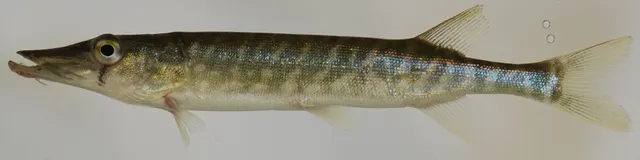 Chain pickerelSeparated by chain-link markings against pale bean-shaped spots, and by the dark bar below the eye.
- CiscoIn North American lakes cisco are a principal pike prey, and pike that key on cisco move deeper and further from cover than the classic weedbed picture suggests.
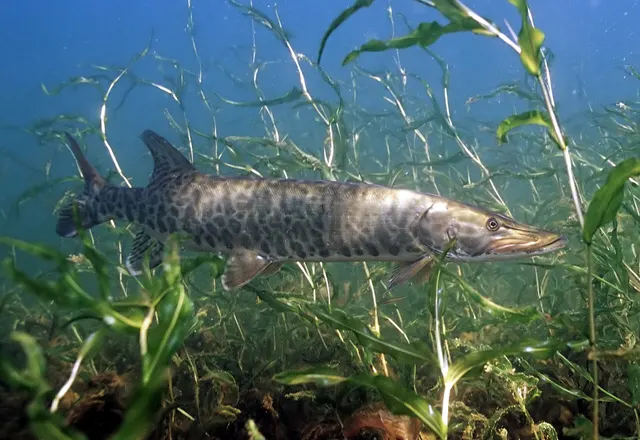 MuskellungeCongeners in Esox that share water across much of the range and are separated by the markings: pike pale on dark, muskellunge dark on pale. They hybridise naturally.
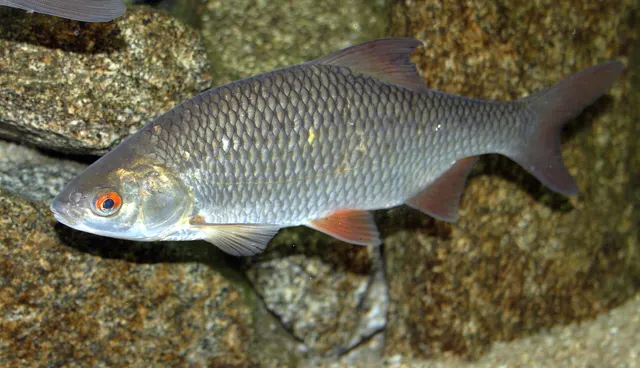 RoachRoach are among the most important prey species for pike across their European range, which is why so much pike lure design is silver and roach-shaped.
Where it lives
- CanalsPresent throughout, holding against what little structure a uniform channel offers — bridges, moorings, marina entrances and far-bank cover.
- Floodplains, backwaters and oxbowsThe temperate case, and the reason this page is not only about the tropics: pike spawn in flooded marginal vegetation and use backwaters and slack water as refuge when a river is in flood.
- Gravel pitsClear water, complex structure and a prey base of roach and bream produce very large pike, holding on bars and drop-offs rather than in weed.
- Lowland riversIn rivers pike hold in slacks, on the inside of bends and beside structure — the same ambush logic applied to moving water.
- Lowland stillwatersPike are strongly associated with weed, margins and structure in standing water, which is where their ambush strategy works.
- ReservoirsReaches exceptional size in trout reservoirs, feeding on stocked fish in open water — one of the clearest cases where a managed fishery creates a predator fishery.
Where you will find it
- CanadaPresent across essentially the whole country in lakes, slow rivers and weedy bays, and the shield's most accessible large predator.
- GermanyPresent inland across the country and, unusually, in the brackish Baltic lagoons behind the islands, where salinity is low enough for a freshwater predator to live and spawn in what is nominally the sea.
- Lake GenevaPresent in the shallow weedy bays and river mouths at either end of the lake, reaching substantial sizes on the available forage.
- Lake VänernAbundant through an archipelago of thousands of islands and skerries, reaching specimen sizes, and the reason a second group of visitors comes.
- Loch LomondPike are the loch's best-known catch, favoured by the shallow, rich, island-scattered southern basin.
- Lough CorribAbundant in the lough and the basis of a substantial fishery, with a long-running argument attached about management on a wild trout water.
- Lough ErneAcross both loughs with the larger fish tending to come from the deep open lower lough, supported by a very large biomass of coarse fish and a modern catch-and-release culture.
- Moroccan mountain and reservoir fresh waterIntroduced deliberately into the reservoir system during the twentieth century and now the principal predator of those fisheries.
18 more
- Northern Ireland Fishing regions
- Sweden Fishing regions
- The Baltic Sea Fishing regions
- The Baltic states Fishing regions
- The English canal network Fishing regions
- The English trout reservoirs Fishing regions
- The Fens and their drains Fishing regions
- The Finnish lake district Fishing regions
- The IJsselmeer Fishing regions
- The Lake District lakes Fishing regions
- The Moy and Lough Conn Fishing regions
- The Netherlands Fishing regions
- The Norfolk Broads Fishing regions
- The Republic of Ireland Fishing regions
- The Rhine Fishing regions
- The River Tay Fishing regions
- The River Trent Fishing regions
- The Shannon system Fishing regions
Understanding this fish
- Contaminants, and what accumulates in a fishThe freshwater case: a long-lived apex predator in waters whose contaminant history is local, which is why freshwater advisories are frequently issued per water body rather than per species.
- Eating freshwater fish you have caughtThe clearest illustration of the cultural split: an inedible nuisance in British angling writing and a classic food fish in French and Scandinavian cooking, with the difference lying entirely in the rules and the culture rather than in the fish.
- Floating, suspending and sinking luresThe fish where buoyancy is most often the whole difference. A pike holding tight to weed or over a shallow bar will take a suspending or slow-rising lure worked in pauses above it, and will ignore the same lure fished as a sinker because it drops into the cover before the fish has decided. The pause is the presentation, and buoyancy is what makes a pause possible.
- Fly fishing for predators: pike, bass and beyondPike are the species this branch of fly fishing is built around in Europe, and the handling requirements it describes are pike-specific.
- How fish detect preyWhether a pike is hunting by sight or by lateral line decides whether you should be manipulating colour or displacement.
- Leaders and tracesPike dentition severs nylon regardless of breaking strain, which makes a trace a welfare requirement wherever pike are present rather than a choice about the target.
- When fish feed, and why timing is not a ruleAn ambush predator that feeds in short windows and then digests for days is why a fish can fail to feed at the time the rule says it should.
- Why fish come off during the fightThe hardest mouth in British fresh water and the clearest case of the record's argument. A pike's jaw is bone and teeth with very little soft tissue for a hook to hold in, so a hook that has not found a purchase at the corner comes away — which is why pike are lost at the net more than almost anything else and why the hook hold is checked rather than trusted.
2 more
Told apart from
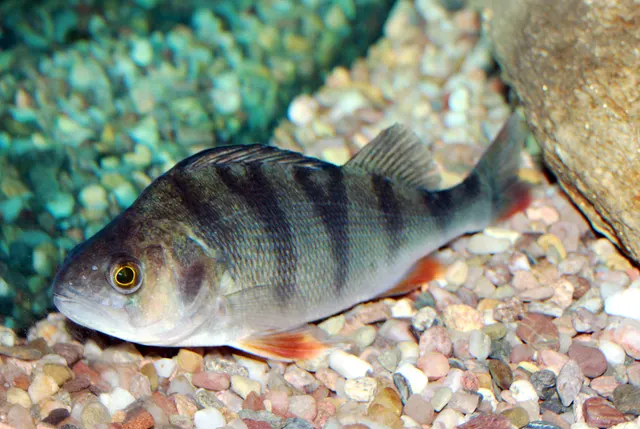 European perchThe inverse of the diet edge, recorded separately because the evidence for a species being eaten and for a species eating is not the same evidence.
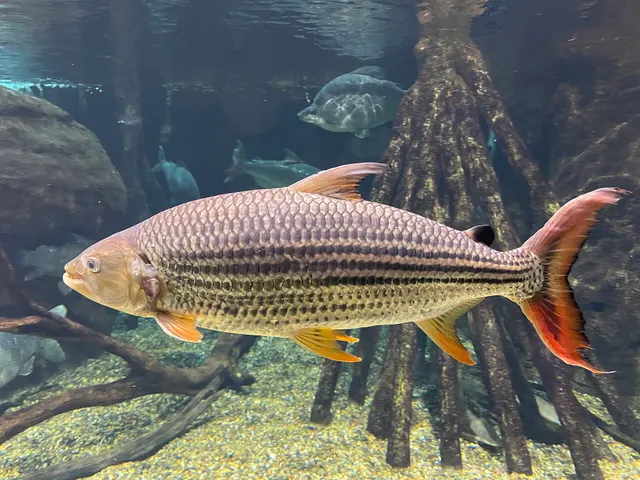 African tigerfishUnrelated fish that arrived at the same solution: a fast, heavily toothed, visually hunting freshwater predator that shears its prey and needs a wire trace between it and the angler.
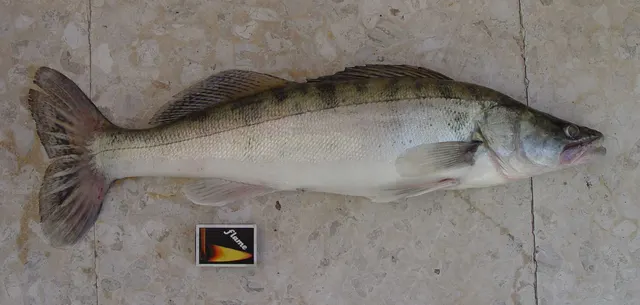 ZanderThe two are constantly confused as a catch and are almost nothing alike: pike is an ambush predator of clear, weedy water hunting by sight; zander is a low-light shoal hunter that is at its best in the turbid water pike struggle in.
Environment and conservation
Sources and evidence
- A short review of pike ecology — Hydrobiologia 601:5–16, Springer, 2008 (Scientific literature)Relied on for: Pike as size-selective piscivores governed by a predator-to-prey size ratio, the role of cannibalism in population dynamics, the 35–70 per cent macrophyte cover requirement, and the attribution of growth to temperature, transparency, productivity, prey and pike density together. Read in full during source review.States this directlyPassage read and verified
- Pike: Biology and Exploitation — Chapman & Hall (Fish and Fisheries Series 19), 1996 (Scientific literature)Relied on for: The wider monograph treatment of pike feeding ecology and of the growth pattern producing large females. Metadata verified; contents not read, which is why the readable 2008 review by the same author now carries the specific claims.Background and mechanism onlyCitation checked — the work exists and is described correctly
- Freshwater Fishes of the British Isles — HarperCollins (New Naturalist 75), 1992 (Reference work)Relied on for: Identification features, spawning timing and habitat association in the British Isles.States this directlyCitation checked — the work exists and is described correctly
- FishBase: a global information system on fishes — Froese, R. and D. Pauly, eds. — FishBase Consortium (Scientific institute)Relied on for: Taxonomy, family placement and recorded size range.States this directlyPassage read and verified
- The IUCN Red List of Threatened Species — International Union for Conservation of Nature (Conservation authority)Relied on for: The global conservation assessment. Re-checked via FishBase's republication of the current category, because the Red List's own pages could not be read.States this directlyCitation checked — the work exists and is described correctly
Why the 66 connections on this page are here, and the sources
Similar and related fish
Backed by research — 5 connections
Supported by peer-reviewed research or fisheries science. The sources are listed and can be checked.
Bleak
Recorded diet evidence identifies Alburnus alburnus as a food item of this predator at species level. The edge is written at that granularity and no further.
- FishBase: a global information system on fishes — Froese, R. and D. Pauly, eds. — FishBase Consortium (Scientific institute)Relied on for: Food items recorded for this predator, including Alburnus alburnus.States this directlyPassage read and verified
- FAO Species Identification Guides for Fishery Purposes and the FAO Species Catalogues — Food and Agriculture Organization of the United Nations (Scientific institute)Relied on for: Species account describing the diet of this predator in the region where Alburnus alburnus occurs.Background and mechanism onlyCitation checked — the work exists and is described correctly
Chain pickerel
An identification comparison naming both binomials: Esox niger and Esox lucius.
- FishBase: a global information system on fishes — Froese, R. and D. Pauly, eds. — FishBase Consortium (Scientific institute)Relied on for: Morphological and distributional data for Esox niger and for Esox lucius.States this directlyPassage read and verified
- The IUCN Red List of Threatened Species — International Union for Conservation of Nature (Conservation authority)Relied on for: Separate assessments treating Esox niger and Esox lucius as distinct species.States this directlyCitation checked — the work exists and is described correctly
Cisco
Recorded diet evidence identifies Coregonus artedi as a food item of this predator at species level. The edge is written at that granularity and no further.
- FishBase: a global information system on fishes — Froese, R. and D. Pauly, eds. — FishBase Consortium (Scientific institute)Relied on for: Food items recorded for this predator, including Coregonus artedi.States this directlyPassage read and verified
- FAO Species Identification Guides for Fishery Purposes and the FAO Species Catalogues — Food and Agriculture Organization of the United Nations (Scientific institute)Relied on for: Species account describing the diet of this predator in the region where Coregonus artedi occurs.Background and mechanism onlyCitation checked — the work exists and is described correctly
Muskellunge
A taxonomic and identification comparison naming both binomials.
- FishBase: a global information system on fishes — Froese, R. and D. Pauly, eds. — FishBase Consortium (Scientific institute)Relied on for: That Esox masquinongy is an Esocidae of the genus Esox, sharing range with Esox lucius across the Great Lakes and St Lawrence.States this directlyPassage read and verified
- Pike: Biology and Exploitation — Chapman & Hall (Fish and Fisheries Series 19), 1996 (Scientific literature)Relied on for: Esocid morphology and the characters separating congeneric pikes.States this directlyCitation checked — the work exists and is described correctly
Roach
Pike diet composition is well studied and cyprinids including roach are consistently recorded as a principal prey group where both occur. This is a claim about the world and is held to a scientific standard.
- Pike: Biology and Exploitation — Chapman & Hall (Fish and Fisheries Series 19), 1996 (Scientific literature)Relied on for: Pike feeding ecology and prey composition, including the predominance of cyprinid prey and specifically Rutilus rutilus where the two co-occur.States this directlyCitation checked — the work exists and is described correctly
- FishBase: a global information system on fishes — Froese, R. and D. Pauly, eds. — FishBase Consortium (Scientific institute)Relied on for: Recorded diet composition for Esox lucius.States this directlyPassage read and verified
How it is caught
What experienced anglers do — 6 connections
Widely and independently recommended by experienced anglers and specialist sources. This is real angling knowledge, not proof: controlled evidence for it is limited, and FishingHQ records it as convention rather than as a demonstrated effect.
Darkhouse spearing
Established angling practice for this species, recorded as convention. The note states the property of the animal or its water that makes the method the answer.
- Fishers' Craft and Lettered Art: Tracts on Fishing from the End of the Middle Ages — University of Toronto Press, 1997 (Scientific literature)Relied on for: That fishing practices develop around the fish and water available to them, and the historical method of reading such traditions.Background and mechanism onlyCitation checked — the work exists and is described correctly
- FAO fishing gear types and fishing technology information — Food and Agriculture Organization of the United Nations (Scientific institute)Relied on for: Classification and operation of the gear type described.States this directlyCitation checked — the work exists and is described correctly
Deadbaiting
Deadbaiting for pike is described as established practice across independent specialist works from different authorial lineages. There is no controlled comparison of deadbaiting against alternatives, so this is recorded as convention rather than as a demonstrated superiority.
- Pike and the Pike Angler — Stanley Paul, 1981 (Specialist angling publication)Relied on for: Deadbaiting method for pike, its rationale and its seasonal application.Citation checked — the work exists and is described correctly
- Freshwater Fishing — Macdonald & Jane's, 1975 (Specialist angling publication)Relied on for: Deadbaiting described as standard predator practice within a general compendium of British method.Citation checked — the work exists and is described correctly
Float-tube fishing
Established angling practice for this species, recorded as convention. The note states the property of the animal or its water that makes the method the answer.
- Freshwater Fishing — Macdonald & Jane's, 1975 (Specialist angling publication)Relied on for: Freshwater angling technique and its application to this species.States this directlyCitation checked — the work exists and is described correctly
- Angling Times — Bauer Media (Specialist angling publication)Relied on for: Contemporary practice for this species in the British and European coarse press.Background and mechanism onlyCitation checked — the work exists and is described correctly
Kayak fishing
Established angling practice for this species, recorded as convention. The note states the property of the animal or its water that makes the method the answer.
- Freshwater Fishing — Macdonald & Jane's, 1975 (Specialist angling publication)Relied on for: Freshwater angling technique and its application to this species.States this directlyCitation checked — the work exists and is described correctly
- Angling Times — Bauer Media (Specialist angling publication)Relied on for: Contemporary practice for this species in the British and European coarse press.Background and mechanism onlyCitation checked — the work exists and is described correctly
Spinning
Long-established and independently described. Recorded as convention.
- Pike and the Pike Angler — Stanley Paul, 1981 (Specialist angling publication)Relied on for: Spinning and lure work for pike.Citation checked — the work exists and is described correctly
- Still-Water Angling — MacGibbon & Kee, 1953 (Specialist angling publication)Relied on for: Lure fishing for predators in stillwater, described from an independent tradition.Citation checked — the work exists and is described correctly
Trolling
Established practice on large lakes and reservoirs, independently described.
- Pike and the Pike Angler — Stanley Paul, 1981 (Specialist angling publication)Relied on for: Trolling for pike on large waters.Citation checked — the work exists and is described correctly
- Angling Times — Bauer Media (Specialist angling publication)Relied on for: Contemporary trolling practice for pike as described by multiple independent contributors.Citation checked — the work exists and is described correctly
Gear for this fish
What experienced anglers do — 8 connections
Widely and independently recommended by experienced anglers and specialist sources. This is real angling knowledge, not proof: controlled evidence for it is limited, and FishingHQ records it as convention rather than as a demonstrated effect.
Jerkbaits
Established specialist practice, independently described.
- Pike and the Pike Angler — Stanley Paul, 1981 (Specialist angling publication)Relied on for: Jerked and worked lures for pike.Citation checked — the work exists and is described correctly
- Angling Times — Bauer Media (Specialist angling publication)Relied on for: Contemporary jerkbait practice.Citation checked — the work exists and is described correctly
Sea deadbaits
Independently described across specialist predator literature and contemporary practice.
- Pike and the Pike Angler — Stanley Paul, 1981 (Specialist angling publication)Relied on for: The use of sea fish deadbaits for pike and their scent characteristics.Citation checked — the work exists and is described correctly
- Angling Times — Bauer Media (Specialist angling publication)Relied on for: Contemporary sea deadbait practice for pike from independent contributors.Citation checked — the work exists and is described correctly
Soft plastics
A practitioner claim about which lure family answers this species' feeding or holding behaviour.
- Pike and the Pike Angler — Stanley Paul, 1981 (Specialist angling publication)Relied on for: Lure categories and their application in pike fishing, treated at length.States this directlyCitation checked — the work exists and is described correctly
- Pike Anglers' Club of Great Britain guidance on pike care and handling — Pike Anglers' Club of Great Britain, 1977 (Angling or fisheries organisation)Relied on for: Contemporary pike lure practice and the handling consequences of each lure type.States this directlyPassage read and verified
Spinnerbaits and bladed jigs
A practitioner claim about a lure-species pairing and the design property behind it.
- Pike and the Pike Angler — Stanley Paul, 1981 (Specialist angling publication)Relied on for: Practitioner treatment of lure selection for pike in weeded and structured water.Citation checked — the work exists and is described correctly
- Pike Anglers' Club of Great Britain guidance on pike care and handling — Pike Anglers' Club of Great Britain, 1977 (Angling or fisheries organisation)Relied on for: Practitioner treatment of pike lure fishing from a source independent of the angling press.Passage read and verified
Spoons
A practitioner claim about which lure family answers this species' feeding or holding behaviour.
- Pike and the Pike Angler — Stanley Paul, 1981 (Specialist angling publication)Relied on for: Lure categories and their application in pike fishing, treated at length.States this directlyCitation checked — the work exists and is described correctly
- Pike Anglers' Club of Great Britain guidance on pike care and handling — Pike Anglers' Club of Great Britain, 1977 (Angling or fisheries organisation)Relied on for: Contemporary pike lure practice and the handling consequences of each lure type.States this directlyPassage read and verified
Wire trace deadbait rig
Which species a terminal arrangement is directed at is established practitioner knowledge, converging across independent angling traditions and literatures, and is labelled as consensus rather than as tested result.
- Pike and the Pike Angler — Stanley Paul, 1981 (Specialist angling publication)Relied on for: Pike angling practice including deadbait presentation, wire traces, multi-hook arrangements and their origins.States this directlyCitation checked — the work exists and is described correctly
- Pike Anglers' Club of Great Britain guidance on pike care and handling — Pike Anglers' Club of Great Britain, 1977 (Angling or fisheries organisation)Relied on for: Pike care and handling guidance, including trace requirements and the unhooking consequences of terminal arrangements.States this directlyPassage read and verified
Wire traces
Universal across independent specialist sources, and the reasoning is mechanical rather than contested — pike dentition cuts line. Recorded as consensus because no controlled study is needed or available for a mechanical fact of this kind, and because the practice is documented independently across traditions.
- Pike Anglers' Club of Great Britain guidance on pike care and handling — Pike Anglers' Club of Great Britain, 1977 (Angling or fisheries organisation)Relied on for: The explicit statement that hooks and bait must ALWAYS be mounted on a wire trace, from the UK specialist pike organisation. Read during source review.Passage read and verified
- Pike and the Pike Angler — Stanley Paul, 1981 (Specialist angling publication)Relied on for: The requirement for a bite-resistant trace when fishing for pike, and the consequences of not using one.Citation checked — the work exists and is described correctly
- Angling Trust guidance for anglers — Angling Trust (Angling or fisheries organisation)Relied on for: Fish welfare guidance requiring tackle that does not leave hooks in fish.Citation checked — the work exists and is described correctly
Crankbaits
Established lure practice, independently described.
- Pike and the Pike Angler — Stanley Paul, 1981 (Specialist angling publication)Relied on for: Diving plug selection for pike.Citation checked — the work exists and is described correctly
- Angling Times — Bauer Media (Specialist angling publication)Relied on for: Contemporary crankbait practice for pike.Citation checked — the work exists and is described correctly
Where it lives
Backed by research — 6 connections
Supported by peer-reviewed research or fisheries science. The sources are listed and can be checked.
Canals
Habitat association recorded for the species, in an environment FishingHQ describes on its own page.
- Freshwater Fishes of the British Isles — HarperCollins (New Naturalist 75), 1992 (Reference work)Relied on for: Habitat association and distribution of European freshwater fishes, including occurrence in artificial and modified waters.States this directlyCitation checked — the work exists and is described correctly
- FishBase: a global information system on fishes — Froese, R. and D. Pauly, eds. — FishBase Consortium (Scientific institute)Relied on for: Habitat association, depth range and water-type tolerance recorded for the species.States this directlyPassage read and verified
Floodplains, backwaters and oxbows
A habitat association resting on the regional identification and fisheries literature rather than on angling report.
- The Flood Pulse Concept in River-Floodplain Systems — Canadian Special Publication of Fisheries and Aquatic Sciences 106, Department of Fisheries and Oceans, Ottawa, 1989 (Scientific literature)Relied on for: That fish move laterally onto the inundated floodplain to feed and breed and return to the channel as water falls, and that floodplain inundation drives production in large river systems.States this directlyCitation checked — the work exists and is described correctly
- FAO Species Identification Guides for Fishery Purposes and the FAO Species Catalogues — Food and Agriculture Organization of the United Nations (Scientific institute)Relied on for: Habitat association and distribution of the species concerned.States this directlyCitation checked — the work exists and is described correctly
Gravel pits
Habitat association recorded for the species, in an environment FishingHQ describes on its own page.
- Freshwater Fishes of the British Isles — HarperCollins (New Naturalist 75), 1992 (Reference work)Relied on for: Habitat association and distribution of European freshwater fishes, including occurrence in artificial and modified waters.States this directlyCitation checked — the work exists and is described correctly
- FishBase: a global information system on fishes — Froese, R. and D. Pauly, eds. — FishBase Consortium (Scientific institute)Relied on for: Habitat association, depth range and water-type tolerance recorded for the species.States this directlyPassage read and verified
Lowland rivers
Recorded habitat association across the species' range.
- FishBase: a global information system on fishes — Froese, R. and D. Pauly, eds. — FishBase Consortium (Scientific institute)Relied on for: Habitat records for Esox lucius including riverine populations.States this directlyPassage read and verified
- Freshwater Fishes of the British Isles — HarperCollins (New Naturalist 75), 1992 (Reference work)Relied on for: Riverine pike distribution and habitat use in the British Isles.FishingHQ's interpretation of what it saysCitation checked — the work exists and is described correctly
Lowland stillwaters
Habitat association is well documented and follows directly from the species' ambush hunting strategy.
- FishBase: a global information system on fishes — Froese, R. and D. Pauly, eds. — FishBase Consortium (Scientific institute)Relied on for: Habitat and ecology records for Esox lucius.States this directlyPassage read and verified
- Pike: Biology and Exploitation — Chapman & Hall (Fish and Fisheries Series 19), 1996 (Scientific literature)Relied on for: The relationship between pike habitat selection, structure and ambush hunting.States this directlyCitation checked — the work exists and is described correctly
Reservoirs
Habitat association recorded for the species, in an environment FishingHQ describes on its own page.
- Freshwater Fishes of the British Isles — HarperCollins (New Naturalist 75), 1992 (Reference work)Relied on for: Habitat association and distribution of European freshwater fishes, including occurrence in artificial and modified waters.States this directlyCitation checked — the work exists and is described correctly
- FishBase: a global information system on fishes — Froese, R. and D. Pauly, eds. — FishBase Consortium (Scientific institute)Relied on for: Habitat association, depth range and water-type tolerance recorded for the species.States this directlyPassage read and verified
Where you will find it
Backed by research — 26 connections
Supported by peer-reviewed research or fisheries science. The sources are listed and can be checked.
Canada
A distribution association between an animal and a kind of water, rather than a claim about any named mark.
- FishBase: a global information system on fishes — Froese, R. and D. Pauly, eds. — FishBase Consortium (Scientific institute)Relied on for: Distribution, habitat association and depth range recorded for the species, including its occurrence in the water body concerned.States this directlyPassage read and verified
- The IUCN Red List of Threatened Species — International Union for Conservation of Nature (Conservation authority)Relied on for: Assessment and range account for the species, including the systems and coasts it occupies.Background and mechanism onlyCitation checked — the work exists and is described correctly
Germany
That a species occurs in these waters, drawn from distribution science and stock assessment. It is a statement about where the animal lives and is not a statement that anybody will catch one, still less where.
- Freshwater Fishes of the British Isles — HarperCollins (New Naturalist 75), 1992 (Reference work)Relied on for: Distribution, habitat requirement and life history of European freshwater fishes, including their occurrence across the continental range named.States this directlyCitation checked — the work exists and is described correctly
- FishBase: a global information system on fishes — Froese, R. and D. Pauly, eds. — FishBase Consortium (Scientific institute)Relied on for: Recorded distribution and habitat association of the freshwater and migratory species named.States this directlyPassage read and verified
Lake Geneva
A distributional claim taken from reference works and databases on the fishes of the region rather than from angling report. It states presence and asserts nothing about a fishery.
- FishBase: a global information system on fishes — Froese, R. and D. Pauly, eds. — FishBase Consortium (Scientific institute)Relied on for: Distribution, habitat association, life history and size recorded for the species concerned.States this directlyPassage read and verified
- Freshwater Fishes of the British Isles — HarperCollins (New Naturalist 75), 1992 (Reference work)Relied on for: Biology, distribution, life history and conservation status of northern European freshwater and diadromous fishes.States this directlyCitation checked — the work exists and is described correctly
Lake Vänern
A distributional claim taken from reference works and databases on the fishes of the region rather than from angling report. It states presence and asserts nothing about a fishery.
- Pike and the Pike Angler — Stanley Paul, 1981 (Specialist angling publication)Relied on for: Predator angling practice on large waters, including deep-water location, trolling and the handling of very large fish.States this directlyCitation checked — the work exists and is described correctly
- Pike: Biology and Exploitation — Chapman & Hall (Fish and Fisheries Series 19), 1996 (Scientific literature)Relied on for: The biology, growth, feeding ecology and habitat use of pike across its Holarctic range.States this directlyCitation checked — the work exists and is described correctly
Loch Lomond
A distributional claim taken from reference works on the fishes of the region rather than from angling report. It states presence and asserts nothing about a fishery.
- FishBase: a global information system on fishes — Froese, R. and D. Pauly, eds. — FishBase Consortium (Scientific institute)Relied on for: Distribution, habitat association, life history and depth range recorded for the species concerned.States this directlyPassage read and verified
- Freshwater Fishes of the British Isles — HarperCollins (New Naturalist 75), 1992 (Reference work)Relied on for: Biology, distribution and conservation status of British and Irish freshwater and diadromous fishes.States this directlyCitation checked — the work exists and is described correctly
- The Fishes of the British Isles and North-West Europe — Macmillan, 1969 (Reference work)Relied on for: Distribution, habitat and biology of the fishes of the British Isles and north-west Europe.States this directlyCitation checked — the work exists and is described correctly
Lough Corrib
A distribution association between an animal and a kind of water, rather than a claim about any named mark.
- Freshwater Fishes of the British Isles — HarperCollins (New Naturalist 75), 1992 (Reference work)Relied on for: Distribution, habitat association and ecology of British and Irish freshwater fishes, including occurrence in the water body concerned.States this directlyCitation checked — the work exists and is described correctly
- FishBase: a global information system on fishes — Froese, R. and D. Pauly, eds. — FishBase Consortium (Scientific institute)Relied on for: Distribution, habitat association and life history recorded for the species.Background and mechanism onlyPassage read and verified
Lough Erne
A claim that a place contains the ground, water and seasonal conditions the species is associated with. It is a distributional statement about the world, it rests on the regional reference literature, and it deliberately asserts nothing about access, permission or catch.
- Freshwater Fishes of the British Isles — HarperCollins (New Naturalist 75), 1992 (Reference work)Relied on for: Distribution, ecology and conservation status of the freshwater fishes of the British Isles, including in artificial and modified waters.States this directlyCitation checked — the work exists and is described correctly
- Environment Agency fisheries management, byelaws and rod licensing information — Environment Agency (Government fisheries body)Relied on for: Fisheries monitoring, water quality and species distribution in English rivers, canals and still waters.States this directlyCitation checked — the work exists and is described correctly
Moroccan mountain and reservoir fresh water
A distribution claim about the world, so it rests on the reference datasets rather than on angling report. FishingHQ's evidence policy requires it.
- FishBase: a global information system on fishes — Froese, R. and D. Pauly, eds. — FishBase Consortium (Scientific institute)Relied on for: Distribution, habitat association and depth range recorded for the species, including its occurrence in the water body concerned.States this directlyPassage read and verified
- FAO Species Identification Guides for Fishery Purposes and the FAO Species Catalogues — Food and Agriculture Organization of the United Nations (Scientific institute)Relied on for: Distribution, habitat, depth and fishery accounts for the species of the eastern central Atlantic and Mediterranean.States this directlyCitation checked — the work exists and is described correctly
Northern Ireland
A distribution claim about the world, so it rests on the reference works rather than on angling report. FishingHQ's evidence policy requires it.
- FishBase: a global information system on fishes — Froese, R. and D. Pauly, eds. — FishBase Consortium (Scientific institute)Relied on for: Distribution, habitat association, water-type tolerance and occurrence records for the species, including its presence in the countries concerned.States this directlyPassage read and verified
- The IUCN Red List of Threatened Species — International Union for Conservation of Nature (Conservation authority)Relied on for: Assessment and range account for the species, including the countries and systems it occupies and its population trend within them.States this directlyCitation checked — the work exists and is described correctly
Sweden
That a species occurs in these waters, drawn from distribution science and stock assessment. It is a statement about where the animal lives and is not a statement that anybody will catch one, still less where.
- Freshwater Fishes of the British Isles — HarperCollins (New Naturalist 75), 1992 (Reference work)Relied on for: Distribution, habitat requirement and life history of European freshwater fishes, including their occurrence across the continental range named.States this directlyCitation checked — the work exists and is described correctly
- FishBase: a global information system on fishes — Froese, R. and D. Pauly, eds. — FishBase Consortium (Scientific institute)Relied on for: Recorded distribution and habitat association of the freshwater and migratory species named.States this directlyPassage read and verified
The Baltic Sea
Occurrence of the species in this system or along this coast: a statement about the animal's distribution, not a venue recommendation.
- Freshwater Fishes of the British Isles — HarperCollins (New Naturalist 75), 1992 (Reference work)Relied on for: Distribution and habitat association of European freshwater fishes, including their occurrence in brackish and coastal waters.States this directlyCitation checked — the work exists and is described correctly
- FishBase: a global information system on fishes — Froese, R. and D. Pauly, eds. — FishBase Consortium (Scientific institute)Relied on for: Salinity tolerance and distribution recorded for the species.States this directlyPassage read and verified
The Baltic states
That a species occurs in these waters, drawn from distribution science and stock assessment. It is a statement about where the animal lives and is not a statement that anybody will catch one, still less where.
- Freshwater Fishes of the British Isles — HarperCollins (New Naturalist 75), 1992 (Reference work)Relied on for: Distribution, habitat requirement and life history of European freshwater fishes, including their occurrence across the continental range named.States this directlyCitation checked — the work exists and is described correctly
- FishBase: a global information system on fishes — Froese, R. and D. Pauly, eds. — FishBase Consortium (Scientific institute)Relied on for: Recorded distribution and habitat association of the freshwater and migratory species named.States this directlyPassage read and verified
The English canal network
A claim that a place contains the ground, water and seasonal conditions the species is associated with. It is a distributional statement about the world, it rests on the regional reference literature, and it deliberately asserts nothing about access, permission or catch.
- Freshwater Fishes of the British Isles — HarperCollins (New Naturalist 75), 1992 (Reference work)Relied on for: Distribution, ecology and conservation status of the freshwater fishes of the British Isles, including in artificial and modified waters.States this directlyCitation checked — the work exists and is described correctly
- Environment Agency fisheries management, byelaws and rod licensing information — Environment Agency (Government fisheries body)Relied on for: Fisheries monitoring, water quality and species distribution in English rivers, canals and still waters.States this directlyCitation checked — the work exists and is described correctly
The English trout reservoirs
A claim that a place contains the ground, water and seasonal conditions the species is associated with. It is a distributional statement about the world, it rests on the regional reference literature, and it deliberately asserts nothing about access, permission or catch.
- Freshwater Fishes of the British Isles — HarperCollins (New Naturalist 75), 1992 (Reference work)Relied on for: Distribution, ecology and conservation status of the freshwater fishes of the British Isles, including in artificial and modified waters.States this directlyCitation checked — the work exists and is described correctly
- Environment Agency fisheries management, byelaws and rod licensing information — Environment Agency (Government fisheries body)Relied on for: Fisheries monitoring, water quality and species distribution in English rivers, canals and still waters.States this directlyCitation checked — the work exists and is described correctly
The Fens and their drains
A distributional claim about where a species occurs, which is a claim about the world and rests on the reference literature rather than on angling report.
- Freshwater Fishes of the British Isles — HarperCollins (New Naturalist 75), 1992 (Reference work)Relied on for: Distribution, habitat association and ecology of the freshwater fishes of the British Isles.States this directlyCitation checked — the work exists and is described correctly
- FishBase: a global information system on fishes — Froese, R. and D. Pauly, eds. — FishBase Consortium (Scientific institute)Relied on for: Distribution, habitat association and life history recorded for the species.States this directlyPassage read and verified
The Finnish lake district
A claim that a place contains the ground, water and seasonal conditions the species is associated with. It is a distributional statement about the world, it rests on the regional reference literature, and it deliberately asserts nothing about access, permission or catch.
- Freshwater Fishes of the British Isles — HarperCollins (New Naturalist 75), 1992 (Reference work)Relied on for: Distribution, ecology and conservation status of European freshwater and migratory fishes, including in modified and artificial waters.States this directlyCitation checked — the work exists and is described correctly
- FishBase: a global information system on fishes — Froese, R. and D. Pauly, eds. — FishBase Consortium (Scientific institute)Relied on for: Recorded distribution, habitat association and life history for the freshwater and migratory species named.States this directlyPassage read and verified
The IJsselmeer
A distributional claim taken from reference works and databases on the fishes of the region rather than from angling report. It states presence and asserts nothing about a fishery.
- Pike and the Pike Angler — Stanley Paul, 1981 (Specialist angling publication)Relied on for: Predator angling practice on large waters, including deep-water location, trolling and the handling of very large fish.States this directlyCitation checked — the work exists and is described correctly
- Pike: Biology and Exploitation — Chapman & Hall (Fish and Fisheries Series 19), 1996 (Scientific literature)Relied on for: The biology, growth, feeding ecology and habitat use of pike across its Holarctic range.States this directlyCitation checked — the work exists and is described correctly
The Lake District lakes
A claim that a place contains the ground, water and seasonal conditions the species is associated with. It is a distributional statement about the world, it rests on the regional reference literature, and it deliberately asserts nothing about access, permission or catch.
- Freshwater Fishes of the British Isles — HarperCollins (New Naturalist 75), 1992 (Reference work)Relied on for: Distribution, habitat and conservation status of British freshwater fishes, including the isolated glacial-relict populations of northern England.States this directlyCitation checked — the work exists and is described correctly
- Environment Agency fisheries management, byelaws and rod licensing information — Environment Agency (Government fisheries body)Relied on for: Fisheries monitoring, water quality and species distribution in English rivers and still waters.States this directlyCitation checked — the work exists and is described correctly
The Moy and Lough Conn
A claim that a coast contains the ground and conditions the species is associated with. It is a distributional statement about the world, it rests on the regional reference literature, and it deliberately asserts nothing about access, permission or catch.
- The Fishes of the British Isles and North-West Europe — Macmillan, 1969 (Reference work)Relied on for: Distribution and habitat association of the marine and estuarine fishes of the British Isles and north-west Europe, including which coasts and ground types a species occupies.States this directlyCitation checked — the work exists and is described correctly
- FishBase: a global information system on fishes — Froese, R. and D. Pauly, eds. — FishBase Consortium (Scientific institute)Relied on for: Recorded distribution, depth range and habitat association for the species named.States this directlyPassage read and verified
The Netherlands
That a species occurs in these waters, drawn from distribution science and stock assessment. It is a statement about where the animal lives and is not a statement that anybody will catch one, still less where.
- Freshwater Fishes of the British Isles — HarperCollins (New Naturalist 75), 1992 (Reference work)Relied on for: Distribution, habitat requirement and life history of European freshwater fishes, including their occurrence across the continental range named.States this directlyCitation checked — the work exists and is described correctly
- FishBase: a global information system on fishes — Froese, R. and D. Pauly, eds. — FishBase Consortium (Scientific institute)Relied on for: Recorded distribution and habitat association of the freshwater and migratory species named.States this directlyPassage read and verified
The Norfolk Broads
A distributional claim taken from reference works on the fishes of the region rather than from angling report. It states presence and asserts nothing about a fishery.
- FishBase: a global information system on fishes — Froese, R. and D. Pauly, eds. — FishBase Consortium (Scientific institute)Relied on for: Distribution, habitat association, life history and depth range recorded for the species concerned.States this directlyPassage read and verified
- Freshwater Fishes of the British Isles — HarperCollins (New Naturalist 75), 1992 (Reference work)Relied on for: Biology, distribution and conservation status of British and Irish freshwater and diadromous fishes.States this directlyCitation checked — the work exists and is described correctly
- The Fishes of the British Isles and North-West Europe — Macmillan, 1969 (Reference work)Relied on for: Distribution, habitat and biology of the fishes of the British Isles and north-west Europe.States this directlyCitation checked — the work exists and is described correctly
The Republic of Ireland
A distribution claim about the world, so it rests on the reference works rather than on angling report. FishingHQ's evidence policy requires it.
- FishBase: a global information system on fishes — Froese, R. and D. Pauly, eds. — FishBase Consortium (Scientific institute)Relied on for: Distribution, habitat association, water-type tolerance and occurrence records for the species, including its presence in the countries concerned.States this directlyPassage read and verified
- The IUCN Red List of Threatened Species — International Union for Conservation of Nature (Conservation authority)Relied on for: Assessment and range account for the species, including the countries and systems it occupies and its population trend within them.States this directlyCitation checked — the work exists and is described correctly
The Rhine
A claim that a place contains the ground, water and seasonal conditions the species is associated with. It is a distributional statement about the world, it rests on the regional reference literature, and it deliberately asserts nothing about access, permission or catch.
- Freshwater Fishes of the British Isles — HarperCollins (New Naturalist 75), 1992 (Reference work)Relied on for: Distribution, ecology and conservation status of European freshwater and migratory fishes, including in modified and artificial waters.States this directlyCitation checked — the work exists and is described correctly
- FishBase: a global information system on fishes — Froese, R. and D. Pauly, eds. — FishBase Consortium (Scientific institute)Relied on for: Recorded distribution, habitat association and life history for the freshwater and migratory species named.States this directlyPassage read and verified
The River Tay
A claim that a place contains the ground, water and seasonal conditions the species is associated with. It is a distributional statement about the world, it rests on the regional reference literature, and it deliberately asserts nothing about access, permission or catch.
- Freshwater Fishes of the British Isles — HarperCollins (New Naturalist 75), 1992 (Reference work)Relied on for: Distribution, ecology and conservation status of the freshwater fishes of the British Isles, including in artificial and modified waters.States this directlyCitation checked — the work exists and is described correctly
- Environment Agency fisheries management, byelaws and rod licensing information — Environment Agency (Government fisheries body)Relied on for: Fisheries monitoring, water quality and species distribution in English rivers, canals and still waters.States this directlyCitation checked — the work exists and is described correctly
The River Trent
A claim that a place contains the ground, water and seasonal conditions the species is associated with. It is a distributional statement about the world, it rests on the regional reference literature, and it deliberately asserts nothing about access, permission or catch.
- Freshwater Fishes of the British Isles — HarperCollins (New Naturalist 75), 1992 (Reference work)Relied on for: Distribution, habitat and conservation status of British freshwater fishes, including the isolated glacial-relict populations of northern England.States this directlyCitation checked — the work exists and is described correctly
- Environment Agency fisheries management, byelaws and rod licensing information — Environment Agency (Government fisheries body)Relied on for: Fisheries monitoring, water quality and species distribution in English rivers and still waters.States this directlyCitation checked — the work exists and is described correctly
The Shannon system
A claim that a place contains the ground, water and seasonal conditions the species is associated with. It is a distributional statement about the world, it rests on the regional reference literature, and it deliberately asserts nothing about access, permission or catch.
- Freshwater Fishes of the British Isles — HarperCollins (New Naturalist 75), 1992 (Reference work)Relied on for: Distribution, ecology and conservation status of the freshwater fishes of the British Isles, including in artificial and modified waters.States this directlyCitation checked — the work exists and is described correctly
- Environment Agency fisheries management, byelaws and rod licensing information — Environment Agency (Government fisheries body)Relied on for: Fisheries monitoring, water quality and species distribution in English rivers, canals and still waters.States this directlyCitation checked — the work exists and is described correctly
Understanding this fish
Backed by research — 2 connections
Supported by peer-reviewed research or fisheries science. The sources are listed and can be checked.
Contaminants, and what accumulates in a fish
A link from a species or a place to the accumulation mechanism that decides whether what is caught there should be eaten, resting on published seafood-hazard guidance and on the species' recorded diet and trophic position.
- ICES Advice on fishing opportunities, catch and effort — International Council for the Exploration of the Sea (Scientific institute)Relied on for: Contaminant monitoring in marine biota and the accumulation of contaminants through marine food webs.States this directlyCitation checked — the work exists and is described correctly
- Fish and Fishery Products Hazards and Controls Guidance — US Food and Drug Administration, Center for Food Safety and Applied Nutrition, 2022 (Standards body)Relied on for: Methylmercury in seafood, the species in which it accumulates, and the advisory approach taken to it.States this directlyPassage read and verified
How fish detect prey
The sensory basis of pike predation is documented in the species monograph.
- Pike: Biology and Exploitation — Chapman & Hall (Fish and Fisheries Series 19), 1996 (Scientific literature)Relied on for: Sensory basis of prey detection in pike.States this directlyCitation checked — the work exists and is described correctly
Official guidance — 3 connections
Stated by a fisheries authority, scientific institute or recognised angling body. Authoritative, but summarising rather than demonstrating.
Eating freshwater fish you have caught
A link from a long-lived freshwater predator to the record covering contaminant accumulation and consumption advisories, which is a hazard specific to that trophic position and life span.
- Fish and Fishery Products Hazards and Controls Guidance — US Food and Drug Administration, Center for Food Safety and Applied Nutrition, 2022 (Standards body)Relied on for: Hazards and controls for fish and fishery products: scombrotoxin formation and the species groups associated with it, seafood parasites, and natural toxins.States this directlyPassage read and verified
Leaders and traces
Specialist body guidance treats wire trace use in pike waters as a standing requirement.
- Pike Anglers' Club of Great Britain guidance on pike care and handling — Pike Anglers' Club of Great Britain, 1977 (Angling or fisheries organisation)Relied on for: Guidance on wire traces in pike fishing and the consequences of a bitten-off lure left in a fish.States this directlyPassage read and verified
When fish feed, and why timing is not a rule
The reason it behaves as it does, explained rather than merely listed.
- FishBase: a global information system on fishes — Froese, R. and D. Pauly, eds. — FishBase Consortium (Scientific institute)Relied on for: Temperature tolerance, oxygen requirement, activity pattern and habitat association recorded for the species concerned.Background and mechanism onlyPassage read and verified
- Understanding the Complexity of Catch-and-Release in Recreational Fishing — Reviews in Fisheries Science 15:75–167, 2007 (Scientific literature)Relied on for: The factors determining post-release survival in recreational fishing, including water temperature, fight duration, air exposure and handling.States this directlyCitation checked — the work exists and is described correctly
What experienced anglers do — 5 connections
Widely and independently recommended by experienced anglers and specialist sources. This is real angling knowledge, not proof: controlled evidence for it is limited, and FishingHQ records it as convention rather than as a demonstrated effect.
Floating, suspending and sinking lures
A fish or a record joined to the comparison it is a worked example of, written only where the subject's own behaviour is what makes the comparison concrete rather than where the comparison could apply to it.
- Freshwater Fishes of the British Isles — HarperCollins (New Naturalist 75), 1992 (Reference work)Relied on for: Feeding biology, behaviour and life history of the freshwater fishes of the British Isles.States this directlyCitation checked — the work exists and is described correctly
- FishBase: a global information system on fishes — Froese, R. and D. Pauly, eds. — FishBase Consortium (Scientific institute)Relied on for: Recorded feeding biology, environment and behaviour of the species named.States this directlyPassage read and verified
Fly fishing for predators: pike, bass and beyond
Why it works, and what that rests on. Fly tackle and technique rest on established practitioner craft rather than on experiment, and the strength shown says so rather than borrowing an authority the subject does not have.
- Trout & Salmon — Bauer Media (Specialist angling publication)Relied on for: Contemporary game and fly angling practice as reported and restated by practitioners, including tackle convention and technique.Background and mechanism onlyCitation checked — the work exists and is described correctly
- General angling website restatements of established technique — Various (Credible secondary source)Relied on for: Widely restated angling practice and belief, recorded as practitioner consensus rather than as tested fact.Background and mechanism onlyCitation checked — the work exists and is described correctly
Why fish come off during the fight
A fish or a record joined to the comparison it is a worked example of, written only where the subject's own behaviour is what makes the comparison concrete rather than where the comparison could apply to it.
- Freshwater Fishes of the British Isles — HarperCollins (New Naturalist 75), 1992 (Reference work)Relied on for: Feeding biology, behaviour and life history of the freshwater fishes of the British Isles.States this directlyCitation checked — the work exists and is described correctly
- FishBase: a global information system on fishes — Froese, R. and D. Pauly, eds. — FishBase Consortium (Scientific institute)Relied on for: Recorded feeding biology, environment and behaviour of the species named.States this directlyPassage read and verified
Why fish follow a lure and turn away
A fish or a record joined to the comparison it is a worked example of, written only where the subject's own behaviour is what makes the comparison concrete rather than where the comparison could apply to it.
- Freshwater Fishes of the British Isles — HarperCollins (New Naturalist 75), 1992 (Reference work)Relied on for: Feeding biology, behaviour and life history of the freshwater fishes of the British Isles.States this directlyCitation checked — the work exists and is described correctly
- FishBase: a global information system on fishes — Froese, R. and D. Pauly, eds. — FishBase Consortium (Scientific institute)Relied on for: Recorded feeding biology, environment and behaviour of the species named.States this directlyPassage read and verified
Why the fish are not where they were last week
A fish or a record joined to the comparison it is a worked example of, written only where the subject's own behaviour is what makes the comparison concrete rather than where the comparison could apply to it.
- Freshwater Fishes of the British Isles — HarperCollins (New Naturalist 75), 1992 (Reference work)Relied on for: Feeding biology, behaviour and life history of the freshwater fishes of the British Isles.States this directlyCitation checked — the work exists and is described correctly
- FishBase: a global information system on fishes — Froese, R. and D. Pauly, eds. — FishBase Consortium (Scientific institute)Relied on for: Recorded feeding biology, environment and behaviour of the species named.States this directlyPassage read and verified
Told apart from
Backed by research — 2 connections
Supported by peer-reviewed research or fisheries science. The sources are listed and can be checked.
European perch
Recorded in the pike diet literature. Held to a scientific standard as a claim about feeding ecology.
- Pike: Biology and Exploitation — Chapman & Hall (Fish and Fisheries Series 19), 1996 (Scientific literature)Relied on for: Perca fluviatilis as recorded prey in the pike diet, and prey selection scaling with predator size.States this directlyCitation checked — the work exists and is described correctly
- FishBase: a global information system on fishes — Froese, R. and D. Pauly, eds. — FishBase Consortium (Scientific institute)Relied on for: Diet records for Esox lucius.Background and mechanism onlyPassage read and verified
Perch are a recorded prey item of pike wherever the two co-occur, and predation pressure from pike is one of the factors that determines whether a perch population stunts or produces large individuals.
- Pike: Biology and Exploitation — Chapman & Hall (Fish and Fisheries Series 19), 1996 (Scientific literature)Relied on for: Predation by Esox lucius on Perca fluviatilis and its role in structuring prey populations.States this directlyCitation checked — the work exists and is described correctly
- Freshwater Fishes of the British Isles — HarperCollins (New Naturalist 75), 1992 (Reference work)Relied on for: The interaction between pike predation and perch population structure in British waters.FishingHQ's interpretation of what it saysCitation checked — the work exists and is described correctly
African tigerfish
A comparison resting on verified dentition and feeding ecology on both sides rather than on the loose resemblance the angling press usually invokes.
- FishBase: a global information system on fishes — Froese, R. and D. Pauly, eds. — FishBase Consortium (Scientific institute)Relied on for: That Hydrocynus vittatus has large fang-like teeth overlapping the jaws and is an exclusive fish feeder above 90 to 100 mm.States this directlyPassage read and verified
- Pike: Biology and Exploitation — Chapman & Hall (Fish and Fisheries Series 19), 1996 (Scientific literature)Relied on for: Pike dentition and feeding ecology as a visually hunting freshwater piscivore.States this directlyCitation checked — the work exists and is described correctly
What experienced anglers do — 2 connections
Widely and independently recommended by experienced anglers and specialist sources. This is real angling knowledge, not proof: controlled evidence for it is limited, and FishingHQ records it as convention rather than as a demonstrated effect.
European perch
The comparison is drawn routinely in predator angling literature.
- Pike and the Pike Angler — Stanley Paul, 1981 (Specialist angling publication)Relied on for: Comparative predator behaviour between pike and perch.Citation checked — the work exists and is described correctly
- Angling Times — Bauer Media (Specialist angling publication)Relied on for: Contemporary comparison of pike and perch angling approaches.Citation checked — the work exists and is described correctly
Zander
The comparison is what a reader arriving at either page is actually holding in their head, and the contrast in hunting strategy is the useful part rather than the family difference.
- Pike and the Pike Angler — Stanley Paul, 1981 (Specialist angling publication)Relied on for: The characterisation of pike as a visual ambush predator of clearer, weedier water.Citation checked — the work exists and is described correctly
- Pike Anglers' Club of Great Britain guidance on pike care and handling — Pike Anglers' Club of Great Britain, 1977 (Angling or fisheries organisation)Relied on for: Practitioner treatment of pike and zander as distinct catch requiring different approaches, from a source independent of the angling press.Passage read and verified
Safety reading
Official guidance — 1 connection
Stated by a fisheries authority, scientific institute or recognised angling body. Authoritative, but summarising rather than demonstrating.
Handling fish safely
Handling guidance for predatory species with hazardous dentition.
- Angling Trust guidance for anglers — Angling Trust (Angling or fisheries organisation)Relied on for: Fish handling practice for predatory species.States this directlyCitation checked — the work exists and is described correctly
Environment and conservation
Official guidance — 1 connection
Stated by a fisheries authority, scientific institute or recognised angling body. Authoritative, but summarising rather than demonstrating.
Predator control and its consequences
An environmental effect attached to the practice that causes it, resting on guidance and monitoring published by the responsible bodies rather than on advocacy.
- JNCC species and habitat conservation advice — Joint Nature Conservation Committee (Conservation authority)Relied on for: Conservation status, designation, monitoring and protection of species and habitats in the United Kingdom.States this directlyCitation checked — the work exists and is described correctly
- Environment Agency fisheries management, byelaws and rod licensing information — Environment Agency (Government fisheries body)Relied on for: The structure of freshwater fisheries management including habitat protection, stocking consent and fishery regulation.States this directlyCitation checked — the work exists and is described correctly
How FishingHQ labels evidence is explained in the evidence policy.