What does northern pike eat?
What is established about how northern pike feeds, kept separate from what anglers infer from it.
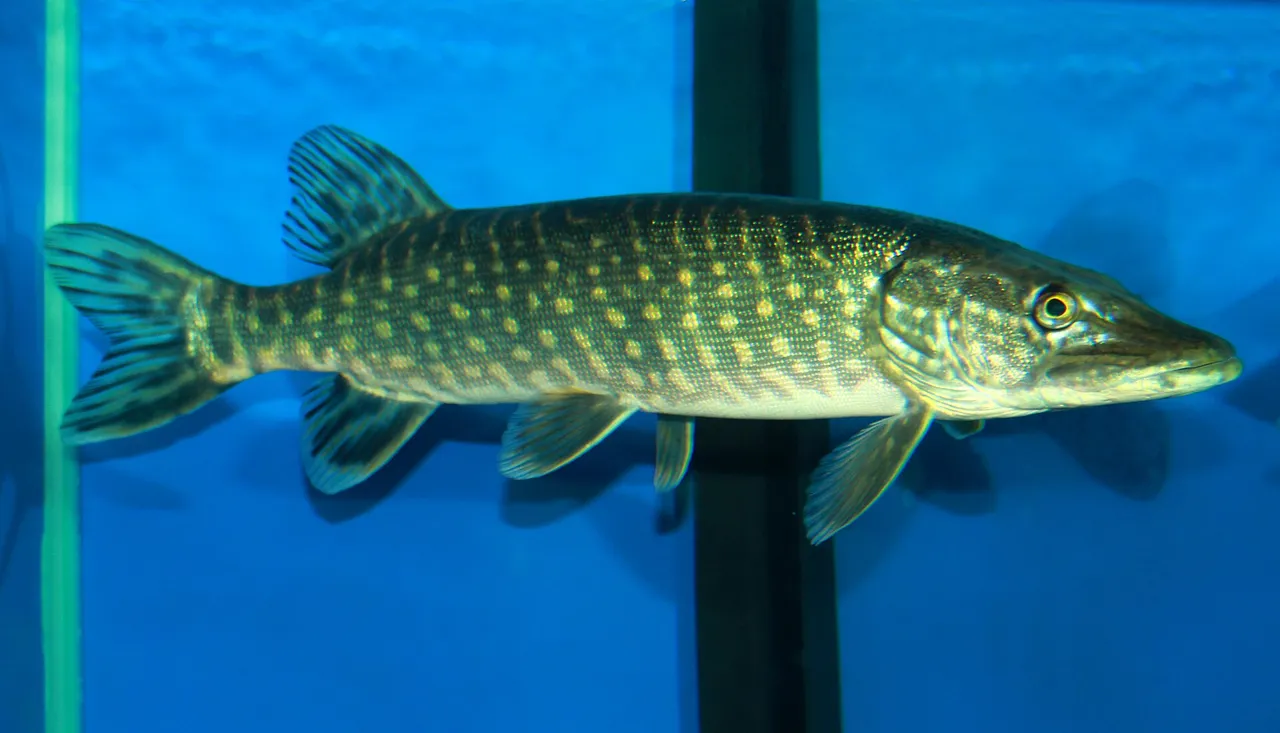
How this was identified, and who took it
Identified by: Duck-bill snout, dorsal and anal fins set well back towards the tail, and the pale bean-shaped spotting on a darker flank — all three present and unambiguous.Karelj, Public domain, via Wikimedia Commons — source, licenceWhat is known about how it feeds
Pike are ambush predators built around a single explosive acceleration rather than a pursuit. The body plan says it plainly: dorsal and anal fins set far back to act as a rear-mounted propulsion unit, a long jaw full of backward-raked teeth, and camouflage that works against weed and structure rather than in open water. Prey is taken sideways in the jaws, held, and then turned and swallowed head-first, which is why a pike that has taken a bait often holds it motionless for some seconds before moving off. Fish dominate the diet in most waters, and FishingHQ carries verified predation on roach, European perch, bleak and, in North American lakes, cisco. The bleak and cisco edges are worth reading together: both are open-water shoaling fish, and pike keying on them are found well away from the weedbed cover the species is usually pictured in. Pike are also strongly cannibalistic, which is a genuine population control rather than an incidental habit — in waters with poor prey-fish recruitment, smaller pike form a substantial part of the diet of larger ones. Prey size scales with predator size across the species' whole range: gape is the limit, and a large pike will take prey a third of its own length. Feeding is not continuous. Pike digest slowly and feed in bouts, and a fish that has fed heavily may not feed again for days, which is the biological reality behind the familiar experience of a swim that produces one fish and then nothing.
The food
Prey with a verified dietary link to this fish. Each entry carries its own evidence, and each is written at the precision the source actually used: a named species where the source named one, a group or food category where it said “polychaetes”, “crustaceans” or “detritus” and meant it. That is why this list is shorter than the animal’s real diet rather than longer.
- Roach — Rutilus rutilus
Roach are among the most important prey species for pike across their European range, which is why so much pike lure design is silver and roach-shaped.
- European perch — Perca fluviatilis
Perch are taken readily despite their spines, and small perch form a substantial part of the diet in waters where they are abundant.
- Bleak — Alburnus alburnus
Bleak are taken alongside roach in open water, particularly by smaller pike working surface shoals in summer.
- Cisco — Coregonus artedi
In North American lakes cisco are a principal pike prey, and pike that key on cisco move deeper and further from cover than the classic weedbed picture suggests.
Food with no page of its own here yet
These are real components of the diet, listed as plain text because FishingHQ has no page for them yet. Inventing pages to make the list look fuller would be the fabrication this whole approach exists to prevent.
- smaller pike (cannibalism)
- bream and other deep-bodied cyprinids
- amphibians
- small waterfowl, occasionally
- small mammals crossing water, occasionally
What anglers do with this
Everything below is interpretation, not finding. It is what experienced anglers conclude from the biology above, and the reasoning is usually sound and almost never tested. It is separated from the biology deliberately.
Anglers read the above as a case for large baits presented near structure, and for giving a fish time before striking. Both are practitioner reasoning rather than findings: the biology establishes that pike take large prey sideways and hold it, and the tackle conclusions anglers draw from that are conventional rather than tested. The one genuinely evidence-led point is the handling consequence. A pike's teeth and the sheer number of them mean unhooking demands proper tools and a chin grip that keeps a hand clear of the gill rakers, and a deeply hooked pike is at real risk. That is not a tactic; it is a duty that follows from the animal's anatomy.
What this does not establish
Diet composition varies enormously between waters and between seasons, and figures from one lake do not transfer to another. FishingHQ records verified predation only for prey species it also carries records for, so the named list is shorter than a pike's real diet even after an earlier pass added the missing forage species. Nothing here establishes what any individual pike is eating in any particular water this week.
Where this connects
These are the baits, lures, methods and explainers FishingHQ already joins to this fish — which is why the list is sometimes short. They are not chosen for this page, and a link here means an evidenced relationship exists, not that it follows from the diet.
Baits recorded for this species
Lures recorded for this species
Methods used for it
Where it lives
The science behind the feeding
- Contaminants, and what accumulates in a fish
- Eating freshwater fish you have caught
- Floating, suspending and sinking lures
- Fly fishing for predators: pike, bass and beyond
- How fish detect prey
- Leaders and traces
- When fish feed, and why timing is not a rule
- Why fish come off during the fight
- Why fish follow a lure and turn away
- Why the fish are not where they were last week
This page covers feeding. The Northern pike record covers identification, lifecycle, seasonal behaviour, handling and the sources behind all of it.
Reviewed 2026-08-10.