Chain pickerel
Fish · Last reviewed 2026-08-10
The smallest widely-fished Esox of eastern North America, marked with a distinctive dark chain-link pattern and a vertical bar beneath the eye.
Safety: injury while handling fish — can cause injury needing treatment.
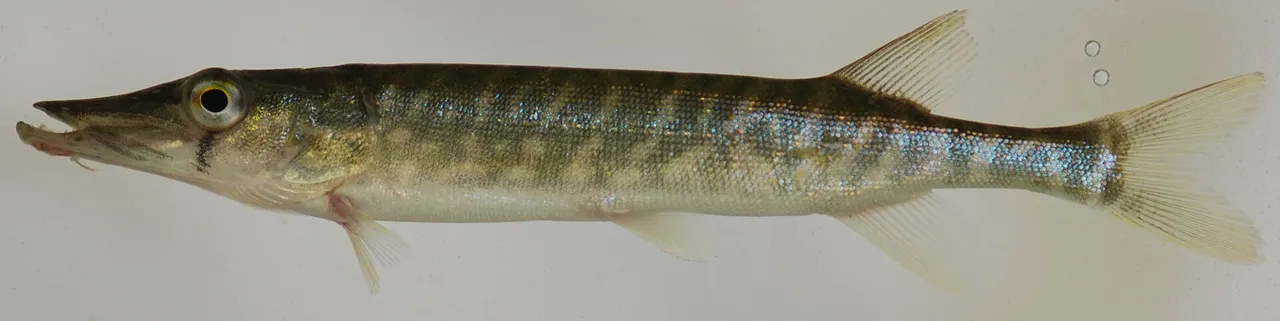
How this was identified, and who took it
Identified by: Identified on the reticulated chain-link flank pattern, which names the species and separates it from redfin and grass pickerels, with the dark teardrop bar below the eye and the genus's duckbill snout. PUBLISHED WITH A STATED LIMITATION: a survey specimen of roughly 100 mm standard length, so a juvenile, recorded as such. The chain pattern is legible at this size; an adult image would be preferable and should replace it.Smithsonian Environmental Research Center — CC BY 2.0, via Wikimedia Commons — source, licence_(12598761723).jpg)
Catching Chain pickerel
Everything here on fishing for it. Each entry opens the page behind it.
- Ground
Chain pickerel is the pike of small water. Where northern pike needs a lake or a large river, pickerel thrive in ponds, weedy backwaters and slow acidic streams across eastern North America, and they behave exactly as a small Esox should — hanging motionless in weed and accelerating hard at anything that passes.
The markings are the identification. A pickerel carries a dark chain-link or reticulated pattern over a green-gold flank, quite unlike the pale bean-shaped spots of a northern pike, and a distinct dark vertical bar running down from the eye.
It is a cold-tolerant fish that feeds through winter, which makes it one of the few reliable targets for hard-water and cold-season anglers in its range.
How it is caught
Gear for this fish
Identification
- Scientific name
- Esox niger
- Family
- Esocidae
- Water
- Freshwater
- Conservation status
- Least Concern
- Regions
- North America
- A dark chain-link or reticulated pattern over a green-gold flank — not the pale spots of a northern pike.
- A distinct dark vertical bar below the eye.
- Fully scaled cheeks and gill covers, and a long duck-billed snout with sharp teeth.
- Dorsal and anal fins set far back near the tail, as in all Esox.
Size
- Typical
- 0.5–1.2 kg (1.1–2.6 lb)
- Large
- 1.6–2.5 kg (3.5–5.5 lb)
Exceptional: FishBase records a maximum of 99 cm and 4.3 kg
How chain pickerel are fished, and why
A small ambush predator of weedy, shallow, still water, and the methods are all about presenting something that looks like escaping prey close to cover.
SPINNING is the primary approach because pickerel hunt by sight from ambush in weed, and a lure moving past the edge of cover triggers a reaction strike rather than a considered decision.
DEADBAITING works because the fish is an opportunist that will take a static dead fish, and because a bait fished near weed reaches fish that are holding rather than actively hunting.
ICE FISHING is a major method across its northern range, where the fish remains active under ice through winter and is reachable by tip-up over the same weedy shallows.
WHAT GENERALISES. A weed-associated ambush predator in still water will be caught by anything that moves past its cover convincingly, and the limiting factor is usually reaching the edge of the weed rather than the choice of lure.
What experienced anglers do — why, and the sources (2)
Widely and independently recommended by experienced anglers and specialist sources. This is real angling knowledge, not proof: controlled evidence for it is limited, and FishingHQ records it as convention rather than as a demonstrated effect.
- FishBase: a global information system on fishes — Froese, R. and D. Pauly, eds. — FishBase Consortium (Scientific institute)Relied on for: Habitat association, depth range, feeding ecology and prey of the species, from which the method association follows.Background and mechanism onlyPassage read and verified
- IGFA International Angling Rules and World Record Requirements — International Game Fish Association (Angling or fisheries organisation)Relied on for: Recognised angling methods and the tackle classes used for them internationally.Background and mechanism onlyPassage read and verified
A small esocid handled like a big one, and why that is the right instinct
A chain pickerel is a pike in miniature and has the same equipment: needle-sharp backward-facing teeth, hard gill rakers inside the covers, and a habit of thrashing at the worst moment. The only difference is that people take it seriously about a tenth as often, and that is where the injuries come from.
THE BACKWARD ANGLE IS WHAT CUTS. Teeth angled to stop prey escaping do not resist a hand going in and catch every millimetre of one coming out. A pickerel's teeth are small enough to look harmless and sharp enough to lay a finger open.
USE THE SAME GRIP AS FOR PIKE. Hand under the gill cover from outside, gripping the bony arch of the lower jaw, fingers clear of the rakers, with the other hand supporting the body. It works at this size exactly as it does at ten times the size, and it is worth learning here where the consequences of getting it slightly wrong are small.
TOOLS, NOT FINGERS. Pickerel take lures deep and are frequently hooked on trebles. Forceps and a hook-out tool make it a five-second job.
AND THEY ARE FRAGILE OUT OF WATER for their size. A small esocid dropped on a boat deck or a rock does real damage to itself. Wet hands, minimal air time, straight back.
What experienced anglers do — why, and the sources (2)
Widely and independently recommended by experienced anglers and specialist sources. This is real angling knowledge, not proof: controlled evidence for it is limited, and FishingHQ records it as convention rather than as a demonstrated effect.
- FishBase: a global information system on fishes — Froese, R. and D. Pauly, eds. — FishBase Consortium (Scientific institute)Relied on for: Dentition, fin and spine morphology, body form, air-breathing capability and distribution for the species, which are the anatomical facts the handling practice below follows from.States this directlyPassage read and verified
- General angling website restatements of established technique — Various (Credible secondary source)Relied on for: Widely restated angling practice for handling this species, recorded as practitioner consensus rather than as tested fact.Background and mechanism onlyCitation checked — the work exists and is described correctly
The small esocid that lives inside the weed rather than beside it
Chain pickerel occupy the same broad ambush niche as pike and muskellunge and partition it by taking the densest cover, which is a good illustration of how three closely related predators share a continent.
THE HABITAT IS SHALLOW, WEEDY, ACIDIC AND WARM. Pickerel occupy vegetated lakes, ponds, swamps, backwaters and slow, weedy river reaches across eastern North America, and they are notably tolerant of the warm, acidic, tannin-stained, low-productivity water of coastal plain and swamp systems that other esocids do poorly in. They handle low oxygen better than pike do.
AND THEY GO INTO THE VEGETATION RATHER THAN HOLDING AT ITS EDGE. This is the interesting part. A pike typically ambushes from the margin of cover into open water; a pickerel is smaller, more slender and lives inside dense weed beds, lily fields and submerged brush, ambushing over very short distances within the cover itself. That is a niche a pike is too large to occupy and it is why the two coexist in the same lake — the pickerel is exploiting the interior of a habitat the pike works the outside of.
THE CONSEQUENCE FOR FISHING IS DIRECT: pickerel are caught with weedless presentations worked through cover rather than lures retrieved along its edge, and open water produces very few of them.
BODY SIZE SETS THE DIET AND THE POSITION. Pickerel are small esocids, so their prey is small — minnows, young sunfish, invertebrates, frogs — which allows them to make a living in shallow, low-productivity water that could not support a population of large predators. Where they overlap with pike or muskellunge they are the smallest of the three and take the smallest prey from the tightest cover, which is a textbook resource partition.
THE WEED IS THEREFORE NOT A PREFERENCE BUT THE HABITAT. Weed removal, dredging and shoreline hardening eliminate pickerel from waters that still hold plenty of open water, because open water is not somewhere a pickerel can operate.
Backed by research — why, and the sources (2)
Supported by peer-reviewed research or fisheries science. The sources are listed and can be checked.
- FishBase: a global information system on fishes — Froese, R. and D. Pauly, eds. — FishBase Consortium (Scientific institute)Relied on for: Habitat association, depth range, substrate preference, salinity tolerance and temperature range recorded for the species.States this directlyPassage read and verified
- The IUCN Red List of Threatened Species — International Union for Conservation of Nature (Conservation authority)Relied on for: Assessment and habitat account, including the habitats on which the species depends and the threats to them.Background and mechanism onlyCitation checked — the work exists and is described correctly
Lifecycle and reproduction
Fast-growing early and relatively short-lived compared with the larger Esox, maturing within a few years. Populations persist well in small, acidic and weedy waters that hold few other predators.
Spawns very early in spring, sometimes under ice-out conditions, scattering adhesive eggs over flooded vegetation in shallow water with no parental care.
Feeding and senses
An ambush predator taking small fish, frogs and invertebrates, striking sideways from cover and turning prey to swallow head-first in the manner of all pike.
Hunts by sight from concealment in weed, keying on movement at short range. Clear water and visible cover define where the fish will be.
Through the year
Active through the coldest months and a mainstay of winter and ice fishing where that is practised, with a spring spawning period and steady warm-season feeding in weed.
Distribution
North America: Nova Scotia, Canada (introduced) to southern Florida, USA; Gulf coast west to Sabine Lake drainage in Louisiana, USA; Mississippi River basin north to Kentucky and Missouri, USA. Introduced to Lakes Ontario and Erie drainages and elsewhere
This is a biological range — where the species occurs, not a prediction that you will catch one. To browse the fishing geography FishingHQ holds, start at fishing places.
Why anglers care
A widely fished eastern North American predator taken on spoons, spinners, jerkbaits and live bait fished around weed, and an important ice-fishing target. Its significance is availability: it provides genuine predator fishing in small, ordinary waters and through the cold months when most other species shut down. Anglers regard it as easy to interest and difficult to hook cleanly because of the bony mouth.
Handling and returning
A small Esox with the full complement of sharp teeth, and it is easily damaged by rough handling. Use forceps or long pliers, support the fish horizontally, and never hold it vertically by the jaw. Wet hands, and unhook in a net where possible.
Going further
- Chain pickerel vs Northern pike — how to tell them apart.
Safety
Injury while handling fish — Can cause injury needing treatment
Like all pike, the mouth is full of backward-raked teeth and the gill rakers are sharp; both cause deep cuts during unhooking.
What reduces it: Use long forceps and a jaw grip that keeps fingers clear of the teeth and gill plates, and unhook the fish in a net.
Where to go next
Similar and related fish
Where it lives
More fish
Not related to this page — just the rest of the section. There is little else joined to this subject yet, and a short page should still lead somewhere.
Sources and evidence
- FishBase: a global information system on fishes — Froese, R. and D. Pauly, eds. — FishBase Consortium (Scientific institute)Relied on for: Family, maximum size, depth and environment, distribution and the IUCN assessment for Esox niger.States this directlyPassage read and verified
- The IUCN Red List of Threatened Species — International Union for Conservation of Nature (Conservation authority)Relied on for: The Least Concern assessment for Esox niger, assessed 01 December 2011.States this directlyCitation checked — the work exists and is described correctly
Why the 7 connections on this page are here, and the sources
Similar and related fish
Backed by research — 1 connection
Supported by peer-reviewed research or fisheries science. The sources are listed and can be checked.
Northern pike
An identification comparison naming both binomials: Esox niger and Esox lucius.
- FishBase: a global information system on fishes — Froese, R. and D. Pauly, eds. — FishBase Consortium (Scientific institute)Relied on for: Morphological and distributional data for Esox niger and for Esox lucius.States this directlyPassage read and verified
- The IUCN Red List of Threatened Species — International Union for Conservation of Nature (Conservation authority)Relied on for: Separate assessments treating Esox niger and Esox lucius as distinct species.States this directlyCitation checked — the work exists and is described correctly
How it is caught
What experienced anglers do — 3 connections
Widely and independently recommended by experienced anglers and specialist sources. This is real angling knowledge, not proof: controlled evidence for it is limited, and FishingHQ records it as convention rather than as a demonstrated effect.
Deadbaiting
A practitioner claim about how Esox niger is commonly fished, following from where and how it feeds.
- General angling website restatements of established technique — Various (Credible secondary source)Relied on for: Widely restated practitioner accounts of fishing for chain pickerel.Citation checked — the work exists and is described correctly
- Sea Angler — Bauer Media (Specialist angling publication)Relied on for: Practitioner treatment of the methods used for chain pickerel and comparable species.Citation checked — the work exists and is described correctly
Ice fishing
A practitioner claim about how Esox niger is commonly fished, following from where and how it feeds.
- General angling website restatements of established technique — Various (Credible secondary source)Relied on for: Widely restated practitioner accounts of fishing for chain pickerel.Citation checked — the work exists and is described correctly
- Sea Angler — Bauer Media (Specialist angling publication)Relied on for: Practitioner treatment of the methods used for chain pickerel and comparable species.Citation checked — the work exists and is described correctly
Spinning
A practitioner claim about how Esox niger is commonly fished, following from where and how it feeds.
- General angling website restatements of established technique — Various (Credible secondary source)Relied on for: Widely restated practitioner accounts of fishing for chain pickerel.Citation checked — the work exists and is described correctly
- Sea Angler — Bauer Media (Specialist angling publication)Relied on for: Practitioner treatment of the methods used for chain pickerel and comparable species.Citation checked — the work exists and is described correctly
Gear for this fish
What experienced anglers do — 2 connections
Widely and independently recommended by experienced anglers and specialist sources. This is real angling knowledge, not proof: controlled evidence for it is limited, and FishingHQ records it as convention rather than as a demonstrated effect.
Jerkbaits
A practitioner claim about tackle commonly used for Esox niger.
- General angling website restatements of established technique — Various (Credible secondary source)Relied on for: Widely restated practitioner accounts of this presentation for chain pickerel.Citation checked — the work exists and is described correctly
- Angling Times — Bauer Media (Specialist angling publication)Relied on for: Practitioner treatment of comparable presentations for the species group.Citation checked — the work exists and is described correctly
Spoons
A practitioner claim about which lure family answers this species' feeding or holding behaviour.
- General angling website restatements of established technique — Various (Credible secondary source)Relied on for: Widely restated North American lure practice for this species.Background and mechanism onlyCitation checked — the work exists and is described correctly
- IGFA International Angling Rules and World Record Requirements — International Game Fish Association (Angling or fisheries organisation)Relied on for: Recognition of the species as an established sport fish taken on artificial lures, and the tackle conventions used for it.States this directlyPassage read and verified
Where it lives
Backed by research — 1 connection
Supported by peer-reviewed research or fisheries science. The sources are listed and can be checked.
Lowland stillwaters
A habitat association for Esox niger taken from the environment and distribution data on its FishBase summary.
- FishBase: a global information system on fishes — Froese, R. and D. Pauly, eds. — FishBase Consortium (Scientific institute)Relied on for: The environment, depth range and habitat description recorded for Esox niger.States this directlyPassage read and verified
How FishingHQ labels evidence is explained in the evidence policy.