Chain pickerel vs Northern pike
How to tell them apart, and what follows from getting it right.
Why they get confused
Both are Esox: long cylindrical body, duck-billed snout, sharp teeth, and dorsal and anal fins set far back near the tail. Across the north-eastern United States and eastern Canada they share water, they take the same lures out of the same weed, and both are called jack locally. A small pike and a large chain pickerel are the same length, the same green, and hooked on the same cast.
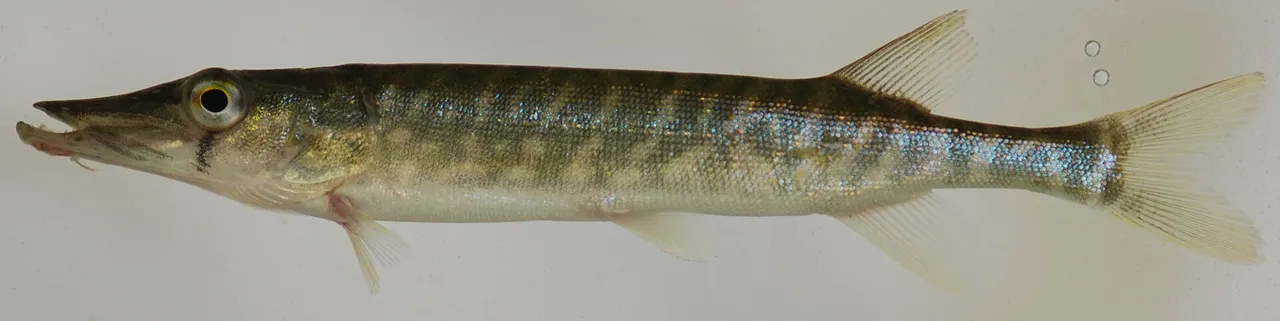
Chain pickerel
Esox niger — Esocidae
_(12598761723).jpg)

The differences
Each difference is marked with how far it can be trusted on its own. A single diagnostic character settles the identification; suggestive ones only narrow it.
| Character | Chain pickerel | Northern pike | Reliability |
|---|---|---|---|
| Whether the gill cover is scaled all overIdentification | Cheek and gill cover both fully scaled, right down to the lower edge. Run a thumb down the gill cover and it is scale the whole way. | Cheek fully scaled but only the UPPER HALF of the gill cover, with the lower half bare. This is the character that separates pike from every other Esox and it works on a fish of any size. | Diagnostic on its own |
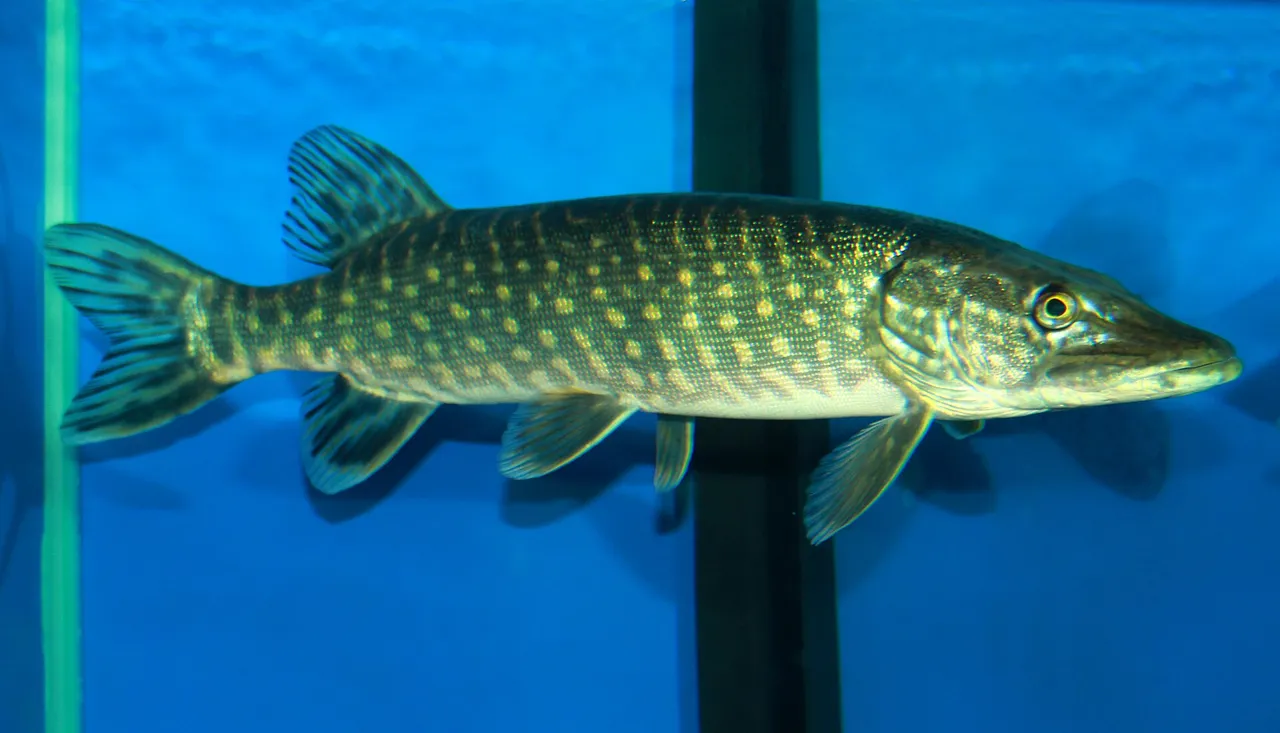
| The pattern on the flankIdentification | A dark chain-link or net-like reticulation laid over green-gold — a dark pattern on a pale ground. | Rows of PALE bean-shaped spots and bars on an olive to grey-green ground — a pale pattern on a dark ground, which is the exact inverse. | Diagnostic on its own |
| A dark bar under the eyeIdentification | A distinct dark vertical bar runs down from below the eye. It is present, it is obvious, and it is easy to check in a photograph. | No vertical bar beneath the eye. The head carries the same pale spotting as the body. | Supporting — use with others |
| The size the fish reachesSize | Most fish run half a kilo to a little over one, a good one is under two and a half, and FishBase records a maximum of 99 cm and 4.3 kg. | Most fish run 45–75 cm and 1.5–5 kg, a fish over 90 cm and 8 kg is memorable, and fish over 20 kg are recorded from large productive waters. A ten-kilo esocid is not a pickerel. | Supporting — use with others |
| When each one spawnsSpawning | Very early in spring, sometimes under ice-out conditions, scattering adhesive eggs over flooded vegetation in the shallows. | Also early — late winter and spring, before most other temperate freshwater fish — over flooded margins and inundated ground. The head start is the strategy in both, and it does not separate them. | Suggestive only — varies |
| How each should be heldHandling | A small Esox with the full set of teeth, easily damaged. Forceps or long pliers, supported horizontally, never held vertically by the jaw, unhooked in the net where possible. | The same instruction at a larger scale, and with an addition: fingers go nowhere near the gill rakers, which cut deeply, and a big fish held vertically by the jaw is carrying its own weight on its spine. | Suggestive only — varies |
Why it matters
The practical consequence is a rule rather than a technique. Size and bag limits for pike and pickerel differ between jurisdictions and frequently within one, and an angler who has decided which fish is on the mat has decided which limit applies. The handling instruction scales rather than changes: a pickerel is a small pike and rewards being treated like one, which is the right instinct in the wrong direction — most people under-handle the small fish rather than over-handle it. Note also that pike hybridise with muskellunge where both occur, so an unusually large esocid with an odd scale pattern is worth a second look before it is named from either page.
The full records
This page compares two species. Each of them has a complete record covering biology, behaviour, handling and the evidence behind all of it.
More about chain pickerel
Where it lives, how it is caught, and what else it is confused with.
Similar and related fish
How it is caught
Gear for this fish
Where it lives
Why the 7 connections on this page are here, and the sources
Similar and related fish
Backed by research — 1 connection
Supported by peer-reviewed research or fisheries science. The sources are listed and can be checked.
Northern pike
An identification comparison naming both binomials: Esox niger and Esox lucius.
- FishBase: a global information system on fishes — Froese, R. and D. Pauly, eds. — FishBase Consortium (Scientific institute)Relied on for: Morphological and distributional data for Esox niger and for Esox lucius.States this directlyPassage read and verified
- The IUCN Red List of Threatened Species — International Union for Conservation of Nature (Conservation authority)Relied on for: Separate assessments treating Esox niger and Esox lucius as distinct species.States this directlyCitation checked — the work exists and is described correctly
How it is caught
What experienced anglers do — 3 connections
Widely and independently recommended by experienced anglers and specialist sources. This is real angling knowledge, not proof: controlled evidence for it is limited, and FishingHQ records it as convention rather than as a demonstrated effect.
Deadbaiting
A practitioner claim about how Esox niger is commonly fished, following from where and how it feeds.
- General angling website restatements of established technique — Various (Credible secondary source)Relied on for: Widely restated practitioner accounts of fishing for chain pickerel.Citation checked — the work exists and is described correctly
- Sea Angler — Bauer Media (Specialist angling publication)Relied on for: Practitioner treatment of the methods used for chain pickerel and comparable species.Citation checked — the work exists and is described correctly
Ice fishing
A practitioner claim about how Esox niger is commonly fished, following from where and how it feeds.
- General angling website restatements of established technique — Various (Credible secondary source)Relied on for: Widely restated practitioner accounts of fishing for chain pickerel.Citation checked — the work exists and is described correctly
- Sea Angler — Bauer Media (Specialist angling publication)Relied on for: Practitioner treatment of the methods used for chain pickerel and comparable species.Citation checked — the work exists and is described correctly
Spinning
A practitioner claim about how Esox niger is commonly fished, following from where and how it feeds.
- General angling website restatements of established technique — Various (Credible secondary source)Relied on for: Widely restated practitioner accounts of fishing for chain pickerel.Citation checked — the work exists and is described correctly
- Sea Angler — Bauer Media (Specialist angling publication)Relied on for: Practitioner treatment of the methods used for chain pickerel and comparable species.Citation checked — the work exists and is described correctly
Gear for this fish
What experienced anglers do — 2 connections
Widely and independently recommended by experienced anglers and specialist sources. This is real angling knowledge, not proof: controlled evidence for it is limited, and FishingHQ records it as convention rather than as a demonstrated effect.
Jerkbaits
A practitioner claim about tackle commonly used for Esox niger.
- General angling website restatements of established technique — Various (Credible secondary source)Relied on for: Widely restated practitioner accounts of this presentation for chain pickerel.Citation checked — the work exists and is described correctly
- Angling Times — Bauer Media (Specialist angling publication)Relied on for: Practitioner treatment of comparable presentations for the species group.Citation checked — the work exists and is described correctly
Spoons
A practitioner claim about which lure family answers this species' feeding or holding behaviour.
- General angling website restatements of established technique — Various (Credible secondary source)Relied on for: Widely restated North American lure practice for this species.Background and mechanism onlyCitation checked — the work exists and is described correctly
- IGFA International Angling Rules and World Record Requirements — International Game Fish Association (Angling or fisheries organisation)Relied on for: Recognition of the species as an established sport fish taken on artificial lures, and the tackle conventions used for it.States this directlyPassage read and verified
Where it lives
Backed by research — 1 connection
Supported by peer-reviewed research or fisheries science. The sources are listed and can be checked.
Lowland stillwaters
A habitat association for Esox niger taken from the environment and distribution data on its FishBase summary.
- FishBase: a global information system on fishes — Froese, R. and D. Pauly, eds. — FishBase Consortium (Scientific institute)Relied on for: The environment, depth range and habitat description recorded for Esox niger.States this directlyPassage read and verified
Reviewed 2026-08-16. FishingHQ does not state what any rule is or where any rule applies. Where this page says the two species are managed differently, that is a reason to check the authority for the water you are on — not a statement of what it requires.