How to identify chain pickerel
Esox niger · Esocidae
The characters that identify chain pickerel, ranked by how far each one can be trusted on its own.
Safety: injury while handling fish — can cause injury needing treatment.
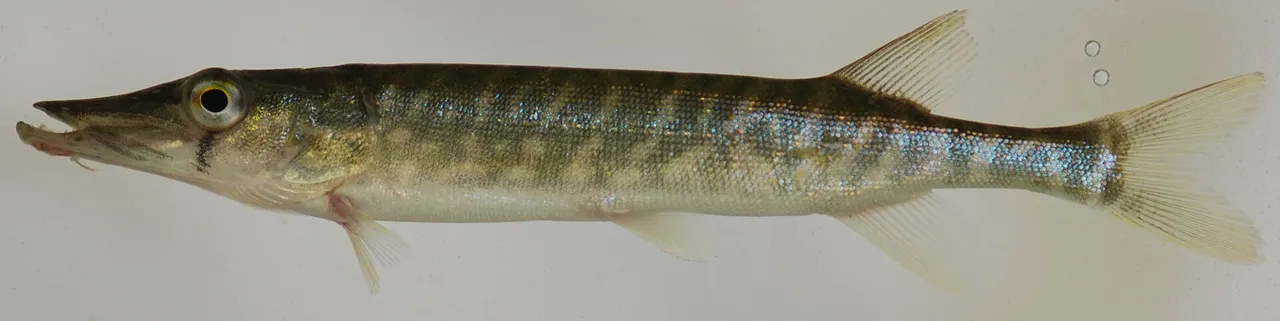
How this was identified, and who took it
Identified by: Identified on the reticulated chain-link flank pattern, which names the species and separates it from redfin and grass pickerels, with the dark teardrop bar below the eye and the genus's duckbill snout. PUBLISHED WITH A STATED LIMITATION: a survey specimen of roughly 100 mm standard length, so a juvenile, recorded as such. The chain pattern is legible at this size; an adult image would be preferable and should replace it.Smithsonian Environmental Research Center — CC BY 2.0, via Wikimedia Commons — source, licenceAbout the image above: The photograph beside this page is a survey specimen of roughly ten centimetres — a juvenile. The chain reticulation is fully formed at that size and is what the page depends on, but the proportions of an adult chain pickerel are heavier and the fish is a good deal longer.
Look at this first
Look at the flank pattern. A chain pickerel carries a network of dark lines that genuinely looks like chain-link fencing laid over a pale green side. No other North American esocid has it, and it is present from a few inches long.
Diagnostic — settles it on its own
Each of these settles the identification on its own. If one is clear, you have your answer.
The chain-link reticulation
Dark lines cross the flank in an interlocking network with pale centres, forming a pattern that reads as chain-link. It is a structural pigment pattern rather than a mood colour, it is present on young fish and old ones, and it is what names the species. Redfin and grass pickerels carry vertical bars instead, not a network.
A fully scaled cheek and gill cover
Both the cheek and the operculum are covered in scales. In a northern pike the lower half of the gill cover is bare; in a muskellunge both the lower cheek and the lower gill cover are bare. Running a finger over the cheek settles which esocid you are holding.
Supporting — use with other characters
Real characters that are not conclusive by themselves. Use two or three together.
A vertical dark bar below the eye
A dark teardrop or bar runs downward from below the eye. Redfin and grass pickerel carry the same mark angled BACKWARD rather than straight down, which is a real if fiddly distinction. On a chain pickerel it is close to vertical.
A duckbill snout and a long body
The elongate body with a flattened duckbill snout and the dorsal fin set far back over the anal fin places the fish in the pike family immediately. It does nothing to separate the species within it, which is why the cheek scaling and the flank pattern do the work.
What it gets confused with
- Redfin and grass pickerel, which are smaller and carry vertical bars rather than a chain network, with the suborbital bar slanted backward.
- Small northern pike, separated by the bare lower half of the gill cover and by pale bean-shaped spots on a dark ground rather than a dark network on a pale one.
- Young muskellunge, which have bare lower cheeks as well as bare lower gill covers.
Side by side: Chain pickerel vs Northern pike.
Where this stops working
Very young esocids of all these species are harder than adults, and the reticulation on a small chain pickerel can read as barring in poor light. The cheek and gill-cover scaling is the check that works at any size and is worth learning by touch. Hybrids between esocids occur, including tiger muskellunge, and are intermediate.
The full record
This page covers identification only. The Chain pickerel record covers behaviour, lifecycle, distribution, handling and the sources behind all of it.
Reviewed 2026-08-15.
More about this fish
Telling it apart is one question. Here are the others.
Similar and related fish
How it is caught
Where it lives
Why the 5 connections on this page are here, and the sources
Similar and related fish
Backed by research — 1 connection
Supported by peer-reviewed research or fisheries science. The sources are listed and can be checked.
Northern pike
An identification comparison naming both binomials: Esox niger and Esox lucius.
- FishBase: a global information system on fishes — Froese, R. and D. Pauly, eds. — FishBase Consortium (Scientific institute)Relied on for: Morphological and distributional data for Esox niger and for Esox lucius.States this directlyPassage read and verified
- The IUCN Red List of Threatened Species — International Union for Conservation of Nature (Conservation authority)Relied on for: Separate assessments treating Esox niger and Esox lucius as distinct species.States this directlyCitation checked — the work exists and is described correctly
How it is caught
What experienced anglers do — 3 connections
Widely and independently recommended by experienced anglers and specialist sources. This is real angling knowledge, not proof: controlled evidence for it is limited, and FishingHQ records it as convention rather than as a demonstrated effect.
Deadbaiting
A practitioner claim about how Esox niger is commonly fished, following from where and how it feeds.
- General angling website restatements of established technique — Various (Credible secondary source)Relied on for: Widely restated practitioner accounts of fishing for chain pickerel.Citation checked — the work exists and is described correctly
- Sea Angler — Bauer Media (Specialist angling publication)Relied on for: Practitioner treatment of the methods used for chain pickerel and comparable species.Citation checked — the work exists and is described correctly
Ice fishing
A practitioner claim about how Esox niger is commonly fished, following from where and how it feeds.
- General angling website restatements of established technique — Various (Credible secondary source)Relied on for: Widely restated practitioner accounts of fishing for chain pickerel.Citation checked — the work exists and is described correctly
- Sea Angler — Bauer Media (Specialist angling publication)Relied on for: Practitioner treatment of the methods used for chain pickerel and comparable species.Citation checked — the work exists and is described correctly
Spinning
A practitioner claim about how Esox niger is commonly fished, following from where and how it feeds.
- General angling website restatements of established technique — Various (Credible secondary source)Relied on for: Widely restated practitioner accounts of fishing for chain pickerel.Citation checked — the work exists and is described correctly
- Sea Angler — Bauer Media (Specialist angling publication)Relied on for: Practitioner treatment of the methods used for chain pickerel and comparable species.Citation checked — the work exists and is described correctly
Where it lives
Backed by research — 1 connection
Supported by peer-reviewed research or fisheries science. The sources are listed and can be checked.
Lowland stillwaters
A habitat association for Esox niger taken from the environment and distribution data on its FishBase summary.
- FishBase: a global information system on fishes — Froese, R. and D. Pauly, eds. — FishBase Consortium (Scientific institute)Relied on for: The environment, depth range and habitat description recorded for Esox niger.States this directlyPassage read and verified
Safety
Injury while handling fish — Can cause injury needing treatment
Like all pike, the mouth is full of backward-raked teeth and the gill rakers are sharp; both cause deep cuts during unhooking.
What reduces it: Use long forceps and a jaw grip that keeps fingers clear of the teeth and gill plates, and unhook the fish in a net.