What does muskellunge eat?
What is established about how muskellunge feeds, kept separate from what anglers infer from it.
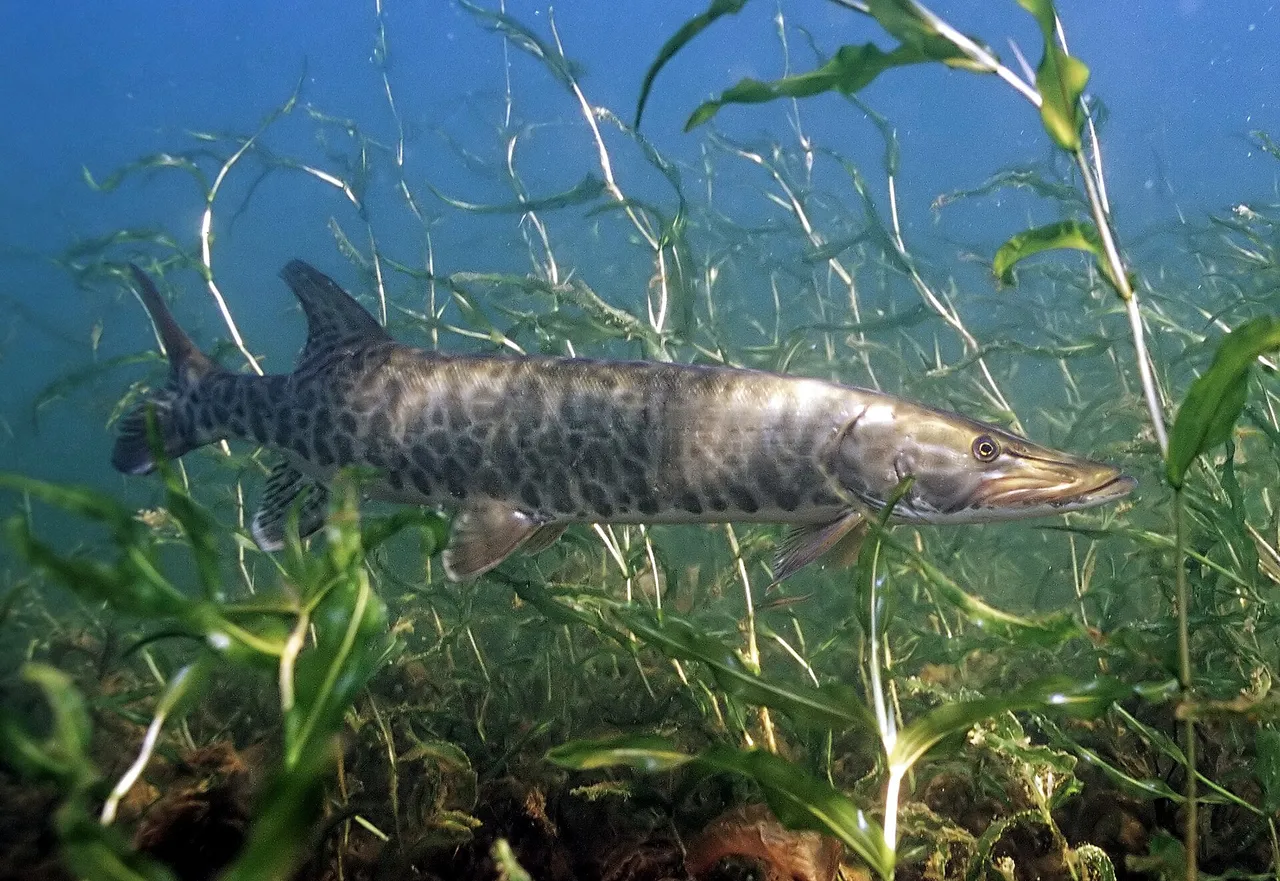
How this was identified, and who took it
Identified by: Full lateral view in weed. The pattern is the point: dark vertical bars and spots on a PALE ground, the inverse of a pike's pale spots on a dark ground, which is the character that separates the two congeners in one look.Engbretson, Eric / U.S. Fish and Wildlife Service — Public domain, via Wikimedia Commons — source, licenceWhat is known about how it feeds
Muskellunge are the largest Esox and feed as an extreme version of the pike pattern: a very large ambush predator taking very large prey, infrequently. FishingHQ carries verified predation on yellow perch and on cisco. The cisco edge is the one that changes where an angler would look: cisco are open-water fish of cold northern lakes, and large muskellunge keying on them are a long way from the cabbage beds the species is associated with. Gape is enormous and prey items of a third to a half of the fish's own length are documented, which places adult muskellunge above almost everything else in their waters. The consequence that matters biologically is metabolic rather than behavioural: a single large meal supports a long period without feeding, so a muskellunge's feeding events are widely spaced and its willingness to feed at any given moment is low. The species is also slow-growing and long-lived, so a very large fish represents many years of accumulated growth in a population that produces few of them. Prey selection is opportunistic within the size range the gape allows, and includes other large predatory fish. Like pike, muskellunge take prey crosswise and turn it to swallow head-first.
The food
Prey with a verified dietary link to this fish. Each entry carries its own evidence, and each is written at the precision the source actually used: a named species where the source named one, a group or food category where it said “polychaetes”, “crustaceans” or “detritus” and meant it. That is why this list is shorter than the animal’s real diet rather than longer.
- Yellow perch — Perca flavescens
Esocids take percids readily and muskellunge attack prey up to a third of their own length, which is why the lures used for them look absurd to anglers from other traditions.
- Cisco — Coregonus artedi
Cisco are a substantial prey item for large muskellunge in northern lakes, and their open-water habit is one of the reasons big muskies are found well away from cover.
Food with no page of its own here yet
These are real components of the diet, listed as plain text because FishingHQ has no page for them yet. Inventing pages to make the list look fuller would be the fabrication this whole approach exists to prevent.
- suckers
- large cyprinids
- other esocids, including smaller muskellunge
- waterfowl, occasionally
What anglers do with this
Everything below is interpretation, not finding. It is what experienced anglers conclude from the biology above, and the reasoning is usually sound and almost never tested. It is separated from the biology deliberately.
The very large baits and lures characteristic of muskellunge angling follow from the gape and the prey-size relationship, and that reasoning is conventional practitioner inference rather than a tested finding. The much-repeated reputation for difficulty is, unusually, well grounded in the biology above: infrequent feeding in a low-density, slow-growing population is a sufficient explanation and does not require any of the folklore normally attached to it. The handling consequence is the serious part. A large muskellunge is old, irreplaceable within a human timescale, and heavy enough that an unsupported lift causes internal damage. Everything about how such a fish is landed, unhooked and returned should follow from that.
What this does not establish
FishingHQ holds two verified prey edges for a fish with a broad opportunistic diet. Prey composition varies by water and by what large forage exists there. Nothing here supports a claim about how often an individual fish feeds, which is variable and hard to observe.
Where this connects
These are the baits, lures, methods and explainers FishingHQ already joins to this fish — which is why the list is sometimes short. They are not chosen for this page, and a link here means an evidenced relationship exists, not that it follows from the diet.
Lures recorded for this species
This page covers feeding. The Muskellunge record covers identification, lifecycle, seasonal behaviour, handling and the sources behind all of it.
Reviewed 2026-08-10.